Results by title
18284 books match the query 'United States' and 850 start with p

Porno Chic and the Sex Wars
American Sexual Representation in the 1970sCarolyn Bronstein
University of Massachusetts Press, 2016
For many Americans, the emergence of a “porno chic” culture provided an opportunity to embrace the sexual revolution by attending a film like Deep Throat (1972) or leafing through an erotic magazine like Penthouse. By the 1980s, this pornographic moment was beaten back by the rise of Reagan-era political conservatism and feminist anti-pornography sentiment.
This volume places pornography at the heart of the 1970s American experience, exploring lesser-known forms of pornography from the decade, such as a new, vibrant gay porn genre; transsexual/female impersonator magazines; and pornography for new users, including women and conservative Christians. The collection also explores the rise of a culture of porn film auteurs and stars as well as the transition from film to video. As the corpus of adult ephemera of the 1970s disintegrates, much of it never to be professionally restored and archived, these essays seek to document what pornography meant to its producers and consumers at a pivotal moment.
In addition to the volume editors, contributors include Peter Alilunas, Gillian Frank, Elizabeth Fraterrigo, Lucas Hilderbrand, Nancy Semin Lingo, Laura Helen Marks, Nicholas Matte, Jennifer Christine Nash, Joe Rubin, Alex Warner, Leigh Ann Wheeler, and Greg Youmans.
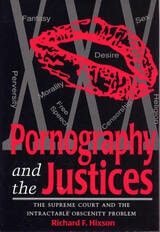
Pornography and the Justices
The Supreme Court and the Intractable Obscenity ProblemRichard F. Hixson
Southern Illinois University Press, 1996
Discussing Supreme Court decisions regarding obscenity, Richard F. Hixson highlights the views of Justices William J. Brennan and John Paul Stevens, borrows from the pioneer decisions of Judge Learned Hand, and consults the work of contemporary First Amendment scholars; finally, though, he relies not on public debate or political machinations but on the justices’ own published opinions, which are, as he says, "the most tantalizing documents of all."
Hixson proceeds chronologically through eleven chapters, with each chapter featuring a specific aspect of the constitutional problem and the approach or solution espoused by a particular justice. Through his case-by-case analysis of the many Supreme Court obscenity rulings, Hixson relates each decision to the temper of the times.
In this investigation of the Supreme Court’s dealings with obscenity, Hixson asks—and answers in detail—a series of pertinent questions. Do Congressional politics and public opinion prejudice the Court’s ability to interpret the Constitution fairly? Must adults be treated the same as children? What are the limits, if any, of "content restriction" on obscene materials? How much "expressive activity" is, or should be, protected by the First Amendment? Does pornography discriminate against women? How protective of the individual can the Supreme Court be and, at the same time, allow as many voices as possible to be heard?
Pornography and the Justices differs from other studies of pornography in its unique focus and its fresh conclusion, which is a composite of views garnered from the Supreme Court justices. As long as there is ample protection of minors and nonconsenting adults, Hixson argues, obscenity should be up to the individual. Separating himself from others who have discussed the issue, Hixson contends that the freedom to speak is as important as the freedom to be heard: it is essential to be able to speak whether or not anyone is listening.
For Hixson, the clear trajectory of Supreme Court opinions implies that the freedom to purchase obscene pornographic matter should be restricted only by time, place, and manner considerations. If a person wants pornography, he or she should be able to get it, albeit perhaps from a higher shelf, in a secluded room, or at a theater clearly marked for adults.

Port Newark and the Origins of Container Shipping
Angus Kress Gillespie
Rutgers University Press, 2023
This fascinating study traces the birth of containerization to Port Newark, New Jersey, in 1956 when trucker Malcom McLean thought of a brilliant new way to transport cargo. It tells the story of how Port Newark grew rapidly as McLean’s idea was backed by both New York banks and the US military, who used containerization to ship supplies to troops in Vietnam. Angus Gillespie takes us behind the scenes of today’s active container shipping operations in Port Newark, talking to the pilots who guide the ships into port, the Coast Guard personnel who help manage the massive shipping traffic, the crews who unload the containers, and even the chaplains who counsel and support the mariners. Port Newark shines a spotlight on the unsung men and women who help this complex global shipping operation run smoothly.
Since McLean's innovation, Port Newark has expanded with the addition of the nearby Elizabeth Marine Terminal. This New Jersey complex now makes up the busiest seaport on the East Coast of the United States. Some have even called it “America’s Front Door.” The book tells the story of the rapid growth of worldwide containerization, and how Port Newark has adapted to bigger ships with deeper channels and a raised bridge. In the end, there is speculation of the future of this port with ever-increasing automation, artificial intelligence, and automation.
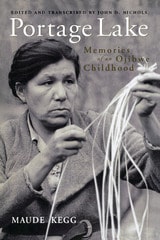
Portage Lake
Memories of an Ojibwe ChildhoodMaude Kegg
University of Minnesota Press, 1993
Portland in Three Centuries
The Place and the PeopleCarl Abbott
Oregon State University Press, 2011
Portland in Three Centuries
The Place and the PeopleCarl Abbott
Oregon State University Press, 2022
Incorporating social history and contemporary scholarship in his narrative, Abbott examines current metropolitan character and issues, giving close attention to historical background. He explores the context of opportunities and problems that have helped to shape the rich mosaic that is Portland.
This revised and updated second edition includes greater attention to the Indigenous peoples of the Portland region, Portland’s communities of color, and the challenges of recent years that have thrust Portland into the national spotlight.
A highly readable character study of a city, and enhanced by more than sixty historic and contemporary images, Portland in Three Centuries will appeal to readers interested in Portland, in Oregon, and in Pacific Northwest history.
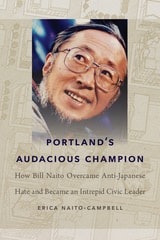
Portland's Audacious Champion
How Bill Naito Overcame Anti-Japanese Hate and Became an Intrepid Civic LeaderErica Naito-Campbell
Oregon State University Press, 2024
William “Bill” Sumio Naito (1925–1996) was a remarkable and visionary individual—the Portland-born son of Japanese immigrants who became one of the city’s most significant business and civic leaders. Every day thousands of people drive on Naito Parkway alongside Portland’s Waterfront Park, yet little has been written about the man for whom it was named.
In this first biography, Erica Naito-Campbell, Bill’s granddaughter, shows how his story is also the story of Portland, the city he loved. Naito’s life, from the Great Depression and World War II through Portland’s rebirth in the 1970s and its profound growth, tracked most of the major events in the city and was the catalyst for many of them. Through hard-earned success in importing and real estate with his brother Sam, Naito came to wield considerable power in the city, and his leadership led to much of what we consider iconic Portland today: the “Portland Oregon” sign near the Burnside Bridge, the annual Christmas tree in Pioneer Courthouse Square, and Harbor Drive’s conversion to Waterfront Park.
Naito’s name became synonymous with civic leadership, whether it was growing Portland’s urban tree canopy, revitalizing its downtown, or preserving historic buildings. But less is known about his difficult childhood—with a father who worked twelve-hour days and a mother whose treatment of him was harsh at best—and the racism he endured during World War II. After the expulsion of Japanese Americans following Pearl Harbor and his military service in Occupied Japan, Naito overcame great emotional turmoil to return to Portland and become one of its greatest change-makers.
Erica Naito-Campbell uses anecdotes, rich details, and previously unknown stories about Bill Naito to bring Portland’s history to life—while acknowledging that the cost of his success was a family rife with resentments and envy. Her book reveals the emotional wounds that drove Naito to become one of Portland’s most inspiring civic leaders, a pivotal player in the city’s journey from a moribund downtown to a national model for livability, urban renewal, and historic preservation.
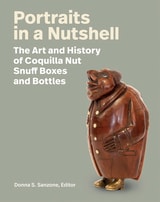
Portraits in a Nutshell
The Art and History of Coquilla Nut Snuff Boxes and BottlesDonna S. Sanzone
Brandeis University Press, 2025
Portraits in a Nutshell showcases intricately carved snuff boxes and bottles sculpted from the Brazilian coquilla nut between the seventeenth and mid-nineteenth centuries. Both utilitarian and decorative, these bottles and boxes were produced and used by diverse people of wide-ranging geographic origin, racial background, and social standing. As a result, coquilla nut snuff boxes present a rich material archive of the Atlantic world and the central role of Indigenous and Black histories within it.
Despite being just three or four inches long, these coquilla nut snuff boxes encapsulate an early modern history of transoceanic movement and creativity. The carvings depict animals and fantastical creatures, scenes of religious and courtly life, portraits of political and military leaders, abolitionists and activists, and people at the margins of colonial society. These images are available to the public and to scholars for the first time in this book and will be of interest to antique collectors, art historians, social historians, and anyone interested in the unusual and the curious.
Over 250 detailed photographs of snuff bottles and boxes from the unique and wide-ranging collection of David Badger not only illustrate the exceptional skill of their creators but also tell the story of millions of Africans transported to Brazil during centuries of the transatlantic slave trade. The text demonstrates the interconnectedness of the Atlantic world, the movements of peoples and ideas, and the commercial exchange of goods and cultural and material objects in Africa, Brazil, the Caribbean, and North America. In this beautiful book, these objects reveal a story never before told.
With a preface by Matthew Francis Rarey, associate professor of African and Black Atlantic art history at Oberlin College, and an introduction by Gwendolyn DuBois Shaw, professor of art history at the University of Pennsylvania and director of the Arthur Ross Gallery.
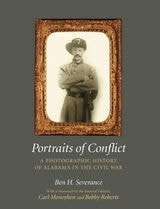
Portraits of Conflict
A Photographic History of Alabama in the Civil WarBen H. Severance
University of Arkansas Press, 2012

Portraits of Conflict
A Photographic History of Louisiana in the Civil WarCarl H. Moneyhon
University of Arkansas Press, 1990
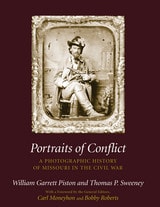
Portraits of Conflict
A Photographic History of Missouri in the Civil WarWilliam Garrett Piston
University of Arkansas Press, 2009
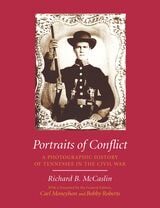
Portraits of Conflict
Tennessee: A Photographic History of Tennessee in the Civil WarRichard B. McCaslin
University of Arkansas Press, 2007
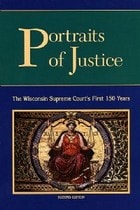
Portraits of Justice
The Wisconsin Supreme Court's First 150 YearsTrina E. Gray
Wisconsin Historical Society Press, 2003
Portraits
A Gallery of IntellectualsEdward Shils
University of Chicago Press, 1997
Highlights include an affectionate treatment of Leo Szilard, the physicist whose involvement with the development of the atomic bomb led him to work ceaselessly to address its social consequences; a discussion of the educational philosophy of Robert Maynard Hutchins, the University of Chicago's fifth and most controversial president; an appreciative account of the Polish emigré Leopold Labedz's well-informed and outspoken resistance to Communism; and an essay about the extraordinary Indian writer Nirad Chaudhuri.
Many of these essays have appeared in The American Scholar, edited by Joseph Epstein, who introduces this volume with his own portrait of Edward Shils.
"Though professionally a sociologist, Edward Shils was a man of wide cosmopolitan culture and experience, greatly concerned with the public problems of his time: in particular with those created by the rise of new and dangerous ideologies, the frightening possibilities of science, and the apparent abrogation of public responsibility by many Western intellectuals."—Hugh Trevor-Roper
The late Edward Shils was a member of the University of Chicago's Committee on Social Thought for forty-five years and a fellow of Peterhouse, Cambridge University. His many books include The Calling of Sociology and The Intellectuals and the Powers, both published by the University of Chicago Press.
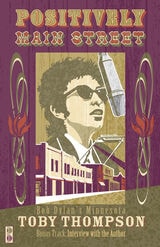
Positively Main Street
Bob Dylan’s MinnesotaToby Thompson
University of Minnesota Press, 2008
“That boy . . . this fellow, Toby . . . has got some lessons to learn.” —Bob Dylan, Rolling Stone, November 29, 1969
"Toby Thompson was there first." —Greil Marcus
“A first-rate novelistic account of Thompson’s own psyche as he uncovers the Dylan few people know . . . A new look at young Dylan done with kindness, enthusiasm and superb language.” —William Kennedy, Look Magazine
“Essential reading. Thompson, unprecedentedly, managed to interview not only Echo Helstrom, almost certainly the ‘Girl of the North Country,’ but Dylan’s mother and brother, his uncle, his friends.” —Michael Gray, Bob Dylan Encyclopedia
“Dylan fans will not want to miss this book.” —Sioux City Journal
“Enough to satisfy any Dylan fan with all the gossip he’ll ever need.” —Huntsville Times
“Well worth the attention of anyone who has fallen under the spell of the boy from the North Country.” —Los Angeles Times
“It’s a must.” —Ft. Worth Press
"Thompson tracked down anybody who knew 'Die-lan' (as the Hibbingites called him), including the guy at the local music store, the guy at the motorcycle shop, his English and music teachers, his uncles, his brother David and even his reluctant but ultimately charmingly chatty mother. Of course, Thompson traveled into a few dead ends. But the stuff with Dylan's mom and his high school girlfriend, Echo Helstrom, is priceless. Positively Main Street is a free-wheelin', fun and quick read that is surprisingly informative." —Minneapolis Star Tribune
"Hundreds of books have been written about Minnesota's most famous songwriter; Bob Dylan's life and music has been analyzed by fans, scholars, and even himself. So, why do we need Toby Thompson's Positively Main Street: Bob Dylan's Minnesota? Because it's a forgotten milestone. Published in 1971, it was the first biography on Dylan. Although it's been out of print since 1977, the book is, with the exception of Dylan's autobiography, perhaps the most readable and necessary volume on the folk icon." —City Pages
"The new Positively Main Street is a lovely little book, even better than the original, a cherished addition to the Dylan bookshelf. Thompson and the University of Minnesota Press have enhanced what was already a classic and made it available to a whole new audience. Dylan fans owe them a debt of gratitude." —The Dylan Daily
"[Thompson] ends up not only interviewing 'the Girl from the North Country,' Echo Haelstrom, and 'Bob’s' mother and brother and teachers etc., but also filling in for Dylan among his old friends and acquaintances, playing Dylan’s songs on the guitar and harmonica and singing them, in a way that may have seemed stratingly revolutionary at the time for a journalist to do, he actually recreates a bit of Dylan’s existence as his own." —Michael Lally, Lally's Alley
Positively No Filipinos Allowed
Building Communities and Discourseedited by Antonio T. Tiongson, Jr., Edgardo V. Gutierrez and Ricardo V. Gutierrez, foreword by Lisa Lowe
Temple University Press, 2006

Possessing Polynesians
The Science of Settler Colonial Whiteness in Hawai`i and OceaniaMaile Arvin
Duke University Press, 2019
Possessive Investment In Whiteness
George Lipsitz
Temple University Press, 1998
Lipsitz's ultimate point is not to condemn all white people as racists but to challenge everyone to begin a principled examination of personal actions and political commitments. Exposing the system of unfairness is not enough. People of all groups -- but especially white people because they benefit from that system -- have to work toward eradicating the rewards of whiteness.
Post-Crisis Leadership
Resilience, Renewal, and Reinvention in the Aftermath of DisruptionRalph A. Gigliotti
Rutgers University Press, 2025
Post-Modern Aura
The Act of Fiction in an Age of InflationCharles Newman
Northwestern University Press, 1985
In the twenty-first century as an interest in Marxist thought again coincides with the specter of financial inflation, The Post-Modern Aura is timely again.
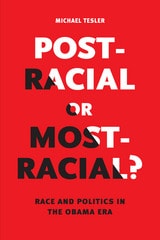
Post-Racial or Most-Racial?
Race and Politics in the Obama EraMichael Tesler
University of Chicago Press, 2016
Michael Tesler shows how, in the years that followed the 2008 election—a presidential election more polarized by racial attitudes than any other in modern times—racial considerations have come increasingly to influence many aspects of political decision making. These range from people’s evaluations of prominent politicians and the parties to issues seemingly unrelated to race like assessments of public policy or objective economic conditions. Some people even displayed more positive feelings toward Obama’s dog, Bo, when they were told he belonged to Ted Kennedy. More broadly, Tesler argues that the rapidly intensifying influence of race in American politics is driving the polarizing partisan divide and the vitriolic atmosphere that has come to characterize American politics.
One of the most important books on American racial politics in recent years, Post-Racial or Most-Racial? is required reading for anyone wishing to understand what has happened in the United States during Obama’s presidency and how it might shape the country long after he leaves office.
Post-Truth Rhetoric and Composition
Bruce Mccomiskey
Utah State University Press, 2017
Post-Truth Rhetoric and Composition is a timely exploration of the increasingly widespread and disturbing effect of “post-truth” on public discourse in the United States. Bruce McComiskey analyzes the instances of bullshit, fake news, feigned ethos, hyperbole, and other forms of post-truth rhetoric employed in recent political discourse.
The book frames “post-truth” within rhetorical theory, referring to the classic triad of logos, ethos, and pathos. McComiskey shows that it is the loss of grounding in logos that exposes us to the dangers of post-truth. As logos is the realm of fact, logic, truth, and valid reasoning, Western society faces increased risks—including violence, unchecked libel, and tainted elections—when the value of reason is diminished and audiences allow themselves to be swayed by pathos and ethos. Evaluations of truth are deferred or avoided, and mendacity convincingly masquerades as a valid form of argument.
In a post-truth world, where neither truth nor falsehood has reliable meaning, language becomes purely strategic, without reference to anything other than itself. This scenario has serious consequences not only for our public discourse but also for the study of composition.
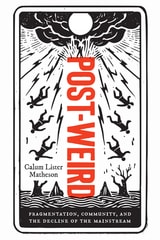
Post-Weird
Fragmentation, Community, and the Decline of the MainstreamCalum Lister Matheson
Rutgers University Press, 2026
An ambitious look at rhetoric and psychosis that explores how communities form when society collapses
American society seems to have fractured. Common touchpoints of authority have receded in recent decades and beliefs that were once taboo are now openly shared, from neo-Nazism to occultism to conspiracy thinking. In this book, Calum Lister Matheson goes beyond the fraying of contemporary American culture to ask how splinter communities form in our current media environment, what keeps them together, and what they build from the ruins of shared language.
In his stirring exploration of how people communicate when old forms of authority and meaning collapse, Matheson examines far-flung groups that have departed the mainstream—Sandy Hook deniers, Appalachian serpent handlers, pro-anorexia bloggers, incels, transvestigators, pseudoscientific reactionaries, and more—and finds unexpected similarities among their many differences. Key among their parallels is the insistence that the symbols shared by each community represent a hidden truth that cannot be questioned or interpreted but is revealed through signs—words, images, videos, and texts. By documenting American fringe cultures, extremism, and the social functions of language, this book rethinks concepts like irony, psychosis, propriety, and what it means to be normal in weird times.
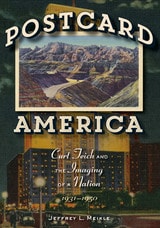
Postcard America
Curt Teich and the Imaging of a Nation, 1931-1950By Jeffrey L. Meikle
University of Texas Press, 2016
Extensively illustrated with representative images, this unique book illuminates the cultural significance of the highly colorized “linen” postcards that depicted a glowing America in the 1930s and 1940s and that fascinate collectors today.
From the Great Depression through the early postwar years, any postcard sent in America was more than likely a “linen” card. Colorized in vivid, often exaggerated hues and printed on card stock embossed with a linen-like texture, linen postcards celebrated the American scene with views of majestic landscapes, modern cityscapes, roadside attractions, and other notable features. These colorful images portrayed the United States as shimmering with promise, quite unlike the black-and-white worlds of documentary photography or Life magazine. Linen postcards were enormously popular, with close to a billion printed and sold.
Postcard America offers the first comprehensive study of these cards and their cultural significance. Drawing on the production files of Curt Teich & Co. of Chicago, the originator of linen postcards, Jeffrey L. Meikle reveals how photographic views were transformed into colorized postcard images, often by means of manipulation—adding and deleting details or collaging bits and pieces from several photos. He presents two extensive portfolios of postcards—landscapes and cityscapes—that comprise a representative iconography of linen postcard views. For each image, Meikle explains the postcard’s subject, describes aspects of its production, and places it in social and cultural contexts. In the concluding chapter, he shifts from historical interpretation to a contemporary viewpoint, considering nostalgia as a motive for collectors and others who are fascinated today by these striking images.
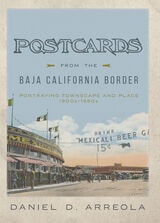
Postcards from the Baja California Border
Portraying Townscape and Place, 1900s–1950sDaniel D. Arreola
University of Arizona Press, 2021
This form of place study calls attention to how we can see a past through a serial view of places, by the nature of repetition, and the photographing of the same place over and over again. Arreola draws our focus to townscapes, or built landscapes, of four border towns—Tijuana, Mexicali, Tecate, and Algodones—during the first half of the twentieth century. With an emphasis on the tourist’s view of these places, this book creates a vivid picture of what life was like for tourists and residents of these towns in the early and mid-twentieth century. Postcards from the Baja California Border is a rich and fascinating experience, one that takes you on a time-travel journey through border town histories and geographies while celebrating the visual intrigue of postcards.
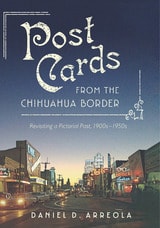
Postcards from the Chihuahua Border
Revisiting a Pictorial Past, 1900s–1950sDaniel D. Arreola
University of Arizona Press, 2019
In Postcards from the Chihuahua Border Daniel D. Arreola captures the exhilaration of places in time, taking us back to Mexico’s northern border towns of Cuidad Juárez, Ojinaga, and Palomas in the early twentieth century. Drawing on more than three decades of archival work, Arreola uses postcards and maps to unveil the history of these towns along west Texas’s and New Mexico’s southern borders.
Postcards offer a special kind of visual evidence. Arreola’s collection of imagery and commentary about them shows us singular places, enriching our understandings of history and the history of change in Chihuahua. No one postcard tells the entire story. But image after image offers a collected view and insight into changing perceptions. Arreola’s geography of place looks both inward and outward. We see what tourists see, while at the same time gaining insight about what postcard photographers and postcard publishers wanted to be seen and perceived about these border communities.
Postcards from the Chihuahua Border is a colorful and dynamic visual history. It invites the reader to time travel, to revisit another era—the first half of the last century—when these border towns were framed and made popular through picture postcards.
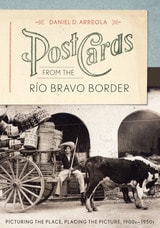
Postcards from the Río Bravo Border
Picturing the Place, Placing the Picture, 1900s–1950sBy Daniel D. Arreola
University of Texas Press, 2013
Between 1900 and the late 1950s, Mexican border towns came of age both as tourist destinations and as emerging cities. Commercial photographers produced thousands of images of their streets, plazas, historic architecture, and tourist attractions, which were reproduced as photo postcards. Daniel Arreola has amassed one of the largest collections of these border town postcards, and in this book, he uses this amazing visual archive to offer a new way of understanding how the border towns grew and transformed themselves in the first half of the twentieth century, as well as how they were pictured to attract American tourists.
Postcards from the Río Bravo Border presents nearly two hundred images of five significant towns on the lower Río Bravo—Matamoros, Reynosa, Nuevo Laredo, Piedras Negras, and Villa Acuña. Using multiple images of sites within each city, Arreola tracks changes both within the cities as places and in the ways in which the cities have been pictured for tourist consumption. He makes a strong case that visual imagery has a shaping influence on how we negotiate and think about places, creating a serial scripting or narrating of the place. Arreola also shows how postcard images, when systematically and chronologically arranged, can tell us a great deal about how Mexican border towns have been viewed over time. This innovative visual approach demonstrates that historical imagery, no less than text or maps, can be assembled to tell a compelling geographical story about place and time.
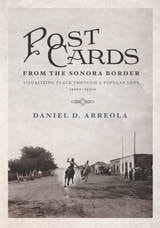
Postcards from the Sonora Border
Visualizing Place Through a Popular Lens, 1900s–1950sDaniel D. Arreola
University of Arizona Press, 2017
Young men ride horses on a dusty main road through town. Cars and gas stations gradually intrude on the land, and, years later, curiosity shops and cantinas change the face of Mexican border towns south of Arizona. Between 1900 and the late 1950s, Mexican border towns came of age both as centers of commerce and as tourist destinations. Postcards from the Sonora Border reveals how images—in this case the iconic postcard—shape the way we experience and think about place.
Making use of his personal collection of historic images, Daniel D. Arreola captures the evolution of Sonoran border towns, creating a sense of visual “time travel” for the reader. Supported by maps and visual imagery, the author shares the geographical and historical story of five unique border towns—Agua Prieta, Naco, Nogales, Sonoyta, and San Luis Río Colorado.
Postcards from the Sonora Border introduces us to these important towns and provides individual stories about each, using the postcards as markers. No one postcard view tells the complete story—rather, the sense of place emerges image by image as the author pulls readers through the collection as an assembled view. Arreola reveals how often the same locations and landmarks of a town were photographed as postcard images generation after generation, giving a long and dynamic view of the inhabitants through time. Arranged chronologically, Arreola’s postcards allow us to discover the changing perceptions of place in the borderlands of Sonora, Mexico.

Postcolonial America
Edited by C. Richard King
University of Illinois Press, 2000
Advancing multiple, even conflicted visions of postcolonial America, this important volume interrogates postcolonial theory and traces the emergence and significance of postcolonial practices and precepts in the United States. Contributors discuss how the unique status of the United States as the colony that became a superpower has shaped its sense of itself. They assess the global networks of inequality that have displaced neocolonial systems of conquest, exploitation, and occupation. They also examine how individuals and groups use music, the Internet, and other media to reconfigure, reinvent, and resist postcoloniality in American culture.
Candidly facing the inherent contradictions of "the American experience," this collection demonstrates the patterns, connections, and histories characteristic of postcoloniality in America and initiates important discussions about how these conditions might be changed.
Postcolonial Configurations
Dictatorship, the Racial Cold War, and Filipino AmericaJosen Masangkay Diaz
Duke University Press, 2023
Postcolonial Grief
The Afterlives of the Pacific Wars in the AmericasJinah Kim
Duke University Press, 2019

Postfeminist War
Women in the Media-Military-Industrial ComplexMary Douglas Vavrus
Rutgers University Press, 2019
Postindian Aesthetics
Affirming Indigenous Literary SovereigntyEdited by Debra K. S. Barker and Connie A. Jacobs
University of Arizona Press, 2022
The works featured are inventive and current, and the writers covered are visionaries who are boldly redefining Indigenous literary aesthetics. The artists covered include Orlando White, LeAnne Howe, Stephen Graham Jones, Deborah Miranda, Heid E. Erdrich, Sherwin Bitsui, and many others.
Postindian Aesthetics is expansive and comprehensive with essays by many of today’s leading Indigenous studies scholars. Organized thematically into four sections, the topics in this book include working-class and labor politics, queer embodiment, national and tribal narratives, and new directions in Indigenous literatures. By urging readers to think beyond the more popularized Indigenous literary canon, the essays in this book open up a new world of possibilities for understanding the contemporary Indigenous experience.
The volume showcases thought-provoking scholarship about literature written by important contemporary Indigenous authors who are inspiring critical acclaim and offers new ways to think about the Indigenous literary canon and encourages instructors to broaden the scope of works taught in literature courses more broadly.
ContributorsEric Gary Anderson
Ellen L. Arnold
Debra K. S. Barker
Laura J. Beard
Esther G. Belin
Jeff Berglund
Sherwin Bitsui
Frank Buffalo Hyde
Jeremy M. Carnes
Gabriel S. Estrada
Stephanie Fitzgerald
Jane Haladay
Connie A. Jacobs
Daniel Heath Justice
Virginia Kennedy
Denise Low
Molly McGlennen
Dean Rader
Kenneth M. Roemer
Susan Scarberry-García
Siobhan Senier
Kirstin L. Squint
Robert Warrior
Posting for Power
Congressional Partisanship on Social MediaJeremy Gelman and Steven Lloyd Wilson
University of Michigan Press, 2026
In the US Congress, lawmakers regularly choose to bicker for political gain, whether or not they disagree on issues. By classifying millions of social media posts as partisan or not, Gelman and Wilson quantify a legislator’s partisan intensity through the time and effort they spend supporting their party and bickering with the opposition. The authors argue that the partisan personas politicians create are both a home style, to help them win reelection, and hill style, to help them become politically influential by showing off as good team players. Bringing together a wide range of data on leadership races, elections, voting records, cosponsorship patterns, and lawmaking outcomes, they demonstrate the nearly consequence-free way that legislators strategically deploy partisanship to impress their copartisans and voters. Gelman and Wilson closely examine what motivates members to differ so much in developing this part of their public personas and offer clear recommendations for how to turn down the partisan heat on Capitol Hill.
Postliterary America
From Bagel Shop Jazz to MicropoetriesMaria Damon
University of Iowa Press, 2011
Postmodern Education
Politics, Culture, and Social CriticismStanley Aronowitz
University of Minnesota Press, 1991
This book offers and opinionated analysis of today’s polemics surrounding the topic of education and society. Aronowitz and Giroux present a conceptual framework for charting the future directions educational theory and practice might take and continue the debate begun in their previous book, Education Under Siege, which was named one of the most significant books in education by the American Educational Studies Association in 1986.
"In Postmodern Education Aronowitz and Giroux are architects of the imagination, presenting essays of political, social, and cultural criticism aimed at altering the ways we understand the existing social order and act to change the conditions of our lives.” Afterimage
Postmodern Theatric(k)s
Monologue in Contemporary American DramaDeborah Geis
University of Michigan Press, 1993
Postmodern/Postwar and After
Rethinking American LiteratureJason Gladstone, Andrew Hoberek, and Daniel Worden
University of Iowa Press, 2016
The first section of essays returns to the category of the “post-modern” and argues for the usefulness of key concepts and themes from postmodernism to the study of contemporary literature, or reevaluates postmodernism in light of recent developments in the field and historical and economic changes in the late twentieth and early twenty-first centuries. These essays take the contemporary abandonments of postmodernism as an occasion to assess the current states of postmodernity. After that, the essays move to address the critical shift away from postmodernism as a description of the present, and toward a new sense of postmodernism as just one category among many that scholars can use to describe the recent past. The final section looks forward and explores the question of what comes after the postwar/postmodern.
Taken together, these essays from leading and emerging scholars on the state of twenty-first-century literary studies provide a number of frameworks for approaching contemporary literature as influenced by, yet distinct from, postmodernism. The result is an indispensable guide that seeks to represent and understand the major overhauling of postwar American literary studies that is currently underway.
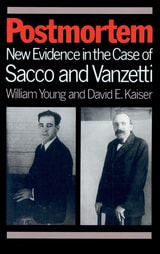
Postmortem
New Evidence in the Case of Sacco and VanzettiWilliam Young
University of Massachusetts Press, 1985
Over six decades after the polemical Sacco and Vanzetti case, in which the two anarchist Italian immigrants were convicted of first-degree murder and executed by the Commonwealth of Massachusetts, Young and Kaiser revisit the case's evidence as well as the key actors who determined its outcome. The authors situate their meticulous reexamination of the court evidence and prosecuting and defense arguments within the long-standing dispute between political leftists and conservatives regarding the integrity of the conviction, edifying the left's accusations of anti-Italianism and anti-anarchism. Their analysis magnifies both the likelihood of contrived evidence and the fallibility of our criminal justice system's impartiality, pointing to important questions concerning the nature of a fair trial and the influence of prejudice and politics in juridical processes. As such, Postmortem functions as a detailed introduction to the infamous 1921 Sacco and Vanzetti trial as well as a meditation on enduring dilemmas of the American judicial branch.
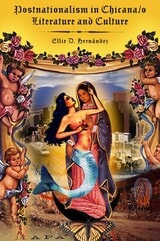
Postnationalism in Chicana/o Literature and Culture
By Ellie D. Hernández
University of Texas Press, 2009
In recent decades, Chicana/o literary and cultural productions have dramatically shifted from a nationalist movement that emphasized unity to one that openly celebrates diverse experiences. Charting this transformation, Postnationalism in Chicana/o Literature and Culture looks to the late 1970s, during a resurgence of global culture, as a crucial turning point whose reverberations in twenty-first-century late capitalism have been profound.
Arguing for a postnationalism that documents the radical politics and aesthetic processes of the past while embracing contemporary cultural and sociopolitical expressions among Chicana/o peoples, Hernández links the multiple forces at play in these interactions. Reconfiguring text-based analysis, she looks at the comparative development of movements within women's rights and LGBTQI activist circles. Incorporating economic influences, this unique trajectory leads to a new conception of border studies as well, rethinking the effects of a restructured masculinity as a symbol of national cultural transformation. Ultimately positing that globalization has enhanced the emergence of new Chicana/o identities, Hernández cultivates important new understandings of borderlands identities and postnationalism itself.
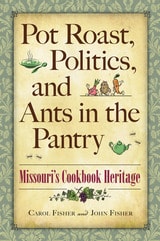
Pot Roast, Politics, and Ants in the Pantry
Missouri's Cookbook HeritageCarol Fisher & John Fisher
University of Missouri Press, 2008
When is a cookbook more than just a cookbook? When it’s a gateway to our culinary heritage. For well over a hundred years, Missouri’s cookbooks have helped readers serve up tasty dishes to the state’s tables, but these publications also document the evolution of our kitchens and households.
Pot Roast,Politics, and Ants in the Pantry, a treasure trove of anecdotes and nuggets of historical information about cookery in the Show-Me State, draws from more than 150 publications to reveal Missouri’s cookbook heritage and to deliver a generous sampling of recipes. Carol Fisher and John Fisher look back to manuscript cookbooks from 1821 St. Louis, then progress through the years and around Missouri before arriving at today’s online recipes. Along the way, they dish out servings of kitchen medicine, household hints, and cookbook literature gleaned from the state’s cache of culinary gems.
From handwritten family recipe collections and mimeographed publications to glossy color editions, the texts the Fishers have obtained from libraries and historical societies as well as their own extensive cookbook collection include such curiosities as the Julia Clark Household Memoranda Book from the William Clark papers, an 1880 production by the Ladies of St. Louis called My Mother’s Cookbook, Mary Foote Henderson’s Practical Cooking and Dinner Giving, and Albert E. Brumley’s All-Day Singin’ and Dinner on the Ground. They tell how various ethnic communities raised money by creating cookbooks, how the state’s Beef Council and Pork Association put recipes on the Internet, and how restaurants like the Blue Owl in Kimmswick and Stephenson’s Apple Farm Restaurant near Kansas City enhanced their reputations with their own cookbooks. Festival cookbooks, company cookbooks, even cookbooks tied to world events—they’re all here in one delightful book.
In this vastly entertaining review, readers will learn where to find recipes for dandelion wine, mock turtle soup (requiring a large calf’s head split open by the butcher), and vinegar pie—as well as the curative properties of potato water, tips for raising chickens in the basement, and even “how to cook a husband.” An extensive bibliography includes information to help readers track down the books discussed and also those on their own wish lists.
Pot Roast, Politics, and Ants in the Pantry: Missouri’s Cookbook Heritage shows how, instead of being just collections of recipes, cookbooks provide history lessons, document changing food ways, and demonstrate the cultural diversity of the state. From Julia Clark’s simple frontier recipes for puddings and preserves to Irma Rombauer’s encyclopedic Joy of Cooking—originally self-published in Missouri—Carol Fisher and John Fisher have laid out a smorgasbord of reading pleasure for cookbook collectors, nostalgia buffs, and gourmands alike.
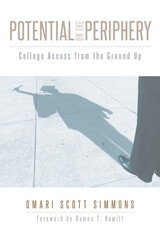
Potential on the Periphery
College Access from the Ground UpOmari Scott Simmons
Rutgers University Press, 2019

Pothole Confidential
My Life as Mayor of MinneapolisR.T. Rybak
University of Minnesota Press, 2016
A pajama party at the Minneapolis–St. Paul International Airport inadvertently helped launch R.T. Rybak’s political career (imagine a rumba line one hundred protesters long chanting, “We deserve to sleep, hey!”), but his earliest lessons in leadership occurred during his childhood. Growing up in a middle-class neighborhood, attending private school with students who had much more than he did, spending evenings at his family’s store in an area where people lived with much less, he witnessed firsthand the opportunity and injustice of the city he called home.
In a memoir that is at once a political coming-of-age story and a behind-the-scenes look at the running of a great city, the three-term mayor takes readers into the highs and lows and the daily drama of a life inextricably linked with Minneapolis over the past fifty years. With refreshing candor and insight, Rybak describes his path through journalism, marketing, and community activism that led to his unlikely (to him, at least) primary election—on September 11, 2001. His personal account of the challenges and crises confronting the city over twelve years, including the tragic collapse of the I-35W bridge, the rising scourge of youth violence, and the bruising fight over a ban on gay marriage (with Rybak himself conducting the first such ceremony at City Hall on August 1, 2013), is also an illuminating, often funny depiction of learning the workings of the job, frequently on the fly, while trying to keep up with his most important constituency, his family.
As bracing as the “fresh air” campaign that swept him into office, Rybak’s memoir is that rare document from a politician: one more concerned with the people he served and the issues of his time than with burnishing his own credentials. As such, it reflects what leadership truly looks like.
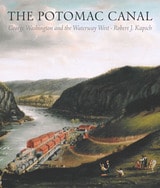
Potomac Canal
George Washington and the Waterway WestROBERT J. KAPSCH
West Virginia University Press, 2007
The Potomac Canal: George Washington and the Waterway West is a history of a new nation’s first effort to link the rich western agricultural lands with the coastal port cities of the east. The Potomac Canal Company was founded in 1785, and was active until it was overtaken by the Chesapeake and Ohio Canal Company in 1828. During its operation, the canal system was used to ship flour from mills in the foothills of Appalachia to the tidewater of the Chesapeake, where the flour was shipped to the Caribbean as trade for sugar and other goods. This trade soon became the basis of agricultural wealth in West Virginia’s eastern panhandle and throughout the Appalachian Piedmont. Coal was also shipped via the canal system from the upper reaches of the Potomac River to workshops at Harpers Ferry and beyond. This industrial trade route laid the foundation for what would eventually become the Chesapeake and Ohio Canal and the Baltimore and Ohio Railroad.
Pottery and Chronology at Angel
Sherri Hilgeman
University of Alabama Press, 2000
By analyzing the pottery found at a well-known archaeological site, Hilgeman constructs the long-awaited timeline for the rise and decline of this ancient society.
Located near present-day Evansville, Indiana, the Angel site is one of the important archaeological towns associated with prehistoric Mississippian society. More than two million artifacts were collected from this site during excavations from 1939 to 1989, but, until now, no systematic survey of the pottery sherds had been conducted. This volume, documenting the first in-depth analysis of Angel site pottery, also provides scholars of Mississippian culture with a chronology of this important site.
Angel is generally thought to have been occupied from before A.D. 1200 to 1450, but scholars have been forced to treat this period as one chronological unit without any sense of the growth and decline of the society that occupied it. Using radiocarbon assays and an analysis of its morphological and stylistic attributes of pottery, Sherri Hilgeman is able to divide the occupation of Angel into a series of recognizable stages. She then correlates those stages with similar ones at other archaeological excavations—especially nearby Kincaid—making it possible to compare Angel society with other native cultures of the lower Ohio Valley. Through this important contribution to native pottery studies, Hilgeman opens a window into the lifeways of prehistoric Angel society and places that society in the larger context of Mississippian culture.
Pound in Purgatory
From Economic Radicalism to Anti-SemitismLeon Surette
University of Illinois Press, 1999
From 1931 to 1945 Pound's poetry took a back seat to his activities as an economic reformer and propagandist for the corporate state. Pound believed he had a simple and practical solution for the economic woes of the world brought on by the Great Depression, and he became increasingly preoccupied with capturing political power for the economic reform he envisioned.
As the world spiraled toward war, Pound's program of economic reform foundered and he gradually succumbed to a paranoid belief in a Jewish conspiracy. Through an incisive analysis of Pound's correspondence and writings, much of it previously unexamined, Surette shows how this belief fostered the virulent anti-Semitism that pervades his work-–both poetry and prose-–from this time forward.
Pound/Cummings
The Correspondence of Ezra Pound and E.E. CummingsBarry Ahearn, Editor
University of Michigan Press, 1996
Throughout the correspondence both poets reveal themselves and their beliefs to a remarkable degree. Pound entrusted to Cummings details of his political outlook in the 1930s and 1940s, including his opinions about Mussolini's Italy. The letters to Cummings also shed new light on the question of Pound's sanity after World War II. Although he was diagnosed as mentally unfit, the letters generally show no evidence of paranoia, only of his characteristic eccentricity.
Similarly, these letters should provoke a reevaluation of Cummings. Critics have treated Cummings's political views as either strictly private matters or merely incidental to his art. The letters, however, show that Cummings's radically conservative political opinions are wholly consistent with his poetics, and raise the question of the relation between Cummings's political principles and his enthusiasm for particular forms (and particular stars) of mass entertainment.
In addition to their political revelations, the letters are steeped in the literary climate--and literary gossip--of the times. Pound comments often and candidly on Cummings's poetry and prose; both Pound and Cummings send light verse to each other. And the poets exchange anecdotes about such figures as Henry James, Wyndham Lewis, T. S. Eliot, Edmund Grosse, Max Eastman, and Aldous Huxley, among other writers.
There is much here to interest and delight both fans and foes of Pound and Cummings. The book will be of primary importance to students and scholars of modern poetry, especially those who emphasize the intersection of literary works and political history.
Barry Ahearn is Associate Professor of English, Tulane University.
Poverty Of Amer Pol 2Nd Ed
H. Mark Roelofs
Temple University Press, 1998
Based on his novel understanding of the American political system, Roelofs presents a devastating and closely reasoned critique that traces our nation's political ills to fundamental flaws in the very design of its founding principles, the character of its major institutions, and the basic pattern of its processes. Dissecting our political and societal problems, he explains the limitations and basic contributions arising from the social democratic/liberal democratic dichotomy that result in our current political poverty.
While Roelofs's analysis remains the same as in the earlier edition, in this revised edition he has sharpened and extended the argument and expanded and updated his illustrative materials. Improved bibliographical citations and new diagrams make the book an even more useful teaching tool.
Poverty and Place
Ghettos, Barrios, and the American CityPaul A. Jargowsky
Russell Sage Foundation, 1997

Poverty and Society
The Growth of the American Welfare State in International ComparisonLevine, Daniel
Rutgers University Press, 1988