Results by title
28164 books match the query 'History' and 1297 start with p
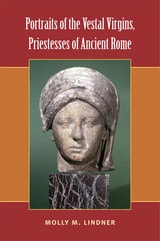
Portraits of the Vestal Virgins, Priestesses of Ancient Rome
Molly M. Lindner
University of Michigan Press, 2015
Portraits
A Gallery of IntellectualsEdward Shils
University of Chicago Press, 1997
Highlights include an affectionate treatment of Leo Szilard, the physicist whose involvement with the development of the atomic bomb led him to work ceaselessly to address its social consequences; a discussion of the educational philosophy of Robert Maynard Hutchins, the University of Chicago's fifth and most controversial president; an appreciative account of the Polish emigré Leopold Labedz's well-informed and outspoken resistance to Communism; and an essay about the extraordinary Indian writer Nirad Chaudhuri.
Many of these essays have appeared in The American Scholar, edited by Joseph Epstein, who introduces this volume with his own portrait of Edward Shils.
"Though professionally a sociologist, Edward Shils was a man of wide cosmopolitan culture and experience, greatly concerned with the public problems of his time: in particular with those created by the rise of new and dangerous ideologies, the frightening possibilities of science, and the apparent abrogation of public responsibility by many Western intellectuals."—Hugh Trevor-Roper
The late Edward Shils was a member of the University of Chicago's Committee on Social Thought for forty-five years and a fellow of Peterhouse, Cambridge University. His many books include The Calling of Sociology and The Intellectuals and the Powers, both published by the University of Chicago Press.
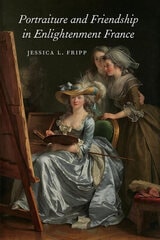
Portraiture and Friendship in Enlightenment France
Jessica Fripp
University of Delaware Press, 2011
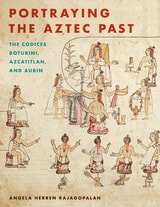
Portraying the Aztec Past
The Codices Boturini, Azcatitlan, and AubinBy Angela Herren Rajagopalan
University of Texas Press, 2019
During the period of Aztec expansion and empire (ca. 1325–1525), scribes of high social standing used a pictographic writing system to paint hundreds of manuscripts detailing myriad aspects of life, including historical, calendric, and religious information. Following the Spanish conquest, native and mestizo tlacuiloque (artist-scribes) of the sixteenth century continued to use pre-Hispanic pictorial writing systems to record information about native culture. Three of these manuscripts—Codex Boturini, Codex Azcatitlan, and Codex Aubin—document the origin and migration of the Mexica people, one of several indigenous groups often collectively referred to as “Aztec.”
In Portraying the Aztec Past, Angela Herren Rajagopalan offers a thorough study of these closely linked manuscripts, articulating their narrative and formal connections and examining differences in format, style, and communicative strategies. Through analyses that focus on the materials, stylistic traits, facture, and narrative qualities of the codices, she places these annals in their historical and social contexts. Her work adds to our understanding of the production and function of these manuscripts and explores how Mexica identity is presented and framed after the conquest.

Portugal and Africa
Ris Af#81David Birmingham
Ohio University Press, 2004
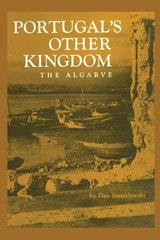
Portugal's Other Kingdom
The AlgarveBy Dan Stanislawski
University of Texas Press, 1963
A land of long ago on the brink of tomorrow. That is the Algarve, the southernmost province of Portugal, a land that knew the Phoenicians, Carthaginians, Greeks, Romans, Visigoths, Moslems—and yet retained its own distinctive personality. In the 1950s it first felt the impact of industrialization, and from that situation the author developed this book.
In presenting this descriptive geography of the Algarve, Dan Stanislawski offers no thesis, except that geographers, economists, politicians, humanists—all those interested in the way the world is developing—should watch the small, culturally disparate areas of the world, to learn what they have of value to teach, to enjoy the qualities of their independent ways of living, and to observe and evaluate their reaction to modern change. This book, the result of detailed observation of one such region, is a valuable contribution to the knowledge necessary to form sound value judgments on the future development of these areas.
From this account the charm of the Algarve emerges in all of its picturesqueness. With the aid of Stanislawski's vivid descriptions, his eighteen helpful maps and graphs, and his more than ninety photographs, the reader moves leisurely through this appealing, but unpublicized, region: along roadways bordered by rock walls and blooming almonds, traveled by sturdy burros bearing their loads of produce; through colorful landscapes of the Lower Algarve, with their pastel-calcimined dwellings and their intensively cultivated plots of olives, figs, carobs, grain, and vegetables; along the rugged cliff coast near Portimão, and the boat-filled port of Faro; past the canyon gardens of the Caldeirão; along the Arade River with its cork barges; northward past Cape S. Vicente to the area of wind-sheared trees.
Guided by Stanislawski, the reader comes to understand Algarvian problems inherent in soils, topography, climate, location, and history. He sees the Algarvians following the occupational practices that have produced for them, in the midst of difficult conditions, a stable culture: fishing, netmaking, shipbuilding, farming, herding, and so on. He realizes that these people, with their unique cultural background and environment, desire to live, and to change, in their own way. Finally, he learns how it is possible to communicate effectively with the Algarvians and with millions of other people whose peculiar problems tend to isolate them from the rest of the world.
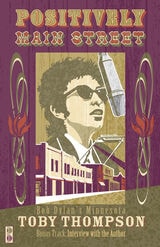
Positively Main Street
Bob Dylan’s MinnesotaToby Thompson
University of Minnesota Press, 2008
“That boy . . . this fellow, Toby . . . has got some lessons to learn.” —Bob Dylan, Rolling Stone, November 29, 1969
"Toby Thompson was there first." —Greil Marcus
“A first-rate novelistic account of Thompson’s own psyche as he uncovers the Dylan few people know . . . A new look at young Dylan done with kindness, enthusiasm and superb language.” —William Kennedy, Look Magazine
“Essential reading. Thompson, unprecedentedly, managed to interview not only Echo Helstrom, almost certainly the ‘Girl of the North Country,’ but Dylan’s mother and brother, his uncle, his friends.” —Michael Gray, Bob Dylan Encyclopedia
“Dylan fans will not want to miss this book.” —Sioux City Journal
“Enough to satisfy any Dylan fan with all the gossip he’ll ever need.” —Huntsville Times
“Well worth the attention of anyone who has fallen under the spell of the boy from the North Country.” —Los Angeles Times
“It’s a must.” —Ft. Worth Press
"Thompson tracked down anybody who knew 'Die-lan' (as the Hibbingites called him), including the guy at the local music store, the guy at the motorcycle shop, his English and music teachers, his uncles, his brother David and even his reluctant but ultimately charmingly chatty mother. Of course, Thompson traveled into a few dead ends. But the stuff with Dylan's mom and his high school girlfriend, Echo Helstrom, is priceless. Positively Main Street is a free-wheelin', fun and quick read that is surprisingly informative." —Minneapolis Star Tribune
"Hundreds of books have been written about Minnesota's most famous songwriter; Bob Dylan's life and music has been analyzed by fans, scholars, and even himself. So, why do we need Toby Thompson's Positively Main Street: Bob Dylan's Minnesota? Because it's a forgotten milestone. Published in 1971, it was the first biography on Dylan. Although it's been out of print since 1977, the book is, with the exception of Dylan's autobiography, perhaps the most readable and necessary volume on the folk icon." —City Pages
"The new Positively Main Street is a lovely little book, even better than the original, a cherished addition to the Dylan bookshelf. Thompson and the University of Minnesota Press have enhanced what was already a classic and made it available to a whole new audience. Dylan fans owe them a debt of gratitude." —The Dylan Daily
"[Thompson] ends up not only interviewing 'the Girl from the North Country,' Echo Haelstrom, and 'Bob’s' mother and brother and teachers etc., but also filling in for Dylan among his old friends and acquaintances, playing Dylan’s songs on the guitar and harmonica and singing them, in a way that may have seemed stratingly revolutionary at the time for a journalist to do, he actually recreates a bit of Dylan’s existence as his own." —Michael Lally, Lally's Alley
Positively No Filipinos Allowed
Building Communities and Discourseedited by Antonio T. Tiongson, Jr., Edgardo V. Gutierrez and Ricardo V. Gutierrez, foreword by Lisa Lowe
Temple University Press, 2006
Positivism in Mexico
By Leopoldo Zea; Translated by Josephine H. Schulte
University of Texas Press, 1974
Positivism, not just an “ivory tower” philosophy, was a major force in the social, political, and educational life of Mexico during the last half of the nineteenth century. Once colonial conservatism had been conquered, the French Intervention ended, and Maximilian of Hapsburg executed, reformers wanted to create a new national order to replace the Spanish colonial one. The victorious liberals strove to achieve “mental emancipation,” a kind of second independence, which would abolish the habits and customs imposed on Mexicans by three centuries of colonialism.
At this singular moment in Mexican history, positivism was offered as an extraordinary means and pathway to a new order. The next stage was the education of the Mexican people in this liberal philosophy and their incorporation into the process of development achieved by modern nations.
Leopoldo Zea traces the forerunners of liberal thought and their influence during Juárez’s time and shows how this ideology degenerated into an “order and progress” philosophy that served merely to maintain colonial forms of exploitation and, at the same time, to create new ones that were peculiar to the neocolonialism that the great nations of the world imposed on other peoples. Zea examines the regime of Porfirio Díaz and its justification by the positivist philosophers of the period. He concludes that the conflict between exploited social groups, on the one hand, and foreign interests and a middle class on the margin of an oligarchy, on the other, brought about the movement known as the Mexican Revolution.
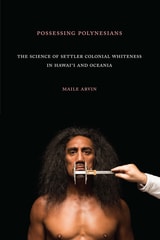
Possessing Polynesians
The Science of Settler Colonial Whiteness in Hawai`i and OceaniaMaile Arvin
Duke University Press, 2019
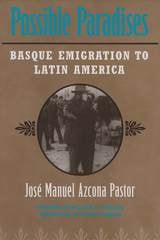
Possible Paradises
Basque Emigration to Latin AmericaAzcona Pastor
University of Nevada Press, 2003
Possible Paradises, José Manuel Azcona Pastor's engaging and meticulously researched study of Basque emigration to the Americas, is a path breaking work of monumental importance. Ranging over the entire former Spanish American empire from Tierra del Fuego to the U.S. Southwest and covering over five centuries of history, Azcona examines the roles and fates of the Basques who came to the New World. He also studies the impact of the New World on the Basque Country, from the importance in the modern Basque diet of such American foodstuffs as corn and beans to the encouragement given to traditional Basque industries by the colonizers' demand for ships and iron tools. He considers the role of Basques in the Spanish imperial expeditions of exploration and conquest; their participation in transatlantic commerce and communication.
The Basque diaspora, although worldwide in dimension, has had its greatest presence and importance in the Americas. Azcona's pioneering study views the Basque presence in the New World through the broadest possible lens, linking Basque communities and activities from Argentina to the North American West.
Foreword by William A. Douglass. Translation by Roland Vazquez.

Post-Anarchism
A ReaderEdited by Duane Rousselle and Sureyyya Evren
Pluto Press, 2011
Post-anarchism has been of considerable importance in the discussions of radical intellectuals across the globe in the last decade. In its most popular form, it demonstrates a desire to blend the most promising aspects of traditional anarchist theory with developments in post-structuralist and post-modernist thought. Post-Anarchism: A Reader includes the most comprehensive collection of essays about this emergent body of thought, making it an essential and accessible resource for academics, intellectuals, activists and anarchists interested in radical philosophy.
Many of the chapters have been formative to the development of a distinctly 'post-anarchist' approach to politics, aesthetics, and philosophy. Others respond to the so-called 'post-anarchist turn' with caution and scepticism. The book also includes original contributions from several of today's 'post-anarchists', inviting further debate and new ways of conceiving post-anarchism across a number of disciplines.
Post-Authoritarian Cultures
Spain and Latin America's Southern ConeLuis Martín-Estudillo
Vanderbilt University Press, 2008
Post-Communism
An IntroductionLeslie Holmes
Duke University Press, 1997

Post-Communism
An IntroductionLeslie Holmes
Duke University Press, 0
Post-Communist Mafia State
The Case of HungaryBálint Magyar
Central European University Press, 2016
Post-Communist Malaise
Cinematic Responses to European IntegrationZoran Samardzija
Rutgers University Press, 2020
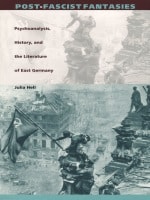
Post-Fascist Fantasies
Psychoanalysis, History, and the Literature of East GermanyJulia Hell
Duke University Press, 1997
By focusing on the unconscious fantasies about post-fascist body and post-fascist voice that suffuse the texts of Wolf and others, Hell radically reconceptualizes the notion of the author’s subjective authenticity. Since this notion occupies a key position in previous literary-historical accounts of East German culture, Hell’s psychoanalytic approach problematizes the established literary model of an "authentic feminine voice" that gradually liberates itself from the GDR’s dominant ideological narrative. Far from operating solely on a narrowly political level, the novels of Wolf and others were intricate family sagas portraying psychic structures linked in complex ways to the GDR’s social dynamics. Hell traces this link through East German literatrure’s dominant narrative, a paternal narrative organized around the figure of the Communist father as antifascist hero.

Post-Military Society
Militarism, Demilitarization and War at the End of the Twentieth CenturyMartin Shaw
Temple University Press, 1991
With the collapse of the Cold War following the Eastern European revolutions and the ongoing democratization of the Soviet republics, optimism about peace has transformed the international political climate. Incidents such as the Gulf War, however, have tempered this optimism and cast doubts on the prospects for demilitarization. In this book, Martin Shaw examines some of the developments that lie behind the recent momentous changes and argues that, despite the Gulf War and other regional wars, militarism is in decisive retreat.
Writing from a broadly sociological perspective, Shaw examines the roles of war and military institutions in human society and the ways in which preoccupation with war has affected domestic, regional, and international politics in the twentieth century. In doing so, he asks: When does the post-war era end? How have nuclear weapons altered the perception of war by society? What is the relationship between industrialism and militarism?
The author contends that, despite the militarism of some Third World countries, societies in the advanced industrial world (especially in Europe) have been undergoing a profound demilitarization. These societies have become politically insulated from war preparation, have recognized the effect of social movements on inter-state relations, and are experiencing a "revolution of rising expectations."
Offering evidence of "post-military citizenship," Shaw describes the increasing resistance to military conscription throughout the Western world, the replacement of blind obedience with demand for accountability in Eastern bloc countries, and the simultaneous rise of nationalism and communitarianism among common market members. And, in light of the collapse of Stalinist militarism in Europe and the USSR, Shaw suggests some of the changes that face Soviet society.
Post-Post-Soviet?
Art, Politics and Society in Russia at the Turn of the DecadeEdited by Marta Dziewanska, Ekaterina Degot, and Ilya Budratskis
Museum of Modern Art in Warsaw, 2013

Post-Specimen Encounters Between Art, Science and Curating
Rethinking Art Practice and Objecthood through Scientific Collections.Edited by Edward Juler and Alistair Robinson
Intellect Books, 2020
Post-Specimen Encounters in Art, Science and Curating examines the ways in which scientific objects held within museums and other collections act as inspiration to contemporary art practices, curating strategies, and their histories. With cross-disciplinary contributions from art historians, artists, poets, anthropologists, critics, and curators, this volume looks at how artistic encounters in museums, ranging from anatomy museums to contemporary cabinets of curiosity, can provoke new modes of thinking.
In particular, this volume draws upon the concept of the specimen—a paradigmatic object in science—as a way of critically investigating these hybrid art–science practices and a means of innovating the practice of art writing itself. Edward Juler and Alistair Robinson bring together a variety of interdisciplinary perspectives from leading specialists in the visual arts that inspire new understandings of the relationships between art, science, and curating.
Post-Truth Rhetoric and Composition
Bruce Mccomiskey
Utah State University Press, 2017
Post-Truth Rhetoric and Composition is a timely exploration of the increasingly widespread and disturbing effect of “post-truth” on public discourse in the United States. Bruce McComiskey analyzes the instances of bullshit, fake news, feigned ethos, hyperbole, and other forms of post-truth rhetoric employed in recent political discourse.
The book frames “post-truth” within rhetorical theory, referring to the classic triad of logos, ethos, and pathos. McComiskey shows that it is the loss of grounding in logos that exposes us to the dangers of post-truth. As logos is the realm of fact, logic, truth, and valid reasoning, Western society faces increased risks—including violence, unchecked libel, and tainted elections—when the value of reason is diminished and audiences allow themselves to be swayed by pathos and ethos. Evaluations of truth are deferred or avoided, and mendacity convincingly masquerades as a valid form of argument.
In a post-truth world, where neither truth nor falsehood has reliable meaning, language becomes purely strategic, without reference to anything other than itself. This scenario has serious consequences not only for our public discourse but also for the study of composition.
Post-Weird
Fragmentation, Community, and the Decline of the MainstreamCalum Lister Matheson
Rutgers University Press, 2026
An ambitious look at rhetoric and psychosis that explores how communities form when society collapses
American society seems to have fractured. Common touchpoints of authority have receded in recent decades and beliefs that were once taboo are now openly shared, from neo-Nazism to occultism to conspiracy thinking. In this book, Calum Lister Matheson goes beyond the fraying of contemporary American culture to ask how splinter communities form in our current media environment, what keeps them together, and what they build from the ruins of shared language.
In his stirring exploration of how people communicate when old forms of authority and meaning collapse, Matheson examines far-flung groups that have departed the mainstream—Sandy Hook deniers, Appalachian serpent handlers, pro-anorexia bloggers, incels, transvestigators, pseudoscientific reactionaries, and more—and finds unexpected similarities among their many differences. Key among their parallels is the insistence that the symbols shared by each community represent a hidden truth that cannot be questioned or interpreted but is revealed through signs—words, images, videos, and texts. By documenting American fringe cultures, extremism, and the social functions of language, this book rethinks concepts like irony, psychosis, propriety, and what it means to be normal in weird times.
Post-World War One Plebiscites and Their Legacies
Exploring the Right of Self-DeterminationSergiusz Bober
Central European University Press, 2024
Plebiscites, or referendums, are epitomes of direct democracy and the right of self-determination. While direct democracy has always been a key subject in the theory and practice of western liberal democracies, the issue of self-determination has been propelled to the fore by the hegemonistic moves of Russia. By providing a historical analysis of the post-World War One plebiscites, this book deals with enduring, painfully contemporary, and in in any case fundamental, concepts.
The contributors to this edited volume approach the referendums comparatively. After grounding the analysis theoretically, the authors look at detailed aspects of individual cases, with the two plebiscites held in the Danish-German border region of Schleswig in the winter of 1920 as points of departure. They then extend the exploration through the inter-war period and address the effects of border delimitations on everyday life or gender roles in the context of ethnic mobilization. Finally, the book places the post-World War One plebiscites in a long-term perspective. The concluding essays assess, among others, the applicability of plebiscitary solutions to contemporary conflicts, taking into consideration issues of borders, religion, language, identity, and minority rights.
Post-capitalist Futures
Political Economy Beyond Crisis and HopeAdam Fishwick
Pluto Press, 2021
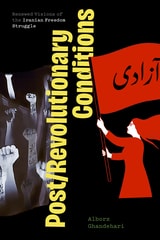
Post/Revolutionary Conditions
Renewed Visions of the Iranian Freedom StruggleAlborz Ghandehari
Northwestern University Press, 2025
An exploration of how the Iranian people have renewed their longtime struggle for freedom
The Woman, Life, Freedom uprising is only the latest manifestation of a century-long struggle for liberation in Iran. This ongoing movement for justice has encompassed two revolutions against domestic dictatorship and foreign imperialism, as well as a series of uprisings since the 1979 Iranian Revolution, which was followed by a new era of repression. Post/Revolutionary Conditions: Renewed Visions of the Iranian Freedom Struggle offers an intersectional analysis of how progressive and radical movement builders have reenvisioned liberation in the post-’79 era, despite new forms of oppression under the Islamic Republic and from US and other foreign imperial powers. Bringing together a diverse array of sources, including oral histories with Iranian labor, student, and gender justice organizers, as well as resistance literature and art, Alborz Ghandehari challenges narratives that treat working-class, feminist, queer, and oppressed ethnic minorities’ movements as separate from one another. Post/Revolutionary Conditions demonstrates how such potent reimaginings of collective liberation and a radically democratic future have been shaped by multiple generations of protest and kindred struggles globally.
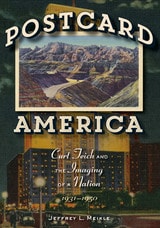
Postcard America
Curt Teich and the Imaging of a Nation, 1931-1950By Jeffrey L. Meikle
University of Texas Press, 2016
Extensively illustrated with representative images, this unique book illuminates the cultural significance of the highly colorized “linen” postcards that depicted a glowing America in the 1930s and 1940s and that fascinate collectors today.
From the Great Depression through the early postwar years, any postcard sent in America was more than likely a “linen” card. Colorized in vivid, often exaggerated hues and printed on card stock embossed with a linen-like texture, linen postcards celebrated the American scene with views of majestic landscapes, modern cityscapes, roadside attractions, and other notable features. These colorful images portrayed the United States as shimmering with promise, quite unlike the black-and-white worlds of documentary photography or Life magazine. Linen postcards were enormously popular, with close to a billion printed and sold.
Postcard America offers the first comprehensive study of these cards and their cultural significance. Drawing on the production files of Curt Teich & Co. of Chicago, the originator of linen postcards, Jeffrey L. Meikle reveals how photographic views were transformed into colorized postcard images, often by means of manipulation—adding and deleting details or collaging bits and pieces from several photos. He presents two extensive portfolios of postcards—landscapes and cityscapes—that comprise a representative iconography of linen postcard views. For each image, Meikle explains the postcard’s subject, describes aspects of its production, and places it in social and cultural contexts. In the concluding chapter, he shifts from historical interpretation to a contemporary viewpoint, considering nostalgia as a motive for collectors and others who are fascinated today by these striking images.
Postcards from Checkpoint Charlie
Images of the Berlin WallEdited by the Bodleian Library
Bodleian Library Publishing, 2008
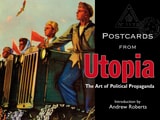
Postcards from Utopia
The Art of Political PropagandaEdited by the Bodleian Library
Bodleian Library Publishing, 2009
Politicians are famous for making extravagant campaign promises. But there are few promises as powerful—or as idealistically utopian—as those put forth by state-sponsored propaganda. Collected here are colorful images of political ideology created and disseminated by the political regimes of Europe, the Soviet Union, and China from the 1920s through the ‘70s.
State leaders of the twentieth century were highly conscious of the need to present a unified national image during a time of serious political transition in Europe, and state-sanctioned art performed a key function in an attempt to consolidate a country behind an idea. These spectacular images provide a rare opportunity to witness how abstract political ideas were rendered as visual picture for a mass audience. Fifty compelling postcards, held in the collection of the Bodleian Library, from the former Soviet Union, China, Germany, Italy, Spain, Czechoslovakia, Hungary, and Albania, reveal that despite national differences there are surprising similarities in political expression and the idealized images presented by each government. An introduction that contextualizes the images within a broader understanding of the ideologies and political powers of the time is provided by European historian, Andrew Roberts.
Taken together, the images in Postcards from Utopia offer a striking look at the art of power and its mythical representation at a time of great political upheaval and experiment.
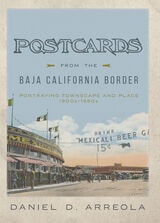
Postcards from the Baja California Border
Portraying Townscape and Place, 1900s–1950sDaniel D. Arreola
University of Arizona Press, 2021
This form of place study calls attention to how we can see a past through a serial view of places, by the nature of repetition, and the photographing of the same place over and over again. Arreola draws our focus to townscapes, or built landscapes, of four border towns—Tijuana, Mexicali, Tecate, and Algodones—during the first half of the twentieth century. With an emphasis on the tourist’s view of these places, this book creates a vivid picture of what life was like for tourists and residents of these towns in the early and mid-twentieth century. Postcards from the Baja California Border is a rich and fascinating experience, one that takes you on a time-travel journey through border town histories and geographies while celebrating the visual intrigue of postcards.
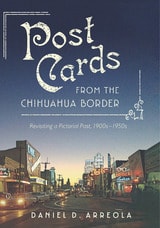
Postcards from the Chihuahua Border
Revisiting a Pictorial Past, 1900s–1950sDaniel D. Arreola
University of Arizona Press, 2019
In Postcards from the Chihuahua Border Daniel D. Arreola captures the exhilaration of places in time, taking us back to Mexico’s northern border towns of Cuidad Juárez, Ojinaga, and Palomas in the early twentieth century. Drawing on more than three decades of archival work, Arreola uses postcards and maps to unveil the history of these towns along west Texas’s and New Mexico’s southern borders.
Postcards offer a special kind of visual evidence. Arreola’s collection of imagery and commentary about them shows us singular places, enriching our understandings of history and the history of change in Chihuahua. No one postcard tells the entire story. But image after image offers a collected view and insight into changing perceptions. Arreola’s geography of place looks both inward and outward. We see what tourists see, while at the same time gaining insight about what postcard photographers and postcard publishers wanted to be seen and perceived about these border communities.
Postcards from the Chihuahua Border is a colorful and dynamic visual history. It invites the reader to time travel, to revisit another era—the first half of the last century—when these border towns were framed and made popular through picture postcards.
Postcards from the Road
Robert Frank’s ‘The Americans’Jonathan Day
Intellect Books, 2014
Taking Frank’s iconic images as his point of reference, Day shot new photographs that commented on the road and contemporary America. Here, these images are paired with critical commentary that details the aspects of the work that are visually expounded and explained in Day’s complementary images. A visual entryway to the photographs and themes of this iconic book in the history of photography, Postcards from the Road represents an innovative, carefully considered departure from standard photographic textbooks.
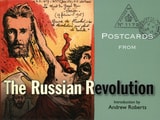
Postcards from the Russian Revolution
Edited by the Bodleian Library
Bodleian Library Publishing, 2008
The postcards originated not only from Russia, but also from Germany, the United States, Belgium, and France, and they reflect their diverse origins in the rich array of artistic styles employed to create them. Whether simply drawn, hand-painted, or mass-printed, the cards present compelling and complex images of the Bolshevik Revolution of 1917 and the people who were enmeshed in it. The cards serve as concise yet powerful artistic documents of Russian history and culture, as they display bloody and graphic street scenes, rare pictures of lesser-known revolutionary leaders, satirical sketches of Russian rulers, portraits of the royal family, illustrations of palaces and institutional buildings, and depictions of pivotal events leading up to the Revolution such as the 1905 assassination of Grand Duke Alexander. Also included in this fascinating visual narrative are cards depicting crucial events from the aftermath of the Revolution, including the great famine of 1921 and public celebrations of the newly formed Union of Soviet Socialist Republics.
An unprecedented and arresting exploration of the Russian Empire in its death throes, Postcards from the Russian Revolution reveals a wholly new and vibrant perspective on one of the most important political movements of the twentieth century.
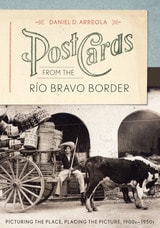
Postcards from the Río Bravo Border
Picturing the Place, Placing the Picture, 1900s–1950sBy Daniel D. Arreola
University of Texas Press, 2013
Between 1900 and the late 1950s, Mexican border towns came of age both as tourist destinations and as emerging cities. Commercial photographers produced thousands of images of their streets, plazas, historic architecture, and tourist attractions, which were reproduced as photo postcards. Daniel Arreola has amassed one of the largest collections of these border town postcards, and in this book, he uses this amazing visual archive to offer a new way of understanding how the border towns grew and transformed themselves in the first half of the twentieth century, as well as how they were pictured to attract American tourists.
Postcards from the Río Bravo Border presents nearly two hundred images of five significant towns on the lower Río Bravo—Matamoros, Reynosa, Nuevo Laredo, Piedras Negras, and Villa Acuña. Using multiple images of sites within each city, Arreola tracks changes both within the cities as places and in the ways in which the cities have been pictured for tourist consumption. He makes a strong case that visual imagery has a shaping influence on how we negotiate and think about places, creating a serial scripting or narrating of the place. Arreola also shows how postcard images, when systematically and chronologically arranged, can tell us a great deal about how Mexican border towns have been viewed over time. This innovative visual approach demonstrates that historical imagery, no less than text or maps, can be assembled to tell a compelling geographical story about place and time.
Postcards from the Sonora Border
Visualizing Place Through a Popular Lens, 1900s–1950sDaniel D. Arreola
University of Arizona Press, 2017
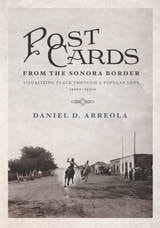
Young men ride horses on a dusty main road through town. Cars and gas stations gradually intrude on the land, and, years later, curiosity shops and cantinas change the face of Mexican border towns south of Arizona. Between 1900 and the late 1950s, Mexican border towns came of age both as centers of commerce and as tourist destinations. Postcards from the Sonora Border reveals how images—in this case the iconic postcard—shape the way we experience and think about place.
Making use of his personal collection of historic images, Daniel D. Arreola captures the evolution of Sonoran border towns, creating a sense of visual “time travel” for the reader. Supported by maps and visual imagery, the author shares the geographical and historical story of five unique border towns—Agua Prieta, Naco, Nogales, Sonoyta, and San Luis Río Colorado.
Postcards from the Sonora Border introduces us to these important towns and provides individual stories about each, using the postcards as markers. No one postcard view tells the complete story—rather, the sense of place emerges image by image as the author pulls readers through the collection as an assembled view. Arreola reveals how often the same locations and landmarks of a town were photographed as postcard images generation after generation, giving a long and dynamic view of the inhabitants through time. Arranged chronologically, Arreola’s postcards allow us to discover the changing perceptions of place in the borderlands of Sonora, Mexico.
Postcards from the Trenches
Images from the First World WarEdited by the Bodleian Library
Bodleian Library Publishing, 2008
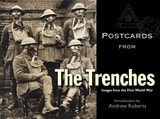
The cards in this compelling volume were created not only by soldiers, but also by embedded journalists from France, Belgium, Austria, Germany, and Britain. The images capture scenes both humorous and poignant, including soldiers having a mock party with little food to eat, wounded soldiers smiling for the camera, a makeshift trench hospital, the bloody aftermath of a battle, and a huddle of men taking what they know could be their last communion before marching onto the battlefield. Other cards document the mundane duties that dominated wartime life, including men digging trenches, troops marching to new trenches and battlefields, and or soldiers nearly comatose with boredom while waiting for the fight to begin. This stunning visual narrative opens a new window into one of the most analyzed events in history, as the postcards’ images testify to the resilience and bravery of soldiers in the most trying circumstances.
A fascinating and unprecedented historical document, Postcards from the Trenches draws back the curtain to unflinchingly show the daily horror and humanity that define life in war.
Postcards of Lost Royals
Edited by the Bodleian Library
Bodleian Library Publishing, 2009
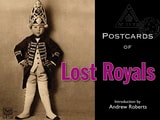
This enchanting, unique collection of postcards recovers an old world swept away and forgotten over the decades. The lost royals captured here have not been misplaced or gone missing—what has been lost is the very foundation of their royalty. Collected here are royal figures from around the world who lost their titles and were displaced as a result of World War I and other early twentieth-century political movements.
The royal houses of Europe, Africa, and Asia once ruled a continent and held dominions beyond the seas. Today, just ten monarchs still reign in Europe, and those with only limited powers. Captured in these distinctive postcards held in the collection of the Bodleian Library are these lost emperors, kings and queens, czars and czarinas, princes and princess, and grand dukes and duchesses, who were left behind by the sweep of history. Featuring monarchs from the Balkans to the Iberian Peninsula, from Ethiopia to Korea, these portraits include members of the Russian imperial family, and royals from Romania, Bulgaria, and Germany, among others. But this is more than just a picture book; it provides a narrative snapshot of world history—alongside each postcard is an intriguing mini-biography of the pictured royal that provides a gripping account of his or her story.
Reminiscent of a forgotten era of glamour, grace, and regal power, Postcards of Lost Royals brings history to life and distills the essence of a long-vanished world of royalty.
Postcards of Political Icons
Leaders of the Twentieth CenturyEdited by the Bodleian Library
Bodleian Library Publishing, 2008

Postcards, Translators and Esperanto Pioneers
An Alternative History of International CommunicationGuilherme Fians, Bernhard Struck, and Claire Taylor
University of London Press, 2025
The early twentieth century was a time when steamships, international postal services and the telephone were setting the pace of an early wave of globalisation in Europe. In this increasingly international scenario, what role did language play? To address the geopolitical problem of cross-border linguistic (mis)understanding, international auxiliary languages like Esperanto were created. But what happened to a constructed language when it travelled to different places?
This book tackles these questions by exploring the letters, postcards and activities of John Beveridge (1857–1943) and his family. This Scottish clergyman was a proficient Esperanto speaker, translator and co-founder of several Esperanto organisations. His long-standing engagement with the language left a unique archive that reveals how many Esperanto speakers exchanged letters across borders, produced literature for an international readership, organised congresses and used this language as an entry point into modernity and globalisation from their ‘marginal’ positions in the world.
By tracing this language-based form of grassroots internationalism, the book uncovers wide-reaching networks connecting a corner of Scotland with rural settings and villages in Finland, Bulgaria and Brazil. Ultimately, it asks: what do we learn about international communication and globalisation through the lens of Esperanto and postcards? Focusing on a constructed language and communication technologies that preceded the dominance of global English and social media, this book offers an alternative vantage point on the history of international communication.
Postclassicisms
The Postclassicisms Collective
University of Chicago Press, 2020
Structured around three primary concepts—value, time, and responsibility—and nine additional concepts, Postclassicisms asks scholars to reflect upon why they choose to work in classics, to examine how proximity to and distance from antiquity has been—and continues to be—figured, and to consider what they seek to accomplish within their own scholarly practices. Together, the authors argue that a stronger critical self-awareness, an enhanced sense of the intellectual history of the methods of classics, and a greater understanding of the ethical and political implications of the decisions that the discipline makes will lead to a more engaged intellectual life, both for classicists and, ultimately, for society. A timely intervention into the present and future of the discipline, Postclassicisms will be required reading for professional classicists and students alike and a model for collaborative disciplinary intervention by scholars in other fields.

Postcolonial America
Edited by C. Richard King
University of Illinois Press, 2000
Advancing multiple, even conflicted visions of postcolonial America, this important volume interrogates postcolonial theory and traces the emergence and significance of postcolonial practices and precepts in the United States. Contributors discuss how the unique status of the United States as the colony that became a superpower has shaped its sense of itself. They assess the global networks of inequality that have displaced neocolonial systems of conquest, exploitation, and occupation. They also examine how individuals and groups use music, the Internet, and other media to reconfigure, reinvent, and resist postcoloniality in American culture.
Candidly facing the inherent contradictions of "the American experience," this collection demonstrates the patterns, connections, and histories characteristic of postcoloniality in America and initiates important discussions about how these conditions might be changed.
Postcolonial Automobility
Car Culture in West AfricaLindsey B. Green-Simms
University of Minnesota Press, 2015
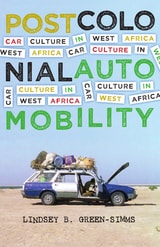
For more than a century cars have symbolized autonomous, unfettered mobility and an increasingly global experience. And yet, they are often used differently outside the centers of global capitalism. This pioneering book considers how, through the lens of the automobile, we can assess the pleasures, dangers, and limits of global modernity in West Africa. Through new and provocative readings of famous plays, novels, and films, as well as recent popular videos, Postcolonial Automobility reveals the surprising ways in which automobility in the region is, at once, an everyday practice, an ethos, a fantasy of autonomy, and an affective activity intimately tied to modern social life.
Lindsey B. Green-Simms begins with the history of motorization in West Africa from the colonial era to the decolonizing decades after World War II, and addresses the tragedy of car accidents through a close reading of Wole Soyinka’s 1965 postindependence play The Road. Shifting to screen media, she discusses Ousmane Sembene’s Xala and Jean-Pierre Bekolo’s Quartier Mozart and reviews popular, low-budget Nollywood films. Finally, Green-Simms considers how feminist texts rewrite and work in dialogue with the male-centered films and novels where the car stands in for patriarchal power and capitalist achievement.
Providing a unique perspective on technology in Africa—one refusing to be confined to narratives of either underdevelopment or inevitable progress—and covering a broad range of interdisciplinary material, Postcolonial Automobility will appeal not only to scholars and students of African literature and cinema but also to those in postcolonial and globalization studies.
Postcolonial Configurations
Dictatorship, the Racial Cold War, and Filipino AmericaJosen Masangkay Diaz
Duke University Press, 2023
Postcolonial Developments
Agriculture in the Making of Modern IndiaAkhil Gupta
Duke University Press, 1998
Based on fieldwork done in the village of Alipur in rural north India from the early 1980s through the 1990s, Postcolonial Developments examines development itself as a post–World War II sociopolitical ideological formation, critiques related policies, and explores the various uses of the concept of the “indigenous” in several discursive contexts. Gupta begins with an analysis of the connections and conflicts between the world food economy, transnational capital, and technological innovations in wheat production. He then examines narratives of village politics in Alipur to show how certain discourses influenced governmental policies on the green revolution. Drawing links between village life, national trends, and global forces, Gupta concludes with a discussion of the implications of environmentalism as exemplified by the Rio Earth Summit and an examination of how global environmental treaties may detrimentally affect the lives of subaltern peoples.
With a series of subtle observations on rural politics, nationalism, gender, modernization, and difference, this innovative study capitalizes on many different disciplines: anthropology, sociology, comparative politics, cultural geography, ecology, political science, agricultural economics, and history.
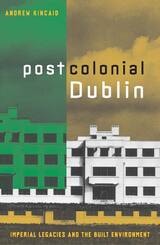
Postcolonial Dublin
Imperial Legacies And The Built EnvironmentAndrew Kincaid
University of Minnesota Press, 2006
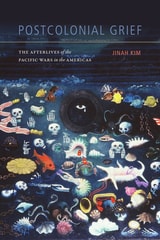
Postcolonial Grief
The Afterlives of the Pacific Wars in the AmericasJinah Kim
Duke University Press, 2019
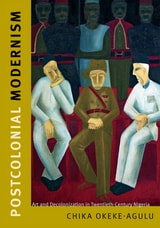
Postcolonial Modernism
Art and Decolonization in Twentieth-Century NigeriaChika Okeke-Agulu
Duke University Press, 2015
Postcolonial Studies and Beyond
Ania Loomba, Suvir Kaul, Matti Bunzl, Antoinette Burton, and Jed Esty, eds.
Duke University Press, 2005
The contributors represent many of the fields altered by postcolonial studies over the past two decades, including literary studies, history, anthropology, Asian and African studies, and political science. They model diverse applications of postcolonial theory to Latin America, East Asia, the Middle East, and the United States. Postcolonial Studies and Beyond propels the field forward. It showcases scholars coming from intellectual precincts usually considered outside the purview of the postcolonial finding new ways to deploy classic techniques of postcolonial analysis, and scholars strongly associated with postcolonial studies offering substantial critiques designed to challenge the field’s most fundamental assumptions.
Contributors. Tani E. Barlow, Ali Behdad, Daniel Boyarin, Timothy Brennan, Matti Bunzl, Antoinette Burton, Laura Chrisman, Jean Comaroff, Frederick Cooper, Vilashini Cooppan, Jed Esty, James Ferguson, Peter Hulme, Suvir Kaul, Neil Lazarus, Ania Loomba, Florencia E. Mallon, Nivedita Menon, Rob Nixon, Elizabeth A. Povinelli, David Scott, Ella Shohat, Kelwyn Sole, Robert Stam, Rebecca L. Stein
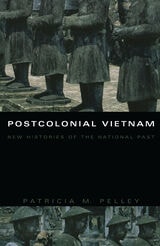
Postcolonial Vietnam
New Histories of the National PastPatricia M. Pelley
Duke University Press, 2002
Although she considers a variety of sources—government directives, census reports, statistics, poetry, civic festivities, ethnographies, and museum displays—Pelley focuses primarily on the work of official historians in Hanoi who argued about and tried to stabilize the meaning of topics ranging from prehistory to the Vietnam War. She looks at their strained and idiosyncratic attempts to plot the Vietnamese past according to Marxist and Stalinist paradigms and their ultimate abandonment of such models. She explores their struggle to redefine Vietnam in multiethnic terms and to normalize the idea of the family-state. Centering on the conversation that began in 1954 among historians in North Vietnam, her work identifies a threefold process of creating the new history: constituting historiographical issues, resolving problems of interpretation and narration, and conventionalizing various elements of the national narrative. As she tracks the processes that shaped the history of postcolonial Vietnam, Pelley dismantles numerous clichés of contemporary Vietnamese history and helps us to understand why and how its history-writing evolved.
Postcoloniality-Decoloniality-Black Critique
Joints and FissuresEdited by Sabine Broeck and Carsten Junker
Campus Verlag, 2014