Results by title
22279 books match the query 'Social Science' and 1104 start with p

Prisons of Poverty
Loïc Wacquant
University of Minnesota Press, 2009
An international best seller dissects the globalization of penal policies “made in U.S.A.” as part of the spread of neoliberalism
In the early 1990s, Mayor Rudolph Giuliani launched a zero-tolerance campaign aimed at street disorders and petty offenders, incarnated in the infamous “squeegee man.” New York City soon became a planetary showcase for an aggressive approach to law enforcement that, despite its extravagant costs and the absence of connection to the crime drop, came to be admired and imitated by other cities in the United States, Western Europe, and Latin America.
In Prisons of Poverty, Loïc Wacquant tracks the incubation and internationalization of the slogans, theories, and measures composing this new punitive “common sense,” fashioned to curb mounting urban inequality and marginality in the metropolis. He finds that a network of Reagan-era conservative think tanks (led by the Manhattan Institute) forged them as weapons in their crusade to dismantle the welfare state and, in effect, to criminalize poverty. He traces their import and export through the agency of the media and the pro-market policy institutes that have mushroomed across the European Union, particularly in Tony Blair’s Britain. And he shows how academics helped smuggle U.S. techniques of penalization into their countries by dressing them up in scholarly garb.Now available in English for the first time in an expanded edition, Prisons of Poverty reveals how the Washington consensus on economic deregulation and welfare retrenchment was extended to encompass punitive crime control because the invisible hand of the market necessitates and calls forth the iron fist of the penal state.
Prisons, Race, and Masculinity in Twentieth-Century U.S. Literature and Film
Peter Caster
The Ohio State University Press, 2008
In Prisons, Race, and Masculinity, Peter Caster demonstrates the centrality of imprisonment in American culture, illustrating how incarceration, an institution inseparable from race, has shaped and continues to shape U.S. history and literature in the starkest expression of what W. E. B. DuBois famously termed “the problem of the color line.”
A prison official in 1888 declared that it was the freeing of slaves that actually created prisons: “we had to establish means for their control. Hence came the penitentiary.” Such rampant racism co ntributed to the criminalization of black masculinity in the cultural imagination, shaping not only the identity of prisoners (collectively and individually) but also America’s national character. Caster analyzes the representations of imprisonment in books, films, and performances, alternating between history and fiction to describe how racism influenced imprisonment during the decline of lynching in the 1930s, the political radicalism in the late 1960s, and the unprecedented prison expansion through the 1980s and 1990s. Offering new interpretations of familiar works by William Faulkner, Eldridge Cleaver, and Norman Mailer, Caster also engages recent films such as American History X, The Hurricane, and The Farm: Life Inside Angola Prison alongside prison history chronicled in the transcripts of the American Correctional Association. This book offers a compelling account of how imprisonment has functioned as racial containment, a matter critical to U.S. history and literary study.

Privacy Matters
Conversations about Surveillance within and beyond the ClassroomEstee Beck
Utah State University Press, 2020
This collection offers practical analyses of surveillance and privacy as they occur within classrooms and communities. Organized by themes—surveillance and classrooms, surveillance and bodies, surveillance and culture—Privacy Matters provides writing, rhetoric, and communication scholars and teachers with specific approaches, methods, inquiries, and examinations into the impact tracking and monitoring has upon people’s habits, bodies, and lived experiences.
While each chapter contributes a new perspective in the discipline and beyond, Privacy Matters affirms that these analyses remain inconclusive. This collection is a call for scholars, researchers, activists, and educators within rhetoric and composition to continue the scholarly conversation because privacy matters to all of us.
Contributors: Christina Cedillo, Jenae Cohn, Dànielle Nicole DeVoss, Dustin Edwards, Norah Fahim, Ann Hill Duin, Gavin P. Johnson, John Peterson, Santos Ramos, Colleen A. Reilly, Jennifer Roth Miller, Jason Tham, Stephanie Vie

Privacy and the Past
Research, Law, Archives, EthicsLawrence, Susan C
Rutgers University Press, 2016

Private Aid, Political Activism
American Medical Relief to Spain and China, 1936–1949Aelwen D. Wetherby
University of Missouri Press, 2017
Private Bodies, Public Texts
Race, Gender, and a Cultural BioethicsKarla FC Holloway
Duke University Press, 2011

Private Equity at Work
When Wall Street Manages Main StreetEileen Appelbaum
Russell Sage Foundation, 2014

Private Eyes
One Hundred and One Knights: A Survey of American Detective Fiction 1922–1984Robert A. Baker and Michael T. Nietzel
University of Wisconsin Press, 1985
Private Eyes is the complete map to what Raymond Bhandler called "the mean streets," the exciting world of the fictional private eye. It is intended to entertain current PI fans and to make new ones.

Private Life, Public Action
How Housing Politics Mobilized Citizens in MoscowAnna Zhelnina
Temple University Press, 2026
Private Life, Public Action traces how residents impacted by the relocation plan became activists despite having little to no experience organizing or even forming political affiliations and opinions. Author Anna Zhelnina details the ways in which neighbors engaged in collective action, as well as the individual and structural changes these interactions caused.
Zhelnina develops the concept of “housing strategies” to explain how residents’ debates with their neighbors about housing were shaped by their private life strategies. She applies her findings about housing in Moscow to ongoing questions about political mobilization, demonstrating how public engagement is shaped by historical and social contexts.
Examining the intersection of housing, politics, and citizenship in contemporary Russia, Private Life, Public Action offers a new way to look at urban change.
In the series Politics, History, and Social Change

Private Lives, Proper Relations
Regulating Black IntimacyCandice M. Jenkins
University of Minnesota Press, 2007
Private Lives, Proper Relations begins with the question of why contemporary African American literature—particularly that produced by black women—is continually concerned with issues of respectability and propriety. Candice M. Jenkins argues that this preoccupation has its origins in recurrent ideologies about African American sexuality, and that it expresses a fundamental aspect of the racial self—an often unarticulated link between the intimate and the political in black culture.
In a counterpoint to her paradigmatic reading of Nella Larsen’s Passing, Jenkins’s analysis of black women’s narratives—including Ann Petry’s The Street, Toni Morrison’s Sula and Paradise, Alice Walker’s The Color Purple, and Gayl Jones’s Eva’s Man—offers a theory of black subjectivity. Here Jenkins describes middle-class attempts to rescue the black community from accusations of sexual and domestic deviance by embracing bourgeois respectability, and asserts that behind those efforts there is the “doubled vulnerability” of the black intimate subject. Rather than reflecting a DuBoisian tension between race and nation, to Jenkins this vulnerability signifies for the African American an opposition between two poles of potential exposure: racial scrutiny and the proximity of human intimacy.
Scholars of African American culture acknowledge that intimacy and sexuality are taboo subjects among African Americans precisely because black intimate character has been pathologized. Private Lives, Proper Relations is a powerful contribution to the crucial effort to end the distortion still surrounding black intimacy in the United States.
Candice M. Jenkins is associate professor of English at Hunter College, City University o

Private Practices
Harry Stack Sullivan, the Science of Homosexuality, and American LiberalismWake, Naoko
Rutgers University Press, 2011
Private Practices examines the relationship between science, sexuality, gender, race, and culture in the making of modern America between 1920 and 1950, when contradictions among liberal intellectuals affected the rise of U.S. conservatism. Naoko Wake focuses on neo-Freudian, gay psychiatrist Harry Stack Sullivan, founder of the interpersonal theory of mental illness. She explores medical and social scientists' conflicted approach to homosexuality, particularly the views of scientists who themselves lived closeted lives.
Wake discovers that there was a gap--often dramatic, frequently subtle--between these scientists' "public" understanding of homosexuality (as a "disease") and their personal, private perception (which questioned such a stigmatizing view). This breach revealed a modern culture in which self-awareness and open-mindedness became traits of "mature" gender and sexual identities. Scientists considered individuals of society lacking these traits to be "immature," creating an unequal relationship between practitioners and their subjects. In assessing how these dynamics--the disparity between public and private views of homosexuality and the uneven relationship between scientists and their subjects--worked to shape each other, Private Practices highlights the limits of the scientific approach to subjectivity and illuminates its strange career--sexual subjectivity in particular--in modern U.S. culture.

Private Prisons in America
A Critical Race PerspectiveMichael A. Hallett
University of Illinois Press, 2006

Private Screenings
Television and the Female ConsumerLynn Spigel
University of Minnesota Press, 1992

Private Subjects
Family Photography in South Africa and the Right to OpacityJohn Peffer
Duke University Press, 2026
Private Virtues, Public Vices
Philanthropy and Democratic EqualityEmma Saunders-Hastings
University of Chicago Press, 2022
Philanthropy plays a huge role in supporting the provision of many public goods in contemporary societies. As a result, decisions that affect public outcomes and people’s diverse interests are often dependent on the preferences and judgments of the rich. Political theorist Emma Saunders-Hastings argues that philanthropy is a deeply political activity. She asks readers to look at how the power wielded by philanthropy impacts democracy and deepens political inequality by enabling the wealthy to exercise outsize influence in public life and by putting in place paternalistic relationships between donors and their intended beneficiaries. If philanthropy is to be made compatible with a democratic society of equals, it must be judged not simply on the benefits it brings but on its wider political consequences. Timely and thought-provoking, Private Virtues, Public Vices will challenge readers’ thoughts on what philanthropy is and how it truly affects us.

Private Women, Public Lives
Gender and the Missions of the CaliforniasBy Bárbara O. Reyes
University of Texas Press, 2009
Through the lives and works of three women in colonial California, Bárbara O. Reyes examines frontier mission social spaces and their relationship to the creation of gendered colonial relations in the Californias. She explores the function of missions and missionaries in establishing hierarchies of power and in defining gendered spaces and roles, and looks at the ways that women challenged, and attempted to modify, the construction of those hierarchies, roles, and spaces.
Reyes studies the criminal inquiry and depositions of Barbara Gandiaga, an Indian woman charged with conspiracy to murder two priests at her mission; the divorce petition of Eulalia Callis, the first lady of colonial California who petitioned for divorce from her adulterous governor-husband; and the testimonio of Eulalia Pérez, the head housekeeper at Mission San Gabriel who acquired a position of significant authority and responsibility but whose work has not been properly recognized. These three women's voices seem to reach across time and place, calling for additional, more complex analysis and questions: Could women have agency in the colonial Californias? Did the social structures or colonial processes in place in the frontier setting of New Spain confine or limit them in particular gendered ways? And, were gender dynamics in colonial California explicitly rigid as a result of the imperatives of the goals of colonization?
Privately Empowered
Expressing Feminism in Islam in Northern Nigerian FictionShirin Edwin
Northwestern University Press, 2016

Privatising Justice
The Security Industry, War and Crime ControlJohn Lea and Wendy Fitzgibbon
Pluto Press, 2020
The development of the welfare state is seen as central to the decline of what the authors call 'old privatisation'. Its succession by neoliberalism has created the ground for the resurgence of the private sector. The growth of private military, policing and penal systems is located within the broader global changes brought about by neoliberalism and the dystopian future that it portends.
The book is a powerful petition for the reversal of the increasing privatization of the state and the neoliberalism that underlies it.

Privileged Minorities
A History of Wealth Concentration in South AfricaMesrob Vartavarian
Ohio University Press, 2026
Explores how anticolonial movements in South Africa enabled enduring inequality through the rise of privileged minorities and exclusive economic advantages
In Privileged Minorities, Mesrob Vartavarian examines a central paradox in South African history: how a nation shaped by anticolonial struggle became fertile ground for wealth concentration and enduring inequality. While these contradictions are not unique to South Africa, its historical trajectory offers broader insights into persistent disparities across African societies.
Vartavarian argues that the rise of privileged minorities—small, exclusive groups that dominate political and economic life—paralleled the development of successful anticolonial movements. These minorities secured exclusive advantages, defined as benefits and protections that enabled material accumulation. Such advantages included land seizures, racialized labor systems, access to coercive institutions, favorable regulatory environments, and targeted state expenditures. Though these mechanisms could foster overall economic growth, they disproportionately benefited select oligarchies and middle classes.
The book traces how distinct sociocultural groups in South Africa navigated and negotiated these advantages from the Dutch colonial era through the rise and decline of African National Congress rule. Rather than dismantling minority privilege, challenges from marginalized groups often served to reshape entrenched advantages by incorporating new actors into existing structures. These dynamics produced composite systems of accumulation that sustained inequality. Through this historical lens, Privileged Minorities offers a compelling framework for understanding how structural advantage persists and evolves, even in the wake of liberation.
Privileged Precarities
An Organizational Ethnography of Early Career Workers at the United NationsLinda M. Mülli
Campus Verlag, 2021
This ethnography focuses on the work and lifeworld at the United Nations in Geneva and Vienna. By emphasizing the perspectives of entry-level workers, this book addresses the increasing flexibility and job insecurity for those at the beginning of their potential UN careers. It explores questions such as: How do career aspirants reconcile their narratives with the organization’s image built over the past decades? How can we understand institutional power and individual agency through the lens of ritual theory and the theory of social orders? This study finally examines the entangled discourses around privilege and prestige on the one hand and the precarity and vulnerability of a growing number of UN workers on the other hand. It shows that these phenomena are not contractionary but two sides of the coin. Using the UN as an example, the study considers mechanisms of flexible and unstable work environments in times of cognitive and affective capitalism.

Privileged Spectatorship
Theatrical Interventions in White SupremacyDani Snyder-Young
Northwestern University Press, 2021
Many professional theater artists attempt to use live performances in formal theater spaces to disrupt racism and create a more equitable society. Privileged Spectatorship: Theatrical Interventions in White Supremacy examines the impact of such projects, looking at how and why they do and do not intervene in white supremacy. In this incisive study, Dani Snyder-Young examines audience responses to a range of theatrical events that focus on race‑related conflict or racial identity in the contemporary United States. The audiences for these performances, produced at mainstream not‑for‑profit professional theaters in major American cities in 2013–18, reflect dominant patterns of theater attendance: the majority of spectators are older, affluent, white, and describe themselves as politically progressive. Snyder-Young studies the ways these audience members consume the stories of racialized others and analyzes how different artistic, organizational, and programmatic strategies can (or cannot) mitigate white privilege.
This book is essential reading for scholars and students of theater, performance studies, and critical ethnic studies and for theater practitioners interested in equity and inclusion.

Probable Cause
Crime Fiction in AmericaLeRoy Lad Panek
University of Wisconsin Press, 1990
American crime fiction has developed into writing that has a commitment to democracy and the democratic way of life, a compassion and empathy and a style which has created a significant branch of American literature.

Probing Arts and Emergent Forms of Life
Michael M. J. Fischer
Duke University Press, 2023

Problem of the Century
Racial Stratification in the United StatesElijah Anderson
Russell Sage Foundation, 2001
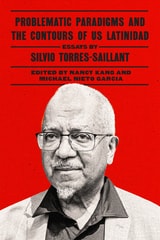
Problematic Paradigms and the Contours of US Latinidad
Essays by Silvio Torres-SaillantEdited by Nancy Kang and Michael Nieto Garcia
University of Texas Press, 2026
Silvio Torres-Saillant’s collected writings examine political contradictions within Latinx identity in the United States.
Since the 1990s Silvio Torres-Saillant’s work has questioned the notion of Latinidad, challenging presumptions of panethnic unity within the US Hispanic population and assessing dominant modes of Latinx representation. The essays in Problematic Paradigms and the Contours of US Latinidad examine the dynamics of a diverse collective of over 65 million people whose cultural heritage, ancestral origins, and belief systems arguably differ as much as they resemble one another. The volume dissects prevailing assumptions, namely the essentializing sense of homogeneity in the Latinx “community,” which mask important nuances and fascinating contradictions. Torres-Saillant also targets the role of marketing and mass communications in shaping popular perceptions of ethnic groups, thereby tracing connections between media rhetoric and the language of scholarship.
Newly revised by editors Nancy Kang and Michael Nieto Garcia, this collection curates Torres-Saillant’s core contributions to Latinx studies over the last two decades and underscores the veteran scholar’s evolving thoughts on key conversations in the field. The epilogue narrates his beginnings in Caribbean studies, acknowledges his ongoing analysis of Dominican blackness, and discourages uncritical views of cultural heritage.

Problems in General Linguistics
An Expanded Edition, Volume 1Émile Benveniste
HAU, 2026
This new edition will delight linguists and philosophers already familiar with Benveniste and introduce his work to a new generation of students. Benveniste studies are going through an enthusiastic revival in Europe; after reading this book, readers elsewhere will understand why.
Problems of Administration in Social Work
Pierce Atwater
University of Minnesota Press, 1940
Problems of Administration in Social Work was first published in 1940. Minnesota Archive Editions uses digital technology to make long-unavailable books once again accessible, and are published unaltered from the original University of Minnesota Press editions.
Problems of Science Teaching at the College Level
The Teaching of Science at the College Level, Volume 1Archer Hurd
University of Minnesota Press, 1929

Process and Meaning in Spatial Archaeology
Investigations into Pre-Columbian Iroquoian Space and PlaceEric Jones
University Press of Colorado, 2017
The research in this volume represents a new wave of spatial research—exploring beyond settlement patterning to the process and the meaning behind spatial arrangement of past communities and people—and describes new approaches being used for better understanding of past Northern Iroquoian societies. Addressing topics ranging from household task-scapes and gender relations to bioarchaeology and social network analysis, Process and Meaning in Spatial Archaeology demonstrates the vitality of current archaeological research into ancestral Northern Iroquoian societies and its growing contribution to wider debates in North American archaeology.
This cutting-edge research will be of interest to archaeologists globally, as well as academics and graduate students studying Northern Iroquoian societies and cultures, geography, and spatial analysis.
Contributors: Kathleen M. S. Allen, Jennifer A. Birch, William Engelbrecht, Crystal Forrest, John P. Hart, Sandra Katz, Robert H. Pihl, Aleksandra Pradzynski, Erin C. Rodriguez, Dean R. Snow, Ronald F. Williamson, Rob Wojtowicz
Process-Tracing Methods
Foundations and GuidelinesDerek Beach and Rasmus Brun Pedersen
University of Michigan Press, 2013
Process-tracing in social science is a method for studying causal mechanisms linking causes with outcomes. This enables the researcher to make strong inferences about how a cause (or set of causes) contributes to producing an outcome. Derek Beach and Rasmus Brun Pedersen introduce a refined definition of process-tracing, differentiating it into three distinct variants and explaining the applications and limitations of each. The authors develop the underlying logic of process-tracing, including how one should understand causal mechanisms and how Bayesian logic enables strong within-case inferences. They provide instructions for identifying the variant of process-tracing most appropriate for the research question at hand and a set of guidelines for each stage of the research process.
Process-Tracing Methods
Foundations and GuidelinesDerek Beach and Rasmus Brun Pedersen
University of Michigan Press, 2019
Processes of Collective Action
Edited by Lorenzo Bosi and Stefan Malthaner
Temple University Press, 2027
Whether collective action takes the form of protest campaigns, social movements, political violence or strikes, there is a dynamic nature to the shared goal of effecting change. But whereas most studies look at when collective action begins, the editors and contributors to Processes of Collective Action take a processual approach, looking at how collective action emerges, proceeds, what is achieved, and how different collective actors react to what unfolds.
Bringing together leading scholars of contentious politics, this volume seeks to explore and advance process analysis across different forms of political conflicts, types of actors, and varieties of collective action. Featuring theoretical concepts, methodological tools, and global cutting-edge research, Processes of Collective Action offers a series of case studies and conceptual essays that reflect on crucial issues in and current transformations of collective action.
Contributors: Irina Aguiari, Kenneth T. Andrews, Javier Auyero, Mark R. Beissinger, Kathleen Blee, Donatella della Porta, Mario Diani, Jennifer Earl, Olivier Fillieule, Sarah Gaby, Thomas Hoebel, Chaeyoon Lim, James M. Jasper, Doug McAdam, Anna Milewski, Pamela Oliver, elena pavan, Anastasia Shesterinina, Katherine Sobering, Mary Ellen Stitt, Sidney Tarrow, Katrin Uba, Mattias Wahlström
Processual Sociology
Andrew Abbott
University of Chicago Press, 2016
In Processual Sociology, Abbott first examines the endurance of individuals and social groups through time and then goes on to consider the question of what this means for human nature. He looks at different approaches to the passing of social time and determination, all while examining the goal of social existence, weighing the concepts of individual outcome and social order. Abbott concludes by discussing core difficulties of the practice of social science as a moral activity, arguing that it is inescapably moral and therefore we must develop normative theories more sophisticated than our current naively political normativism. Ranging broadly across disciplines and methodologies, Processual Sociology breaks new ground in its search for conceptual foundations of a rigorously processual account of social life.
Producers, Parasites, Patriots
Race and the New Right-Wing Politics of PrecarityDaniel Martinez HoSang
University of Minnesota Press, 2019
The shifting meaning of race and class in the age of Trump
The profound concentration of economic power in the United States in recent decades has produced surprising new forms of racialization. In Producers, Parasites, Patriots, Daniel Martinez HoSang and Joseph E. Lowndes show that while racial subordination is an enduring feature of U.S. political history, it continually changes in response to shifting economic and political conditions, interests, and structures.
The authors document the changing politics of race and class in the age of Trump across a broad range of phenomena, showing how new forms of racialization work to alter the economic protections of whiteness while promoting some conservatives of color as models of the neoliberal regime. Through careful analyses of diverse political sites and conflicts—racially charged elections, attacks on public-sector unions, new forms of white precarity, the rise of black and brown political elites, militia uprisings, multiculturalism on the far right—they highlight new, interwoven deployments of race in the ascendant age of inequality. Using the concept of “racial transposition,” the authors demonstrate how racial meanings and signification can be transferred from one group to another to shore up both neoliberalism and racial hierarchy.
From the militia movement to the Alt-Right to the mainstream Republican Party, Producers, Parasites, Patriots brings to light the changing role of race in right-wing politics.

Producing
Lewis, Jon
Rutgers University Press, 2015

Producing Bollywood
Inside the Contemporary Hindi Film IndustryTejaswini Ganti
Duke University Press, 2012

Producing Children
Critical Studies in Childhood CreativityPeter C. Kunze
Rutgers University Press, 2025

Producing Children’s Television in the On-demand Age
Anna Potter
Intellect Books, 2020
Much like the rest of the traditional television industry, children’s programming is undergoing a revolution. In this book, Anna Potter provides a detailed insider account of the creative circumstances that are transforming contemporary children’s screen content and reshaping the surrounding digital media landscape. Drawing on extended interviews with leading screen industry figures, Potter explores television’s distribution revolution and reveals how creative practices, funding models, and production norms in children’s TV have adapted to fit the changing times.
Combining comprehensive case studies, scholarly research, and industry perspectives, Potter presents a rigorous study of success stories in the children’s screen production sector. The book explores effects on the industry from disruptions by streaming giants like Netflix, Amazon, and YouTube, and describes the challenges faced by public service broadcasters like the BBC in their efforts to stay relevant to adolescent culture in the UK. Interdisciplinary and informative, this volume is compulsory reading for anyone struggling to make sense of television’s distribution revolution and what it means for children and young people.
Producing Dreams, Consuming Youth
Mexican Americans and Mass MediaMayer, Vicki
Rutgers University Press, 2003
Latinos are the fastest-growing ethnic group in America and the ascendance of their popular culture has become a huge phenomenon. But beyond J. Lo and Shakira, there is a deeper story to tell about culture, class, and community identities.
Producing Dreams, Consuming Youth takes us behind the scenes in San Antonio, Texas, a major market for Mexican American popular culture. Vicki Mayer brings readers the perspectives of those who produce and consume mass media—including music, television, and newspapers. Through the voices of people ranging from Spanish-language advertising agency executives to English-speaking working-class teenagers, we see how the media brings together communities of Mexican Americans as they pursue cultural dreams, identification, and empowerment. At the heart of the book is a debate about the future of Mexican American media, and thus of the youth market. How and why do media professionals imagine ethnic youths? How do young Mexican Americans accept, negotiate, and resist these images of themselves? Producing Dreams, Consuming Youth emphasizes the paradoxes of media industries that seek to include youths of color while profiting from their creative energies.

Producing Excellence
The Making of VirtuososWagner, Izabela
Rutgers University Press, 2015
A musician and a parent of a young violinist, sociologist Izabela Wagner offers an inside look at how her young subjects set out on the long road to becoming a soloist. The remarkable research she conducted—at rehearsals, lessons, and in other educational settings—enabled her to gain deep insight into what distinguishes these talented prodigies and their training. She notes, for instance, the importance of a family culture steeped in the values of the musical world. Indeed, more than half of these students come from a family of professional musicians and were raised in an atmosphere marked by the importance of instrumental practice, the vitality of music as a vocation, and especially the veneration of famous artists. Wagner also highlights the highly structured, rigorous training system of identifying, nurturing, and rewarding talent, even as she underscores the social, economic, and cultural factors that make success in this system possible.
Offering an intimate portrait of the students, their parents, and their instructors, Producing Excellence sheds new light on the development of exceptional musical talent, as well as draw much larger conclusions as to “producing prodigy” in other competition-prone areas, such as sports, sciences, the professions, and other arts. Wagner’s insights make this book valuable for academics interested in the study of occupations, and her clear, lively writing is perfect for general readers curious about the ins and outs of training to be a violin soloist.

Producing Guanxi
Sentiment, Self, and Subculture in a North China VillageAndrew B. Kipnis
Duke University Press, 1997
Producing Guanxi combines the theory of Pierre Bourdieu and the insights of symbolic anthropology to contest past portrayals of guanxi as either a function of Chinese political economics or an unchanging Confucian social structure. In this analysis guanxi emerges as a purposeful human effort that makes use of past cultural logics while generating new ones. By exploring the role of sentiment in the creation of self, Kipnis critiques recent theories of subjectivity for their narrow focus on language and discourse, and contributes to the anthropological discussion of comparative selfhood. Navigating a path between mainstream social science and abstract social theory, Kipnis presents a more nuanced examination of guanxi than has previously been available and contributes generally to our understanding of relationships and human action.
Producing Local Color
Art Networks in Ethnic ChicagoDiane Grams
University of Chicago Press, 2010
In big cities, major museums and elite galleries tend to dominate our idea of the art world. But beyond the cultural core ruled by these moneyed institutions and their patrons are vibrant, local communities of artists and art lovers operating beneath the high-culture radar. Producing Local Color is a guided tour of three such alternative worlds that thrive in the Chicago neighborhoods of Bronzeville, Pilsen, and Rogers Park.
These three neighborhoods are, respectively, historically African American, predominantly Mexican American, and proudly ethnically mixed. Drawing on her ethnographic research in each place, Diane Grams presents and analyzes the different kinds of networks of interest and support that sustain the making of art outside of the limelight. And she introduces us to the various individuals—from cutting-edge artists to collectors to municipal planners—who work together to develop their communities, honor their history, and enrich the experiences of their neighbors through art. Along with its novel insights into these little examined art worlds, Producing Local Color also provides a thought-provoking account of how urban neighborhoods change and grow.
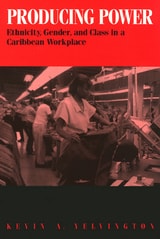
Producing Power
Ethnicity, Gender, and Class in a Caribbean WorkplaceKevin A. Yelvington
Temple University Press, 1995
In a small, locally owned Trinidadian factory that produces household goods, 80 percent of the line workers are women, almost all black or East Indian. The supervisors are all men, either white or East Indian. Kevin Yelvington worked for a year in this factory to study how ethnicity and gender are integral elements of the class structure, a social and economic structure that permeates all relations between men and women in the factory. These primary divisions determine the way the production process is ordered and labor divided.
Unlike women in other industries in "underdeveloped" parts of the world who are recruited by foreign firms, Caribbean women have always contributed to the local economy. Within this historical context, Yelvington outlines the development of the state, and addresses exploitation and domination in the labor process. Yelvington also documents the sexually charged interactions between workers and managers and explores how both use flirting and innuendo to their advantage. Weddings and other social events outside the factory provide insightful details about how the creation of social identities carries over to all aspects of the local culture.
Producing Sovereignty
The Rise of Indigenous Media in CanadaKarrmen Crey
University of Minnesota Press, 2024
Exploring how Indigenous media has flourished across Canada from the 1990s to the present
In the early 1990s, Indigenous media experienced a boom across Canada, resulting in a vast landscape of film, TV, and digital media. Coinciding with a resurgence of Indigenous political activism, Indigenous media highlighted issues around sovereignty and Indigenous rights to broader audiences in Canada. In Producing Sovereignty, Karrmen Crey considers the conditions—social movements, state policy, and evolutions in technology—that enabled this proliferation.
Exploring the wide field of media culture institutions, Crey pays particular attention to those that Indigenous media makers engaged during this cultural moment, including state film agencies, arts organizations, provincial broadcasters, and more. Producing Sovereignty ranges from the formation of the Aboriginal Film and Video Art Alliance in the early 1990s and its partnership with the Banff Centre for the Arts to the Canadian Broadcasting Corporation’s 2016 production of Highway of Tears—an immersive 360-degree short film directed by Anishinaabe filmmaker Lisa Jackson—highlighting works by Indigenous creators along the way and situating Indigenous media within contexts that pay close attention to the role of media-producing institutions.
Importantly, Crey focuses on institutions with limited scholarly attention, shifting beyond the work of the National Film Board of Canada to explore lesser-known institutions such as educational broadcasters and independent production companies that create programming for the Aboriginal Peoples Television Network. Through its refusal to treat Indigenous media simply as a set of cultural aesthetics, Producing Sovereignty offers a revealing media history of this cultural moment.

Producing Success
The Culture of Personal Advancement in an American High SchoolPeter Demerath
University of Chicago Press, 2009
Middle- and upper-middle-class students continue to outpace those from less privileged backgrounds. Most attempts to redress this inequality focus on the issue of access to financial resources, but as Producing Success makes clear, the problem goes beyond mere economics. In this eye-opening study, Peter Demerath examines a typical suburban American high school to explain how some students get ahead.
Demerath undertook four years of research at a Midwestern high school to examine the mercilessly competitive culture that drives students to advance. Producing Success reveals the many ways the community’s ideology of achievement plays out: students hone their work ethics and employ various strategies to succeed, from negotiating with teachers to cheating; parents relentlessly push their children while manipulating school policies to help them get ahead; and administrators aid high performers in myriad ways, even naming over forty students “valedictorians.” Yet, as Demerath shows, this unswerving commitment to individual advancement takes its toll, leading to student stress and fatigue, incivility and vandalism, and the alienation of the less successful. Insightful and candid, Producing Success is an often troubling account of the educationally and morally questionable results of the American culture of success.
Production Culture
Industrial Reflexivity and Critical Practice in Film and TelevisionJohn Thornton Caldwell
Duke University Press, 2008
Drawing on interviews, observations of sets and workplaces, and analyses of TV shows, industry documents, economic data, and promotional materials, Caldwell shows how film and video workers function in a transformed, post-network industry. He chronicles how workers have responded to changes including media convergence, labor outsourcing, increasingly unstable labor and business relations, new production technologies, corporate conglomeration, and the proliferation of user-generated content. He explores new struggles over “authorship” within collective creative endeavors, the way that branding and syndication have become central business strategies for networks, and the “viral” use of industrial self-reflexivity to motivate consumers through DVD bonus tracks, behind-the-scenes documentaries, and “making-ofs.” A significant, on-the-ground analysis of an industry in flux, Production Culture offers new ways of thinking about media production as a cultural activity.
Professing Selves
Transsexuality and Same-Sex Desire in Contemporary IranAfsaneh Najmabadi
Duke University Press, 2013
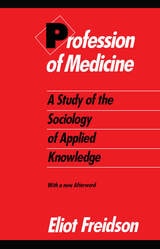
Profession of Medicine
A Study of the Sociology of Applied KnowledgeEliot Freidson
University of Chicago Press, 1988
"Profession of Medicine is a challenging monograph; the ideas presented are stimulating and thought provoking. . . . Given the expanding domain of what illness is and the contentions of physicians about their rights as professionals, Freidson wonders aloud whether expertise is becoming a mask for privilege and power. . . . Profession of Medicine is a landmark in the sociological analysis of the professions in modern society."—Ron Miller, Sociological Quarterly
"This is the first book that I know of to go to the root of the matter by laying open to view the fundamental nature of the professional claim, and the structure of professional institutions."—Everett C. Hughes, Science

Professional Identity Crisis
Race, Class, Gender, and Success at Professional SchoolsCarrie Yang Costello
Vanderbilt University Press, 2006
The author spent over 400 hours observing how first-year students are socialized in two very different environments, Boalt School of Law and the School of Social Welfare at UC Berkeley, watching how they adapted to different expectations of how to speak, dress, and behave in the classroom.
Costello found that students who were female, of color, disabled, or poor were not underqualified compared with their privileged peers. Nor did the research uncover intentional bigotry. Instead, the disproportionate success of white men can be explained by the fact that they are more likely to acquire appropriate professional identities swiftly, with little inner conflict. Students from less privileged backgrounds, however, suffered from "identity dissonance." For example, Jasmine, a Filipino student from Los Angeles, explained, "In the legal culture you have to adopt a different way of being, a different vocabulary and way to carry yourself . . . That's how I got this far. And when I go home, if I act the way I do here, they won't get it. My cousins and my friends say, 'You're kind of whitewashed.' And when I come back here I have to get back my law style."

Professional Powers
A Study of the Institutionalization of Formal KnowledgeEliot Freidson
University of Chicago Press, 1986
"As an attempt to provide a complex, wide-ranging account this book should be essential reading for specialist students, and it should act as a stimulus for the extension of both empirical research and theory."—Alex Faulkner, Sociological Review
"Freidson's book is a concise introduction to the professions, challenging specialists with its puncturing of theoretically induced misconceptions and offering general readers a clear but critical entrée to the theoretical literature concerning this central aspect of modern society."—Andrew Abbott, Science
"This is a stimulating and well-written book which opens up a new perspective on the professions as well as contributing to existing debates."—David Podmore, Times Higher Education Supplement