Results by title
1441 books match the query 'Great Britain' and 59 start with p

Propaganda Blitz
How the Corporate Media Distort RealityDavid Edwards and David Cromwell
Pluto Press, 2018
Propaganda Blitz shows that the corporate media does not just 'spin' the news - it fundamentally distorts everything it touches, hiding the real issues from public view, and often completely reversing the truth. This book uncovers a storm of top-down campaigns behind war reporting from Iraq, Syria and Palestine, as well as the destruction of the credibility of figures on the left, including Jeremy Corbyn and Hugo Chavez.
Exposing propagandists at the top levels of the BBC, as well as their reporting on the Scottish independence referendum, the dismantling of the NHS and looming climate chaos, Propaganda Blitz explains the real meaning of 'objective' journalism, exposes the fake news about 'fake news' and outlines a model for anti-business media activism.
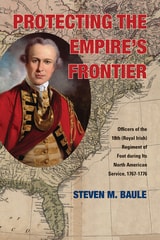
Protecting the Empire’s Frontier
Officers of the 18th (Royal Irish) Regiment of Foot during Its North American Service, 1767–1776Steven M. Baule
Ohio University Press, 2013
Protecting the Empire’s Frontier tells stories of the roughly eighty officers who served in the 18th (Royal Irish) Regiment of Foot, which served British interests in America during the crucial period from 1767 through 1776. The Royal Irish was one of the most wide-ranging regiments in America, with companies serving on the Illinois frontier, at Fort Pitt, and in Boston, New York, and Philadelphia, with some companies taken as far afield as Florida, Spanish Louisiana, and present-day Maine. When the regiment was returned to England in 1776, some of the officers remained in America on staff assignments. Others joined provincial regiments, and a few joined the American revolutionary army, taking up arms against their king and former colleagues.
Using a wide range of archival resources previously untapped by scholars, the text goes beyond just these officers’ service in the regiment and tells the story of the men who included governors, a college president, land speculators, physicians, and officers in many other British regular and provincial regiments. Included in these ranks were an Irishman who would serve in the U.S. Congress and as an American general at Yorktown; a landed aristocrat who represented Bath as a member of Parliament; and a naval surgeon on the ship transporting Benjamin Franklin to France. This is the history of the American Revolutionary period from a most gripping and everyday perspective.
An epilogue covers the Royal Irish’s history after returning to England and its part in defending against both the Franco-Spanish invasion attempt and the Gordon Rioters. With an essay on sources and a complete bibliography, this is a treat for professional and amateur historians alike.
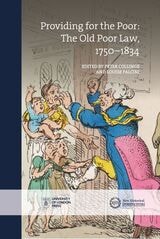
Providing for the Poor
The Old Poor Law, 1750-1834Edited by Peter Collinge and Louise Falcini
University of London Press, 2022
The Old Poor Law, which was established in 1601 in England and Wales and was in force until 1834, was administered by the local parish and dispensed goods and services to paupers, providing a uniquely comprehensive, premodern system of support for the poor. Providing for the Poor brings together academics and practitioners from across disciplines to reexamine the micropolitics of poverty in the long eighteenth century through the eyes of the poor, their providers, and enablers. Covering such topics as the providence of the parochial sixpence, which was given in order to get a beggar to move along to another parish, to coercive marriages, plebeian clothing, and the much broader implications of vagrancy toward the end of the long eighteenth century, this volume aims to bridge the gaps in our understanding of the experiences of people across the social spectrum whose lives were touched by the Old Poor Law. It brings together some of the wider arguments concerning the nature of welfare during economically difficult times and documents the rising bureaucracy inherent in the system to produce a radical new history of the Old Poor Law in astonishing detail.
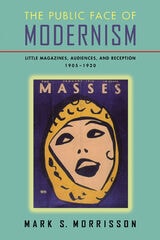
Public Face Of Modernism
Little Magazines, Audiences, And Reception, 1905-1920Mark S. Morrisson
University of Wisconsin Press, 2000
The phenomenal successes of new advertising agencies and mass market publishers did elicit what Morrisson calls a "crisis of publicity" for some modernists and for many concerned citizens in both countries. But, as Morrisson demonstrates, the vast influence of these industries on consumers also had a profound and largely overlooked effect upon many modernist authors, artists, and others. By exploring the publicity and audience reception of several of the most important modernist magazines of the period, The Public Face of Modernism shows how modernists, far from lamenting the destruction of meaningful art and public culture by the new mass market, actually displayed optimism about the power of mass-market technologies and strategies to transform and rejuvenate contemporary culture—and, above all, to restore a public function to art.
This reconstruction of the "public face of modernism" offers surprising new perceptions about the class, gender, racial, and even generational tensions within the public culture of the early part of the century, and provides a rare insight into the actual audiences for modernist magazines of the period. Moreover, in new readings of works by James Joyce, George Bernard Shaw, Wyndham Lewis, Ford Madox Ford, T. S. Eliot, William Carlos Williams, and many others, Morrisson shows that these contexts also had an impact on the techniques and concerns of the literature itself.

Public and Private
Gender, Class, and the British Novel (1764-1878)Patricia McKee
University of Minnesota Press, 1997
Public and Private was first published in 1997. Minnesota Archive Editions uses digital technology to make long-unavailable books once again accessible, and are published unaltered from the original University of Minnesota Press editions.
This groundbreaking work examines the emergent and fluctuating relationship between the public and private social spheres of the late eighteenth and nineteenth centuries. By assessing novels such as Mary Shelley's Frankenstein and Jane Austen's Emma through the lens of the social theories of Jürgen Habermas and Michel Foucault, Patricia McKee presents a fresh and highly original contribution to literary studies.
McKee explores the themes of production and consumption as they relate to gender and class throughout the works of many of the most influential novels of the age including Tobias Smollett's Humphry Clinker, Horace Walpole's The Castle of Otranto, Emma, Frankenstein, Anthony Trollope's Barchester Towers, Charles Dickens's Little Dorrit and The Old Curiosity Shop, Mrs. Henry Wood's East Lynne, and Thomas Hardy's The Return of the Native.
McKee analyzes portrayals of a society in which abstract idealism belonged to knowledgeable, productive men and the realm of ignorance was left to emotional, consuming women and the uneducated. She traces the various ways British literature of the eighteenth and nineteenth centuries worked to reform this social experience. Topics include Dickens's attack on the bureaucratic use of knowledge to maintain the status quo; the function of antiprogressive depictions of knowledge in Trollope, Shelley, and Hardy; and Austen's characterization of the protagonist Emma as an exception in a society that denied women's productive use of knowledge.
Offering a sharp challenge to theorists who have charted a linear division of public and private experience, McKee highlights the unexpected configurations of the emergence of the public and private spheres and the effect of knowledge distribution across class and gender lines.
Patricia McKee is professor of English at Dartmouth College. She is the author of Heroic Commitment in Richardson, Eliot, and James (1986).
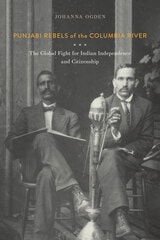
Punjabi Rebels of the Columbia River
The Global Fight for Indian Independence and CitizenshipJohanna Ogden
Oregon State University Press, 2024
Oregon is commonly perceived to have little, let alone notable, South Asian history. Yet in the early 1900s Oregon was at the center of two entwined quests for Indian independence and civic belonging that rocked the world.
Punjabi Rebels of the Columbia River traces the stories of the radical Indian independence organization known as Ghadar and Bhagat Singh Thind’s era-defining US Supreme Court citizenship case. Ghadar sought the overthrow of India’s British colonizers while Thind utilized sanctioned legal channels to do so. Despite widely differing strategies, both the movement and the man were targeted, often in coordination, by the highest levels of the US and British governments. The empires’ united message: India would not be an independent country and Indians could not be citizens. In the decades that followed, it was a verdict Indians refused to abide.
Johanna Ogden’s detailed history of migrants’ experience expands the time frame, geographic boundaries, and knowledge of the conditions and contributions of Indians in North America. It is the story of a people’s awakening amid a rich community of international workers in an age of nationalist uprisings. To understand why one of the smallest western Indian settlements became a resistance center, Punjabi Rebels mines the colonial underpinnings of labor, race, and place-making and their regional and global connections, rendering a history of whiteness and labor as much as of Indian-ness and migration. The first work to rejoin the lived experience of Thind and Ghadar activists, Punjabi Rebels complicates our understanding not just of the global fight for Indian political rights but of multi-racial democracy.
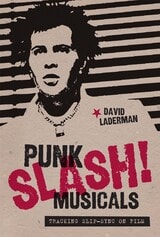
Punk Slash! Musicals
Tracking Slip-Sync on FilmBy David Laderman
University of Texas Press, 2010
Punk Slash! Musicals is the first book to deal extensively with punk narrative films, specifically British and American punk rock musicals produced from roughly 1978 to 1986. Films such as Jubilee, Breaking Glass, Times Square, Smithereens, Starstruck, and Sid and Nancy represent a convergence between independent, subversive cinema and formulaic classical Hollywood and pop musical genres.
Guiding this project is the concept of "slip-sync." Riffing on the commonplace lip-sync phenomenon, "slip-sync" refers to moments in the films when the punk performer "slips" out of sync with the performance spectacle, and sometimes the sound track itself, engendering a provocative moment of tension. This tension frequently serves to illustrate other thematic and narrative conflicts, central among these being the punk negotiation between authenticity and inauthenticity.
Laderman emphasizes the strong female lead performer at the center of most of these films, as well as each film's engagement with gender and race issues. Additionally, he situates his analyses in relation to the broader cultural and political context of the neo-conservatism and new electronic audio-visual technologies of the 1980s, showing how punk's revolution against the mainstream actually depends upon a certain ironic embrace of pop culture.

Pure Intelligence
The Life of William Hyde WollastonMelvyn C. Usselman
University of Chicago Press, 2015
Pure Intelligence is the first book-length study of Wollaston, his science, and the environment in which he thrived. Drawing on previously-unstudied laboratory records as well as historical reconstructions of chemical experiments and discoveries, and written in a highly accessible style, Pure Intelligence will help to reinstate Wollaston in the history of science, and the pantheon of its great innovators.
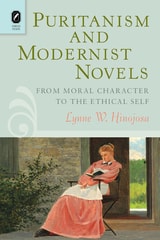
Puritanism and Modernist Novels
From Moral Character to the Ethical SelfLynne W. Hinojosa
The Ohio State University Press, 2015
Puritanism and Modernist Novels offers new formal and contextual readings of early modernist novels by Oscar Wilde, E. M. Forster, James Joyce, and Ford Madox Ford. Hinojosa demonstrates that, while they long for escape, these authors still question the value of the novelistic narrative of confinement and escape. Bridging modernist and novel studies, Puritanism and Modernist Novels contributes to conversations about secularization and religion in both fields, highlighting the limitations created by the secularization narrative of modernity.