Results by title
5448 books match the query 'History and criticism' and 305 start with p

Perfect Copies
Reproduction and the Contemporary ComicShiamin Kwa
Rutgers University Press, 2023
Perfidy and Passion
Reintroducing the IliadMark Buchan
University of Wisconsin Press, 2012
Homer’s Iliad is often considered a poem of blunt truthfulness, his characters’ motivation pleasingly simple. A closer look, however, reveals a complex interplay of characters who engage in an awful lot of lies. Beginning with Achilles, who hatches a secret plot to destroy his own people, Mark Buchan traces motifs of deception and betrayal throughout the poem. Homer’s heroes offer bluster, their passion linked to and explained by their lack of authenticity. Buchan reads Homer’s characters between the lies, showing how the plot is structured individual denial and what cannot be said.
Performance and the Afterlives of Injustice
Catherine M. Cole
University of Michigan Press, 2020
Performative Polemic
Anti-Absolutist Pamphlets and their Readers in Late Seventeenth-Century FranceKathrina Ann LaPorta
University of Delaware Press, 2021
Performing America
Cultural Nationalism in American TheaterJeffrey D. Mason and J. Ellen Gainor, Editors
University of Michigan Press, 1999
Performing America provides fresh perspectives on the development of visions of both America and "America"--that is, the actual community and the constructed concept--on a variety of theatrical stages. It explores the role of theater in the construction of American identity, highlighting the tension between the desire to categorize American identity and the realization that such categorical uniformity may neither be desirable nor possible. The topics covered include the links between politics and the stage during the Federalist period, the appropriation of "Indian" artifacts, an exploration of early gender roles, and the metaphorical connections between the theater and western expansion. Other essays treat vaudeville's artistically colonized cultures; Chautauqua's attempt to homogenize culture and commercialize American ideals; W. E. B. Du Bois's pageant, The Star of Ethiopia, as a strategy for constructing "African-American" as "Other" in an attempt to promote a vision of black nationalism; and how theater was used to help immigrants form a new sense of community while joining the resident culture.The collection then turns to questions of how various ethnic minorities through their recent theatrical work have struggled to argue their identities, especially in relation to the dominant white culture. Two final essays offer critiques of contrasting aspects of the American male. Throughout, the collection addresses questions of marginality and community, exclusion and inclusion, colonialism and imperialism, heterogeneity and homogeneity, conflict and negotiation, repression and opportunity, failure and success, and, above all, the relationship of American stages at large. It will appeal to readers of a wide range of disciplines including history, American culture, gender studies, and theater studies.
Performing Asian America
Race and Ethnicity on the Contemporary StageJosephine Lee
Temple University Press, 1998
For instance, some Asian American playwrights critique the separation of issues of race and ethnicity from those of economics and class, or they see ethnic identity as a voluntary choice of lifestyle rather than an impetus for concerted political action. Others deal with the problem of cultural stereotypes and how to reappropriate their power. Lee is attuned to the complexities and contradictions of such performances, and her trenchant thinking about the criticisms lobbed at Asian American playwrights -- for their choices in form, perpetuation of stereotype, or apparent sexism or homophobia -- leads her to question how the presentation of Asian American identity in the theater parallels problems and possibilities of identity offstage as well.
Discussed are better-known plays such as Frank Chin's The Chickencoop Chinaman, David Henry Hwang's M. Butterfly, and Velina Hasu Houston's Tea, and new works like Jeannie Barroga's Walls and Wakako Yamauchi's 12-1-a.
Performing Commemoration
Musical Reenactment and the Politics of TraumaAnnegret Fauser and Michael A. Figueroa, editors
University of Michigan Press, 2020
Performing Democracy
Bulgarian Music and Musicians in TransitionDonna A. Buchanan
University of Chicago Press, 2005
Based on fieldwork conducted between 1988 and 1996 with professional Bulgarian folk musicians, Donna A. Buchanan's PerformingDemocracy argues that the performances of traditional music groups may be interpreted not only as harbingers but as agents of Bulgaria's political transition. Many of the musicians in socialist Bulgaria's state folk ensembles served as official cultural emissaries for several decades. Through their reminiscences and repertoires, Buchanan reveals the evolution of Bulgarian musical life as it responded to and informed the political process. By modifying their art to accommodate changing political ideologies, these musicians literally played out regime change on the world's stages, performing their country's democratization musically at home and abroad.
Performing Democracy and its accompanying CD-ROM, featuring traditional Bulgarian music, lyrics, notation, and photos, will fascinate any reader interested in the many ways art echoes and influences politics.
Performing Drama/Dramatizing Performance
Alternative Theater and the Dramatic TextMichael Vanden Heuvel
University of Michigan Press, 1993

Performing Glam Rock
Gender and Theatricality in Popular MusicPhilip Auslander
University of Michigan Press, 2006
Yet glam was as much about substance as style, and Performing Glam Rock delves into the many ways glam paved the way for new explorations of identity in terms of gender, sexuality, and performance. Philip Auslander positions glam historically and examines it as a set of performance strategies, exploring the ways in which glam rock-while celebrating the showmanship of 1950s rock and roll-began to undermine rock's adherence to the ideology of authenticity in the late 1960s.
In this important study of a too-often-overlooked phenomenon, Auslander takes a fresh look at the genius of the glam movement and introduces glam to a new generation of performance enthusiasts and scholars alike.
Philip Auslander is Professor in the School of Literature, Communication, and Culture at the Georgia Institute of Technology and author of numerous books, including Liveness: Performance in a Mediatized Culture and Presence and Resistance: Postmodernism and Cultural Politics in Contemporary American Performance. He is editor of the major reference work Performance: Critical Concepts and coeditor, with Carrie Sandahl, of Bodies in Commotion: Disability and Performance.
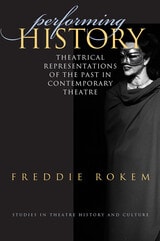
Performing History
Theatrical Representations of the Past in Conetmporary TheatreFreddie Rokem
University of Iowa Press, 2000
Performing Identities on the Restoration Stage
Cynthia Lowenthal
Southern Illinois University Press, 2002
In Performing Identities on the Restoration Stage, Cynthia Lowenthal explores identity—especially masculinity and femininity, English and “foreign,” middle-class and aristocratic—as it is enacted, idealized, deployed, and redefined on the late-seventeenth-century British stage. Particular emphasis is placed on the ways the theatre contributed to new and often shifting early modern definitions of the boundaries of nation, status, and gender.
The first portion of the book focuses on the playwrights’ presentations of idealized men and the comic ridicule of male bodies and behaviors that fall short of the ideal. Of special interest are those moments when playwrights use stereotypes of national character, particularly the Spaniards and Turks, as examples of the worst in male behavior, judgments that are always inflected with elements of class or status inconsistency.
The second portion of Lowenthal’s discussion focuses on playwrights’ attempts to redefine the idealized woman. Lowenthal investigates the ways that an extratheatrical discourse surrounding the actresses, one that essentialized them as sexual bodies demanding scrutiny and requiring containment, also serves to secure for them an equally essential aristocratic status. Anchored by Manley’s Royal Mischief, Lowenthal’s reading reveals that even a woman playwright’s attempts to represent female subjectivity or interiority at odds with the surfaces of the body are doomed to return to those same surfaces.
By focusing on a new, early modern lability of identity and by reading less canonical women playwrights, such as Manley and Pix, alongside established male playwrights such as Dryden and Wycherley, Performing Identities on the Restoration Stage yields both a more accurate and a more compelling picture of the cultural dynamics at work on the early modern stage.
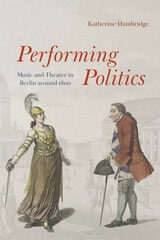
Performing Politics
Music and Theater in Berlin Around 1800Katherine Hambridge
University of Chicago Press, 2027
A new account of the emergence of modern cultural politics through a study of music and theater in Berlin around 1800.
Berlin around 1800 has been seen—at the time and since—as somewhat behind other major European cities in terms of its musical culture, peripheral to the momentous developments attributed to the period. By contrast, early nineteenth-century Berlin has been exhaustively studied as the site of a nascent German-national movement and the Prussian Reforms. In Performing Politics, Katherine Hambridge examines the confluence of music and politics in Berlin around 1800, engaging directly with the themes of being behind/ahead, central/peripheral, in order to tell new stories about nineteenth-century German history, musical and otherwise.
Performing Politics emphasizes events as much as repertoires, and non-canonical repertoires over the more familiar music of this period: dynastic birthday celebrations, the music of historical dramas, political song and communal singing, popular music theater. By focusing our attention on the unfamiliar specificity of Berlin Nationaltheater, Hambridge reenergizes our understanding of 1800–1815 as a key period in the development of musical and political modernity. Using sources largely unexploited by musicologists, and phenomena neglected by historians, she reveals the quotidian aesthetics, values, and practices that shaped both the sociopolitical narratives and musical developments of the time. Performing Politics is thus not only a history of music and theater in Berlin at a critical moment, but a music history of modern cultural politics.

Performing Television
Contemporary Drama and the Media CultureElizabeth Klaver
University of Wisconsin Press, 2000
Klaver applies post-structuralist theories of subjectivity to drama while ranging through Beckett’s plays, National Hockey League games, “The Tonight Show,” gay and lesbian drama, minority drama, avant-garde performance, and the topics of theatrical paranoia, the mediatized Imaginary, and the spectatorial gaze.
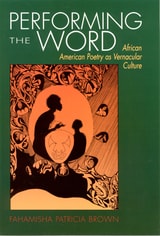
Performing The Word
African American Poetry As Vernacular CultureBrown, Fahamisha Patricia
Rutgers University Press, 1999
Fahamista Patricia Brown examines elements of African American expressive culture- its language practices, both fold and popular. Her book is an excellent introduction to a diverse group of poets and the common basis of their work in language practices and performativity, in the expressive culture of a people. Performing the Word is an important contribution to the understanding of African American culture and American poetry as a whole.
Performing Unification
History and Nation in German Theater after 1989Matt Cornish
University of Michigan Press, 2017

Performing Violence
Literary and Theatrical Experiments of New Russian DramaBirgit Beumers and Mark Lipovetsky
Intellect Books, 2009
The so-called “New Russian Drama” emerged at the end of the twentieth century, following a long period of decline in dramatic writing in the late Soviet and post-Soviet era. In Performing Violence, Birgit Beumers and Mark Lipovetsky examine the representation of violence in these new dramatic works by young Russian playwrights. Reflecting the disappointment in Yeltsin’s democratic reforms and Putin’s neoconservative politics, the plays focus on political and social representations of violence, its performances, and its justifications.
As the first English-language study of Russian drama and theatre in the twenty-first century, Performing Violence seeks a vantage point for the analysis of brutality in post-Soviet culture. While previous generations had preferred poetry and prose, this new breed of authors—the Presnyakov brothers, Evgeni Grishkovets, and Vasili Sigarev among them—have garnered international recognition for their fierce plays. This book investigates the violent portrayal of the identity crisis of a generation as represented in their theatrical works, and will be a key text for students and scholars of drama, Russian studies, and literature.
Performing Women and Modern Literary Culture in Latin America
Intervening ActsBy Vicky Unruh
University of Texas Press, 2006
Women have always been the muses who inspire the creativity of men, but how do women become the creators of art themselves? This was the challenge faced by Latin American women who aspired to write in the 1920s and 1930s. Though women's roles were opening up during this time, women writers were not automatically welcomed by the Latin American literary avant-gardes, whose male members viewed women's participation in tertulias (literary gatherings) and publications as uncommon and even forbidding. How did Latin American women writers, celebrated by male writers as the "New Eve" but distrusted as fellow creators, find their intellectual homes and fashion their artistic missions?
In this innovative book, Vicky Unruh explores how women writers of the vanguard period often gained access to literary life as public performers. Using a novel, interdisciplinary synthesis of performance theory, she shows how Latin American women's work in theatre, poetry declamation, song, dance, oration, witty display, and bold journalistic self-portraiture helped them craft their public personas as writers and shaped their singular forms of analytical thought, cultural critique, and literary style. Concentrating on eleven writers from Argentina, Brazil, Cuba, Mexico, Peru, and Venezuela, Unruh demonstrates that, as these women identified themselves as instigators of change rather than as passive muses, they unleashed penetrating critiques of projects for social and artistic modernization in Latin America.
Performing the Nation
Swahili Music and Cultural Politics in TanzaniaKelly Askew
University of Chicago Press, 2002
As Askew shows, the genres of ngoma (traditional dance), dansi (urban jazz), and taarab (sung Swahili poetry) have played prominent parts in official articulations of "Tanzanian National Culture" over the years. Drawing on over a decade of research, including extensive experience as a taarab and dansi performer, Askew explores the intimate relations among musical practice, political ideology, and economic change. She reveals the processes and agents involved in the creation of Tanzania's national culture, from government elites to local musicians, poets, wedding participants, and traffic police. Throughout, Askew focuses on performance itself—musical and otherwise—as key to understanding both nation-building and interpersonal power dynamics.
Pericles on Stage
Political Comedy in Aristophanes' Early PlaysBy Michael Vickers
University of Texas Press, 1996
Since the eighteenth century, classical scholars have generally agreed that the Greek playwright Aristophanes did not as a matter of course write "political" plays. Yet, according to an anonymous Life of Aristophanes, when Dionysius the tyrant of Syracuse wanted to know about the government of Athens, Plato sent him a copy of Aristophanes' Clouds.
In this boldly revisionist work, Michael Vickers convincingly argues that in his earlier plays, Aristophanes in fact commented on the day-to-day political concerns of Athenians. Vickers reads the first six of Aristophanes' eleven extant plays in a way that reveals the principal characters to be based in large part on Pericles and his ward Alcibiades.
According to Vickers, the plays of Aristophanes—far from being nonpolitical—actually allow us to gauge the reaction of the Athenian public to the events that followed Pericles' death in 429 B.C., to the struggle for the political succession, and to the problems presented by Alcibiades' emergence as one of the most powerful figures in the state. This view of Aristophanes reaffirms the central role of allegory in his work and challenges all students of ancient Greece to rethink long-held assumptions about this important playwright.
Permissible Narratives
The Promise of Latino/a LiteratureChristopher González
The Ohio State University Press, 2017
Bringing together cultural critique, memory, narratology, cognition, and comprehension, González examines Latina/o authors—such as Oscar “Zeta” Acosta, Gloria Anzaldúa, Piri Thomas, Giannina Braschi, Gilbert Hernandez, Sandra Cisneros, and Junot Díaz—investigating how they successfully, and sometimes unsuccessfully, use the expansive canvas of narrative form to capture the imaginations of an open-minded readership. Permissible Narratives highlights both the inequitable accessibility of narrative devices and, crucially, the daring of Latina/o authors to nurture a readership to afford the same literary deference to them that is so often afforded to white, male, straight authors.

Persecution, Plague, and Fire
Fugitive Histories of the Stage in Early Modern EnglandEllen MacKay
University of Chicago Press, 2011
The theater of early modern England was a disastrous affair. The scant record of its performance demonstrates as much, for what we tend to remember today of the Shakespearean stage and its history are landmark moments of dissolution: the burning down of the Globe, the forced closure of playhouses during outbreaks of the plague, and the abolition of the theater by its Cromwellian opponents.
Persecution, Plague, and Fire is a study of these catastrophes and the theory of performance they convey. Ellen MacKay argues that the various disasters that afflicted the English theater during its golden age were no accident but the promised end of a practice built on disappearance and erasure—a kind of fatal performance that left nothing behind but its self-effacing poetics. Bringing together dramatic theory, performance studies, and theatrical, religious, and cultural history, MacKay reveals the period’s radical take on the history and the future of the stage to show just how critical the relation was between early modern English theater and its public.

Persephone's Girdle
Narratives of Rape in Seventeenth-Century Spanish LiteratureMarcia L. Welles
Vanderbilt University Press, 2000
Marcia Welles applies her extensive knowledge of Spanish Golden Age literature and her insightful grasp of current literary theory to synthesize a wide range of material into a uniquely engaging and refreshing interpretation of well-known texts. While the subject of rape and violence has been studied in other European literatures, Persephone's Girdle is the first to do so in the field of early modern Spanish literature.
Persius
A Study in Food, Philosophy, and the FiguralShadi Bartsch
University of Chicago Press, 2015
In Persius, Shadi Bartsch explores this Stoic framework and argues that Persius sets his own bizarre metaphors of food, digestion, and sexuality against more appealing imagery to show that the latter—and the poetry containing it—harms rather than helps its audience. Ultimately, he encourages us to abandon metaphor altogether in favor of the non-emotive abstract truths of Stoic philosophy, to live in a world where neither alluring poetry, nor rich food, nor sexual charm play a role in philosophical teaching.
Persona and Humor in Mark Twain's Early Writings
Don Florence
University of Missouri Press, 1995
In Persona and Humor in Mark Twain's Early Writings, Don Florence explains that Samuel Clemens did more than use the borrowed name of Mark Twain to sign his writings. He also developed a separate identity, or persona, becoming "a literary personality in his own right."
Challenging mainstream Twain criticism on many fronts, Florence focuses exclusively on Twain's early writings. He demonstrates how Twain evolved in his early narratives into the "Mark Twain" we now recognize. Florence maintains that this process was evolutionary: Although Twain might have been dependent on Clemens for the initial experiences, they become Twain's experiences, necessary for his development as a persona. Traditionally, critics of Twain have been preoccupied with dualities, but Florence sees this emphasis upon polarities as an oversimplification. He argues that much of Twain's humor strives to shape more and more of the world, giving Twain multiple narrative voices and letting him be inclusive, not exclusive.
Finally, this study asserts that there is more continuity to Mark Twain's career than has been generally recognized. Many Twain scholars have argued that Twain's later writings are radically different from his earlier writings because of their emphasis upon illusion and dream. Florence argues that the preoccupation with illusion and fantasy is scarcely new. Whether Twain's mood is exuberant or dark, he emphasizes subjectivity over objectivity, the dominance of fantasy, the creative powers of humor, and his ability as persona to determine what we consider "reality." Florence contends that Twain's early writings show Mark Twain gradually evolving into a masterfully comic persona.
Jargon-free and eloquently written, Persona and Humor in Mark Twain's Early Writings provides a fascinating look at Mark Twain's developing genius and will be a welcome addition to Twain literature.
Perspectives of Roman Poetry
A Classics SymposiumEdited by G. Karl Galinsky
University of Texas Press, 1974
Written by leading specialists, the essays in Perspectives of Roman Poetry seek to provide a broad range of readers with a good understanding of some essential aspects of major Roman poets and poetic genres. The value of the essays is enhanced, for comparative purposes, by their extensive reference to modern authors. such as Shakespeare and Tolkien. For the modern reader, Latin quotations are accompanied by effective English translations.
The essays and their authors are as follows:
- "The Woman's Role in Latin Love Poetry," by Georg Luck
- "Autobiography and Art in Horace," by William S. Anderson
- "Some Trees in Virgil and Tolkien," by Kenneth J. Reckford
- "The Business of Roman Comedy," by Erich Segal
- "Ovid's Metamorphosis of Myth," by G. Karl Galinsky
Perspectives of Roman Poetry resulted from a symposium held at the University of Texas at Austin in 1972. These essays offer different and, in some cases, heterodox interpretations that will serve as a basis for future discussions.
Perspectives
Modes of Viewing and Knowing in Nineteenth-Century EnglandLinda M. Shires
The Ohio State University Press, 2009
Perverse Attachments
Reading Fiction Around 1800Anastasia Eccles
University of Chicago Press, 2026
This new theory of reader response describes “perverse attachment,” or the powerful desire to intervene in a story, even when it is impossible to do so.
Fiction has long inspired resistance in its readers: making them, for example, wish for a different plot, cringe at a moment of social discomfort, or itch to warn a character about an approaching calamity. These are symptoms of a condition that Anastasia Eccles calls “perverse attachment,” in which a person feels an urge to act on something beyond their control. Eccles theorizes this form of frustrated agency as a constitutive part of the experience of reading fiction, especially under the influence of literary sentimentalism in the late eighteenth and early nineteenth centuries. It was also, significantly, a defining aspect of the mass politics that emerged in the same period, which rested on the demands of new political subjects to participate in a process that excluded them.
Perverse Attachments recovers a repertoire of aesthetic responses keyed to the psychodynamics of modern political life: complicity, suspense, historical regret, and cringing. Combining identification and disidentification, immersion and detachment, these experiences challenge deep-seated binaries in our theories of reading and point toward a new account of the political stakes of literary form.
Through readings of works by Charlotte Smith, Walter Scott, Jane Austen, and others Eccles shows how this distinctive aesthetic and political relation shaped the major genres of Romantic fiction and gave rise to some of the novel’s characteristic forms, like the character type of the witness-protagonist and the techniques of free indirect discourse. The result is a major work in the theory of the novel and the history of readerly experience.

Perversion and the Social Relation
sic IVMolly Anne Rothenberg, Dennis A. Foster and Slavoj Zizek, eds.
Duke University Press, 2003
By focusing on perversion as a psychic structure rather than as aberrant behavior, the contributors provide an alternative to models of social interpretation based on classical Oedipal models of maturation and desire. At the same time, they critique claims that the perverse is necessarily subversive or liberating. In their lucid introduction, the editors explain that while fixation at the stage of the perverse can result in considerable suffering for the individual and others, perversion motivates social relations by providing pleasure and fulfilling the psychological need to put something in the place of the Father. The contributors draw on a variety of psychoanalytic perspectives—Freudian and Lacanian—as well as anthropology, history, literature, and film. From Slavoj Žižek's meditation on “the politics of masochism” in David Fincher's movie Fight Club through readings of works including William Styron's The Confessions of Nat Turner, Don DeLillo’s White Noise, and William Burroughs's Cities of the Red Night, the essays collected here illuminate perversion's necessary role in social relations.
Contributors. Michael P. Bibler, Dennis A. Foster, Bruce Fink, Octave Mannoni, E. L. McCallum, James Penney, Molly Anne Rothenberg, Nina Schwartz, Slavoj Žižek

Petrochemical Fantasies
The Art and Energy of American ComicsDaniel Worden
The Ohio State University Press, 2024
Finalist, Comics Studies Society Charles Hatfield Book Prize 2025
Nominee, Eisner Award for Best Academic/Scholarly Work 2025
In Petrochemical Fantasies, Daniel Worden reveals the entwined history of comics and fossil fuels in the United States. From the 1840s to the present, comics have depicted the power, pollution, and rapid expansion of energy systems—especially the explosive growth of coal and oil. In the 1930s, some of the first comic books were the gas station giveaways Gulf Funny Weekly and Standard Oil Comics. And in recent years, comics have become one of the major sites for visualizing life after oil, a striking reversal of the medium’s early boosterism.
Surveying the work of acclaimed artists such as Nell Brinkley, George Herriman, Jack Kirby, Winsor McCay, and R. F. Outcault and recovering little-known works, Worden advances a new history of American comics in the Anthropocene. From late nineteenth- and early twentieth-century editorial cartoons and superhero comics that visualize our modern energy culture to contemporary comics grappling with climate crises, Petrochemical Fantasies places comics, environmental humanities, and energy studies in conversation with each other to unearth the crucial but overlooked history of comics’ place in US energy culture.
Phantom Ladies
Hollywood Horror and the Home FrontSnelson, Tim
Rutgers University Press, 2014
Phenomenal Reading
Essays on Modern and Contemporary PoeticsBrian M. Reed
University of Alabama Press, 2012
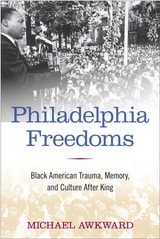
Philadelphia Freedoms
Black American Trauma, Memory, and Culture after KingMichael Awkward
Temple University Press, 2013
Philosophy Beside Itself
On Deconstruction and ModernismStephen W. MelvilleForeword by Donald Marshall
University of Minnesota Press, 1986
Philosophy Beside Itself was first published in 1986. Minnesota Archive Editions uses digital technology to make long-unavailable books once again accessible, and are published unaltered from the original University of Minnesota Press editions.
The writings of French philosopher Jacques Derrida have been the single most powerful influence on critical theory and practice in the United States over the past decade. But with few exceptions American philosophers have taken little or no interest in Derrida's work, and the task of reception, translation, and commentary has been left to literary critics. As a result, Derrida has appeared as a figure already defined by essentially literary critical activities and interests.
Stephen Melville's aim in Philosophy Beside Itself is to insist upon and clarify the distinctions between philosophy and criticism. He argues that until we grasp Derrida's philosophical project as such, we remain fundamentally unable to see his significance for criticism. In terms derived from Stanley Cavell's writings on modernism, Melville develops a case for Derrida as a modernist philosopher, working at once within and against that tradition and discipline.
Melville first places Derrida in a Hegelian context, the structure of which he explores by examining the work of Heidegger, Lacan, and Bataille. With this foundation, he is able to reappraise the project of deconstructive criticism as developed in Paul de Man's Blindness and Insight and further articulated by other Yale critics. Central to this critique is the ambivalent relationship between deconstructive criticism and Lacanian psychoanalysis. Criticism—radical self-criticism—is a central means through which the difficult facts of human community come to recognition, and Melville argues for criticism as an activity intimately bound to the ways in which we do and do not belong in time and in community. Derrida's achievement has been to find a new and necessary way to assert that the task of philosophy is criticism; the task of literary criticism is to assume the burden of that achievement.
Stephen Melville is an assistant professor of English at Syracuse University, and Donald Marshall is a professor of English at the University of Iowa.
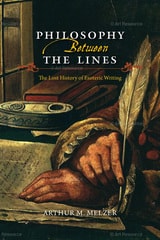
Philosophy Between the Lines
The Lost History of Esoteric WritingArthur M. Melzer
University of Chicago Press, 2014
Arthur M. Melzer serves as our deeply knowledgeable guide in this capacious and engaging history of philosophical esotericism. Walking readers through both an ancient (Plato) and a modern (Machiavelli) esoteric work, he explains what esotericism is—and is not. It relies not on secret codes, but simply on a more intensive use of familiar rhetorical techniques like metaphor, irony, and insinuation. Melzer explores the various motives that led thinkers in different times and places to engage in this strange practice, while also exploring the motives that lead more recent thinkers not only to dislike and avoid this practice but to deny its very existence. In the book’s final section, “A Beginner’s Guide to Esoteric Reading,” Melzer turns to how we might once again cultivate the long-forgotten art of reading esoteric works.
Philosophy Between the Lines is the first comprehensive, book-length study of the history and theoretical basis of philosophical esotericism, and it provides a crucial guide to how many major writings—philosophical, but also theological, political, and literary—were composed prior to the nineteenth century.
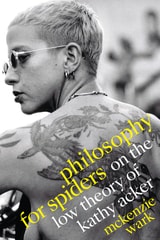
Philosophy for Spiders
On the Low Theory of Kathy AckerMcKenzie Wark
Duke University Press, 2021
Phonographic Memories
Popular Music and the Contemporary Caribbean NovelNjelle W. Hamilton
Rutgers University Press, 2019
Njelle W. Hamilton's Spotify playlist to accompany Phonographic Memories: https://spoti.fi/2tCQRm8
Phonographic Modernity
The Gramophone Industry and Music Genres in East and Southeast AsiaEdited by Fumitaka Yamauchi and Ying-fen Wang
University of Illinois Press, 2024
A roster of experts on countries from Japan to Indonesia explores the complicated relationship between the gramophone industry and music genres in East and Southeast Asia. Extending the boundaries of their research across multiple disciplines, the contributors connect the gramophone industry to theories surrounding phonography and modernity. Their focus on phonography combines an interest in discs with an interest in the sounds contributing to the recent sonic-auditory turn in sound studies.
Ambitious and expansive, Phonographic Modernity examines the bloc of East and Southeast Asia within the larger global history of sound recording.
Phonographies
Grooves in Sonic Afro-ModernityAlexander G. Weheliye
Duke University Press, 2005
Weheliye surveys literature, film, and music to focus on engagements with recorded sound. He offers substantial new readings of canonical texts by W. E. B. Du Bois and Ralph Ellison, establishing dialogues between these writers and popular music and film ranging from Louis Armstrong’s voice to DJ mixing techniques to Darnell Martin’s 1994 movie I Like It Like That. Looking at how questions of diasporic belonging are articulated in contemporary black musical practices, Weheliye analyzes three contemporary Afro-diasporic musical acts: the Haitian and African American rap group the Fugees, the Afro- and Italian-German rap collective Advanced Chemistry, and black British artist Tricky and his partner Martina. Phonographies imagines the African diaspora as a virtual sounding space, one that is marked, in the twentieth century and twenty-first, by the circulation of culture via technological reproductions—records and tapes, dubbing and mixing, and more.

Photopoetics at Tlatelolco
Afterimages of Mexico, 1968By Samuel Steinberg
University of Texas Press, 2016
In the months leading up to the 1968 Olympic games in Mexico City, students took to the streets, calling for greater democratization and decrying crackdowns on political resistance by the ruling PRI party. During a mass meeting held at the Plaza of the Three Cultures in the Tlatelolco neighborhood, paramilitary forces opened fire on the gathering. The death toll from the massacre remains a contested number, ranging from an official count in the dozens to estimates in the hundreds by journalists and scholars. Rereading the legacy of this tragedy through diverse artistic-political interventions across the decades, Photopoetics at Tlatelolco explores the state’s dual repression—both the massacre’s crushing effects on the movement and the manipulation of cultural discourse and political thought in the aftermath.
Examining artifacts ranging from documentary photography and testimony to poetry, essays, chronicles, cinema, literary texts, video, and performance, Samuel Steinberg considers the broad photographic and photopoetic nature of modern witnessing as well as the specific elements of light (gunfire, flares, camera flashes) that ultimately defined the massacre. Steinberg also demonstrates the ways in which the labels of “massacre” and “sacrifice” inform contemporary perceptions of the state’s blatant and violent repression of unrest. With implications for similar processes throughout the rest of Latin America from the 1960s to the present day, Photopoetics at Tlatelolco provides a powerful new model for understanding the intersection of political history and cultural memory.

Physics Envy
American Poetry and Science in the Cold War and AfterPeter Middleton
University of Chicago Press, 2015
In Physics Envy, Peter Middleton examines the influence of science, particularly physics, on American poetry since World War II. He focuses on such diverse poets as Charles Olson, Muriel Rukeyser, Amiri Baraka, and Rae Armantrout, among others, revealing how the methods and language of contemporary natural and social sciences—and even the discourse of the leading popular science magazine Scientific American—shaped their work. The relationship, at times, extended in the other direction as well: leading physicists such as Robert Oppenheimer, Werner Heisenberg, and Erwin Schrödinger were interested in whether poetry might help them explain the strangeness of the new, quantum world. Physics Envy is a history of science and poetry that shows how ultimately each serves to illuminate the other in its quest for the true nature of things.

Pick Up the Pieces
Excursions in Seventies MusicJohn Corbett
University of Chicago Press, 2019
Rock. Disco. Pop. Soul. Jazz. Folk. Funk. The music scene of the 1970s was as varied as it was exhilarating, but the decade’s diversity of sound has never been captured in one book before now. Pick Up the Pieces gives a panoramic view of the era’s music and culture through seventy-eight essays that allow readers to dip in and out of the decade at random or immerse themselves completely in Corbett’s chronological journey.
An inviting mix of skilled music criticism and cultural observation, Pick Up the Pieces is also a coming-of-age story, tracking the author’s absorption in music as he grows from age seven to seventeen. Along with entertaining personal observations and stories, Corbett includes little-known insights into musicians from Pink Floyd, Joni Mitchell, James Brown, and Fleetwood Mac to the Residents, Devo, Gal Costa, and Julius Hemphill.
A master DJ on the page, Corbett takes us through the curated playlist that is Pick Up the Pieces with captivating melody of language and powerful enthusiasm for the era. This funny, energetic book will have readers longing nostalgically for a decade long past.

Pictures of Romance
Form against Context in Painting and LiteratureWendy Steiner
University of Chicago Press, 1988
Romances violate the casual, temporal, and logical cohesiveness of realist novels, and they do so in part by depicting love as a state of suspension, a condition outside of time. Steiner argues that because Renaissance and post-Renaissance painting also represents a suspended moment of perception with "unnatural" clarity and compression of meaning, it readily serves the romance as a symbol of antirealism. Yet the atemporality of stopped-action painting was actually an attempt to achieve pictorial realism—the way things "really" look. It is this paradox that interests Steiner: to signal their departure from realism, romances evoke the symbol of "realistic" visual artwork. Steiner explores this problem through analyses of Keats, Hawthorne, Joyce, and Picasso. She then examines a return to narrative conventions in visual art in the twentieth century, in the work of Lichtenstein and Warhol, and speculates on the fate of pictorial storytelling and the romance in postmodern art. An aesthetic fantasia of sorts, this study combines theory and analysis to illuminate an unexpected interconnection between literature and the visual arts.
Pictures of the Heart
The <em>Hyakunin Isshu</em> in Word and ImageJoshua S. Mostow
University of Michigan Press, 2015
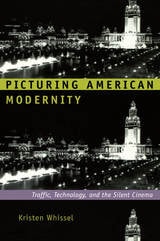
Picturing American Modernity
Traffic, Technology, and the Silent CinemaKristen Whissel
Duke University Press, 2008
Whissel shows that by portraying key events, achievements, and anxieties, the cinema invited American audiences to participate in the rapidly changing world around them. Moving pictures provided astonishing visual dispatches from military camps prior to the outbreak of fighting in the Spanish-American War. They allowed audiences to delight in images of the Pan-American Exposition, and also to mourn the assassination of President McKinley there. One early film genre, the reenactment, presented spectators with renditions of bloody battles fought overseas during the Philippine-American War. Early features offered sensational dramatizations of the scandalous “white slave trade,” which was often linked to immigration and new forms of urban work and leisure. By bringing these frequently distant events and anxieties “near” to audiences in cities and towns across the country, the cinema helped construct an American national identity for the machine age.
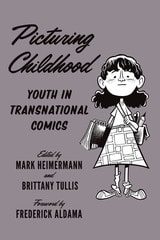
Picturing Childhood
Youth in Transnational ComicsEdited by Mark Heimermann and Brittany Tullis, Foreword by Frederick Aldama
University of Texas Press, 2017
Comics and childhood have had a richly intertwined history for nearly a century. From Richard Outcault’s Yellow Kid, Winsor McCay’s Little Nemo, and Harold Gray’s Little Orphan Annie to Hergé’s Tintin (Belgium), José Escobar’s Zipi and Zape (Spain), and Wilhelm Busch’s Max and Moritz (Germany), iconic child characters have given both kids and adults not only hours of entertainment but also an important vehicle for exploring children’s lives and the sometimes challenging realities that surround them.
Bringing together comic studies and childhood studies, this pioneering collection of essays provides the first wide-ranging account of how children and childhood, as well as the larger cultural forces behind their representations, have been depicted in comics from the 1930s to the present. The authors address issues such as how comics reflect a spectrum of cultural values concerning children, sometimes even resisting dominant cultural constructions of childhood; how sensitive social issues, such as racial discrimination or the construction and enforcement of gender roles, can be explored in comics through the use of child characters; and the ways in which comics use children as metaphors for other issues or concerns. Specific topics discussed in the book include diversity and inclusiveness in Little Audrey comics of the 1950s and 1960s, the fetishization of adolescent girls in Japanese manga, the use of children to build national unity in Finnish wartime comics, and how the animal/child hybrids in Sweet Tooth act as a metaphor for commodification.
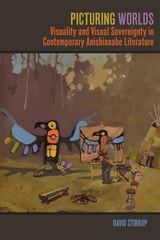
Picturing Worlds
Visuality and Visual Sovereignty in Contemporary Anishinaabe LiteratureDavid Stirrup
Michigan State University Press, 2020
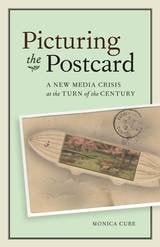
Picturing the Postcard
A New Media Crisis at the Turn of the CenturyMonica Cure
University of Minnesota Press, 2018
The first full-length study of a once revolutionary visual and linguistic medium
Literature has “died” many times—this book tells the story of its death by postcard. Picturing the Postcard looks to this unlikely source to shed light on our collective, modern-day obsession with new media. The postcard, almost unimaginably now, produced at the end of the nineteenth century the same anxieties and hopes that many people think are unique to twenty-first-century social media such as Facebook or Twitter. It promised a newly connected social world accessible to all and threatened the breakdown of authentic social relations and even of language.
Arguing that “new media” is as much a discursive object as a material one, and that it is always in dialogue with the media that came before it, Monica Cure reconstructs the postcard’s history through journals, legal documents, and sources from popular culture, analyzing the postcard’s representation in fiction by well-known writers such as E. M. Forster and Edith Wharton and by more obscure writers like Anne Sedgwick and Herbert Flowerdew. Writers deployed uproar over the new medium of the postcard by Anglo-American cultural critics to mirror anxieties about the changing nature of the literary marketplace, which included the new role of women in public life, the appeal of celebrity and the loss of privacy, an increasing dependence on new technologies, and the rise of mass media. Literature kept open the postcard’s possibilities and in the process reimagined what literature could be.

Pieces of Sound
German Experimental RadioDaniel Gilfillan
University of Minnesota Press, 2009
A cultural history of German radio broadcasting from the 1920s to today
Since the rise of film and television, radio has continued to evolve, with satellite radio and podcasts as its latest incarnations. Any understanding of the development of radio, like its visual counterparts, depends on closely examining the artistic ventures that preceded commercial acceptance.
In Pieces of Sound, Daniel Gilfillan offers a cultural history that explores these major aspects of the medium by focusing on German radio broadcasting, providing a context that sees beyond programming to consider regulations, cultural politics, and social standardization. Gilfillan showcases the work of radio pioneers and artists over the past century, including Brecht’s work with the form, and how radio was employed before and after World War II. He traces how German radio broadcasters experimented with networked media not only to expand the artistic and communicative possibilities of radio, but also to inform perceptions about the advantages and direction of newer telecommunications media like Internet broadcasting and pirate radio, which artists are using today to engage with a medium that is increasingly under corporate control. Gilfillan astutely observes how claims made for the Internet today echo those made for radio in its infancy and puts forth a broad and incisive historical analysis of German cultural broadcasting.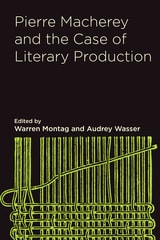
Pierre Macherey and the Case of Literary Production
Edited by Warren Montag and Audrey Wasser
Northwestern University Press, 2022
This collection revisits A Theory of Literary Production (1966) to show how Pierre Macherey’s remarkable—and still provocative—early work can contribute to contemporary discussions about the act of reading and the politics of formal analysis. Across a series of historically and philosophically contextualized readings, the volume’s contributors interrogate Macherey’s work on a range of pressing issues, including the development of a theory of reading and criticism, the relationship between the spoken and the unspoken, the labor of poetic determination and of literature’s resistance to ideological context, the literary relevance of a Spinozist materialism, the process of racial subjectification and the ontology of Blackness, and a theorization of the textual surface. Pierre Macherey and the Case of Literary Production also includes three new texts by Macherey, presented here in English for the first time: his postface to the revised French edition of A Theory of Literary Production; “Reading Althusser,” in which Macherey analyzes the concept of symptomatic reading; and a comprehensive interview in which Macherey reflects on the historical conditions of his early work, the long arc of his career at the intersection of philosophy and literature, and the ongoing importance of Louis Althusser’s thought.
Recent translations of Macherey’s work into English have introduced new readers to the critic’s enduring power and originality. Timely in its questions and teeming with fresh insights, Pierre Macherey and the Case of Literary Production demonstrates the depths to which his work resonates, now more than ever.