Results by title
1947 books match the query 'Music' and 83 start with p
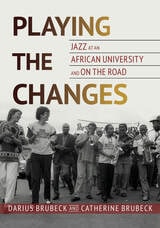
Playing the Changes
Jazz at an African University and on the RoadDarius Brubeck and Catherine Brubeck
University of Illinois Press, 2024
Catherine and Darius Brubeck’s 1983 move to South Africa launched them on a journey that helped transform jazz education. Blending biography with storytelling, the pair recount their time at the University of KwaZulu-Natal, where they built a pioneering academic program in jazz music and managed and organized bands, concerts, and tours around the world.
The Brubecks and the musicians faced innumerable obstacles, from the intensification of apartheid and a lack of resources to the hardscrabble lives that forced even the most talented artists to the margins. Building a program grounded in multi-culturalism, Catherine and Darius encouraged black and white musicians to explore and expand the landscape of South African jazz together Their story details the sometimes wily, sometimes hilarious problem-solving necessary to move the institution forward while offering insightful portraits of South African jazz players at work, on stage, and providing a soundtrack to the freedom struggle and its aftermath.
Frank and richly detailed, Playing the Changes provides insiders’ accounts of how jazz intertwined with struggle and both expressed and resisted the bitter unfairness of apartheid-era South Africa.
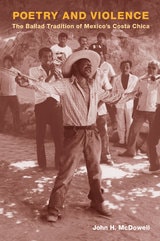
Poetry and Violence
The Ballad Tradition of Mexico's Costa ChicaJohn H. McDowell
University of Illinois Press, 1999
Detailed and rife with social and cultural implications, Poetry and Violence is a compelling commentary on violence as both human experience and communicative action.
Policing Pop
edited by Martin Cloonan and Reebee Garofalo
Temple University Press, 2002
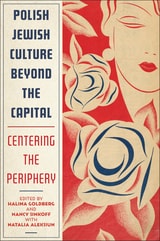
Polish Jewish Culture Beyond the Capital
Centering the PeripheryHalina Goldberg
Rutgers University Press, 2023
PIASA's 2024 Anna M. Cienciala Award for Best-Edited Multi-Authored Scholarly Volume
Polish Jewish Culture beyond the Capital: Centering the Periphery is a path-breaking exploration of the diversity and vitality of urban Jewish identity and culture in Polish lands from the second half of the nineteenth century to the outbreak of the Second World War (1899–1939). In this multidisciplinary essay collection, a cohort of international scholars provides an integrated history of the arts and humanities in Poland by illuminating the complex roles Jews in urban centers other than Warsaw played in the creation of Polish and Polish Jewish culture.
Each essay presents readers with the extraordinary production and consumption of culture by Polish Jews in literature, film, cabaret, theater, the visual arts, architecture, and music. They show how this process was defined by a reciprocal cultural exchange that flourished between cities at the periphery—from Lwów and Wilno to Kraków and Łódź—and international centers like Warsaw, thereby illuminating the place of Polish Jews within urban European cultures.
Companion website (https://polishjewishmusic.iu.edu)

Politics as Sound
The Washington, DC, Hardcore Scene, 1978-1983Shayna L. Maskell
University of Illinois Press, 2021
A fascinating analysis of a punk rock hotbed, Politics as Sound tells the story of how a generation created music that produced--and resisted--politics and power.
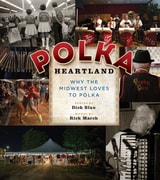
Polka Heartland
Why the Midwest Loves to PolkaRick March
Wisconsin Historical Society Press, 2015
"Polka Heartland" captures the beat that pulses in the heart of Midwestern culture--the polka--and offers up the fascinating history of how "oompah-pah" came to be the sound of middle America. From the crowded dance tent at Pulaski Polka Days to an off-the-grid Mexican polka dance in small-town Wisconsin, "Polka Heartland" explores the people, places, and history behind the Midwest's favorite music.
From polka's surprising origin story as a cutting-edge European fad to an exploration of the modern-day polka scene, author Rick March and photographer Dick Blau take readers on a joyful romp through this beloved, unique, and richly storied genre. "Polka Heartland" describes the artists, venues, instruments, and music-makers who have been pivotal to polka's popularity across the Midwest and offers six full-color photo galleries to immerse readers in today's vibrant polka scene.
Pop Song Piracy
Disobedient Music Distribution since 1929Barry Kernfeld
University of Chicago Press, 2011

Pop Song Piracy
Disobedient Music Distribution since 1929Barry Kernfeld
University of Chicago Press, 2011
Pop When the World Falls Apart
Music in the Shadow of DoubtEric Weisbard, ed.
Duke University Press, 2012
Drawn from presentations at the annual Experience Music Project Pop Conference—hailed by Robert Christgau as “the best thing that’s ever happened to serious consideration of pop music”—the essays in this book include inquiries into the sonic dimension of war in Iraq; the cultural life of jazz in post-Katrina New Orleans; Isaac Hayes’s reappropriation of a country song, “By the Time I Get to Phoenix,” as a symbol of black nationalism; and punk rock pranks played on record execs looking for the next big thing in central Virginia. Offering a diverse range of voices, perspectives, and approaches, this volume mirrors the eclecticism of pop itself.
Contributors: Larry Blumenfeld , Austin Bunn, Nate Chinen, J. Martin Daughtry, Brian Goedde, Michelle Habell-Pallán, Jonathan Lethem, Eric Lott, Kembrew McLeod, Elena Passarello, Diane Pecknold, David Ritz, Carlo Rotella, Scott Seward, Tom Smucker, Greg Tate, Karen Tongson, Alexandra T. Vazquez, Oliver Wang, Eric Weisbard, Carl Wilson

Popular Music Ethnographies
Practice, Place and IdentityEdited by Sarah Raine, Shane Blackman, Robert McPherson, and Iain A. Taylor
Intellect Books, 2025
This edited collection offers evocative ways into an international selection of popular music, from the Ecuadorian indie scene to Chinese rock. In exploring the experiences of musicians, fans, industry professionals, and academics, the rich complexity of popular music is brought to life through ethnography as an immersive approach to both undertaking and communicating research.
Experimenting with ethnography through the joys and tribulations of musical production, fandom, and scholarship, the contributors critically consider what it means to be a popular music ethnographer and what it means to take an ethnographic approach to studying popular music.
In addition to the critical essays, shorter vignettes are provided by musicians, venue owners, music writers, live music photographers, and fans. Altogether, the book explores the practices, places, and identities behind the music.
Popular Music in Leeds
Histories, Heritage, People and PlacesEdited by Brett Lashua, Karl Spracklen, and Kitty Ross
Intellect Books, 2023
This is the first scholarly volume to focus on popular music in Leeds. It delves into the rich musical history of Leeds and its long tradition of vibrant venues, nightclubs, dance halls, pubs, and other sites of musical entertainment. The contributors use the popular music of Leeds to exemplify and inform understandings of broader cultural and urban changes, the social and historical significance of music as mass media; music and migration; music, racialization, and social equity; and industrial decline, deindustrialization, neoliberalism, and the rise of the twenty-four-hour city. Charting moments of stark musical politicization and de-politicization, while also tracing arguments about heritagizing popular music within discussions about music’s place in museums and in the urban economy, this book contributes to debates about why music matters, has mattered, and continues to matter in Leeds and beyond.
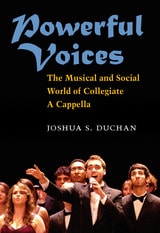
Powerful Voices
The Musical and Social World of Collegiate A CappellaJoshua S. Duchan
University of Michigan Press, 2016
Collegiate a cappella, part of a long tradition of unaccompanied singing, is known to date back on American college campuses to at least the colonial era. Considered in the context of college glee clubs, barbershop quartets, early-twentieth-century vocal pop groups, doo-wop groups, and contemporary a cappella manifestations in pop music, collegiate a cappella is an extension of a very old tradition of close harmony singing---one that includes but also goes beyond the founding of the Yale Whiffenpoofs. Yet despite this important history, collegiate a cappella has until now never been the subject of scholarly examination.
In Powerful Voices: The Musical and Social World of Collegiate A Cappella, Joshua S. Duchan offers the first thorough accounting of the music's history and reveals how the critical issues of sociability, gender, performance, and technology affect its music and experience. Just as importantly, Duchan provides a vital contribution to music scholarship more broadly, in several important ways: by expanding the small body of literature on choruses and amateur music; by addressing musical and social processes in a field where the vast majority of scholarship focuses on individuals and their products; and by highlighting a musical context long neglected by musicologists---the college campus. Ultimately, Powerful Voices is a window on a world of amateur music that has begun to expand its reach internationally, carrying this uniquely American musical form to new global audiences, while playing an important role in the social, cultural, and musical education of countless singers over the last century.

Prague Soundscapes
Zuzana Jurková
Karolinum Press, 2014
Prague Soundscapes seeks to understand why in human society—in its behavior, values, and relationships—music is produced and how those who make it listen to it. Based on recent theories of cultural anthropology, this study offers an account of the musical activities of contemporary Prague in different musical genres, cultural spaces, and events. The text is bolstered by color photographs of the musical events, producers, and listeners.
Pres
The Story of Lester YoungLuc Delannoy
University of Arkansas Press, 1993
Present Tense
Rock & Roll and CultureAnthony DeCurtis, ed.
Duke University Press, 1992
In this collection, Greil Marcus creates a collage of words and pictures that evokes and explores Elvis Presley's grisly fate as an American cultural image, while Robert Palmer tells the gripping tale of the origins and meanings of the electric guitar. Rap music, MTV, and the issue of gender identity in the work of Bruce Springsteen all undergo thorough examination; rock & roll's complex relationship with the forces of censorship gets a remarkably fresh reading; and the mainstreaming of rock & roll in the 1980s is detailed and analyzed. And, in an interview with Laurie Anderson and an essay by Atlanta musician Jeff Calder, the artists speak for themselves.
Contributors. Jeff Calder, Anthony DeCurtis, Mark Dery, Paul Evans, Glenn Gass, Trent Hill, Michael Jarrett, Alan Light, Greil Marcus, Robert Palmer, Robert B. Ray, Dan Rubey, David R. Shumway, Martha Nell Smith, Paul Smith
Pressing On
The Roni Stoneman StoryRoni Stoneman as told to Ellen Wright
University of Illinois Press, 2006
Drawn from more than seventy-five hours of recorded interviews, Pressing On reveals Roni's gifts as a master storyteller. With characteristic spunk and candor, she describes her "pooristic" ("way beyond 'poverty-stricken'") Appalachian childhood, and how her brother Scott taught her to play the challenging and innovative three-finger banjo picking style developed by Earl Scruggs. She also warmly recounts Hee Haw-era adventures with Minnie Pearl, Roy Clark, and Buck Owens; her encounters as a musician with country greats like Loretta Lynn, Johnny Cash, June Carter, and Patsy Cline; as well as her personal struggles with shiftless and violent husbands, her relationships with her children, and her musical life after Hee Haw.
Pretty Good for a Girl
Women in BluegrassMurphy Henry
University of Illinois Press, 2013
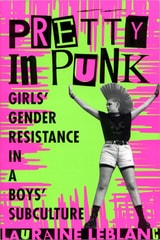
Pretty in Punk
Girl's Gender Resistance in a Boy's SubcultureLeblanc, Lauraine
Rutgers University Press, 1999
Pretty in Punk combines autobiography, interviews, and sophisticated analysis to create the first insider’s examination of the ways punk girls resist gender roles and create strong identities.
Why would an articulate, intelligent, thoughtful young women shave off most of her hair, dye the remainder green, shape it into a mohawk, and glue it onto her head? What attracts girls to male-dominated youth subcultures like the punk movement? What role does the subculture play in their perceptions of themselves, and in their self-esteem? How do girls reconcile a subcultural identity that is deliberately coded “masculine” with the demands of femininity?
Research has focused on the ways media and cultural messages victimize young women, but little attention has been paid to the ways they resist these messages. In Pretty in Punk, Lauraine Leblanc examines what happens when girls ignore these cultural messages, parody ideas of beauty, and refuse to play the games of teenage femininity. She explores the origins and development of the punk subculture, the processes by which girls decide to “go punk,” patterns of resistance to gender norms, and tactics girls use to deal with violence and harassment.
Pretty in Punk takes readers into the lives of girls living on the margins of contemporary culture. Drawing on interviews with 40 girls and women between the ages of 14-37, Leblanc examines the lives of her subjects, illuminating their forms of rebellion and survival. Pretty in Punk lets readers hear the voices of these women as they describe the ways their constructions of femininity—from black lipstick to slamdancing—allow them to reject damaging cultural messages and build strong identities. The price they pay for resisting femininity can be steep—girls tell of parental rejection, school expulsion, institutionalization, and harassment. Leblanc illuminates punk girls’ resistance to adversity, their triumphs over tough challenges, and their work to create individual identities in a masculine world.
Prince, Musical Genre, and the Construction of Racial Identity
Griffin Woodworth
University of Michigan Press, 2025
Each chapter includes detailed musical analyses and transcriptions of Prince’s songs, focusing on his use of rock guitar, new-wave synthesizers, funk drumming, gospel singing, and R&B horns. By tracking Prince’s transformations of instrumental and vocal idioms derived from specific musical genres, and considering the historical and cultural values embedded within those genres, Griffin Woodworth explores the ways that Prince musically broke down stereotypes of Black masculinity. With its intersectional approach to musical analysis, this book captures the sounds of American racial politics in the 1980s, 90s, and 2000s as heard through the music of one of the era’s most popular artists as he worked to transform and transcend those politics.

Prison Song
Music and Incarceration in the United StatesDavid Metzer
University of Michigan Press, 2026

Problem Solved!
The Music and Theater of The Negro ProblemStew Stewart and Heidi Rodewald, Edited and with an Introduction by Brandon Woolf
University of Michigan Press, 2027
Problem Solved! invites readers into the exhilarating, unpredictable artistic world of The Negro Problem, the genre-defying music and theater collective behind the Tony and Obie Award–winning Passing Strange. Blending previously unpublished song lyrics, playscripts, critical essays, intimate interviews, and performance texts, the collection charts more than three decades of daring experimentation across rock music, musical theater, avant-garde performance, and other interdisciplinary forms of social and artistic critique.
Equal parts archive, mixtape, and critical meditation, the book captures The Negro Problem’s unique ability to move between seriousness and satire, activism and irony, intellectual rigor and irresistible melody. In addition to theatrical texts written and composed by Stew Stewart and Heidi Rodewald, the volume features a contextual essay by historian Scott Kurashige, close readings of The Total Bent by performance studies scholar Tavia Nyong’o, dramaturgical analyses of Passing Strange by volume editor Brandon Woolf, and a long-form interview about the band’s origins from co-leader Heidi Rodewald. The volume explores how the band challenges conventional ideas about race, identity, authenticity, activism, and musical theater through humor, contradiction, experimentation, and joyful disruption. Problem Solved! invites general readers, music enthusiasts, scholars, and theater lovers alike to explore how song can boldly and beautifully rise to meet our fractious cultural moment.
Producing Excellence
The Making of VirtuososWagner, Izabela
Rutgers University Press, 2015
A musician and a parent of a young violinist, sociologist Izabela Wagner offers an inside look at how her young subjects set out on the long road to becoming a soloist. The remarkable research she conducted—at rehearsals, lessons, and in other educational settings—enabled her to gain deep insight into what distinguishes these talented prodigies and their training. She notes, for instance, the importance of a family culture steeped in the values of the musical world. Indeed, more than half of these students come from a family of professional musicians and were raised in an atmosphere marked by the importance of instrumental practice, the vitality of music as a vocation, and especially the veneration of famous artists. Wagner also highlights the highly structured, rigorous training system of identifying, nurturing, and rewarding talent, even as she underscores the social, economic, and cultural factors that make success in this system possible.
Offering an intimate portrait of the students, their parents, and their instructors, Producing Excellence sheds new light on the development of exceptional musical talent, as well as draw much larger conclusions as to “producing prodigy” in other competition-prone areas, such as sports, sciences, the professions, and other arts. Wagner’s insights make this book valuable for academics interested in the study of occupations, and her clear, lively writing is perfect for general readers curious about the ins and outs of training to be a violin soloist.
Prophets of the Hood
Politics and Poetics in Hip HopImani Perry
Duke University Press, 2004
Perry offers detailed readings of the lyrics of many hip hop artists, including Ice Cube, Public Enemy, De La Soul, krs-One, OutKast, Sean “Puffy” Combs, Tupac Shakur, Lil’ Kim, Biggie Smalls, Nas, Method Man, and Lauryn Hill. She focuses on the cultural foundations of the music and on the form and narrative features of the songs—the call and response, the reliance on the break, the use of metaphor, and the recurring figures of the trickster and the outlaw. Perry also provides complex considerations of hip hop’s association with crime, violence, and misogyny. She shows that while its message may be disconcerting, rap often expresses brilliant insights about existence in a society mired in difficult racial and gender politics. Hip hop, she suggests, airs a much wider, more troubling range of black experience than was projected during the civil rights era. It provides a unique public space where the sacred and the profane impulses within African American culture unite.

Prosdocimo de' Beldomandi's Musica Plana and Musica Speculativa
Prosdocimo de Beldomandi. Translated by Jan Herlinger.
University of Illinois Press, 2007
Available in English for the first time, Prosdocimo's Tractatus plane musice (1412) and Tractatus musice speculative (1425) are exemplary texts for understanding the high sophistication of music theory in the early fifteenth century. Known for considering music as a science based on demonstrable mathematical principles, Prosdocimo praises Marchetto for his theory of plainchant but criticizes his influential Lucidarium for its heterodox mathematics. In dismissing Marchetto as a “mere performer,” Prosdocimo takes up matters as broad as the nature and definition of music and as precise as counterpoint, tuning, and ecclesiastical modes. The treatises also reveal much about Prosdocimo’s understanding of plainchant; his work with Euclid's Elementa; and his familiarity with the music theory of Boethius, Macrobius, and Johannes de Muris. A foremost authority on Italian music theory of the Middle Ages and early Renaissance, Jan Herlinger consults manuscripts from Bologna, Cremona, and Lucca in preparing these valuable first critical editions.
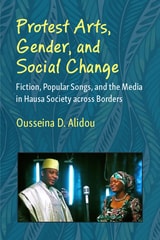
Protest Arts, Gender, and Social Change
Fiction, Popular Songs, and the Media in Hausa Society across BordersOusseina D. Alidou
University of Michigan Press, 2024
While there is an abundance of social science studies giving voice to the dominant actors of hegemonic violence in Hausa society, there is a dearth of works that center the voices of the afflicted, unprivileged, and marginalized class, among whom are women and youth. One aim of this book is to examine the ways popular songs and fiction fill up the humanistic urgency to capture the dignity of the life of those dehumanized by local, national, and international hegemonic religious and secular forces. The book focuses on the resistance narratives of one female novelist and six song composers and performers that generate alternative counterhegemonic responses to dominant patriarchal discourses produced by cultural, religious, and political elites, thus reaching out to marginalized local and national communities and global audiences. Alidou interweaves the social, political, and biomedical epidemics with the concept of “Hausa interiority” to create a unique perspective on contemporary Hausa culture and politics through the lens of artistic productions.

Psychobilly
Subcultural SurvivalKimberly Kattari
Temple University Press, 2020
“I got 1-2-3-4 psychobilly DNA”—Norm and the Nightmarez
Call it punk rockabilly with science-fiction horror lyrics. The outsider musical genre known as psychobilly, which began in 1980s Britain, fuses punk, heavy metal, new wave, and shock rock with carnivalesque elements. The participants in this underground scene sport coffin tattoos and 1950s fashions. Bands such as The Meteors, Nekromantix, and Demented Are Go play with a wild energy and a fast tempo. Sometimes fake blood runs down a performer’s mouth.
Psychobilly is ethnomusicologist Kimberly Kattari’s fascinating, decade-long study of this little-known anti-mainstream genre. She provides a history and introduces readers to the core aspects of the music as she interviews passionate performers and fans. Kattari seeks to understand how psychobilly so strongly affects—and reflects—its participants’ lives and identities so strongly. She observes that it provides not only a sense of belonging but a response to feelings and experiences of socio-economic marginalization and stigmatization.
Psychobilly shows how this subculture organized around music furnishes an outlet for members to resist normative expectations and survive; they adhere to their own rules by having a good time while going through a hard time.
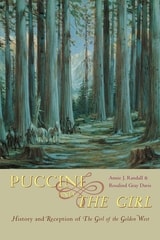
Puccini and The Girl
History and Reception of The Girl of the Golden WestAnnie J. Randall and Rosalind Gray Davis
University of Chicago Press, 2004
Adapted from American playwright David Belasco's Broadway production, The Girl of the Golden West, Fanciulla was Puccini's most consciously modern work, and its Met debut received mixed reviews. Annie J. Randall and Rosalind Gray Davis base their account of its creation on previously unknown letters from Puccini to his main librettist, Carlo Zangarini. They mine musical materials, newspaper accounts, and rare photographs and illustrations to tell the full story of this controversial opera. Puccini and the Girl considers the production and reception of Puccini's "cowboy" opera in the light of contemporary criticism, providing both fascinating insight into its history and a look to the future as its centenary approaches.

Puccini
His International ArtMichele Girardi
University of Chicago Press, 2000
Punk Identities, Punk Utopias
Global Punk and MediaEdited by Russ Bestley, Mike Dines, Matt Grimes, Paula Guerra
Intellect Books, 2021
Punk Identities, Punk Utopias unpacks punk and the factors that shape its increasingly complex and indefinable social, political, and economic setting. The third offering in Intellect’s Global Punk series, produced in collaboration with the Punk Scholars Network, this volume examines the broader social, political, and technological concerns that affect punk scenes around the world, from digital technology and new media to gender, ethnicity, identity, and representation.
Drawing on scholarship in cultural studies, musicology, and social sciences, this interdisciplinary collection will add to the academic discussion of contemporary popular culture, particularly in relation to punk and the critical understanding of transnational and cross-cultural dialogue.
Punk Now!!
Contemporary Perspectives on PunkEdited by Matt Grimes and Mike Dines
Intellect Books, 2020
Punk and Revolution
Seven More Interpretations of Peruvian RealityShane Greene
Duke University Press, 2016

Punks in Peoria
Making a Scene in the American HeartlandJonathan Wright and Dawson Barrett
University of Illinois Press, 2021
Synonymous with American mediocrity, Peoria was fertile ground for the boredom- and anger-fueled fury of punk rock. Jonathan Wright and Dawson Barrett explore the do-it-yourself scene built by Peoria punks, performers, and scenesters in the 1980s and 1990s. From fanzines to indie record shops to renting the VFW hall for an all-ages show, Peoria's punk culture reflected the movement elsewhere, but the city's conservatism and industrial decline offered a richer-than-usual target environment for rebellion. Eyewitness accounts take readers into hangouts and long-lost venues, while interviews with the people who were there trace the ever-changing scene and varied fortunes of local legends like Caustic Defiance, Dollface, and Planes Mistaken for Stars. What emerges is a sympathetic portrait of a youth culture in search of entertainment but just as hungry for community—the shared sense of otherness that, even for one night only, could unite outsiders and discontents under the banner of music.
A raucous look at a small-city underground, Punks in Peoria takes readers off the beaten track to reveal the punk rock life as lived in Anytown, U.S.A.
Pynchon’s Sound of Music
Christian Hänggi
Diaphanes, 2020