Results by title
1148 books match the query 'Political Ideologies' and 59 start with p
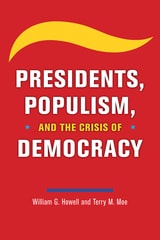
Presidents, Populism, and the Crisis of Democracy
William G. Howell and Terry M. Moe
University of Chicago Press, 2020
The most visible cause is Donald Trump, who has used his presidency to attack the nation’s institutions and violate its democratic norms. Yet Trump is but a symptom of causes that run much deeper: social forces like globalization, automation, and immigration that for decades have generated economic harms and cultural anxieties that our government has been wholly ineffective at addressing. Millions of Americans have grown angry and disaffected, and populist appeals have found a receptive audience. These are the drivers of Trump’s dangerous presidency. And after he leaves office, they will still be there for other populists to weaponize.
What can be done to safeguard American democracy? The disruptive forces of modernity cannot be stopped. The solution lies, instead, in having a government that can deal with them—which calls for aggressive new policies, but also for institutional reforms that enhance its capacity for effective action.
The path to progress is filled with political obstacles, including an increasingly populist, anti-government Republican Party. It is hard to be optimistic. But if the challenge is to be met, we need reforms of the presidency itself—reforms that harness the promise of presidential power for effective government, but firmly protect against the fear that it may be put to anti-democratic ends.

Pride, Not Prejudice
National Identity as a Pacifying Force in East AsiaEunbin Chung
University of Michigan Press, 2022
As shown by China’s relationship to Japan, and Japan’s relationship to South Korea, even growing regional economic interdependencies are not enough to overcome bitter memories grounded in earlier wars, invasions, and periods of colonial domination. Although efforts to ease historical animosity have been made, few have proven to be successful in Northeast Asia. In previous research scholars anticipated an improvement in relations through thick economic interdependence or increased societal contact. In economic terms, however, Japan and China already trade heavily: Japan has emerged as China’s largest trading partner and China as second largest to Japan. Societal contact is already intense, as millions of Chinese, Koreans, and Japanese visit one another’s countries annually as students, tourists, and on business trips. But these developments have not alleviated international distrust and negative perception, or resolved disagreement on what constitutes “adequate reparation” regarding the countries’ painful history.
Noticing clashes of strong nationalisms around the world in areas like Northeast Asia, numerous studies have suggested that more peaceful relations are likely only if countries submerge or paper over existing national identities by promoting universalism. Pride, Not Prejudice argues, to the contrary, that affirmation of national identities may be a more effective way to build international cooperation. If each national population reflects on the values of their national identity, trust and positive perception can increase between countries. This idea is consistent with the theoretical foundation that those who have a clear, secure, and content sense of self, in turn, can be more open, evenhanded, and less defensive toward others. In addition, this reduced defensiveness also enhances guilt admission by past “inflictors” of conflict and colonialism. Eunbin Chung borrows the social psychological theory of self-affirmation and applies it to an international context to argue that affirmation of a national identity, or reflecting on what it means to be part of one’s country, can increase trust, guilt recognition, and positive perception between countries.

Prison Letters
Antonio Gramsci
Pluto Press, 1997
Antonio Gramsci is one of the great European Marxists, hailed by Eric Hobsbawm as 'an extraordinary philosopher ... probably the most original communist thinker of twentieth-century Europe'.
Gramsci developed Marx's ideas with an emphasis on culture rather than economics. This classic work reveals his thinking through letters to friends and family written whilst he was in prison.
His primary contribution has been in his insistence on an understanding of popular culture in the battle to create a revolutionary consciousness. It is this humanitarian aspect of his thinking that illuminates the vivid personal testimony of his prison letters, written between 1926 and 1937.
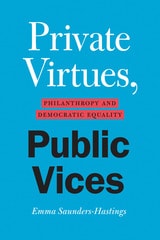
Private Virtues, Public Vices
Philanthropy and Democratic EqualityEmma Saunders-Hastings
University of Chicago Press, 2022
Philanthropy plays a huge role in supporting the provision of many public goods in contemporary societies. As a result, decisions that affect public outcomes and people’s diverse interests are often dependent on the preferences and judgments of the rich. Political theorist Emma Saunders-Hastings argues that philanthropy is a deeply political activity. She asks readers to look at how the power wielded by philanthropy impacts democracy and deepens political inequality by enabling the wealthy to exercise outsize influence in public life and by putting in place paternalistic relationships between donors and their intended beneficiaries. If philanthropy is to be made compatible with a democratic society of equals, it must be judged not simply on the benefits it brings but on its wider political consequences. Timely and thought-provoking, Private Virtues, Public Vices will challenge readers’ thoughts on what philanthropy is and how it truly affects us.
Privatization in Eastern Europe
Is the State Withering Away?Roman Frydman
Central European University Press, 1994
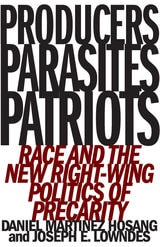
Producers, Parasites, Patriots
Race and the New Right-Wing Politics of PrecarityDaniel Martinez HoSang
University of Minnesota Press, 2019
The shifting meaning of race and class in the age of Trump
The profound concentration of economic power in the United States in recent decades has produced surprising new forms of racialization. In Producers, Parasites, Patriots, Daniel Martinez HoSang and Joseph E. Lowndes show that while racial subordination is an enduring feature of U.S. political history, it continually changes in response to shifting economic and political conditions, interests, and structures.
The authors document the changing politics of race and class in the age of Trump across a broad range of phenomena, showing how new forms of racialization work to alter the economic protections of whiteness while promoting some conservatives of color as models of the neoliberal regime. Through careful analyses of diverse political sites and conflicts—racially charged elections, attacks on public-sector unions, new forms of white precarity, the rise of black and brown political elites, militia uprisings, multiculturalism on the far right—they highlight new, interwoven deployments of race in the ascendant age of inequality. Using the concept of “racial transposition,” the authors demonstrate how racial meanings and signification can be transferred from one group to another to shore up both neoliberalism and racial hierarchy.
From the militia movement to the Alt-Right to the mainstream Republican Party, Producers, Parasites, Patriots brings to light the changing role of race in right-wing politics.

Prometheus Wired
The Hope for Democracy in the Age of Network TechnologyDarin Barney
University of Chicago Press, 2000
In Prometheus Wired, Darin Barney debunks claims that a networked society will provide the infrastructure for a political revolution and shows that the resources we need for understanding and making sound judgments about this new technology are surprisingly close at hand. By looking to thinkers who grappled with the relationship of society and technology, such as Plato, Aristotle, Marx, and Heidegger, Barney critically examines such assertions about the character of digital networks.
Along the way, Barney offers an eye-opening history of digital networks and then explores a wide range of contemporary issues, such as electronic commerce, telecommuting, privacy, virtual community, digital surveillance, and the possibility of sovereign governance in an age of global networks. Ultimately, Barney argues that instead of placing power back in the hands of the public, a networked economy seems to exacerbate the worst features of industrial capitalism, and, in terms of the surveillance and control it exerts, reduces our political freedom.
Of vital interest to politicians, communicators, and anyone concerned about the future of democracy in the digital age, Prometheus Wired adds a provocative new voice to the debate swirling around "the Net" and the ways in which it will, or will not, change our political lives.
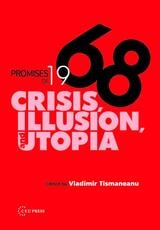
Promises of 1968
Crisis, Illusion and UtopiaVladimir Tismaneanu
Central European University Press, 2011

Protestantism and Politics in Eastern Europe and Russia
The Communist and Post-Communist ErasSabrina P. Ramet, ed.
Duke University Press, 1993
Based on extensive field research, including interviews with notable figures in the Protestant churches in the region, the essays in this volume address broad topics such as the church's involvment in environmentalism, pacifism, and other dissident movements, as well as issues particular to Russia, Poland, Czechoslovakia, East Germany, (1949–1989), Hungary, Yugoslavia (1945-1991), Bulgaria, and Romania. The final volume in the three-volume work "Christianity Under Stress," Protestantism and Politics in Eastern Europe and Russia will prove invaluable to anyone hoping to understand not only the workings of religion under Communism, but the historical and contemporary interactions of church and state in general.
Contributors. Paul Bock, Lawrence Klippenstein, Paul Mojzes, Earl A. Pope, Joseph Pungur, Sabrina Petra Ramet, Walter Sawatsky, N. Gerald Shenk, Gerd Stricker, Sape A. Zylstra