Results by title
704 books match the query 'Political Process' and 80 start with p

Popular Resistance in Palestine
A History of Hope and EmpowermentMazin B. Qumsiyeh
Pluto Press, 2011
The book contains hundreds of stories of the heroic and highly innovative methods of resistance employed by the Palestinians over more than 100 years. The author also analyses the successes, failures, missed opportunities and challenges facing ordinary Palestinians as they struggle for freedom against incredible odds. This is the only book to critically and comparatively study the uprisings of 1920-21, 1929, 1936-9, 1970s, 1987-1991 and 2000-2006.
The compelling human stories told in this book will inspire people of all faiths and political backgrounds to chart a better and more informed direction for a future of peace with justice.

Populism in Latin America
Michael L. Conniff
University of Alabama Press, 1999
Populism in Latin America provides a lively, accessible, and up-to- date introduction to the fascinating populist leaders who dominated much of 20th-century Latin American politics.
From the earliest years in the La Plata region to the end of the 1990s, Latin American populists proved amazingly successful at gaining high office, holding onto power, maintaining their followings, and renewing their careers. They raised more campaign money, got more voters to the polls, and held followers' allegiances far better than traditional politicians. Certainly some populist leaders corrupted their countries, others manipulated their followers, and still others disgraced themselves. Nevertheless, populist leaders were extraordinarily effective in reaching masses of voters, and some left positive legacies for future generations. Populism in Latin America provides an in-depth and thought-provoking assessment of the most prominent of these colorful and charismatic leaders, whose impact has been profound yet not fully recognized.
Latin American scholars here survey the populist experiences in those nations most profoundly influenced by this distinctively Latin American way of conducting the public's business--Argentina, Brazil, Chile, Mexico, Peru, Venezuela, Ecuador, and Panama. Joel Horowitz, for example, examines Argentina's strong legacy of populism, beginning with the remarkable Hip-lito Yrigoyen, moving through the archetypal Juan and Evita Perón, and ending with still-active president Carlos Menem. Ximena Sosa-Buchholz provides a fascinating view of populism in Ecuador, a country often overlooked by students of modern politics. Kurt Weyland challenges the notion that neoliberal, or monetarist, economic policies are incompatible with populism. Other populist leaders profiled include Lazaro Cardenas, Romulo Betancourt, and Alberto Fujimori to name a few.
In his epilogue and bibliographic essay, volume editor Michael Conniff suggests new directions for further research and offers a comprehensive survey of the evolution of major writings, theories, and methodologies in the field.
Populist Seduction in Latin America
The Ecuadorian ExperienceCarlos De La Torre
Ohio University Press, 2000
earlier work up to date, comparing classical nationalist, populist regimes of the 1940s, such as those of Juan Perón and José María Velasco Ibarra, with their contemporary neoliberal and radical successors. De la Torre explores their similarities and differences, focusing on their discourses and uses of political symbols and myths.
Post-Communism
An IntroductionLeslie Holmes
Duke University Press, 1997

Post-Communism
An IntroductionLeslie Holmes
Duke University Press, 0

Post-Ethical Society
The Iraq War, Abu Ghraib, and the Moral Failure of the SecularDouglas V. Porpora, Alexander G. Nikolaev, Julia Hagemann May, and Alexander Jenkins
University of Chicago Press, 2013
In this singular examination of the American discourse over war and torture, Douglas V. Porpora, Alexander Nikolaev, Julia Hagemann May, and Alexander Jenkins investigate the opinion pages of American newspapers, television commentary, and online discussion groups to offer the first empirical study of the national conversation about the 2003 invasion of Iraq and the revelations of prisoner abuse at Abu Ghraib a year later. Post-Ethical Society is not just another shot fired in the ongoing culture war between conservatives and liberals, but a pensive and ethically engaged reflection of America’s feelings about itself and our actions as a nation. And while many writers and commentators have opined about our moral place in the world, the vast amount of empirical data amassed in Post-Ethical Society sets it apart—and makes its findings that much more damning.
Post-World War One Plebiscites and Their Legacies
Exploring the Right of Self-DeterminationSergiusz Bober
Central European University Press, 2024
Plebiscites, or referendums, are epitomes of direct democracy and the right of self-determination. While direct democracy has always been a key subject in the theory and practice of western liberal democracies, the issue of self-determination has been propelled to the fore by the hegemonistic moves of Russia. By providing a historical analysis of the post-World War One plebiscites, this book deals with enduring, painfully contemporary, and in in any case fundamental, concepts.
The contributors to this edited volume approach the referendums comparatively. After grounding the analysis theoretically, the authors look at detailed aspects of individual cases, with the two plebiscites held in the Danish-German border region of Schleswig in the winter of 1920 as points of departure. They then extend the exploration through the inter-war period and address the effects of border delimitations on everyday life or gender roles in the context of ethnic mobilization. Finally, the book places the post-World War One plebiscites in a long-term perspective. The concluding essays assess, among others, the applicability of plebiscitary solutions to contemporary conflicts, taking into consideration issues of borders, religion, language, identity, and minority rights.
Posting for Power
Congressional Partisanship on Social MediaJeremy Gelman and Steven Lloyd Wilson
University of Michigan Press, 2026
In the US Congress, lawmakers regularly choose to bicker for political gain, whether or not they disagree on issues. By classifying millions of social media posts as partisan or not, Gelman and Wilson quantify a legislator’s partisan intensity through the time and effort they spend supporting their party and bickering with the opposition. The authors argue that the partisan personas politicians create are both a home style, to help them win reelection, and hill style, to help them become politically influential by showing off as good team players. Bringing together a wide range of data on leadership races, elections, voting records, cosponsorship patterns, and lawmaking outcomes, they demonstrate the nearly consequence-free way that legislators strategically deploy partisanship to impress their copartisans and voters. Gelman and Wilson closely examine what motivates members to differ so much in developing this part of their public personas and offer clear recommendations for how to turn down the partisan heat on Capitol Hill.
Power to the Partners
Organizational Coalitions in Social Justice AdvocacyMaraam A. Dwidar
University of Chicago Press, 2025
A vital examination of how social and economic justice organizations overcome resource disadvantages and build political power.
Why do some coalitions triumph while others fall short? In Power to the Partners, Maraam A. Dwidar documents the vital role of social and economic justice organizations in American politics and explores the process by which they strategically build partnerships to advance more effective and equitable advocacy. Using original data tracking the collaboration patterns of more than twenty thousand nationally active advocacy organizations, Dwidar evaluates the micro- and macro-level conditions surrounding these groups’ successful efforts to collectively shape public policy.
Power to the Partners reveals that while organizational advocates for social and economic justice are at a disadvantage in the American lobbying landscape—financially, tactically, and politically—coalition work can help ameliorate these disparities. By building and sustaining coalitions with structures and memberships that facilitate clarity, learning, and diverse perspectives, these advocates can successfully—and uniquely—make their mark on American public policy. Dwidar’s work offers critical insights for scholars and practitioners alike, from groundbreaking academic findings to evidence-based lessons for political organizers.
Power, Patronage, and the Local State in Ghana
Barry Driscoll
Ohio University Press, 2023
Practical Anarchism
A Guide for Daily LifeScott Branson
Pluto Press, 2022
You may not realise it, but you are probably already practicing anarchism in your daily life. From relationships to school, work, art, even the way you organise your time, anarchism can help you find fulfilment, empathy and liberation in the everyday.
From the small questions such as 'Why should I steal?' to the big ones like 'how do I love?', Scott Branson shows that anarchism isn’t only something we do when we react to the news, protest or even riot. With practical examples enriched by history and theory, these tips will empower you to break free from the consumerist trappings of our world.
Anarchism is not just for white men, but for everyone. In reading this book, you can detach from patriarchal masculinity, norms of family, gender, sexuality, racialisation, individual responsibility and the destruction of our planet, and replace them with ideas of sustainable living, with ties of mutual aid, and the horizon of collective liberation.

Practicing Electoral Assistance
A Critical EthnographyEva Johais
University of Michigan Press, 2027
Electoral assistance is the prototypical tool to promote democracy and the related goals of peace and development. Rather than assessing whether this tool achieves its intentions, Practicing Electoral Assistance explains how international support for election processes has become normal practice. For this practice-theoretical approach to world politics, Eva Johais combines theories and methods from anthropology, international relations, political science, and sociology. Based on multisited ethnographic fieldwork, she presents detailed empirical knowledge of the relevant institutions, organizations, actors, and actions. Practicing Electoral Assistance takes readers to hotel rooftops, embassies, government buildings, and offices in Abidjan (Côte d’Ivoire), Addis Ababa (Ethiopia), Conakry (Guinea), and to the United Nations headquarters in New York. Through this journey, readers come to understand that electoral assistance means different things: it is a mission for democracy promoters, an intervention tool for peacebuilders, a work for election experts, and a business line for managers of development organizations. While the practice is anchored in the aid system, it has gained independence from the system’s structural constraints through the professionalization of election administration and the establishment of the transnational election profession.
Pre-Election Polling
Sources of Accuracy and ErrorIrving Crespi
Russell Sage Foundation, 1988
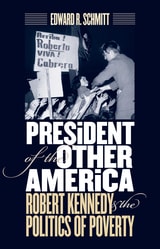
President of the Other America
Robert Kennedy and the Politics of PovertyEdward R. Schmitt
University of Massachusetts Press, 2010
Robert Kennedy's abbreviated run for the presidency in 1968 has assumed almost mythical proportions in American memory. His campaign has been romanticized because of its tragic end, but also because of the foreign and domestic crises that surrounded it. Yet while most media coverage initially focused on Kennedy's opposition to the Vietnam War as the catalyst of his candidacy, another issue commanded just as much of his attention. That issue was poverty. Stumping across the country, he repeated the same antipoverty themes before college students in Kansas and Indiana, loggers and women factory workers in Oregon, farmers in Nebraska, and business groups in New York. Although his calls to action sometimes met with apathy, he refused to modify his message. “If they don't care,” he told one aide, “the hell with them.”
As Edward R. Schmitt demonstrates, Kennedy's concern with the problem of poverty was not new. Although critics at the time accused him of opportunistically veering left in order to outflank an unpopular president, a closer look at the historical record reveals a steady evolution rather than a dramatic shift in his politics.
Presidential Campaigns and Presidential Accountability
Michele P. Claibourn
University of Illinois Press, 2011
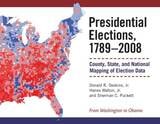
Presidential Elections, 1789-2008
County, State, and National Mapping of Election DataDonald R. Deskins, Jr., Hanes Walton, Jr., and Sherman C. Puckett
University of Michigan Press, 2010
"Hanes Walton, Donald Deskins, and Sherman Puckett have produced a highly impressive collection and valuable contribution to the literature on American electoral politics. This work is indispensable for academic libraries, political scientists, historians, and serious students of American government."
---Immanuel Ness, Professor, Department of Political Science, Brooklyn College, City University of New York
"Massive amounts of information about presidential elections which are not readily available elsewhere. Unprecedented coverage in one volume of every single American presidential election."
---James Gimpel, Professor of Government, University of Maryland
"This is an extraordinary research endeavor; the most comprehensive set of aggregate election data ever assembled. Painstakingly researched, this color-coded volume presents data for every presidential election from 1789 to 2008. Unlike most, the wide ranging narrative for this atlas identifies racial patterns in the vote. Everyone who studies or is interested in presidential elections should have this impressive collection of statistical data in their libraries. A visual gem for the digital age."
---Robert Smith, Professor of Political Science, San Francisco State University
"Presidential Elections, 1789-2008 is a genuine tour de force that captures in an extremely accessible and comprehensive way the electoral geography of America's presidential elections, from Washington to Obama. An invaluable addition to the library of all those interested in presidential elections and U.S. politics."
---Marion Orr, Frederick Lippitt Professor of Public Policy and Professor of Political Science, Brown University
"This volume sets an extraordinarily high standard in scholarship, completeness, description, and explanation of our political process. It has been said that all politics are local, but never before has this been demonstrated with such clarity and panache, using the simple method of standardized tables summarizing voting, then showing state and county breakdowns of the numbers, greatly strengthened by beautiful full-color maps and cartograms. Every scholar of politics and democracy will benefit from the work laid out in this volume."
---Keith Clarke, Professor of Geography, University of California, Santa Barbara
Presidential Elections is an almanac of the popular vote in every presidential election in American history, analyzed at the county level with histories of each campaign, graphs, and stunning four-color maps. Most Americans are familiar with the crude red state/blue state maps used by commentators and campaign strategists---and even, for want of an alternative, by many academics. In providing a higher-resolution view of voting behavior the authors of this new volume enable examination of local and regional political trends that are invisible in state-level aggregations.
Presidential Elections will enable scholars to more subtly analyze voting behavior, campaigns, and presidential politics; commentators will use it to analyze trends and trace the historical evolution of new coalitions and voting blocs; strategists will use it to plan campaigns and mobilize constituencies. Presidential Elections will become the standard almanac on the subject: a required resource for academic and public libraries, as well as for scholars, consultants, and pundits nationwide.
Donald R. Deskins, Jr., is a political geographer and Emeritus Professor of Sociology and a former Associate Dean of the Horace H. Rackham School of Graduate Studies at the University of Michigan.
Hanes Walton, Jr., is Professor of Political Science at the University of Michigan. He also holds positions as Senior Research Scientist at the Center for Political Studies and as a faculty member in the Center for Afroamerican and African Studies.
Presidential Mandates
How Elections Shape the National AgendaPatricia Heidotting Conley
University of Chicago Press, 2001
Presidents claim mandates, Conley shows, only when they can mobilize voters and members of Congress to make a major policy change: the margin of victory, the voting behavior of specific groups, and the composition of Congress all affect their decisions. Using data on elections since 1828 and case studies from Truman to Clinton, she demonstrates that it is possible to accurately predict which presidents will ask for major policy changes at the start of their term. Ultimately, she provides a new understanding of the concept of mandates by changing how we think about the relationship between elections and policy-making.
Presidential Responsiveness and Public Policy-Making
The Publics and the Policies that Presidents ChooseJeffrey E. Cohen
University of Michigan Press, 1999
We expect a president to respond to public opinion as an elected official in a democracy. Indeed, the president needs public support to overcome opposition to his policies in Congress and the bureaucracy. At the same time the president may want to pursue policies that do not have widespread support. How does public opinion affect presidential policy making? Jeffrey Cohen finds that presidents are responsive to the public in selecting issues to focus on. If an issue has captured the interest of the people, then the president will focus on that issue. Cohen finds that having chosen to work on an issue, presidents pay less attention to public opinion when making a policy. The president will try to maintain control over the details of the policy so that the outcome fits his policy agenda. Cohen examines the way presidents from Eisenhower through Clinton have dealt with public opinion in policy making. He uses case studies of issues such as Clinton and gays in the military, Bush and the extension of unemployment benefits, and Kennedy and cutting the income tax, to explore the relationship between presidents and public opinion. In addition Cohen uses a quantitative analysis of State of the Union addresses and positions on roll call votes of presidents from Eisenhower through George Bush to test his theories. This book should appeal to political scientists and historians interested in the presidency and in public opinion, as well as general readers interested in the history of the American presidency.

Presidential Selection
Alexander Heard and Michael Nelson, eds.
Duke University Press, 1987
What are the international implications of how the Unites States chooses its presidents? How does the process affect other nations? Does it enhance or diminish the ability of the United States to deal effectively with the rest of the world?
How do the changing characteristics of the the presidential selection process affect the shaping of public policies, and vice versa? For example, how have changes in citizen participation, campaign technologies, and campaign finance laws altered the balance of political power among institutions and interests?
What is the influence of the Constitution on presidential selection, as in the prescribed qualifications for the office and in provisions for unusual circumstances?
Presidents Creating the Presidency
Deeds Done in WordsKarlyn Kohrs Campbell and Kathleen Hall Jamieson
University of Chicago Press, 2008
Identifying the primary genres of presidential oratory, Campbell and Jamieson add new analyses of signing statements and national eulogies to their explorations of inaugural addresses, veto messages, and war rhetoric, among other types. They explain that in some of these genres, such as farewell addresses intended to leave an individual legacy, the president acts alone; in others, such as State of the Union speeches that urge a legislative agenda, the executive solicits reaction from the other branches. Updating their coverage through the current administration, the authors contend that many of these rhetorical acts extend over time: George W. Bush’s post-September 11 statements, for example, culminated in a speech at the National Cathedral and became a touchstone for his subsequent address to Congress.
For two centuries, presidential discourse has both succeeded brilliantly and failed miserably at satisfying the demands of audience, occasion, and institution—and in the process, it has increased and depleted political capital by enhancing presidential authority or ceding it to the other branches. Illuminating the reasons behind each outcome, Campbell and Jamieson draw an authoritative picture of how presidents have used rhetoric to shape the presidency—and how they continue to re-create it.
Presidents and Parties in the Public Mind
Gary C. Jacobson
University of Chicago Press, 2019
With Presidents and Parties in the Public Mind, Gary C. Jacobson draws on survey data from the past seven administrations to show that the expansion of the executive branch in the twentieth century that gave presidents a greater role in national government also gave them an enlarged public presence, magnifying their role as the parties’ public voice and face. As American politics has become increasingly nationalized and president-centered over the past few decades, the president’s responsibility for the party’s image and status has continued to increase dramatically. Jacobson concludes by looking at the most recent presidents’ effects on our growing partisan polarization, analyzing Obama’s contribution to this process and speculating about Trump’s potential for amplifying the widening demographic and cultural divide.
Prisms of the People
Power & Organizing in Twenty-First-Century AmericaHahrie Han, Elizabeth McKenna, and Michelle Oyakawa
University of Chicago Press, 2021
Prisms of the People addresses those questions and more. Using data from six movement organizations—including a coalition that organized a 104-day protest in Phoenix in 2010 and another that helped restore voting rights to the formerly incarcerated in Virginia—Hahrie Han, Elizabeth McKenna, and Michelle Oyakawa show that the power of successful movements most often is rooted in their ability to act as “prisms of the people,” turning participation into political power just as prisms transform white light into rainbows. Understanding the organizational design choices that shape the people, their leaders, and their strategies can help us understand how grassroots groups achieve their goals.
Linking strong scholarship to a deep understanding of the needs and outlook of activists, Prisms of the People is the perfect book for our moment—for understanding what’s happening and propelling it forward.

Private Life, Public Action
How Housing Politics Mobilized Citizens in MoscowAnna Zhelnina
Temple University Press, 2026
Private Life, Public Action traces how residents impacted by the relocation plan became activists despite having little to no experience organizing or even forming political affiliations and opinions. Author Anna Zhelnina details the ways in which neighbors engaged in collective action, as well as the individual and structural changes these interactions caused.
Zhelnina develops the concept of “housing strategies” to explain how residents’ debates with their neighbors about housing were shaped by their private life strategies. She applies her findings about housing in Moscow to ongoing questions about political mobilization, demonstrating how public engagement is shaped by historical and social contexts.
Examining the intersection of housing, politics, and citizenship in contemporary Russia, Private Life, Public Action offers a new way to look at urban change.
In the series Politics, History, and Social Change
Processing Politics
Learning from Television in the Internet AgeDoris A. Graber
University of Chicago Press, 2001
More and more people rely on information from television and the Internet to make important decisions. Processing Politics offers a sound, well-researched defense of these remarkably versatile media, and challenges us to make them work for us in our democracy.
Public Financing in American Elections
Edited by Costas Panagopoulos
Temple University Press, 2011
Reformers argue that public financing of campaigns will help rescue American democracy from the corruptive influence of money in elections. Public Financing in American Elections evaluates this claim and aims to remove much of the guesswork from the discussion about public finance.
Featuring some of the most senior scholars in political science and electoral studies, this book provides an up-to-date treatment of campaign finance research and thinking about public campaign financing reforms. Exploring proposals at the local, state, and federal levels, the contributors provide a comprehensive overview of public financing initiatives in the United States and discuss their impact. Focused analyses of several current public programs are also presented.
Public Interests
Media Advocacy and Struggles over U.S. TelevisionPerlman, Allison
Rutgers University Press, 2016
Nearly as soon as television began to enter American homes in the late 1940s, social activists recognized that it was a powerful tool for shaping the nation’s views. By targeting broadcast regulations and laws, both liberal and conservative activist groups have sought to influence what America sees on the small screen. Public Interests describes the impressive battles that these media activists fought and charts how they tried to change the face of American television.
Public Modalities
Edited by Daniel C. Brouwer and Robert Asen
University of Alabama Press, 2010
A bold rethinking of public discourse, Public Modalities explores how people shape civic life through protest, media, and identity in an ever-evolving public sphere.
This book explores the ways that scholars, journalists, politicians, and citizens conceive of “the public” or “public life,” and how those entities are defined and invented. For decades, scholars have used the metaphors of spheres, systems, webs, or networks to talk about, describe, and map various practices. This volume proposes a new metaphor—modalities—to suggest that publics are forever in flux, and much more fluid and dynamic than the static models of systems or spheres would indicate—especially in the digital age, where various publics rapidly evolve and dissipate.
Contributors to the volume—employing approaches from the fields of communication studies, English, sociology, psychology, and history—explore a broad range of texts and artifacts that give rise to publics, and discuss what they reveal about conceptualizations of social space. By focusing on process in public engagement, these scholars highlight questions of how people advance their interests and identities, and how they adapt to situational constraints.
Bringing together scholars in rhetorical, cultural, and media studies, this collection of new case studies illustrates a modalities approach to the study of publics. These case studies explore the implications of different ways of forming publics, including alternative means of expression (protests, culture jamming); the intersection of politics and consumerism (how people express their identities and interests through their consumer behavior); and online engagement (blogs as increasingly important public fora). In doing so, they raise important questions of access, community, and political efficacy
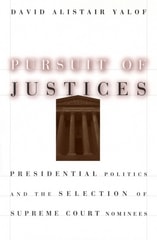
Pursuit of Justices
Presidential Politics and the Selection of Supreme Court NomineesDavid Alistair Yalof
University of Chicago Press, 1999
Yalof draws on the papers of seven modern presidents, from Truman to Reagan, and firsthand interviews with key figures, such as Ramsey Clark, Edwin Meese, and President Gerald Ford. He documents and analyzes the selection criteria these presidents used, the pool of candidates from which they chose, their strategies, and the political pressures affecting their decisions, both successes and failures. Yalof also disputes much conventional wisdom about the selection process, including the widely held view that presidents choose nominees primarily to influence future decisions of the high court. In a substantial epilogue, Yalof offers insightful observations about the selections of Presidents George Bush and Bill Clinton.
By focusing on a neglected area of presidential politics, Yalof offers a fascinating and unprecedented glimpse into the intricate world of executive branch decisionmaking and the Supreme Court appointment process as a whole.
Winner of the 2000 Richard E. Neustadt Award for Best Book on the American Presidency
Push Back, Move Forward
The National Council of Women's Organizations and Coalition AdvocacyLaura R. Woliver
Temple University Press, 2018
The coalition known as the National Council of Women’s Organizations no longer exists today, but the history and the lessons learned from the NCWO’s activism remain as important as ever—perhaps even more so in this age of Trump. Laura Woliver spent fifteen years doing fieldwork and conducting research and interviews to understand how the NCWO coalition group functioned. The result is her impressive study, Push Back, Move Forward.
Woliver explores the foundational work of the NCWO and member groups to promote women’s economic security, citizen status, and political rights. She investigates women’s access to previously “male only” organizations, such as private clubs; the increase in voter participation generated by measures such as early voting; advocacy campaigns for such benefit programs as Social Security and the Affordable Care Act; and global human and women’s rights activism. In addition, she examines the accomplishments of women of color, both alongside and within the NCWO, who orient their politics toward achieving justice and attaining rights.
Push Back, Move Forward artfully documents this important group’s activities while also gleaning larger lessons about coalition organizations.
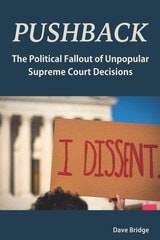
Pushback
The Political Fallout of Unpopular Supreme Court DecisionsDave Bridge
University of Missouri Press, 2024
Certain to appeal to anyone interested in American political science and history, Pushback closes with a detailed examination of the unequivocally countermajoritarian Supreme Court ruling of our lifetimes, Dobbs v. Jackson Women’s Health Organization, which overturned Roe. For the first time in 50 years, conditions are ripe for a party to win votes by campaigning against the will of the Court. Upcoming elections will tell if the Republicans overplayed their hand, or if Democrats will play theirs as skillfully as did the GOP after Roe.