Results by title
1095 books match the query 'Rhetoric' and 56 start with p
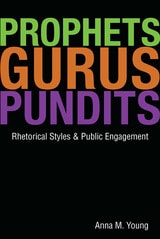
Prophets, Gurus, and Pundits
Rhetorical Styles and Public EngagementAnna M. Young
Southern Illinois University Press, 2014
In Prophets, Gurus, and Pundits, author Anna M. Young proposes that the difficulty of bridging the gap between intellectuals and the public is not a failure of ideas; rather, it is an issue of rhetorical strategy. By laying a rhetorical foundation and presenting analytical case studies of contemporary “public intellectuals,” Young creates a training manual for intellectuals who seek to connect with a public audience and effect change writ large.
Young begins by defining key aspects of rhetorical style before moving on to discuss the specific ways in which intellectuals may present ideas to a general audience in order to tackle large-scale social problems. Next, she defines the ways in which five crucial turning points in our nation—the rise of religious fundamentalism, a growing lack of trust in our institutions, the continued destruction of the environment, the ubiquity of media and information in our daily lives, and the decline of evidence-based reasoning—have set the stage for opportunities in the current public-intellectual dialogue.
Via case studies of such well-known personalities as Deepak Chopra and Professor Cornel West, Young goes on to reveal the six types of public intellectuals who achieve success in presenting scholarly ideas to audiences at large:
The Prophet presents the public’s sins for contemplation, then offers a path to redemption.
The Guru shepherds his or her flock to enlightenment and a higher power.
The Sustainer draws upon our natural and human resources to proffer solutions for social, political, and ecological systems.
The Pundit utilizes wit and brevity to bring crucial issues to the attention of the public.
The Narrator combines a variety of perspectives to create a story the average person can connect with and understand.
The Scientist taps into the dreams of the public to offer ideas from above and beyond the typical scope of public discourse.
At once a rallying cry and roadmap, The Politics of Thinking Out Loud draws upon rhetorical expertise and analysis of contemporary public intellectuals to offer a model for scholars to effectively engage the public—and in doing so, perhaps forever change the world in which we live.
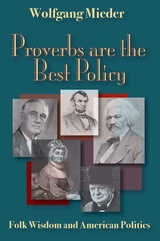
Proverbs Are The Best Policy
Folk Wisdom And American PoliticsWolfgang Mieder
Utah State University Press, 2005
Provocations of Virtue
Rhetoric, Ethics, and the Teaching of WritingJohn Duffy
Utah State University Press, 2018
Drawing upon Aristotle’s Nicomachean Ethics and the branch of philosophical inquiry known as “virtue ethics,” Provocations of Virtue calls for the reclamation of “rhetorical virtues” as a core function in the writing classroom. Duffy considers what these virtues actually are, how they might be taught, and whether they can prepare students to begin repairing the broken state of public argument. In the discourse of the virtues, teachers and scholars of writing are offered a common language and a shared narrative—a story that speaks to the inherent purpose of the writing class and to what is at stake in teaching writing in the twenty-first century.
This book is a timely and historically significant contribution to the field and will be of major interest to scholars and administrators in writing studies, rhetoric, composition, and linguistics as well as philosophers and those exploring ethics.
Public Debate in the Civil War Era
A Rhetorical History of the United States, Volume IVDavid Zarefsky
Michigan State University Press, 2023
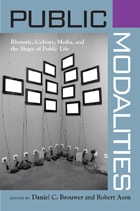
Public Modalities
Edited by Daniel C. Brouwer and Robert Asen
University of Alabama Press, 2010
A bold rethinking of public discourse, Public Modalities explores how people shape civic life through protest, media, and identity in an ever-evolving public sphere.
This book explores the ways that scholars, journalists, politicians, and citizens conceive of “the public” or “public life,” and how those entities are defined and invented. For decades, scholars have used the metaphors of spheres, systems, webs, or networks to talk about, describe, and map various practices. This volume proposes a new metaphor—modalities—to suggest that publics are forever in flux, and much more fluid and dynamic than the static models of systems or spheres would indicate—especially in the digital age, where various publics rapidly evolve and dissipate.
Contributors to the volume—employing approaches from the fields of communication studies, English, sociology, psychology, and history—explore a broad range of texts and artifacts that give rise to publics, and discuss what they reveal about conceptualizations of social space. By focusing on process in public engagement, these scholars highlight questions of how people advance their interests and identities, and how they adapt to situational constraints.
Bringing together scholars in rhetorical, cultural, and media studies, this collection of new case studies illustrates a modalities approach to the study of publics. These case studies explore the implications of different ways of forming publics, including alternative means of expression (protests, culture jamming); the intersection of politics and consumerism (how people express their identities and interests through their consumer behavior); and online engagement (blogs as increasingly important public fora). In doing so, they raise important questions of access, community, and political efficacy
Puritan Rhetoric
The Issue of Emotion in ReligionEugene E. White. Foreword by David Potter
Southern Illinois University Press, 1972
The nature of Puritanism in America and the role of emotion in religion is the subject of this important and useful collection of five religious orations, discussed and appraised by Professor White for students of Puritanism and rhetoric. The five orations presented here consist of three by Jonathan Edwards, “Future Punishment,” “Distinguishing Marks,” and “The Nature of the Affections”; one by Charles Chauncy, “Enthusiasm Described and Caution’d Against”; and one by Ebenezer Gay, “Natural Religion, as Distinguished from Revealed.”
In the first or introductory part of the book, Professor White discusses in considerable detail the broader implications of the confrontation between rationalists and revivalists in New England, represented by the following orations, during this most important upheaval in the Colonies prior to the Revolution. The orations themselves are arranged to represent the force and counterforce of reason versus emotionalism and the precarious balance maintained momentarily and, eventually, lost. And in the third part of the book Professor White provides critical analysis and suggested appraisal for further interpretation and inquiry.