Results by title
18284 books match the query 'United States' and 850 start with p
Parcels
Memories of Salvadoran MigrationMike Anastario
Rutgers University Press, 2019
Parenthood In America
Undervalued, Underpaid, Under SiegeJack C. Westman, M.D.
University of Wisconsin Press, 2001
Parenthood in America brings the insights of experts in child development, education, health, media studies, economics, history, sociology, and human services to bear on practical aspects of childrearing and on the kinds of policies that have a real effect on parenting. In response to the stresses of parenthood today, they call for:
o family-friendly workplaces and decent childcare options
o pediatric health care for all
o programs that aid children’s development as well as their physical health
o recognition by professionals of parents’ expert knowledge about their own children
o alternatives to vapid or violent games and TV programs
o prioritization of time for family meals, talks, chores, and activities
o valuing of caring relationships above wealth and possessions
o appreciation of cultural and religious diversity
o supportive networks among parents, teachers, pediatricians, and childcare providers.
Parenting and Professing
Balancing Family Work with an Academic CareerRachel Hile Bassett
Vanderbilt University Press, 2005
Parents Without Papers
The Progress and Pitfalls of Mexican American IntegrationFrank D. Bean is Distinguished Professor of Sociology and Director of the Center for Research on International Migration at the University of California, Irvine. Susan K. Brown is associate professor of sociology at the University of California, Irvine. James D. Bachmeier is assistant professor of sociology at Temple University.
Russell Sage Foundation, 2015
Parents Without Papers provides both a general conceptualization of immigrant integration and an in-depth examination of the Mexican American case. The authors draw upon unique retrospective data to shed light on three generations of integration. They show in particular that the “membership exclusion” experienced by unauthorized Mexican immigrants—that is, their fear of deportation, lack of civil rights, and poor access to good jobs—hinders the education of their children, even those who are U.S.-born. Moreover, they find that children are hampered not by the unauthorized entry of parents itself but rather by the long-term inability of parents, especially mothers, to acquire green cards.
When unauthorized parents attain legal status, the disadvantages of the second generation begin to disappear. These second-generation men and women achieve schooling on par with those whose parents come legally. By the third generation, socioeconomic levels for women equal or surpass those of native white women. But men reach parity only through greater labor-force participation and longer working hours, results consistent with the idea that their integration is delayed by working-class imperatives to support their families rather than attend college.
An innovative analysis of the transmission of advantage and disadvantage among Mexican Americans, Parents Without Papers presents a powerful case for immigration policy reforms that provide not only realistic levels of legal less-skilled migration but also attainable pathways to legalization. Such measures, combined with affordable access to college, are more important than ever for the integration of vulnerable Mexican immigrants and their descendants.
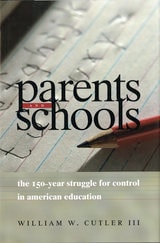
Parents and Schools
The 150-Year Struggle for Control in American EducationWilliam W. Cutler III
University of Chicago Press, 2000
Cutler shows how in the 1920s and 1930s schools expanded their responsibility for children's well-being outside the classroom. These efforts sowed the seeds for later conflict as schools came to be held accountable for solving society's problems. Finally, he brings the reader into recent decades, in which a breakdown of trust, racial tension, and "parents' rights" have taken the story full circle, with parents and schools once again at odds.
Cutler's book is an invaluable guide to understanding how parent-teacher cooperation, which is essential for our children's educational success, might be achieved.
Parents and Their Deaf Children
The Early YearsKathryn P. Meadow-Orlans
Gallaudet University Press, 2003
To correct the paucity of information on deaf or hard of hearing children and their parents’ experiences with early intervention services, researchers explored these relationships as part of the National Parent Project. From this investigation, Parents and Their Deaf Children details the experiences of a group of parents and their deaf children from the first identification of the latter’s hearing loss through their early years in elementary school. Renowned scholars Kathryn Meadow-Orlans, Donna Mertens, and Marilyn Sass-Lehrer reveal here for the first time the goals and expectations of the parents, the children’s achievements and troubles, and the families’ satisfaction and disappointment with health and educational systems.
Parents and their Deaf Children stems from a nationwide survey of parents with six-to-seven-year-old deaf or hard of hearing children, followed up by interviews with 80 parents. The authors not only discuss the parents’ communication choices for their children, but also provide how parents’ experiences differ, especially for those whose children are hard of hearing, have additional conditions, or have cochlear implants. Also, one chapter is devoted to families from minority cultures. The final section of this distinctive study offers solid advice for other parents of deaf children and also the professionals who serve them.
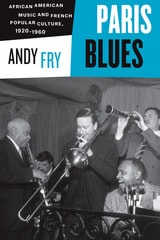
Paris Blues
African American Music and French Popular Culture, 1920-1960Andy Fry
University of Chicago Press, 2014
In Paris Blues, Andy Fry provides an alternative history of African American music and musicians in France, one that looks beyond familiar personalities and well-rehearsed stories. He pinpoints key issues of race and nation in France’s complicated jazz history from the 1920s through the 1950s. While he deals with many of the traditional icons—such as Josephine Baker, Django Reinhardt, and Sidney Bechet, among others—what he asks is how they came to be so iconic, and what their stories hide as well as what they preserve. Fry focuses throughout on early jazz and swing but includes its re-creation—reinvention—in the 1950s. Along the way, he pays tribute to forgotten traditions such as black musical theater, white show bands, and French wartime swing. Paris Blues provides a nuanced account of the French reception of African Americans and their music and contributes greatly to a growing literature on jazz, race, and nation in France.
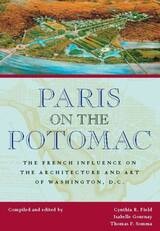
Paris on the Potomac
The French Influence on the Architecture and Art of Washington, D.C.Cynthia R. Field
Ohio University Press, 2007
In 1910 John Merven Carrère, a Paris-trained American architect, wrote, “Learning from Paris made Washington outstanding among American cities.” The five essays in Paris on the Potomac explore aspects of this influence on the artistic and architectural environment of Washington, D.C., which continued long after the well-known contributions of Peter Charles L’Enfant, the transplanted French military officer who designed the city’s plan.
Isabelle Gournay’s introductory essay provides an overview and examines the context and issues involved in three distinct periods of French influence: the classical and Enlightenment principles that prevailed from the 1790s through the 1820s, the Second Empire style of the 1850s through the 1870s, and the Beaux-Arts movement of the early twentieth century. William C. Allen and Thomas P. Somma present two case studies: Allen on the influence of French architecture, especially the Halle aux Blés, on Thomas Jefferson’s vision of the U.S. Capitol; and Somma on David d’Angers’s busts of George Washington and the Marquis de Lafayette. Liana Paredes offers a richly detailed examination of French-inspired interior decoration in the homes of Washington’s elite in the late nineteenth and early twentieth centuries. Cynthia R. Field concludes the volume with a consideration of the influence of Paris on city planning in Washington, D.C., including the efforts of the McMillan Commission and the later development of the Federal Triangle complex.
The essays in this collection, the latest addition to the series Perspectives on the Art and Architectural History of the United States Capitol, originated in a conference held by the U.S. Capitol Historical Society in 2002 at the French Embassy’s Maison Française.
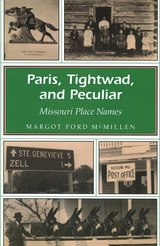
Paris, Tightwad, and Peculiar
Missouri Place NamesMargot Ford McMillen
University of Missouri Press, 1994
Paris, Tightwad, Peculiar, Neosho, Gasconade, Hannibal, Diamond, Quarantine, Zif, and Zig. These are just a few of the names Margot Ford McMillen covers in her lively book on the history of place names in Missouri. The origins behind the names range from humorous to descriptive:
•Tightwad, Missouri, is said to have been named after a store owner who cheated a mailman out of his rightful watermelon to make an extra fifty cents. •Plad, Missouri, was supposed to be named "Glad," but the post office printed the name wrong, and it was too much trouble to get it changed. •Some place names describe a location, such as Big Spring or Flat River. •Other names show the influence of immigrants to the state, like Hermann, which is a German name, or the Maries River, which was derived from the French. •Many places are named for people or wildlife found nearby, while others are backed up by legend or simply picked out of thin air.
Parish Nursing - 2011 Edition
Stories of Service and CareVerna Benner Carson
Templeton Press, 2011
The engaging stories in Parish Nursing provide accessible and enjoyable accounts of real parish nurses, both paid and volunteer, who attend to the needs of their congregations in a variety of ways—from home, hospice, and hospital visits to community outreach. This revised edition gathers their stories of hearing and heeding God’s call, of their faith that they are doing the “right thing,” of their joys, sorrows, and challenges, and of their quiet dedication as they offer their time and talents to meet the needs of others.
By offering inspiration and encouragement, along with a healthy dose of updated practical advice, this collection will make parish nursing theory come to life. These stories will honor practicing parish nurses, will guide the way for anyone contemplating parish nursing as a career, and will challenge church members and leaders to examine the role that their congregations play in health ministry—especially in meeting the long-term care needs of an aging population.

Parks for Texas
Enduring Landscapes of the New DealBy James Wright Steely
University of Texas Press, 1999
State parks across Texas offer a world of opportunities for recreation and education. Yet few park visitors or park managers know the remarkable story of how this magnificent state park system came into being during the depths of the Great Depression in the 1930s. Drawing on archival records and examining especially the political context of the New Deal, James Wright Steely here provides the first comprehensive history of the founding and building of the Texas state park system.
Steely's history begins in the 1880s with the movement to establish parks around historical sites from the Texas Revolution. He follows the fits-and-starts progress of park development through the early 1920s, when Governor Pat Neff envisioned the kind of park system that ultimately came into being between 1933 and 1942.
During the Depression an amazing cast of personalities from Franklin D. Roosevelt to Lyndon Johnson led, followed, or obstructed the drive to create this state park system. The New Deal federal-state partnerships for depression relief gave Texas the funding and personnel to build 52 recreational parks under the direction of the National Park Service. Steely focuses in detail on the activities of the Civilian Conservation Corps, whose members built parks from Caddo Lake in the east to the first park improvements in the Big Bend out west. An appendix lists and describes all the state parks in Texas through 1945, while Steely's epilogue brings the parks' story up to the present.
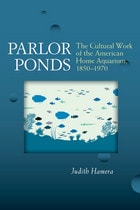
Parlor Ponds
The Cultural Work of the American Home Aquarium, 1850 - 1970Judith Hamera
University of Michigan Press, 2012
Parlor Ponds: The Cultural Work of the American Home Aquarium, 1850–1970 examines the myriad cultural meanings of the American home aquarium during the nineteenth and twentieth centuries and argues that the home aquarium provided its enthusiasts with a potent tool for managing the challenges of historical change, from urbanization to globalization. The tank could be a window to an alien world, a theater for domestic melodrama, or a vehicle in a fantastical undersea journey. Its residents were seen as inscrutable and wholly disposable “its,” as deeply loved and charismatic individuals, and as alter egos by aquarists themselves.
Parlor Ponds fills a gap in the growing field of animal studies by showing that the tank is an emblematic product of modernity, one using elements of exploration, technology, science, and a commitment to rigorous observation to contain anxieties spawned by industrialization, urbanization, changing gender roles, and imperial entanglements. Judith Hamera engages advertisements, images, memoirs, public aquarium programs, and enthusiast publications to show how the history of the aquarium illuminates complex cultural attitudes toward nature and domestication, science and religion, gender and alterity, and national conquest and environmental stewardship with an emphasis on the ways it illuminates American public discourse on colonial and postcolonial expansion.

Parodies of Ownership
Hip-Hop Aesthetics and Intellectual Property LawRichard L. Schur
University of Michigan Press, 2009
"Richard Schur offers a provocative view of contemporary African American cultural politics and the relationship between African American cultural production and intellectual property law."
---Mark Anthony Neal, Duke University
"Whites used to own blacks. Now, they accomplish much the same thing by insisting that they 'own' ownership. Blacks shouldn't let them. A culture that makes all artists play by its rules will end up controlling new ideas and stifling change. Richard Schur's fine book explains why."
---Richard Delgado, Seattle University
What is the relationship between hip-hop and African American culture in the post--Civil Rights era? Does hip-hop share a criticism of American culture or stand as an isolated and unique phenomenon? How have African American texts responded to the increasing role intellectual property law plays in regulating images, sounds, words, and logos? Parodies of Ownership examines how contemporary African American writers, artists, and musicians have developed an artistic form that Schur terms "hip-hop aesthetics." This book offers an in-depth examination of a wide range of contemporary African American painters and writers, including Anna Deavere Smith, Toni Morrison, Adrian Piper, Colson Whitehead, Michael Ray Charles, Alice Randall, and Fred Wilson. Their absence from conversations about African American culture has caused a misunderstanding about the nature of contemporary cultural issues and resulted in neglect of their innovative responses to the post--Civil Rights era. By considering their work as a cross-disciplinary and specifically African American cultural movement, Schur shows how a new paradigm for artistic creation has developed.
Parodies of Ownership offers a broad analysis of post--Civil Rights era culture and provides the necessary context for understanding contemporary debates within American studies, African American studies, intellectual property law, African American literature, art history, and hip-hop studies. Weaving together law, literature, art, and music, Schur deftly clarifies the conceptual issues that unify contemporary African American culture, empowering this generation of artists, writers, and musicians to criticize how racism continues to affect our country.
Richard L. Schur is Director, Interdisciplinary Studies Center, and Associate Professor of Interdisciplinary Studies at Drury University. Visit the author's website: http://www2.drury.edu/rschur/index.htm.
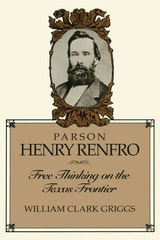
Parson Henry Renfro
Free Thinking on the Texas FrontierBy William C. Griggs
University of Texas Press, 1994
The years following the Texas Revolution held even more turbulent events as diverse droves of pioneers crossed the Sabine and Red Rivers to start new lives in Texas. Early Texas society contended with religious issues, family life in a rugged environment, and the Civil War. This cultural history was clearly reflected in the life of frontier preacher Henry C. Renfro.
Migrating to Texas in 1851, Renfro enrolled in the fledgling Baylor University and became a Baptist preacher. Eventually disillusioned with Baptist orthodoxy, Renfro was disenfranchised on charges of infidelity as he embraced the ideals of the Free Thought Movement, inspired by the writings of men such as Thomas Paine, Spinoza, and Robert Ingersoll.
Renfro's Civil War experience was no less unusual. Serving as both soldier and chaplain, Renfro left a valuable legacy of insight into the conflict, captured in a wealth of correspondence that is in itself significant.
Drawing on a vast body of letters, speeches, sermons, and oral histories that had never before been available, this chronological narrative of "The Parson's" life describes significant changes in Texas from 1850 to 1900, especially the volatile formation and growth of Baptist churches in North Central Texas. William Griggs' study yields numerous new details about the Free Thought Movement and depicts public reaction to sectarian leaders in nineteenth-century Texas.
The author also describes the developing Central Texas region known as the Cross Timbers, including the personal dynamics between a frontier family and its patriarch and encompassing such issues as property conflicts, divorce, and family reconciliation. This work unlocks an enlightening, engaging scene from Texas history.
Participation in America
Political Democracy and Social EqualitySidney Verba and Norman H. Nie
University of Chicago Press, 1987
Participatory Composition
Video Culture, Writing, and ElectracySarah J. Arroyo
Southern Illinois University Press, 2013
Like. Share. Comment. Subscribe. Embed. Upload. Check in. The commands of the modern online world relentlessly prompt participation and encourage collaboration, connecting people in ways not possible even five years ago. This connectedness no doubt influences college writing courses in both form and content, creating possibilities for investigating new forms of writing and student participation. In this innovative volume, Sarah J. Arroyo argues for a “participatory composition,” inspired by the culture of online video sharing and framed by theorist Gregory Ulmer’s concept of electracy.
Electracy, according to Ulmer, “is to digital media what literacy is to alphabetic writing.” Although electracy can be compared to digital literacy, it is not something shut on and off with the power buttons on computers or mobile devices. Rather, electracy encompasses the cultural, institutional, pedagogical, and ideological implications inherent in the transition from a culture of print literacy to a culture saturated with electronic media, regardless of the presence of actual machines.
Arroyo explores the apparatus of electracy in many of its manifestations while focusing on the participatory practices found in online video culture, particularly on YouTube. Chapters are devoted to questions of subjectivity, definition, authorship, and pedagogy. Utilizing theory and incorporating practical examples from YouTube, classrooms, and other social sites, Arroyo presents accessible and practical approaches for writing instruction. Additionally, she outlines the concept of participatory composition by highlighting how it manifests in online video culture, offers student examples of engagement with the concept, and advocates participatory approaches throughout the book.
Arroyo presents accessible and practical possibilities for teaching and learning that will benefit scholars of rhetoric and composition, media studies, and anyone interested in the cultural and instructional implications of the digital age.
Parties and Elections in Greece
The Search for LegitimacyRichard Clogg
Duke University Press, 1987
Parties and Leaders in the Postreform House
David W. Rohde
University of Chicago Press, 1991
Offering a concise and compelling explanation of the causes of this resurgence, David W. Rohde argues that a realignment of electoral forces led to a reduction of sectional divisions within the parties—particularly between the northern and southern Democrats—and to increased divergence between the parties on many important issues. He challenges previous findings by asserting that congressional reform contributed to, rather than restrained, the increase of partisanship. Among the Democrats, reforms siphoned power away from conservative and autocratic committee chairs and put control of those committees in the hands of Democratic committee caucuses, strengthening party leaders and making both party and committee leaders responsible to rank-and-file Democrats. Electoral changes increased the homogeneity of House Democrats while institutional reforms reduced the influence of dissident members on a consensus in the majority party. Rohde's accessible analysis provides a detailed discussion of the goals of the congressional reformers, the increased consensus among Democrats and its reinforcement by their caucus, the Democratic leadership's use of expanded powers to shape the legislative agenda, and the responses of House Republicans. He also addresses the changes in the relationship between the House majority and the president during the Carter and Reagan administrations and analyzes the legislative consequences of the partisan resurgence.
A readable, systematic synthesis of the many complex factors that fueled the recent resurgence of partisanship, Parties and Leaders in the Postreform House is ideal for course use.
Parties and Prejudice
The Normalization of Antiminority Rhetoric in US PoliticsManeesh Arora
University of Chicago Press, 2025
An essential guide to how the interactions between social norms, party politics, and expressions of prejudice are driving contemporary politics.
Antiminority rhetoric in American politics has grown more overt. What were once fringe comments on Stormfront have now become typical campaign appeals from many mainstream politicians. If there was ever a doubt, this is a poignant reminder that the boundaries of what is “acceptable” and “unacceptable” to say and do are fluid and socially enforced.
In Parties and Prejudice, Maneesh Arora offers a broad framework for understanding this new political terrain. Arora argues that the interaction between social norms and party politics determines what the political consequence of prejudicial speech will be. He illuminates this nuanced relationship by showing that norms vary based on the targeted minority group and the intended audience.
Drawing on experiments, survey data, news coverage, and real-world examples, Parties and Prejudice examines the distinctive ways that egalitarian/inegalitarian norms have developed—within each party—for Black, Muslim, and LGBTQ+ Americans. It is essential reading for understanding Donald Trump’s rise to power, the modern conservative agenda (including opposition to critical race theory and transgender rights), and threats to the development of a multiracial democracy.
Parties in Transition
Warren Miller
Russell Sage Foundation, 1986
Parties on the Ground
A Study of Nominations for the House of RepresentativesKathleen Bawn, Knox Brown, Angela X. Ocampo, Shawn Patterson Jr., John L. Ray, and John Zaller
University of Chicago Press, 2026
A close-up examination of the roots of congressional politics in nominations for the House of Representatives.
With most House seats all but guaranteed for one party in general elections, primary elections for party nominees often decide who goes to Congress. Yet primaries are notoriously difficult to study, due in part to both the variety of rules that govern them and the differences in the influence of local leaders. Based on wide-ranging evidence from field interviews to fundraising data to exit polls, Parties on the Ground overcomes these challenges to take readers under the hood for an in-depth look at the nomination process.
Although progressive reformers sought the adoption of primaries to empower voters’ control over nominations, Parties on the Ground finds that most voters pay too little attention to make use of the opportunity. Instead, the most important actors are intense policy demanders—such as interest groups and activist organizations—who supply campaign resources to some candidates and deny them to others. These groups care most about securing an agent for their own interests and values; to this end, they put serious effort into vetting candidates and often coordinate among themselves or with local parties in support of their choices. At the same time, competition between establishment and insurgent groups can be high, especially in the Republican Party. Developing a nuanced account of House nominations in today’s parties, Parties on the Ground offers a host of new insights into this understudied but significant piece of the puzzle of American politics.
Parties, Rules, and the Evolution of Congressional Budgeting
Lance T. LeLoup
The Ohio State University Press, 2005
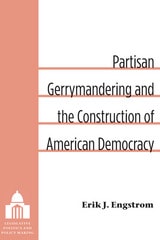
Partisan Gerrymandering and the Construction of American Democracy
Erik J. Engstrom
University of Michigan Press, 2016
Erik J. Engstrom offers a historical perspective on the effects of gerrymandering on elections and party control of the U.S. national legislature. Aside from the requirements that districts be continuous and, after 1842, that each select only one representative, there were few restrictions on congressional districting. Unrestrained, state legislators drew and redrew districts to suit their own partisan agendas. With the rise of the “one-person, one-vote” doctrine and the implementation of the Voting Rights Act of 1965, however, redistricting became subject to court oversight.
Engstrom evaluates the abundant cross-sectional and temporal variation in redistricting plans and their electoral results from all the states, from 1789 through the 1960s, to identify the causes and consequences of partisan redistricting. His analysis reveals that districting practices across states and over time systematically affected the competitiveness of congressional elections, shaped the partisan composition of congressional delegations, and, on occasion, determined party control of the House of Representatives.
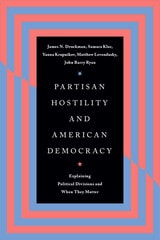
Partisan Hostility and American Democracy
Explaining Political Divisions and When They MatterJames N. Druckman, Samara Klar, Yanna Krupnikov, Matthew Levendusky, and John Barry Ryan
University of Chicago Press, 2024
An unflinching examination of the effects and boundaries of partisan animosity.
For generations, experts argued that American politics needed cohesive parties to function effectively. Now many fear that strong partisan views, particularly hostility to the opposing party, are damaging democracy. Is partisanship as dangerous as we fear it is?
To provide an answer, this book offers a nuanced evaluation of when and how partisan animosity matters in today’s highly charged, dynamic political environment, drawing on panel data from some of the most tumultuous years in recent American history, 2019 through 2021. The authors show that partisanship powerfully shapes political behaviors, but its effects are conditional, not constant. Instead, it is most powerful when politicians send clear signals and when an issue is unlikely to bring direct personal consequences. In the absence of these conditions, other factors often dominate decision-making.
The authors argue that while partisan hostility has degraded US politics—for example, politicizing previously non-political issues and undermining compromise—it is not in itself an existential threat. As their research shows, the future of American democracy depends on how politicians, more than ordinary voters, behave.
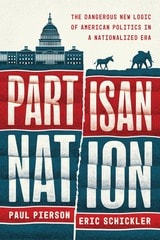
Partisan Nation
The Dangerous New Logic of American Politics in a Nationalized EraPaul Pierson and Eric Schickler
University of Chicago Press, 2024
A provocative exploration of how America’s democratic crisis is rooted in a dangerous mismatch between our Constitution and today’s nationalized, partisan politics.
The ground beneath American political institutions has moved, with national politics subsuming and transforming the local. As a result, American democracy is in trouble.
In this paradigm-shifting book, political scientists Paul Pierson and Eric Schickler bring a sharp new perspective to today’s challenges. Attentive to the different coalitions, interests, and incentives that define the Democratic and Republican parties, they show how contemporary polarization emerged in a rapidly nationalizing country and how it differs from polarization in past eras. In earlier periods, three key features of the political landscape—state parties, interest groups, and media—varied locally and reinforced the nation’s stark regional diversity. But this began to change in the 1960s as the two parties assumed clearer ideological identities and the power of the national government expanded, raising the stakes of conflict. Together with technological and economic change, these developments have reconfigured state parties, interest groups, and media in self-reinforcing ways. The result is that today’s polarization is self-perpetuating—and intensifying.
Partisan Nation offers a powerful caution. As a result of this polarization, America’s political system is distinctly and acutely vulnerable to an authoritarian movement emerging in the contemporary Republican Party, which has both the motive and the means to exploit America’s unusual Constitutional design. Combining the precision and acuity characteristic of their earlier work, Pierson and Schickler explain what these developments mean for American governance and democracy.
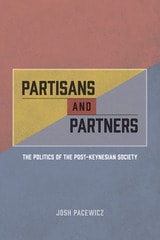
Partisans and Partners
The Politics of the Post-Keynesian SocietyJosh Pacewicz
University of Chicago Press, 2016
Wheels-down in Iowa—that most important of primary states—Pacewicz looks to two cities, one traditionally Democratic, the other traditionally Republican, and finds that younger voters are rejecting older-timers’ strict political affiliations. A paradox is emerging—as the dividing lines between America’s political parties have sharpened, Americans are at the same time growing distrustful of traditional party politics in favor of becoming apolitical or embracing outside-the-beltway candidates. Pacewicz sees this change coming not from politicians and voters, but from the fundamental reorganization of the community institutions in which political parties have traditionally been rooted. Weaving together major themes in American political history—including globalization, the decline of organized labor, loss of locally owned industries, uneven economic development, and the emergence of grassroots populist movements—Partisans and Partners is a timely and comprehensive analysis of American politics as it happens on the ground.
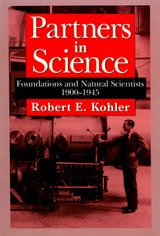
Partners in Science
Foundations and Natural Scientists, 1900-1945Robert E. Kohler
University of Chicago Press, 1991
"This book is a rich historical tapestry of people, institutions and scientific ideas. It will stand for a long time as a source of precise and detailed information about an important aspect of the scientific enterprise. . .It also contains many valuable lessons for the coming years."—John Ziman, Times Higher Education Supplement
Party Discipline in the U.S. House of Representatives
Kathryn Pearson
University of Michigan Press, 2015
Party Organization and Activism in the American South
Robert P. Steed
University of Alabama Press, 1998
Maps the ways political parties remain vital components in the American political system, especially in the eleven states in the South
As Tocqueville noted more than 100 years ago, “No countries need associations more . . . than those with a democratic social state.” Although some contemporary observers see a decline in associations, especially in the political sphere, the contributors in this volume argue not only that political parties remain an essential component of the American political system but also that grassroots political groups have revitalized the political process, especially in the South.
Using data gathered from local party officials in the eleven southern states, the authors examine such key issues as: Who becomes involved in local party organizations and why? How do parties recruit and retain workers? What are the ideological and issue orientations of these activists? How does intraparty factionalism affect local party organizations? What is the connection between the party organization and its external environment?
The large regional database provides these contributors with the opportunity to extend the study of local party organization and activists, thus addressing some of the significant gaps in previous research. The additional data enable them to clarify the nature of local party organizations and, in a larger sense, the role of the parties in the contemporary American political system.
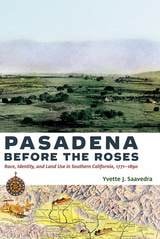
Pasadena Before the Roses
Race, Identity, and Land Use in Southern California, 1771–1890Yvette J. Saavedra
University of Arizona Press, 2018
But what existed before the roses? Before it was Pasadena, this land was Hahamog’na, the ancestral lands of the Tongva people. Later, it comprised the heart of the San Gabriel Mission lands, and in the Mexican period, it became Rancho San Pascual. The 1771 Spanish conquest of this land set in motion several colonial processes that would continue into the twentieth century and beyond.
In Pasadena Before the Roses, historian Yvette J. Saavedra examines a period of 120 years to illustrate the interconnectedness of power, ideas of land use, and the negotiation of identity within multiple colonial moments. By centering the San Gabriel Mission lands as the region’s economic, social, and cultural foundation, she shows how Indigenous, Spanish, Mexican, and American groups each have redefined the meanings of land use to build their homes and their lives. These visions have resulted in competing colonialisms that framed the racial, ethnic, gender, and class hierarchies of their respective societies.

Passage to Wonderland
Rephotographing Joseph Stimson's Views of the Cody Road to Yellowstone National Park, 1903 and 2008Michael A. Amundson
University Press of Colorado, 2012
Amundson examines the physical changes along "the most scenic fifty miles in America" and explores the cultural and natural history behind them. This careful analysis of the paired images make Passage to Wonderland more than a "then and now" photography book--it is a unique exploration of the interconnectedness between the Old West and the New West. It will be a wonderful companion for those touring the Cody Road as well as those armchair tourists who can follow the road on Google Earth using the provided GPS coordinates.
The University Press of Colorado gratefully acknowledges the generous support of the Charles Redd Center for Western Studies at Brigham Young University toward the publication of this book.
Passing Performances
Queer Readings of Leading Players in American Theater HistoryRobert A. Schanke and Kim Marra, Editors
University of Michigan Press, 1998
The actors, directors, producers, and agents examined here include Edwin Forrest, Charlotte Cushman, and Adah Isaacs Menken, whose personal lives and careers traded on the same-sex erotics of "true love" in the antebellum period; Elisabeth Marbury, Elsie de Wolfe, Elsie Janis, Nance O'Neil, and Alla Nazimova, whose intimate female liaisons were variously interpreted around the turn of the century; the "lavender marriages" of Alfred Lunt to Lynne Fontanne and Guthrie McClintic to Katharine Cornell; the lesbian collaborations of Margaret Webster and Cheryl Crawford; the comic antics of Monty Woolley, which negotiated codified constructions of homosexual perversion in the post-Freudian interwar years; and the on- and offstage performances of Mary Martin and Joe Cino, which resisted the paranoid enforcements of heterosexual normality in the McCarthy era. Central to these investigations are the complex connections of performances of sexuality and gender and their different implications for men and women practitioners working under pervasive sexism and homophobia.
The volume also includes striking archival photographs of the performers and their performances, and an index to facilitate the cross-referencing of subjects' intersecting careers. Passing Performances will engage both general and academic readers interested in theater, gay and lesbian history, American studies, and biography.
Robert A. Schanke is Professor of Theatre and Chair of the Division of Fine Arts, Central College, Iowa. Kim Marra is Associate Professor of Theatre Arts, University of Iowa.

Passing Performances
Queer Readings of Leading Players in American Theater HistoryRobert A. Schanke and Kim Marra, Editors
University of Michigan Press, 0

Passing and Pedagogy
THE DYNAMICS OF RESPONSIBILITYPamela L. Caughie
University of Illinois Press, 1999
Caughie's discussion of passing illuminates a recent phenomenon in academic writing and popular culture that revolves around identities and the ways in which they are deployed, both in the arts and in lived experience. Through a wide variety of texts—novels, memoirs, film, drama, theory, museum exhibits, legal cases—she demonstrates the dynamics of passing, presenting it not as the assumption of a fraudulent identity but as the recognition that the assumption of any identity, including for the purposes of teaching, is a form of passing.
Astutely addressing the relevance of passing for pedagogy, Caughie presents the possibility of a dynamic ethics responsive to the often polarizing difficulties inherent in today's culture. Challenging and thought-provoking, Passing and Pedagogy offers insight and inspiration for teachers and scholars as they seek to be responsible and effective in a complex, rapidly changing intellectual and cultural environment.
Passing and the Fictions of Identity
Elaine K. Ginsberg
Duke University Press, 1996
These essays consider a wide range of texts and moments from colonial times to the present that raise significant questions about the political motivations inherent in the origins and maintenance of identity categories and boundaries. Through discussions of such literary works as Running a Thousand Miles for Freedom, The Autobiography of an Ex–Coloured Man, Uncle Tom’s Cabin, The Hidden Hand, Black Like Me, and Giovanni’s Room, the authors examine issues of power and privilege and ways in which passing might challenge the often rigid structures of identity politics. Their interrogation of the semiotics of behavior, dress, language, and the body itself contributes significantly to an understanding of national, racial, gender, and sexual identity in American literature and culture.
Contextualizing and building on the theoretical work of such scholars as Judith Butler, Diana Fuss, Marjorie Garber, and Henry Louis Gates Jr., Passing and the Fictions of Identity will be of value to students and scholars working in the areas of race, gender, and identity theory, as well as U.S. history and literature.
Contributors. Martha Cutter, Katharine Nicholson Ings, Samira Kawash, Adrian Piper, Valerie Rohy, Marion Rust, Julia Stern, Gayle Wald, Ellen M. Weinauer, Elizabeth Young
Passing for Perfect
College Impostors and Other Model Minoritieserin Khuê Ninh
Temple University Press, 2021
In her engaging study, Passing for Perfect,erin Khuê Ninh considers the factors that drove college imposters such as Azia Kim—who pretended to be a Stanford freshman—and Jennifer Pan—who hired a hitman to kill her parents before they found out she had never received her high school diploma—to extreme lengths to appear successful. Why would someone make such an illogical choice? And how do they stage these lies so convincingly, and for so long?
These outlier examples prompt Ninh to address the larger issue of the pressures and difficulties of striving to be model minority, where failure is too ruinous to admit. Passing for Perfect insists that being a “model minority” is not a “myth,” but coded into one’s programming as an identity—a set of convictions and aspirations, regardless of present socioeconomic status or future attainability—and that the true cost of turning children into high-achieving professionals may be higher than anyone can bear.
Ninh’s book codifies for readers the difference between imposters who are con artists or shysters and those who don’t know how to stop passing for perfect.
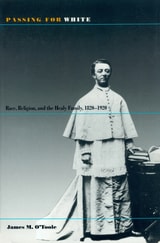
Passing for White
Race, Religion, and the Healy Family, 1820-1920James M. O'Toole
University of Massachusetts Press, 2002
Through the prism of one family's experience, this book explores questions of racial identity, religious tolerance, and black-white “passing” in America. Spanning the century from 1820 to 1920, it tells the story of Michael Morris Healy, a white Irish immigrant planter in Georgia; his African American slave Eliza Clark Healy, who was also his wife; and their nine children. Legally slaves, these brothers and sisters were smuggled north before the Civil War to be educated. In spite of the hardships imposed by American society on persons of mixed racial heritage, the Healy children achieved considerable success. Rejecting the convention that defined as black anyone with “one drop of Negro blood,” they were able to transform themselves into white Americans.
Their unlikely ally in this transition was the Catholic church, as several of them became priests or nuns. One brother served as a bishop in Maine, another as rector of the Cathedral in Boston, and a third as president of Georgetown University. Of the two sisters who became nuns, one was appointed the superior of convents in the United States and Canada. Another brother served for twenty years as a captain in the U.S. Coast Guard, enforcing law and order in the waters off Alaska. The Healy children's transition from black to white should not have been possible according to the prevailing understandings of race, but they accomplished it with apparent ease. Relying on their abilities, and in most cases choosing celibacy, which precluded mixed-race offspring, they forged a place for themselves. They also benefited from the support of people in the church and elsewhere. Even those white Americans who knew the family's background chose to overlook their African ancestry and thereby help them to “get away” with passing. By exploring the lifelong struggles of the members of the Healy family to redefine themselves in a racially polarized society, this book makes a distinctive contribution to our understanding of the enduring dilemma of race in America.
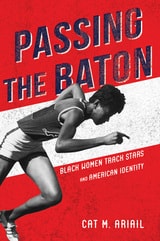
Passing the Baton
Black Women Track Stars and American IdentityCat M. Ariail
University of Illinois Press, 2020
A rare exploration of African American women athletes and national identity, Passing the Baton reveals young Black women as active agents in the remaking of what it means to be American.
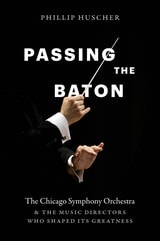
Passing the Baton
The Chicago Symphony Orchestra and the Music Directors Who Shaped Its GreatnessPhillip Huscher
University of Chicago Press, 2026
The untold story of how the Chicago Symphony Orchestra forged its place among the world’s foremost performing arts institutions through 135 years of change.
The Chicago Symphony Orchestra boasts a tradition and staying power that few cultural institutions can rival—a legacy that is tested each time one music director passes the conductor’s baton to another. In this first narrative account of the orchestra’s 135-year history, music critic and historian Phillip Huscher delivers a passionate description of how an upstart ensemble rose to international prominence and established itself as the premier symphony orchestra in the United States.
With a scholar’s care for detail and a novelist’s attention to drama, Huscher invites us into the tangled machinations behind the success or failure of each chapter in the orchestra’s storied past. We see how legendary directors such as Fritz Reiner, Sir Georg Solti, and Riccardo Muti carried the orchestra to new heights of technical perfection and sonic brilliance, but also how others provoked public outcry, caved to insider hostility, or fell to cruel press. The result is a vivid portrait of an orchestra fighting to sustain its identity amid the constant contest between past and present, supporters and critics, and artistic and financial vision.
Woven into this saga are personal stories drawn from newly uncovered documents and interviews with players, conductors, and policymakers about the burden of inheritance, the price of ambition, and the yearning to forge a legacy. Taken together, this is a tale about the power of music—how it can help us navigate our lives and leave a lasting impact on the world around us.
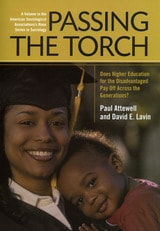
Passing the Torch
Does Higher Education for the Disadvantaged Pay Off Across the Generations?Paul Attewell
Russell Sage Foundation, 2007
The steady expansion of college enrollment rates over the last generation has been heralded as a major step toward reducing chronic economic disparities. But many of the policies that broadened access to higher education—including affirmative action, open admissions, and need-based financial aid—have come under attack in recent years by critics alleging that schools are admitting unqualified students who are unlikely to benefit from a college education. In Passing the Torch, Paul Attewell, David Lavin, Thurston Domina, and Tania Levey follow students admitted under the City University of New York’s “open admissions” policy, tracking its effects on them and their children, to find out whether widening college access can accelerate social mobility across generations.
Unlike previous research into the benefits of higher education, Passing the Torch follows the educational achievements of three generations over thirty years. The book focuses on a cohort of women who entered CUNY between 1970 and 1972, when the university began accepting all graduates of New York City high schools and increasing its representation of poor and minority students. The authors survey these women in order to identify how the opportunity to pursue higher education affected not only their long-term educational attainments and family well-being, but also how it affected their children’s educational achievements. Comparing the record of the CUNY alumnae to peers nationwide, the authors find that when women from underprivileged backgrounds go to college, their children are more likely to succeed in school and earn college degrees themselves. Mothers with a college degree are more likely to expect their children to go to college, to have extensive discussions with their children, and to be involved in their children’s schools. All of these parenting behaviors appear to foster higher test scores and college enrollment rates among their children. In addition, college-educated women are more likely to raise their children in stable two-parent households and to earn higher incomes; both factors have been demonstrated to increase children’s educational success.
The evidence marshaled in this important book reaffirms the American ideal of upward mobility through education. As the first study to indicate that increasing access to college among today’s disadvantaged students can reduce educational gaps in the next generation, Passing the Torch makes a powerful argument in favor of college for all.
Passing the Torch
Planning for the Next Generation of Leaders in Public ServiceKarl Besel
University of Arkansas Press, 2016
Public-service executives, both elected and appointed within the public and nonprofit sectors, are retiring at record levels, and the number of Americans reaching age sixty-five annually will continue to rise over the next decade and is expected to surpass four million in 2020. Finding qualified, motivated leaders to fill vital public-service positions will challenge the public and nonprofit sectors.
Unfortunately, recent studies show that few proactive steps are being taken by public-service organizations to plan for the next generation. Passing the Torch: Planning for the Next Generation of Public-Service Leaders provides an outline for those who will be facing and managing these looming changes.
In this valuable guide, the factors that influence selection of a career in public service are explored through the authors’ years of experience as leaders in public-service organizations and through interviews with other public-service professionals. Passing the Torch will be essential for leaders of nonprofit organizations, university faculty, researchers in the field of nonprofit management, and students in nonprofit management courses.
Passion And Power
Sexuality in HistoryKathy Peiss
Temple University Press, 1989
Passion and Craft
CONVERSATIONS WITH NOTABLE WRITERSEdited by Bonnie Lyons and Bill Oliver
University of Illinois Press, 1998
Craft go beyond the merely autobiographical, revealing that, despite
their differences, they share passionate devotion and discipline for their
craft.
Included are Richard Ford, winner in 1995 of both the Pulitzer Prize
and the PEN/Faulkner Award; Gina Berriault, 1997 winner of the National
Book Critics Circle Award; Bobbie Ann Mason; T. Coraghessan Boyle; Rick
Bass; Leonard Michaels; Christopher Tilghman; Thom Jones; Julia Alvarez;
Andre Dubus; Jayne Anne Phillips; and Tobias Wolff.
Their comments will interest readers devoted to their novels and stories,
other writers, and aspiring writers.
Passionate Doubts
Interpretation In FictionPatrick O'Donnell
University of Iowa Press, 1986
In an introductory dialogue and a closing chapter on the reader in contemporary fiction, O'Donnell shows that the formation of the reader's self, like character, plot, or any other element in fiction, is also part of the experience of the text, requiring a distinctive conception of interpretation. Calling upon a wide assemblage of modern theorists including Foucault, Derrida, Serres, Binswanger, Geertz, and Gadamer, O'Donnell elicits a broad range of interpretive possibilities—philosophical, psychological, archaeological, and linguistic—which speak to each novel's central concern with the act of reading as a form of signification.
While Passionate Doubts is broadly a hermeneutic study of contemporary fiction, the heart of this intriguing work resides in the close scrutiny of six modern novels which so richly evoke the very elements from which theories derive: language, form, and impulse. It is this specific application of theory that sets Passionate Doubts apart from other works in the field, yielding a series of important insights on the subject of language, sign, and the self in modern literature.

Past Imperfect
Essays on History, Libraries, and the HumanitiesLawrence W. Towner
University of Chicago Press, 1993
Towner's essays and talks cover a broad range of topics of continuing relevance to scholarship and the humanities. His writings gathered in Past Imperfect are concerned with such issues as the role of independent research libraries and the politics of funding. A section of historical essays on the common people of New England reveal his concern with neglected fields of history, a theme that guided his career as a librarian. Spanning the range of his experience and expertise, this volume expresses Towner's coherent vision of the place of humanities, libraries, and scholarship in American life.
Lawrence W. Towner (1921-92) taught history at M.I.T., the College of William and Mary, and Northwestern University. In 1962 he was appointed librarian of the Newberry Library and directed the library for the next twenty-four years.

Past Or Portal? Enhancing Undergraduate Learning Through
Eleanor Mitchell
Assoc of College & Research Libraries, 2012
Past Titan Rock
Journeys into an Appalachian ValleyEllesa Clay High
West Virginia University Press, 2021
Past Titan Rock, a winner of the Appalachian Award for Literature, is available in a new edition as part of the series Sounding Appalachia, with an introduction by series editor Travis D. Stimeling.
In 1977 Ellesa Clay High thought she would spend an afternoon interviewing Lily May Ledford, best known as the lead performer of an all-female string band that began playing on the radio in the 1930s. That meeting began an unexpected journey leading into the mountains of eastern Kentucky and a hundred years into the past. Set in Red River Gorge, an area of steep ridges and box canyons, Past Titan Rock is a multigenre, multivocal re-creation of life in that region. With Ledford’s guidance, High traveled and lived in the gorge, visiting with people who could remember life there before the Works Progress Administration built roads across the ridges and into the valleys during the New Deal. What emerges through a unique combination of personal essay, oral history, and short fiction is a portrait of a mountain culture rich in custom, oral tradition, and song. Past Titan Rock demonstrates the depth of community ties in the Red River Gorge and raises important questions about how to resist destructive forces today.
Past or Portal
Enhancing Undergraduate Learning through Special Collections and ArchivesEleanor Mitchell
Assoc of College & Research Libraries, 2012
Pastkeepers in A Small Place
Five Centuries in Deerfield, MassachusettsMichael C. Batinski
University of Massachusetts Press, 2004
Like many small places in the American landscape, Batinski points out, Deerfield does not fit into the history we learn in textbooks. With the exception of the famous French and Indian raid on the town in 1704, nothing of national significance has happened there. Yet that has not diminished the interest of local inhabitants in establishing and maintaining a vital connection to the past.
Different groups, from Native Pocumtuck to Puritan settlers to the grandchildren of Polish immigrants, have told the Deerfield story in varied and sometimes conflicting ways, each drawing on the past to shape its own sense of collective identity. Together their efforts at pastkeeping reveal how people organize and explain the motion of time, why they feel it important to pass on family stories, and why they keep family heirlooms. In doing so, Batinski argues, they illustrate why the preservation of the past remains a civic concern to us all.
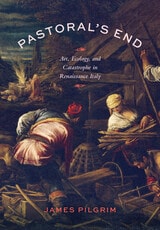
Pastoral’s End
Art, Ecology, and Catastrophe in Renaissance ItalyJames Pilgrim
University of Chicago Press, 2026
In the sixteenth century, Italian artist Jacopo Bassano painted pictures of herdsmen and animals moving through dark and muddy landscapes. But he also participated in the agricultural development of the region in which he lived, producing topographical maps of local mountains and forests, inventing new methods of drainage and irrigation, and studying the latest techniques of crop rotation and fertilization. The relationship between Bassano’s rustic art and his participation in environmental transformation has, however, never been explored.
One of the first studies of Italian Renaissance art to grapple with the connections between visual culture and the environment, Pastoral’s End explores this crucial, formative relationship. James Pilgrim looks at Bassano’s career holistically, demonstrating how his involvement in a world marked by agricultural expansion, industrialization, resource extraction, environmental degradation, social transformation, and radical philosophical development informed his paintings of country life. Introducing new archival and visual evidence of Bassano’s knowledge of hydrology, agronomy, husbandry, and architecture, Pastoral’s End argues that he transformed the more placid rustic imagery of previous Renaissance artists into visions of dangerous ecological instability.