Results by title
2285 books match the query 'Women' and 75 start with p
Power and Everyday Life
The Lives of Working Women in Nineteenth-Century BrazilDias, Maria Odila Silva
Rutgers University Press, 1995
This important new work is a study of the everyday lives of the inhabitants of São Paulo in the nineteenth century. Full of vivid detail, the book concentrates on the lives of working women--black, white, Indian, mulatta, free, freed, and slaves, and their struggles to survive. Drawing on official statistics, and on the accounts of travelers and judicial records, the author paints a lively picture of the jobs, both legal and illegal, that were performed by women. Her research leads to some surprising discoveries, including the fact that many women were the main providers for their families and that their work was crucial to the running of several urban industries. This book, which is a unique record of women’s lives across social and race strata in a multicultural society, should be of interest to students and researchers in women’s studies, urban studies, historians, geographers, economists, sociologists, and anthropologists.
Power and Gender in Renaissance Spain
Eight Women of the Mendoza Family, 1450-1650Edited by Helen Nader
University of Illinois Press, 2003
These essays explore the lives of powerful women whose lineage gave them status within a patriarchal society designed to keep women from public life. Each of the influential and literary women discussed in this volume handled her status differently, and their concerns were not dissimilar from the concerns of feminists today: the blurring of the personal and the political, public versus private space, language and voice, and property.
Spanning the two centuries between Juana Pimentel, a widow who manipulated the patronage system to her own ends, and Luisa de Carvajal y Mendoza, who rejected both convent and marriage in favor of missionary work, Power and Gender in Renaissance Spain reveals a complex society in which women were limited by law, and yet their social status made those laws negotiable.
These women found that their personal agendas had a broad societal impact, challenging the laws of the land and patriarchal assumptions about women's inferiority.

Power of the Weak
STUDIES ON MEDIEVAL WOMENEdited by Jennifer Carpenter and Sally-Beth MacLean
University of Illinois Press, 1996
sixteenth centuries, these essays suggest that influence and power may
have paradoxically been available to women despite, and sometimes precisely
because of, their subordinate position in society. Striking for its range
of scholarship, this collection explores the power and independence, relationships
and influence of medieval queens, holy women, mothers, widows, Jewish
conversas, and others. Latin and Anglo-Norman hagiography, confessors'
manuals, coronation rituals, responsa literature, and legal theory
are represented.
"An intriguing exploration
of a basic paradox of medieval society, and an excellent blend of theory
and gender studies with detailed work relevant for social and political
history." -- Joel Rosenthal, author of Patriarchy and Families
of Privilege in Fifteenth-Century England
JENNIFER CARPENTER
is a lecturer in history at the University of Otago, Dunedin, New Zealand.
Precarious Workers
History of Debates, Political Mobilization, and Labor Reforms in ItalyEloisa Betti
Central European University Press, 2023
The recent vast upsurge in social science scholarship on job precarity has generally little to say about earlier forms of this phenomenon. Eloisa Betti’s monograph convincingly demonstrates on the example of Italy that even in the post-war phase of Keynesian stability and welfare state, precarious labor was an underlying feature of economic development. She examines how in this short period exceptional politics of labor stability prevailed. The volume then presents the processes whereby labor precarity regained momentum— under the name of flexibility— in the post-Fordist phase from the early 1980s, taking on new forms in the Craxi and Berlusconi eras.
Multiple actors are addressed in the analysis. The book gives voice to intellectuals, scholars, politicians and trade unionists as they have framed the concept and debates on precarious work from the 1950s onwards. Views of labor law experts, politicians and public servants are investigated in regard to labor regulations. Positions of the very precarians are explored, ranging from rural women, industrial homeworkers and blue-collar workers to physicians, university researchers and trainees, unveiling the emergence of anti-precarity social movements. The continuous role of women’s associations and feminist groups in opposing labor precarity since the 1950s is prominently exposed.
Pregnancy and Birth in Early Modern France
Treatises by Caring Physicians and Surgeons (1581–1625)François Rousset, Jean Liebault, Jacques Guillemeau, Jacques Duval, and Louis de Serres
Iter Press, 2013
—Gianna Pomata
Professor of the History of Medicine, Johns Hopkins University

Pregnancy in the Victorian Novel
Livia Arndal Woods
The Ohio State University Press, 2023
In Pregnancy in the Victorian Novel—the first book-length study of the topic—Livia Arndal Woods traces the connections between literary treatments of pregnancy and the medicalization of pregnancy and childbirth occurring over the long nineteenth century. Woods uses the problem of pregnancy in the Victorian novel (in which pregnancy is treated modestly as a rule and only rarely as an embodied experience) to advocate for “somatic reading,” a practice attuned to impressions of the body on the page and in our own messy lived experiences.
Examining works by Emily Brontë, Charlotte Mary Yonge, Anthony Trollope, George Eliot, Thomas Hardy and others, Woods considers instances of pregnancy that are tied to representations of immodesty, poverty, and medical diagnosis. These representations, Woods argues, should be understood in the arc of Anglo-American modernity and its aftershocks, connecting backward to early modern witch trials and forward to the criminalization of women for pregnancy outcomes in twenty-first-century America. Ultimately, she makes the case that by clearing space for the personal and anecdotal in scholarship, somatic reading helps us analyze with uncertainty rather than against it and allows for richer and more relevant textual interpretation.
Pregnant on Arrival
Making the Illegal ImmigrantEithne Luibhéid
University of Minnesota Press, 2013
“State alert as pregnant asylum seekers aim for Ireland.” “Country Being Held Hostage by Con Men, Spongers, and Those Taking Advantage of the Maternity Residency Policy.” From 1997 to 2004, headlines such as these dominated Ireland’s mainstream media as pregnant immigrants were recast as “illegals” entering the country to gain legal residency through childbirth. As immigration soared, Irish media and politicians began to equate this phenomenon with illegal immigration that threatened to destroy the country’s social, cultural, and economic fabric.
Pregnant on Arrival explores how pregnant immigrants were made into paradigmatic figures of illegal immigration, as well as the measures this characterization set into motion and the consequences for immigrants and citizens. While focusing on Ireland, Eithne Luibhéid’s analysis illuminates global struggles over the citizenship status of children born to immigrant parents in countries as diverse as the United States, Hong Kong, and elsewhere. Scholarship on the social construction of the illegal immigrant calls on histories of colonialism, global capitalism, racism, and exclusionary nation building but has been largely silent on the role of nationalist sexual regimes in determining legal status. Eithne Luibhéid turns to queer theory to understand how pregnancy, sexuality, and immigrants’ relationships to prevailing sexual norms affect their chances of being designated as legal or illegal.
Pregnant on Arrival offers unvarnished insight into how categories of immigrant legal status emerge and change, how sexual regimes figure prominently in these processes, and how efforts to prevent illegal immigration ultimately redefine nationalist sexual norms and associated racial, gender, economic, and geopolitical hierarchies.
Presumed Incompetent II
Race, Class, Power, and Resistance of Women in AcademiaYolanda Flores Niemann
Utah State University Press, 2020
The courageous and inspiring personal narratives and empirical studies in Presumed Incompetent II: Race, Class, Power, and Resistance of Women in Academia name formidable obstacles and systemic biases that all women faculty—from diverse intersectional and transnational identities and from tenure track, terminal contract, and administrative positions—encounter in their higher education careers. They provide practical, specific, and insightful guidance to fight back, prevail, and thrive in challenging work environments. This new volume comes at a crucial historical moment as the United States grapples with a resurgence of white supremacy and misogyny at the forefront of our social and political dialogues that continue to permeate the academic world.
Contributors: Marcia Allen Owens, Sarah Amira de la Garza, Sahar Aziz, Jacquelyn Bridgeman, Jamiella Brooks, Lolita Buckner Inniss, Kim Case, Donna Castaneda, Julia Chang, Meredith Clark, Meera Deo, Penelope Espinoza, Yvette Flores, Lynn Fujiwara, Jennifer Gomez, Angela Harris, Dorothy Hines, Rachelle Joplin, Jessica Lavariega Monforti, Cynthia Lee, Yessenia Manzo, Melissa Michelson, Susie E. Nam, Yolanda Flores Niemann, Jodi O’Brien, Amelia Ortega, Laura Padilla, Grace Park, Stacey Patton, Desdamona Rios, Melissa Michal Slocum, Nellie Tran, Rachel Tudor, Pamela Tywman Hoff, Adrien Wing, Jemimah Li Young

Pretty Good for a Girl
Women in BluegrassMurphy Henry
University of Illinois Press, 2013

Primitive Passions
Men, Women, and the Quest for EcstasyMarianna Torgovnick
University of Chicago Press, 1998
"Primitive Passions intends to provoke thought, not to tell you what you already know and for that reason alone it's extraordinary."—Walter Kendrick, New York Times Book Review
"A powerfully argued, impassioned, and intelligent exploration of the 'primitive' in our culture and in ourselves. Like Marianna Torgovnick's previous work, it is certain to be much discussed and provocative."—Joyce Carol Oates
"An inspiring effort to bring gender to bear on matters of race, ethnic identity, and spirituality."—Susan Gubar
"A fascinating, wide-ranging and provocative tour of twentieth century Western culture."—Cynthia D. Schrager, Women's Review of Books
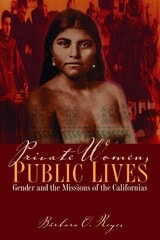
Private Women, Public Lives
Gender and the Missions of the CaliforniasBy Bárbara O. Reyes
University of Texas Press, 2009
Through the lives and works of three women in colonial California, Bárbara O. Reyes examines frontier mission social spaces and their relationship to the creation of gendered colonial relations in the Californias. She explores the function of missions and missionaries in establishing hierarchies of power and in defining gendered spaces and roles, and looks at the ways that women challenged, and attempted to modify, the construction of those hierarchies, roles, and spaces.
Reyes studies the criminal inquiry and depositions of Barbara Gandiaga, an Indian woman charged with conspiracy to murder two priests at her mission; the divorce petition of Eulalia Callis, the first lady of colonial California who petitioned for divorce from her adulterous governor-husband; and the testimonio of Eulalia Pérez, the head housekeeper at Mission San Gabriel who acquired a position of significant authority and responsibility but whose work has not been properly recognized. These three women's voices seem to reach across time and place, calling for additional, more complex analysis and questions: Could women have agency in the colonial Californias? Did the social structures or colonial processes in place in the frontier setting of New Spain confine or limit them in particular gendered ways? And, were gender dynamics in colonial California explicitly rigid as a result of the imperatives of the goals of colonization?
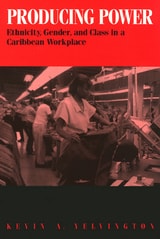
Producing Power
Ethnicity, Gender, and Class in a Caribbean WorkplaceKevin A. Yelvington
Temple University Press, 1995
In a small, locally owned Trinidadian factory that produces household goods, 80 percent of the line workers are women, almost all black or East Indian. The supervisors are all men, either white or East Indian. Kevin Yelvington worked for a year in this factory to study how ethnicity and gender are integral elements of the class structure, a social and economic structure that permeates all relations between men and women in the factory. These primary divisions determine the way the production process is ordered and labor divided.
Unlike women in other industries in "underdeveloped" parts of the world who are recruited by foreign firms, Caribbean women have always contributed to the local economy. Within this historical context, Yelvington outlines the development of the state, and addresses exploitation and domination in the labor process. Yelvington also documents the sexually charged interactions between workers and managers and explores how both use flirting and innuendo to their advantage. Weddings and other social events outside the factory provide insightful details about how the creation of social identities carries over to all aspects of the local culture.
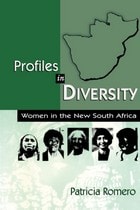
Profiles in Diversity
Women in the New South AfricaPatricia Romero
Michigan State University Press, 1998
A revealing oral history collection, Profiles in Diversity contains in-depth interviews of twenty-six women in South Africa from different racial, class, and age backgrounds. Conducted in Johannesburg, Pretoria, Bloemfontein, Vryburg, Cape Town, Port Elizabeth, Grahamstown, Durban, and a rural section of Kwa-Zulu Natal, these life histories encompass diverse experiences ranging from a squatter in a township outside Cape Town to an ANC activist in Port Elizabeth, who lost three sons to the struggle for democracy and who herself was imprisoned several times during what many in South Africa now refer to as the "civil war."
Nearly all of these women describe their formative years spent growing up in South Africa's segregated society. Three young black students discuss the hardships they experienced in an unequal educational system as well as aspects of segregation in their childhood. They are joined in their memories and hopes for the future by two mature women—one now a high court judge in Durban and the other a linguist at the University of South Africa in Pretoria—both of whom studied at Harvard in the United States. Nancy Charton, the first woman ordained as an Anglican priest in South Africa, speaks about her past and what led her, in her early seventies, to a vocation in the church.
Three Afrikaner women, including one in her late twenties, speak about growing up in South Africa and articulate their concerns for a future that, in some respects, differs from the predictions of their English-speaking or black sisters. Two now-deceased members of the South African Communist Party provide disparate accounts of what led them to lives of active opposition to the discrimination that marked the lives of people of color, long before apartheid became embedded in South Africa's legal system. Also included is an account by Dr. Goonam, an Indian woman who grew up in relative comfort in the then province of Natal, while Ray Alexander discusses how she witnessed the tyranny visited on the Jews of her native Latvia before immigrating to the Cape.
Prologues and Epilogues of Restoration Theater
Gender and Comedy, Performance and PrintDiana Solomon
University of Delaware Press, 2013
Published by University of Delaware Press. Distributed worldwide by Rutgers University Press.
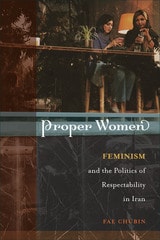
Proper Women
Feminism and the Politics of Respectability in IranFae Chubin
Temple University Press, 2024
Chubin brings attention to the varying class, ethnic, religious, and national identities of NGO staff and clients that shaped their differing understandings of oppression and justice. Her examination of the tensions within the organization reveals why the efforts of the NGO workers failed to gain purchase among the intended beneficiaries.
Proper Women concludes by encouraging feminist activists to not only examine the role of local politics and transnational connections in shaping their definitions of empowerment, but also consider the advantages of a justice-enhancing practice as opposed to justice monism for their target populations.

Prostitution, Repentance and Social Welfare in Renaissance Florence
Gillian Jack
University of London Press, 2026
A study of the survival of Sant'Elisabetta delle Convertite, the Florence monastery for repentant prostitutes, during the long Renaissance.
From the fourteenth century, prostitutes in Florence were encouraged to leave their profession and spend their lives in repentance at the monastery of Sant’Elisabetta delle Convertite. Many did over its five hundred years, and the monastery was soon one of the most populous in Florence. As the longest enduring monastery for repentant prostitutes, Sant’Elisabetta is an integral part of the history of nuns and of prostitution in the medieval and early modern periods, and it had an important place in municipal responses to social welfare and civic morality. It is only by uncovering successive governments’ involvement in Sant'Elisabetta that we can fully understand how the city attempted to manage both prostitution and welfare.
This is the first book-length study to put Sant’Elisabetta into its full historical context. It establishes the place of this often-overlooked nunnery in the wider world of medieval penitential piety, renaissance charity, and early modern social welfare, exploring the myriad ways in which the Florentine authorities attempted to stabilize Sant’Elisabetta’s finances and ensure its continued survival. Drawing on diverse archival sources, the book’s long chronological scope offers valuable insights into the broader histories of the relationship between the Florentine state and monastic institutions, public policy, welfare, and women in the long Renaissance.
Protecting Women
Labor Legislation in Europe, the United States, and Australia, 1880-1920Edited by Ulla Wikander, Alice Kessler-Harris, and Jane Lewis
University of Illinois Press, 1995
Public Feminisms
From Academy to CommunityEdited by Carrie N. Baker and Aviva Dove-Viebahn
Lever Press, 2023
The field of feminist studies grew from the U.S. women’s movements of the 1960s and 1970s and has continued to be deeply connected to ongoing movements for social justice. As educational institutions are increasingly seeing public scholarship and community engagement as relevant and fruitful complements to traditional academic work, feminist scholars have much to offer in demonstrating different ways to inform and interact with various communities. In Public Feminisms: From Academy to Community edited by Carrie N. Baker and Aviva Dove-Viebahn, a diverse range of feminist scholar-activists write about the dynamic and varied methods they use to reach beyond the traditional academic classroom and scholarly journals to share their work with the public.
Part one explores how feminist scholars engage broader audiences through art, media, and public programming, including essays on a public discussion series teaching intersectional feminist analysis of popular films, and a podcast from Latina scholars discussing issues of reproductive justice, social justice, motherhood, sexuality, race, and gender. Part two focuses on activism and public education, including essays on “Take Back the Night,” and archiving the women’s march protests. Part three turns to public writing and scholarship, including an essay on elevating the perspectives and voices of underrepresented creatives in the film and television industry. Part four explores feminist pedagogies for community engagement and for teaching public feminisms.
Accessible and engaging to a broad range of readers, the essays in this volume are a rich resource for scholars and students interested in infusing their academic knowledge into the public sphere. With this timely book, the editors offer an opportunity to reflect on the meaning and importance of community engagement and highlight some of the important public-facing work feminist scholars are doing today. Faculty, graduate, and undergraduate students, as well as administrators hoping to increase their schools’ connections to the community, will find this volume indispensable.

Public Loves, Private Troubles
Migration, Technology, and Intimacy in Rural Indigenous GuatemalaMeghan Farley Webb
University of Alabama Press, 2025
Examines the role of digital technologies in the lives of Kaqchikel Maya women whose husbands work abroad.
Anthropologist Meghan Farley Webb’s ethnography, Public Loves, Private Troubles, uses the lens of cellphones and other digital technologies to unpack marriage, love, sexuality, and family issues of Kaqchikel Maya women who remain in Guatemala while their husbands are part of the transnational migration workforce. Indigenous intimacy has been underexplored in ethnographic literature, and this is among the first books to focus on information technology's impact on intimacy and family in the Maya area. Overall, Webb shows how Maya women are empowered with their more autonomous lives when the husbands are absent but also are constrained by social media monitoring of their activities.
To begin, Webb surveys the Tecpán highland setting and civil war and migration history. She discusses how neoliberal policies are manifested in the financial and emotional stress of having to leave for the United States for economic opportunities. Chapter 1 characterizes the lives of Maya women in Guatemala who “endure” while their husbands are working abroad. Webb describes how marriage, family, and even the Catholic Church shape how the women see themselves and their situations. Chapter 2 delves into the history and use of technologies, such as cellphones and WhatsApp, and how they affect communication in these transnational households. Insight is given to the family and personhood. Chapter 3 focuses on the prominent use of the Facebook platform. Men use the app to conduct extramarital affairs, but the app is also used by couples as a way to express a public performance of devotion and a happy family. Chapter 4 focuses on the surveillance, including malicious gossip, that Kaqchikel women are subjected to especially from their mothers-in-law, who live nearby or in the same household. The narrative culminates in a discussion of how many wives are happier and more empowered without the men at home, yet they still can experience uncertainty, loneliness, and depression.
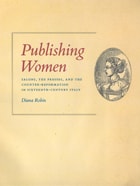
Publishing Women
Salons, the Presses, and the Counter-Reformation in Sixteenth-Century ItalyDiana Robin
University of Chicago Press, 2007
Even the most comprehensive Renaissance histories have neglected the vibrant groups of women writers that emerged in cities across Italy during the mid-1500s—and the thriving network of printers, publishers, and agents that specialized in producing and selling their books. In Publishing Women, Diana Robin finally brings to life this story of women’s cultural and intellectual leadership in early modern Italy, illuminating the factors behind—and the significance of—their sudden dominance.
Focusing on the collective publication process, Robin portrays communities in Naples, Venice, Rome, Siena, and Florence, where women engaged in activities that ranged from establishing literary salons to promoting religious reform. Her innovative cultural history considers the significant roles these women played in tandem with men, rather than separated from them. In doing so, it collapses the borders between women’s history, Renaissance and Reformation studies, and book history to evoke a historical moment that catapulted women’s writings and women-sponsored books into the public sphere for the first time anywhere in Europe.
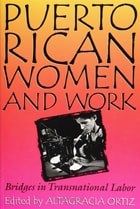
Puerto Rican Women and Work
Bridges in Transnational Laboredited by Altagracia Ortiz
Temple University Press, 1996
Puerto Rican Women and Work: Bridges in Transnational Labor is the only comprehensive study of the role of Puerto Rican women workers in the evolution of a transnational labor force in the twentieth century.
This book examines Puerto Rican women workers, both in Puerto Rico and on the U.S. mainland. It contains a range of information--historical, ethnographic, and statistical. The contributors provide insights into the effects of migration and unionization on women's work, taking into account U.S. colonialism and globalization of capitalism throughout the century as well as the impact of Operation Bootstrap. The essays are arranged in chronological order to reveal the evolutionary nature of women's work and the fluctuations in migration, technology, and the economy. This one-of-a-kind collection will be a valuable resource for those interested in women's studies, ethnic studies, and Puerto Rican and Latino studies, as well as labor studies.

Purple Hummingbird
A Biography of Elizabeth Warder Crozer CampbellClaude N. Warren and Joan S. Schneider
University of Utah Press, 2016
Elizabeth Warder Crozer Campbell and her husband, William Campbell, found themselves forced to move to the Mojave Desert in 1924, its dry climate proving to be the best for William’s frail lungs burned by mustard gas in World War I. They camped at Twentynine Palm Oasis in what is now Joshua Tree National Park, homesteaded nearby, and became a central part of that early community. Life in the remote, stark landscape contrasted sharply with Elizabeth’s early years of wealth and privilege in Pennsylvania. Her resilient spirit made the best of what at first seemed like a bleak situation: she became an amateur archaeologist and explored the desert. A keen observer and independent thinker, she soon hypothesized that prehistoric people had lived in the California deserts along the shores of late Pleistocene lakes and waterways much earlier than was then believed. She devised a means for testing her hypothesis and found evidence to support it. Her interpretations, however, conflicted with the archaeological paradigm of the day and she was dismissed by formally trained archaeologists. Even so, she and her husband continued their work, convinced of the accuracy of her findings. Four decades later the archaeological establishment validated and accepted her ideas. Campbell’s research ultimately revolutionized archaeological thought, forming the basis of today’s landscape archaeology.
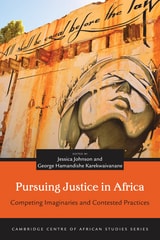
Pursuing Justice in Africa
Competing Imaginaries and Contested PracticesJessica Johnson
Ohio University Press, 2018
Pursuing Justice in Africa focuses on the many actors pursuing many visions of justice across the African continent—their aspirations, divergent practices, and articulations of international and vernacular idioms of justice. The essays selected by editors Jessica Johnson and George Hamandishe Karekwaivanane engage with topics at the cutting edge of contemporary scholarship across a wide range of disciplines. These include activism, land tenure, international legal institutions, and postconflict reconciliation.
Building on recent work in sociolegal studies that foregrounds justice over and above concepts such as human rights and legal pluralism, the contributors grapple with alternative approaches to the concept of justice and its relationships with law, morality, and rights. While the chapters are grounded in local experiences, they also attend to the ways in which national and international actors and processes influence, for better or worse, local experiences and understandings of justice. The result is a timely and original addition to scholarship on a topic of major scholarly and pragmatic interest.
Contributors:
Felicitas Becker, Jonathon L. Earle, Patrick Hoenig, Stacey Hynd, Fred Nyongesa Ikanda, Ngeyi Ruth Kanyongolo, Anna Macdonald, Bernadette Malunga, Alan Msosa, Benson A. Mulemi, Holly Porter, Duncan Scott, Olaf Zenker.
Push Back, Move Forward
The National Council of Women's Organizations and Coalition AdvocacyLaura R. Woliver
Temple University Press, 2018
The coalition known as the National Council of Women’s Organizations no longer exists today, but the history and the lessons learned from the NCWO’s activism remain as important as ever—perhaps even more so in this age of Trump. Laura Woliver spent fifteen years doing fieldwork and conducting research and interviews to understand how the NCWO coalition group functioned. The result is her impressive study, Push Back, Move Forward.
Woliver explores the foundational work of the NCWO and member groups to promote women’s economic security, citizen status, and political rights. She investigates women’s access to previously “male only” organizations, such as private clubs; the increase in voter participation generated by measures such as early voting; advocacy campaigns for such benefit programs as Social Security and the Affordable Care Act; and global human and women’s rights activism. In addition, she examines the accomplishments of women of color, both alongside and within the NCWO, who orient their politics toward achieving justice and attaining rights.
Push Back, Move Forward artfully documents this important group’s activities while also gleaning larger lessons about coalition organizations.
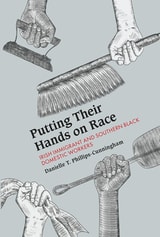
Putting Their Hands on Race
Irish Immigrant and Southern Black Domestic WorkersDanielle T. Phillips-Cunningham
Rutgers University Press, 2020
Putting Their Hands on Race offers an important labor history of 19th and early 20th century Irish immigrant and US southern Black migrant domestic workers. Drawing on a range of archival sources, this intersectional study explores how these women were significant to the racial labor and citizenship politics of their time. Their migrations to northeastern cities challenged racial hierarchies and formations. Southern Black migrant women resisted the gendered racism of domestic service, and Irish immigrant women strove to expand whiteness to position themselves as deserving of labor rights. On the racially fractious terrain of labor, Black women and Irish immigrant women, including Victoria Earle Matthews, the “Irish Rambler”, Leonora Barry, and Anna Julia Cooper, gathered data, wrote letters and speeches, marched, protested, engaged in private acts of resistance in the workplace, and created women’s institutions and organizations to assert domestic workers’ right to living wages and protection.