Results by title
28167 books match the query 'History' and 1297 start with p

Protestant Diplomacy and the Near East
Missionary Influence on American Policy, 1810-1927Joseph L. Grabill
University of Minnesota Press, 1971
Protestant Diplomacy and the Near East was first published in 1971. Minnesota Archive Editions uses digital technology to make long-unavailable books once again accessible, and are published unaltered from the original University of Minnesota Press editions.
For understand of the Middle East today, it is essential to know something of the historical background of that region, traditionally known as the Near East. In tracing the influence of American Protestant missionary activities on American foreign policy and diplomacy in the Near East, Professor Grabill contributes significantly to an understanding of contemporary affairs.
It becomes clear, in this account, that missionaries and philanthropists were the most influential force in the United States' relations with the Near East through the First World War and its aftermath. An important turning point in the history occurred in 1915 when officials of the Ottoman Empire massacred or deported several hundred thousand Turkish Armenians, among whom were the principal constituents of the American missionaries. This prompted the mission groups to shift their emphasis from evangelism and education to the development of the second largest relief organization in the United States history ) eventually called Near East Relief). Through powerful lobbying, the missionaries got their government to consider seriously a protectorate over Armenia or all of Asia Minor. Despite their political failure, the religionists succeeded as cultural frontiersmen through their colleges, such as the American University of Beirut, and their technical assistance programs, which showed the way for the Fulbright, foreign aid, and Peace Corps programs.
The archives of the American Board of Commissioners for Foreign Missions
(Congregational) and the Presbyterian Board of Missions provided rich source material for this book. The illustrations include photographs and maps.
Protestant Nation
The Fragile Christian Roots of America's GreatnessAlain Besançon
St. Augustine's Press, 2017
Protestant--Catholic--Jew
An Essay in American Religious SociologyWill Herberg
University of Chicago Press, 1983
"In Protestant-Catholic-Jew Will Herberg has written the most fascinating essay on the religious sociology of America that has appeared in decades. He has digested all the relevant historical, sociological and other analytical studies, but the product is no mere summary of previous findings. He has made these findings the basis of a new and creative approach to the American scene. It throws as much light on American society as a whole as it does on the peculiarly religious aspects of American life. Mr. Herberg. . . illumines many facets of the American reality, and each chapter presents surprising, and yet very compelling, theses about the religious life of this country. Of all these perhaps the most telling is his thesis that America is not so much a melting pot as three fairly separate melting pots."—Reinhold Niebuhr, New Yorks Times Book Review
Protestantism and Political Conflict in the Ninteenth-Century Hispanic Caribbean
Martínez-Fernández, Luis
Rutgers University Press, 2001
Catholicism has long been recognized as one of the major forces shaping the Hispanic Caribbean (Cuba, Puerto Rico, and the Dominican Republic) during the nineteenth century, but the role of Protestantism has not been fully explored. Protestantism and Political Conflict in the Nineteenth-Century Hispanic Caribbean traces the emergence of Protestantism in Cuba and Puerto Rico during a crucial period of national consolidation involving both social and political struggle. Using a comparative framework, Martínez-Fernández looks at the ways in which Protestantism, though officially “illegal” for most of the century, established itself, competed with Catholicism, and took differing paths in Cuba and Puerto Rico.
One of the book’s main goals is to trace the links between religion and politics, particularly with regard to early Protestant activities. Protestants encountered a complex social, economic, and political landscape both in Cuba and in Puerto Rico and soon found that their very presence, coupled with their demands for freedom of worship and burial rights, involved them in a series of interrelated struggles in which the Catholic Church was embroiled along with the other main forces of the period—the peasantry, the agrarian bourgeoisie, the mercantile bourgeoisie, and the colonial state. While the established Catholic Church increasingly identified with the conservative, pro-slavery, and colonialist causes, newly arrived Protestants tended to be nationalistic and to pursue particular economic activities—such as cigar exportation in Cuba and the sugar industry in Puerto Rico. The author argues that the early Protestant communities reflected the socio-cultural milieus from which they emerged and were profoundly shaped by the economic activities of their congregants. This influence, in turn, shaped not only the congregations’ composition, but also their political and social orientations.
Protestantism in Guatemala
Living in the New JerusalemBy Virginia Garrard-Burnett
University of Texas Press, 1998
Guatemala has undergone an unprecedented conversion to Protestantism since the 1970s, so that thirty percent of its people now belong to Protestant churches, more than in any other Latin American nation. To illuminate some of the causes of this phenomenon, Virginia Garrard-Burnett here offers the first history of Protestantism in a Latin American country, focusing specifically on the rise of Protestantism within the ethnic and political history of Guatemala.
Garrard-Burnett finds that while Protestant missionaries were early valued for their medical clinics, schools, translation projects, and especially for the counterbalance they provided against Roman Catholicism, Protestantism itself attracted few converts in Guatemala until the 1960s. Since then, however, the militarization of the state, increasing public violence, and the "globalization" of Guatemalan national politics have undermined the traditional ties of kinship, custom, and belief that gave Guatemalans a sense of identity, and many are turning to Protestantism to recreate a sense of order, identity, and belonging.
Protocols of Liberty
Communication Innovation and the American RevolutionWilliam B. Warner
University of Chicago Press, 2013
Protogaea
Gottfried Wilhelm Leibniz
University of Chicago Press, 2008
Though the works of Leibniz have been widely translated, Protogaea has languished in its original Latin for centuries. Now Claudine Cohen and Andre Wakefield offer the first English translation of this central text in natural philosophy and natural history. Written between 1691 and 1693, and first published after Leibniz’s death in 1749, Protogaea reemerges in this bilingual edition with an introduction that carefully situates the work within its historical context.

Protohistoric Yamato
Archaeology of the First Japanese StateGina Lee Barnes
University of Michigan Press, 1988
Provenance Research for Mediterranean Antiquities
Methods and ResourcesJudith Barr
J. Paul Getty Trust, The, 2026
The first of its kind, this book is an accessible, comprehensive primer of methods and resources for researching the provenance of Mediterranean (Greek, Roman, and Etruscan) antiquities. In addition to outlining effective strategies for documentation and investigation, the volume features an annotated guide to key archives, databases, and twentieth-century dealers to facilitate a broad spectrum of research endeavors. Building upon a decade-long review of the Getty Museum’s antiquities collection, it draws together instructive case studies, legal perspectives, and practical experience to provide an efficient reference for museum professionals, scholars, collectors, and students. The authors aim to emphasize the need for diligent provenance research and to shorten the learning curve for such projects.
The free online edition of this open-access publication is available at getty.edu/publications/provenance-research and includes zoomable illustrations. Also available are free PDF and EPUB downloads of the book.
Providence Watching
Journeys from Wartorn Poland to the Canadian PrairiesKazimierz Patalas
University of Manitoba Press, 2003
Providing for the Poor
The Old Poor Law, 1750-1834Edited by Peter Collinge and Louise Falcini
University of London Press, 2022
The Old Poor Law, which was established in 1601 in England and Wales and was in force until 1834, was administered by the local parish and dispensed goods and services to paupers, providing a uniquely comprehensive, premodern system of support for the poor. Providing for the Poor brings together academics and practitioners from across disciplines to reexamine the micropolitics of poverty in the long eighteenth century through the eyes of the poor, their providers, and enablers. Covering such topics as the providence of the parochial sixpence, which was given in order to get a beggar to move along to another parish, to coercive marriages, plebeian clothing, and the much broader implications of vagrancy toward the end of the long eighteenth century, this volume aims to bridge the gaps in our understanding of the experiences of people across the social spectrum whose lives were touched by the Old Poor Law. It brings together some of the wider arguments concerning the nature of welfare during economically difficult times and documents the rising bureaucracy inherent in the system to produce a radical new history of the Old Poor Law in astonishing detail.
Provincial Inca
Archaeological and Ethnohistorical Assessment of the Impact of the Inca StateMichael A. Malpass
University of Iowa Press, 1993
Provincial Soldiers and Imperial Instability in the Histories of Tacitus
Jonathan Master
University of Michigan Press, 2016
Master draws on scholarship in political theory, Latin historiography, Roman history, and ethnic identity to demonstrate how Tacitus presented to his contemporary audience in Trajanic Rome the dangerous consequences of the city’s failure to reward and incorporate its provincial subjects. Master argues that Tacitus’ presentation of the Vitellian and Flavian armies, and especially the Batavian auxiliary soldiers, reflects a central lesson of the Histories: the Empire’s exploitation of provincial manpower (increasingly the majority of all soldiers under Roman banners) while offering little in return, set the stage for civil wars and ultimately the separatist Batavian revolt.

Proving Grounds
Project Plowshare and the Unrealized Dream of Nuclear EarthmovingKirsch, Scott L
Rutgers University Press, 2005
Although unthinkable by today’s standards, the U.S. Atomic Energy Commission spent hundreds of millions of dollars between 1957 and 1974 studying the feasibility of using nuclear explosions for so-called “peaceful” purposes under a program called Project Plowshare. Nuclear earthmoving, promoted by the famed physicist, defense strategist, and anticommunist Edward Teller, was the most notorious of Plowshare’s experimental programs. Teller and his colleagues proposed using nuclear explosions to build canals, dig harbors, and create dams and quarries. Such “constructive” uses of atomic weaponry, they believed, would help defuse Americans’ fears about radioactive fallout and nuclear testing and would encourage continued support for nuclear research programs.
In Proving Grounds, Scott Kirsch traces the rise and fall of this astonishing cold war initiative. He examines the work that went into making “geographical engineering” or “earthmoving” an imminent possibility as well as the public controversy, scientific uncertainty, and political opposition that kept it—with the exception of several massive craters in the Nevada desert—out of the landscape.
On one level, Kirsch demonstrates how the history of Project Plowshare was shaped by the specific issues and sentiments that influenced American nuclear and environmental policy during the 1950s and 1960s. But Kirsch also argues that the lessons learned from this case continue to hold relevance today. By exploring key issues of science and risk, Proving Grounds warns that knowledge production and environmental politics are still very much intimately, and dangerously, related.
Provisional Authority
Police, Order, and Security in IndiaBeatrice Jauregui
University of Chicago Press, 2016
Jauregui explores the paradoxical demands placed on Indian police, who are at once routinely charged with abuses of authority at the same time that they are asked to extend that authority into any number of both official and unofficial tasks. Her ethnography of their everyday life and work demonstrates that police authority is provisional in several senses: shifting across time and space, subject to the availability and movement of resources, and dependent upon shared moral codes and relentless instrumental demands. In the end, she shows that police authority in India is not simply a vulgar manifestation of raw power or the violence of law but, rather, a contingent and volatile social resource relied upon in different ways to help realize human needs and desires in a pluralistic, postcolonial democracy.
Provocative and compelling, Provisional Authority provides a rare and disquieting look inside the world of police in India, and shines critical light on an institution fraught with moral, legal and political contradictions.

Provocative Eloquence
Theater, Violence, and Antislavery Speech in the Antebellum United StatesLaura L. Mielke
University of Michigan Press, 2019
Provoking the Press
(MORE) Magazine and the Crisis of Confidence in American JournalismKevin M. Lerner
University of Missouri Press, 2023
Two of these new journalists, a Pulitzer Prize—winning, Harvard-educated New York Times reporter named J. Anthony Lukas, and a former Newsweek media writer named Richard Pollak, founded a journalism review called (MORE) in 1971, with its pilot issue appearing the same month that the Times began publishing the Pentagon Papers. (MORE) covered the press with a critical attitude that blended seriousness and satire—part New York Review of Books, part underground press. In the eight years that it published, (MORE) brought together nearly every important American journalist of the 1970s, either as a writer, a subject of its critical eye, or as a participant in its series of raucous "A.J. Liebling Counter-Conventions"—meetings named after the outspoken press critic—the first of which convened in 1974. In issue after issue the magazine considered and questioned the mainstream press's coverage of explosive stories of the decade, including the Watergate scandal; the "seven dirty words" obscenity trial; the debate over a reporter's constitutional privilege; the rise of public broadcasting; the struggle for women and minorities to find a voice in mainstream newsrooms; and the U.S. debut of press baron Rupert Murdoch.
In telling the story of (MORE) and its legacy, Kevin Lerner explores the power of criticism to reform and guide the institutions of the press and, in turn, influence public discourse.

Proxmire
Bulldog of the SenateJonathan Kasparek
Wisconsin Historical Society Press, 2019

Psychiatric Contours
New African Histories of MadnessNancy Rose Hunt and Hubertus Büschel, editors
Duke University Press, 2024
Contributors. Hubertus Büschel, Raphaël Gallien, Matthew M. Heaton, Richard Hölzl, Nancy Rose Hunt, Richard C. Keller, Sloan Mahone, Nana Osei Quarshie, Jonathan Sadowsky, Romain Tiquet
Psychoanalysis and the Challenge of Islam
Fethi Benslama
University of Minnesota Press, 2009
Unveils the psychoanalytic undercurrents of contemporary Islam
Fethi Benslama is a psychoanalyst who, although a secular thinker, identifies himself as a person of Muslim culture who rejects ready-made explanations for Islamic fundamentalism. In that spirit, Benslama demythifies both Islam and Western ideas of the religion by addressing the psychoanalytic root causes of the Muslim world’s clash with modernity and subsequent turn to fundamentalism.
Tracing this ideological strain to its origins, Benslama shows that contemporary Islam consists of a fairly recent hybridization of Arab nationalism, theocracy, and an attempt (both naïve and deadly) to ground science in faith. Combining textual analysis and Lacanian and Freudian psychoanalysis, he examines Islam’s foundation, providing fresh readings of the book of Genesis, the Koran, The Arabian Nights, and the work of medieval Islamic philosophers.Refreshingly, Benslama writes without ideological bias and undoes the simplistic, Western view of Islam while refusing to romanticize terrorism or Muslim extremism. This is a penetrating work that reveals an alternate history of the Islamic religion and opens new possibilities for its future development.
Psychological Testing and American Society, 1890-1913
Sokal, Michael M
Rutgers University Press, 1990
Psychology and Politics
Intersections of Science and Ideology in the History of Psy-SciencesFerenc Eros
Central European University Press, 2019
Psy-sciences (psychology, psychiatry, psychoanalysis, pedagogy, criminology, special education, etc.) have been connected to politics in different ways since the early twentieth century. Here in twenty-two essays scholars address a variety of these intersections from a historical perspective.
The chapters include such diverse topics as the cultural history of psychoanalysis, the complicated relationship between psychoanalysis and the occult, and the struggles for dominance between the various schools of psychology. They show the ambivalent positions of the "psy" sciences in the dictatorships and authoritarian regimes of Nazi Germany, East European communism, Latin-American military dictatorships, and South African apartheid, revealing the crucial role of psychology in legitimating and "normalizing" these regimes.
The authors also discuss the ideological and political aspects of mental health and illness in Hungary, Germany, post-WW1 Transylvania, and Russia. Other chapters describe the attempt by critical psychology to understand the production of academic, therapeutic, and everyday psychological knowledge in the context of the power relations of modern capitalist societies.

Psychology in Human Context
Essays in Dissidence and ReconstructionSigmund Koch
University of Chicago Press, 1999
The broad scope of essays in Psychology in Human Context—which began as the basis for the eagerly anticipated postscript to Koch's seminal Psychology: A Study of a Science—reveals his writings to be as fresh and relevant today as ever. Carefully edited by two of Koch's close associates, this collection places psychological and philosophical issues in the context of twentieth-century thought and provides intellectual and moral signposts for future travelers in what Koch regarded as the irreducibly rich and human realm of the psychological studies.
Sigmund Koch was University Professor of Psychology and Philosophy at Boston University, the editor of the landmark six-volume series Psychology: A Study of a Science (1959-1963) and coeditor of A Century of Psychology as Science. He served as the president of three divisions of the American Psychological Association and was director of the Ford Foundation program in the Humanities and the Arts (1964-1967).

Public Affairs
Politics in the Age of Sex ScandalsPaul Apostolidis and Juliet A. Williams, eds.
Duke University Press, 2004
The essays in Public Affairs reflect on a number of sex scandals while emphasizing the Clinton/Lewinsky affair, certainly the most avidly followed and momentous sex scandal in American political history. Leading scholars situate contemporary public affairs in the context not only of earlier sex scandals in American politics (such as Thomas Jefferson’s and Sally Hemings’s affair), but also of more purely political scandals (including Teapot Dome and Watergate) and sex scandals centered around public figures other than politicians (such as the actor Hugh Grant and the minister Jimmy Swaggart). Some essays consider the Clinton affair in light of feminist and anti-racist politics, while others discuss the dynamics of scandals as major media events. By charting a critical path through the muck of scandal rather than around it, Public Affairs illuminates why sex scandals have become such a prominent feature of American public life.
Contributors. Paul Apostolidis, Jodi Dean, Joshua Gamson, Theodore J. Lowi, Joshua D. Rothman, George Shulman, Anna Marie Smith, Jeremy Varon, Juliet A. Williams
Public City/Public Sex
Homosexuality, Prostitution, and Urban Culture in Nineteenth-Century ParisAndrew Israel Ross
Temple University Press, 2019
In the 1800s, urban development efforts modernized Paris and encouraged the creation of brothels, boulevards, cafés, dancehalls, and even public urinals. However, complaints also arose regarding an apparent increase in public sexual activity, and the appearance of “individuals of both sexes with depraved morals” in these spaces. Andrew Israel Ross’s illuminating study, Public City/Public Sex, chronicles the tension between the embourgeoisement and democratization of urban culture in nineteenth-century Paris and the commercialization and commodification of a public sexual culture, the emergence of new sex districts, as well as the development of gay and lesbian subcultures.
Public City/Public Sex examines how the notion that male sexual desire required suitable outlets shaped urban policing and development. Ross traces the struggle to control sex in public and argues that it was the very effort to police the city that created new opportunities for women who sold sex and men who sought sex with other men. Placing public sex at the center of urban history, Ross shows how those who used public spaces played a central role in defining the way the city was understood.
Public Debate in the Civil War Era
A Rhetorical History of the United States, Volume IVDavid Zarefsky
Michigan State University Press, 2023
Public Documents from Sinnar
Jay Spaulding
Michigan State University Press, 1989
This selection of Arabic and English translations illuminates the changes of eighteenth-century government in the northern Nile Valley of Sudan, and provides reliable chronological points of reference for the history of the region.
The documents offered in this volume, including charter grants of land and privilege, administrative letters, judicial rulings, and other official government records, date form 1702 to 1820. This period marks the apogee of the wealth, power, and geographical extent of the realm of the Funji kings of Sinnar who reigned over much of the Sudan from about 1500 until the Turkish colonial conquest of 1821.
These records document with concrete precision and eloquence the dissolution of the agrarian social order of an old African kingdom under the corroding influence of intrusive Mediterranean commercial practices and culture. They reveal the Sudan's legacy of a traditionally weak government vulnerable to manipulation or conquest by foreign powers and a divided and impoverished society dominated by a minority of urban interests.
Public Education and Social Reform
A History of the Illinois Education AssociationThomas J. Suhrbur
University of Illinois Press, 2025
Suhrbur pays particular attention to the impact of race, gender, religion, and tax policy on the IEA and public schools. He also examines the IEA’s evolution from a professional organization controlled by administrations and officials through its radical transformation into a teacher-led independent labor union. As a workers’ organization, the IEA successfully fought for collective bargaining and organized K–12 and higher education while continually standing against right-wing efforts to privatize education and undermine public schools with vouchers, for-profit institutions, and tax credits.
Multifaceted and up to date, Public Education and Social Reform tells the story of the organization and figures dedicated to sustaining and advancing Illinois public education.
Public Face Of Modernism
Little Magazines, Audiences, And Reception, 1905-1920Mark S. Morrisson
University of Wisconsin Press, 2000
The phenomenal successes of new advertising agencies and mass market publishers did elicit what Morrisson calls a "crisis of publicity" for some modernists and for many concerned citizens in both countries. But, as Morrisson demonstrates, the vast influence of these industries on consumers also had a profound and largely overlooked effect upon many modernist authors, artists, and others. By exploring the publicity and audience reception of several of the most important modernist magazines of the period, The Public Face of Modernism shows how modernists, far from lamenting the destruction of meaningful art and public culture by the new mass market, actually displayed optimism about the power of mass-market technologies and strategies to transform and rejuvenate contemporary culture—and, above all, to restore a public function to art.
This reconstruction of the "public face of modernism" offers surprising new perceptions about the class, gender, racial, and even generational tensions within the public culture of the early part of the century, and provides a rare insight into the actual audiences for modernist magazines of the period. Moreover, in new readings of works by James Joyce, George Bernard Shaw, Wyndham Lewis, Ford Madox Ford, T. S. Eliot, William Carlos Williams, and many others, Morrisson shows that these contexts also had an impact on the techniques and concerns of the literature itself.
Public Health
The Development of a Discipline, From the Age of Hippocrates to the Progressive EraSchneider, Dona
Rutgers University Press, 2008
The editors provide annotated readings and biographical details to punctuate the historical timeline and to provide students with insights into the progression of ideas, initiatives, and reforms in the field. From Hippocrates and John Graunt in the early period, to John Snow and Florence Nightingale during the nineteenth-century sanitary reform movement, to Upton Sinclair and Margaret Sanger in the Progressive Era, readers follow the identification, evolution, and implementation of public health concepts as they came together under one discipline.
Public Health
The Development of a Discipline, Twentieth-Century ChallengesSchneider, Dona
Rutgers University Press, 2011
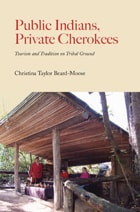
Public Indians, Private Cherokees
Tourism and Tradition on Tribal GroundChristina Taylor Beard-Moose
University of Alabama Press, 2008
A major economic industry among American Indian tribes is the public promotion and display of aspects of their cultural heritage in a wide range of tourist venues. Few do it better than the Eastern Band of the Cherokee, whose homeland is the Qualla Boundary of North Carolina. Through extensive research into the work of other scholars dating back to the late 1800s, and interviews with a wide range of contemporary Cherokees, Beard-Moose presents the two faces of the Cherokee people. One is the public face that populates the powwows, dramatic presentations, museums, and myriad roadside craft locations. The other is the private face whose homecoming, Indian fairs, traditions, belief system, community strength, and cultural heritage are threatened by the very activities that put food on their tables. Constructing an ethnohistory of tourism and comparing the experiences of the Cherokee with the Florida Seminoles and Southwestern tribes, this work brings into sharp focus the fine line between promoting and selling Indian culture.

Public Lettering
Script, Power, and CultureArmando Petrucci
University of Chicago Press, 1993
buildings, commercial graphics, signs, epitaphs on tombstones,
graffiti—is a fixture of urban life. In Public
Lettering, Armando Petrucci reconstructs the history of
public writing in the West and traces its social functions
from the eleventh century through the modern period.
Taking the city of Rome as a case study, Petrucci begins
with a consideration of the first civic inscriptions after
ancient times. Substantial chapters on the uses of public
writing in the industrial revolution and the early twentieth
century prepare the way for his provocative discussions of
public lettering in the the contexts of fascism, post-war
radicalism, and the student revolutions of 1968 and 1977.
Throughout, Petrucci is concerned with the relations
between the functions and styles of letters and the places
where they appear. Writing, he argues, is one of the
instruments of public power; display lettering is often the
image and mirror of power itself, making the social use of
written forms a type of conquest. Because of Rome's role as
a “World-City,” Petrucci's interdisciplinary study has
wide-ranging implications for our understanding of the social
function of graphic design.

Public Libraries in Nazi Germany
Margaret F. Stieg
University of Alabama Press, 1992
"Margaret F. Stieg's thoroughly researched study, the first comprehensive examination of public libraries in Nazi Germany, reveals that library policy in the Third Reich was far more complex than we might assume, with the positive and the negative hopelessly entangled. . . . A solid and welcome contribution."
—American Historical Review

Public Loves, Private Troubles
Migration, Technology, and Intimacy in Rural Indigenous GuatemalaMeghan Farley Webb
University of Alabama Press, 2025
Examines the role of digital technologies in the lives of Kaqchikel Maya women whose husbands work abroad.
Anthropologist Meghan Farley Webb’s ethnography, Public Loves, Private Troubles, uses the lens of cellphones and other digital technologies to unpack marriage, love, sexuality, and family issues of Kaqchikel Maya women who remain in Guatemala while their husbands are part of the transnational migration workforce. Indigenous intimacy has been underexplored in ethnographic literature, and this is among the first books to focus on information technology's impact on intimacy and family in the Maya area. Overall, Webb shows how Maya women are empowered with their more autonomous lives when the husbands are absent but also are constrained by social media monitoring of their activities.
To begin, Webb surveys the Tecpán highland setting and civil war and migration history. She discusses how neoliberal policies are manifested in the financial and emotional stress of having to leave for the United States for economic opportunities. Chapter 1 characterizes the lives of Maya women in Guatemala who “endure” while their husbands are working abroad. Webb describes how marriage, family, and even the Catholic Church shape how the women see themselves and their situations. Chapter 2 delves into the history and use of technologies, such as cellphones and WhatsApp, and how they affect communication in these transnational households. Insight is given to the family and personhood. Chapter 3 focuses on the prominent use of the Facebook platform. Men use the app to conduct extramarital affairs, but the app is also used by couples as a way to express a public performance of devotion and a happy family. Chapter 4 focuses on the surveillance, including malicious gossip, that Kaqchikel women are subjected to especially from their mothers-in-law, who live nearby or in the same household. The narrative culminates in a discussion of how many wives are happier and more empowered without the men at home, yet they still can experience uncertainty, loneliness, and depression.
Public Office in Early Rome
Ritual Procedure and Political PracticeRoberta Stewart
University of Michigan Press, 2010
---Bryn Mawr Classical Review
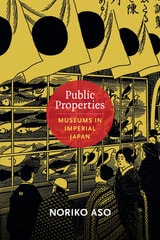
Public Properties
Museums in Imperial JapanNoriko Aso
Duke University Press, 2013
Public Relations and the Press
The Troubled EmbraceKarla Gower
Northwestern University Press, 2007
A democracy works when individuals have access to reliable information upon which to base decisions—information that in our day comes from the mass media. But what if journalists do not have the wherewithal to question their sources and evaluate the information they provide? This, Karla K. Gower explains, is precisely what happens when economic and competitive pressures shift power from the journalist to the source—and the source, not the journalist, controls the flow of information to the public. Gowers describes a situation in which people, “informed” by practitioners of public relations, do not have sufficient information to make valid decisions. At stake is the core credibility of the press itself, and therefore the essential claim of journalism to a privileged role in a democratic social order.
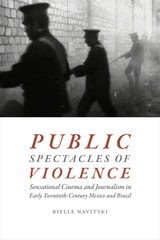
Public Spectacles of Violence
Sensational Cinema and Journalism in Early Twentieth-Century Mexico and BrazilRielle Navitski
Duke University Press, 2017
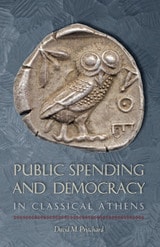
Public Spending and Democracy in Classical Athens
By David M. Pritchard
University of Texas Press, 2015
In his On the Glory of Athens, Plutarch complained that the Athenian people spent more on the production of dramatic festivals and “the misfortunes of Medeas and Electras than they did on maintaining their empire and fighting for their liberty against the Persians.” This view of the Athenians’ misplaced priorities became orthodoxy with the publication of August Böckh’s 1817 book Die Staatshaushaltung der Athener [The Public Economy of Athens], which criticized the classical Athenian dēmos for spending more on festivals than on wars and for levying unjust taxes to pay for their bloated government. But were the Athenians’ priorities really as misplaced as ancient and modern historians believed?
Drawing on lines of evidence not available in Böckh’s time, Public Spending and Democracy in Classical Athens calculates the real costs of religion, politics, and war to settle the long-standing debate about what the ancient Athenians valued most highly. David M. Pritchard explains that, in Athenian democracy, voters had full control over public spending. When they voted for a bill, they always knew its cost and how much they normally spent on such bills. Therefore, the sums they chose to spend on festivals, politics, and the armed forces reflected the order of the priorities that they had set for their state. By calculating these sums, Pritchard convincingly demonstrates that it was not religion or politics but war that was the overriding priority of the Athenian people.
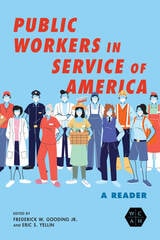
Public Workers in Service of America
A ReaderEdited by Frederick W. Gooding Jr. and Eric S. Yellin
University of Illinois Press, 2023
From white-collar executives to mail carriers, public workers meet the needs of the entire nation. Frederick W. Gooding Jr. and Eric S. Yellin edit a collection of new research on this understudied workforce. Part One begins in the late nineteenth- and early twentieth century to explore how questions of race, class, and gender shaped public workers, their workplaces, and their place in American democracy. In Part Two, essayists examine race and gender discrimination while revealing the subtle contemporary forms of marginalization that keep Black men and Black and white women underpaid and overlooked for promotion. The historic labor actions detailed in Part Three illuminate how city employees organized not only for better pay and working conditions but to seek recognition from city officials, the public, and the national labor movement. Part Four focuses on nurses and teachers to address the thorny question of whether certain groups deserve premium pay for their irreplaceable work and sacrifices or if serving the greater good is a reward unto itself.
Contributors: Eileen Boris, Cathleen D. Cahill, Frederick W. Gooding Jr., William P. Jones, Francis Ryan, Jon Shelton, Joseph E. Slater, Katherine Turk, Eric S. Yellin, and Amy Zanoni
Public and Private
Gender, Class, and the British Novel (1764-1878)Patricia McKee
University of Minnesota Press, 1997
Public and Private was first published in 1997. Minnesota Archive Editions uses digital technology to make long-unavailable books once again accessible, and are published unaltered from the original University of Minnesota Press editions.
This groundbreaking work examines the emergent and fluctuating relationship between the public and private social spheres of the late eighteenth and nineteenth centuries. By assessing novels such as Mary Shelley's Frankenstein and Jane Austen's Emma through the lens of the social theories of Jürgen Habermas and Michel Foucault, Patricia McKee presents a fresh and highly original contribution to literary studies.
McKee explores the themes of production and consumption as they relate to gender and class throughout the works of many of the most influential novels of the age including Tobias Smollett's Humphry Clinker, Horace Walpole's The Castle of Otranto, Emma, Frankenstein, Anthony Trollope's Barchester Towers, Charles Dickens's Little Dorrit and The Old Curiosity Shop, Mrs. Henry Wood's East Lynne, and Thomas Hardy's The Return of the Native.
McKee analyzes portrayals of a society in which abstract idealism belonged to knowledgeable, productive men and the realm of ignorance was left to emotional, consuming women and the uneducated. She traces the various ways British literature of the eighteenth and nineteenth centuries worked to reform this social experience. Topics include Dickens's attack on the bureaucratic use of knowledge to maintain the status quo; the function of antiprogressive depictions of knowledge in Trollope, Shelley, and Hardy; and Austen's characterization of the protagonist Emma as an exception in a society that denied women's productive use of knowledge.
Offering a sharp challenge to theorists who have charted a linear division of public and private experience, McKee highlights the unexpected configurations of the emergence of the public and private spheres and the effect of knowledge distribution across class and gender lines.
Patricia McKee is professor of English at Dartmouth College. She is the author of Heroic Commitment in Richardson, Eliot, and James (1986).
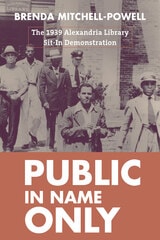
Public in Name Only
The 1939 Alexandria Library Sit-In DemonstrationBrenda Mitchell-Powell
University of Massachusetts Press, 2022
Library History Round Table Reads Selection, March 2024
Alexandria Historical Society Special Merit Award, 2023
When Alexandria, Virginia’s first public library, was constructed just a few blocks from his home, Samuel Wilbert Tucker, a young, Black attorney, was appalled to learn that he could not use the library because of his race. Inspired by the legal successes of the NAACP in discrimination cases, he organized a grassroots protest to desegregate the library that his tax dollars supported.
Public in Name Only tells the important, but largely forgotten, story of Tucker and a group of Black citizens who agitated for change in the terms and conditions of their lives. Employing the combined strategies of direct-action public protest, nonviolent civil disobedience, and municipal litigation, Tucker’s initiative dovetailed with the national priorities and tactics of larger civil rights organizations. While Tucker’s campaign did not end with the desegregation of the Alexandria Library, but instead resulted in the creation of a “separate-and-unequal” Jim Crow Black branch, the sit-in demonstration represents a momentous early struggle for racial equity waged through civil rights activism.
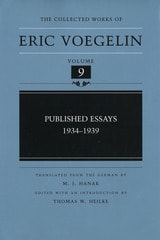
Published Essays, 1934-1939 (CW9)
Eric Voegelin, Edited & Intro by Thomas W. Heilke, & Translated by M. J. Hanak
University of Missouri Press, 2001
In this collection of essays, which covers the years from 1934 to1939, we see Eric Voegelin in the role of both scholar and public intellectual in Vienna until he was forced to flee the Nazi terror that descended on Austria in 1938. Revealing the broad spectrum of thinking and scientific study of this relatively young scholar, Voegelin's essays range from Austrian politics, Austrian constitutional history, and European racism to questions of the formation and expression of public opinion, theories of administrative law, and the role of political science in public university education. Several essays serve as useful commentaries on, elaborations of, or synopses of arguments Voegelin made in the five books he had published between 1928 and 1938.
Within these topical headings, there are multiple thematic threads that wind their way through these essays and that remain of interest to contemporary readers. Thirteen of the pieces contained in this collection are short items that Voegelin published in trade journals and newspapers, of which nine appeared in the Wiener Zeitung in 1934 and the Neue Freie Presse in 1937. In these we see two brief periods in which Voegelin played the role of public intellectual not only as a lecturer but also in print.
These essays will be of interest to a wide range of scholars, including constitutional historians, historians of political science, political theorists, and students of Voegelin's later work.
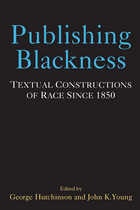
Publishing Blackness
Textual Constructions of Race Since 1850George Hutchinson and John K. Young, Editors
University of Michigan Press, 2013
From the white editorial authentication of slave narratives, to the cultural hybridity of the Harlem Renaissance, to the overtly independent publications of the Black Arts Movement, to the commercial power of Oprah's Book Club, African American textuality has been uniquely shaped by the contests for cultural power inherent in literary production and distribution. Always haunted by the commodification of blackness, African American literary production interfaces with the processes of publication and distribution in particularly charged ways. An energetic exploration of the struggles and complexities of African American print culture, this collection ranges across the history of African American literature, and the authors have much to contribute on such issues as editorial and archival preservation, canonization, and the "packaging" and repackaging of black-authored texts. Publishing Blackness aims to project African Americanist scholarship into the discourse of textual scholarship, provoking further work in a vital area of literary study.
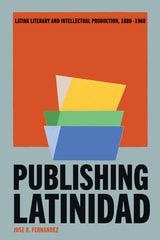
Publishing Latinidad
Latinx Literary and Intellectual Production, 1880–1960Jose O. Fernandez
University of Arizona Press, 2025
Publishing Latinidad brings to light the overlooked contributions of early Latinx writers and intellectuals, offering a fresh perspective on their roles in shaping American literary and cultural landscapes.
Jose O. Fernandez meticulously examines the works of notable figures like José Martí, Arturo Schomburg, Jesús Colón, José de la Luz Sáenz, Adela Sloss-Vento, and Américo Paredes, illuminating their innovative approaches to circumventing exclusionary practices in the publishing world. He demonstrates how these writers and intellectuals entered literary, cultural, and intellectual discourses through alternative modes of literary production: crónicas, translations, paratexts, bibliographies, archival practices, sketches, diaries, biographies, unpublished fiction, and scholarly monographs. Through these examples, Fernandez situates Latinx literary production in this time period within the broader context of racial and ethnic solidarity movements in the United States.
Publishing Latinidad is essential reading for anyone interested in the social and cultural underpinnings of Latinx literature and intellectual thought. It challenges traditional narratives and enriches our appreciation of the diverse voices that have long been instrumental in the fight for justice.
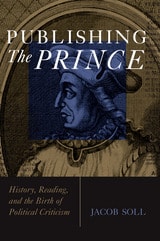
Publishing The Prince
History, Reading, and the Birth of Political CriticismJacob Soll
University of Michigan Press, 2010
As new ideas arose during the Enlightenment, many political thinkers published their own versions of popular early modern "absolutist" texts and transformed them into manuals of political resistance. As a result, these works never achieved a fixed and stable edition. Publishing The Prince illustrates how Abraham-Nicolas Amelot de La Houssaye created the most popular late seventeenth- and eighteenth-century version of Machiavelli's masterpiece. In the process of translating, Amelot also transformed the work, altering its form and meaning, and his ideas spread through later editions.
Revising the orthodox schema of the public sphere in which political authority shifted away from the crown with the rise of bourgeois civil society in the eighteenth century, Soll uses the example of Amelot to show for the first time how the public sphere in fact grew out of the learned and even royal libraries of erudite scholars and the bookshops of subversive, not-so-polite publicists of the republic of letters.
Jacob Soll is Associate Professor of History at Rutgers University.
Cover art courtesy of Annenberg Rare Book Room and Manuscript Library, University of Pennsylvania
Jacket Design: Stephanie Milanowski
"Jacob Soll traces the origins of Enlightenment criticism to the practices of learned humanists and hard-pressed literary entrepreneurs. This learned and lively book is also a tour de force of historical research and interpretation."
---Anthony Grafton, author of Cardano's Cosmos and Bring Out Your Dead
"Brilliant. How the printed page changed political philosophy into investigative reporting, and reason of state into the unmasking of power."
---J. G. A. Pocock, author of The Machiavellian Moment
"Soll's path-breaking study is a 'must read' for all those interested in the history of political thought and early modern intellectual history."
---Barbara Shapiro, University of California Berkeley
"Soll has done [Amelot] and his context justice, writing as he does with a clear, singular, and welcome voice."
---Margaret C. Jacobs, American Historical Review
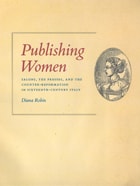
Publishing Women
Salons, the Presses, and the Counter-Reformation in Sixteenth-Century ItalyDiana Robin
University of Chicago Press, 2007
Even the most comprehensive Renaissance histories have neglected the vibrant groups of women writers that emerged in cities across Italy during the mid-1500s—and the thriving network of printers, publishers, and agents that specialized in producing and selling their books. In Publishing Women, Diana Robin finally brings to life this story of women’s cultural and intellectual leadership in early modern Italy, illuminating the factors behind—and the significance of—their sudden dominance.
Focusing on the collective publication process, Robin portrays communities in Naples, Venice, Rome, Siena, and Florence, where women engaged in activities that ranged from establishing literary salons to promoting religious reform. Her innovative cultural history considers the significant roles these women played in tandem with men, rather than separated from them. In doing so, it collapses the borders between women’s history, Renaissance and Reformation studies, and book history to evoke a historical moment that catapulted women’s writings and women-sponsored books into the public sphere for the first time anywhere in Europe.
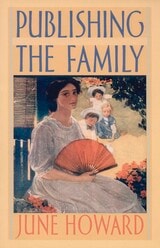
Publishing the Family
June Howard
Duke University Press, 2001
Publishing the Family describes the sources and controversial outcome of a fascinating literary experiment. Howard embeds the story of The Whole Family in the story of Harper & Brothers’ powerful and pervasive presence in American cultural life, treating the publisher, in effect, as an author.
Each chapter of Publishing the Family casts light on some aspect of life in the United States at a moment that arguably marked the beginning of our own era. Howard revises common views of the turn-of-the-century literary marketplace and discusses the perceived crisis in the family as well as the popular and expert discourses that emerged to remedy it. She also demonstrates how creative women like Bazar editor Elizabeth Jordan blended their own ideas about the “New Woman” with traditional values. Howard places these analyses in the framework of far-reaching historical changes, such as the transformation of the public meaning of emotion and “sentimentality.” Taken together, the chapters in Publishing the Family show how profoundly the modern mapping of social life relies on boundaries between family and business, culture and commerce, which The Whole Family and Publishing the Family constantly unsettle.
Publishing the Family will interest students and scholars of American history, literature, and culture, as well as those studying gender, sexuality, and the family.
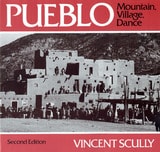
Pueblo
Mountain, Village, DanceVincent Scully
University of Chicago Press, 1989
Scully's observations, presented in lively prose and exciting photographs, are based on his own personal experiences of the Southwest; on his exploration of the region of the Rio Grande and the Hopi mesas; on his witnessing of the dances and ceremonies of the Pueblos and others; and on his research into their culture and history. He draws on the vast literature inspired by the Native Americans—from early exploration narratives to the writing of D. H. Lawrence to recent scholarship—to enrich and support his unique approach to the subject.
To this second edition Scully has added a new preface that raises issues of preservation and development. He has also written an extensive postscript that reassesses the relationship between nature and culture in Native American tradition and its relevance to contemporary architecture and landscape.
"Coming to Pueblo architecture as he does from a provocative study of sacred architecture in ancient Greece, Scully has much to say that is both striking and moving of the Pueblo attitudes toward sacred places, the arrangement of structures in space, the lives of men and beasts, and man's relation to rain, earth, vegetation."—Robert M. Adams, New York Review of Books