Results by title
5550 books match the query 'Biography & Autobiography' and 171 start with p

Prisoner of Pinochet
My Year in a Chilean Concentration CampSergio Bitar
University of Wisconsin Press, 2017
Prisoner of Pinochet is the gripping first-person chronicle of Bitar's year as a political prisoner before being expelled from Chile; a poignant narrative of men held captive together in a labor camp under harsh conditions, only able to guess at their eventual fate; and an insightful memoir of the momentous events of the early 1970s that led to seventeen years of bloody authoritarian rule in Chile. Available in English for the first time, this edition includes maps and photos from the 1970s and contextual notes by historian Peter Winn.

Prisoner of Wars
A Hmong Fighter Pilot's Story of Escaping Death and Confronting LifeChia Youyee Vang
Temple University Press, 2021
Retired Captain Pao Yang was a Hmong airman trained by the U.S. Air Force and CIA to fly T-28D aircraft for the U.S. Secret War in Laos. However, his plane was shot down during a mission in June 1972. Yang survived, but enemy forces captured him and sent him to a POW camp in northeastern Laos. He remained imprisoned for four years after the United States withdrew from Vietnam because he fought on the American side of the war.
Prisoner of Wars shows the impact the U.S Secret War in Laos had on Hmong combatants and their families. Chia Vang uses oral histories thatpoignantly recount Yang’s story and the deeply personal struggles his loved ones—who feared he had died—experienced in both Southeast Asia and the United States. As Yang eventually rebuilt his life in America, he grappled with issues of freedom and trauma.
Yang’s life provides a unique lens through which to better understand the lasting impact of the wars in Southeast Asia and the diverse journeys that migrants from Asia made over the last two centuries. Prisoner of Wars makes visible an aspect of the collateral damage that has been left out of dominant Vietnam War narratives.

Privilege and Prejudice
The Life of a Black PioneerClifton R. Wharton
Michigan State University Press, 2015

Professor Baseball
Searching for Redemption and the Perfect Lineup on the Softball Diamonds of Central ParkEdwin Amenta
University of Chicago Press, 2007
It happens every summer: packs of beer-bellied men with gloves and aluminum bats, putting their middle-aged bodies to the test on the softball diamond. For some, this yearly ritual is driven by a simple desire to enjoy a good ballgame; for others, it’s a way to forge friendships—and rivalries. But for one short, wild-haired, bespectacled professor, playing softball in New York’s Central Park means a whole lot more. It's one last chance to heal the nagging wounds of Little League trauma before the rust of decline and the relentless responsibilities of fatherhood set in.
Professor Baseball is the coming-of-middle-age story of New York University professor and Little League benchwarmer Edwin Amenta. As rookie manager of the Performing Arts Softball League’s doormat Sharkeys, he reverses softball’s usual brawn-over-brains formula. He coaxes his skeptical teammates to follow his sabermetric and sociological approach, based equally on Bill James and Max Weber, which in the heady days of early success he dubs “Eddy Ball.” But Amenta soon learns that his teammates’ attachments to favorite positions and time-honored (if ineffective) strategies are hard to break—especially when the team begins losing. And though he rejects the baseball-as-life metaphor, life keeps intruding on his softball season. Amenta here comes to grips with the humiliation of assisted reproduction, suffers mysterious ailments, and finds himself lingering at the sponsor’s bar, while his partner, a beautiful but baseball-challenged professor, second-guesses his book in the making. Can he turn his team—and his life—around?
Packed with colorful personalities, dramatic games, and the bustle of New York life, Professor Baseball will charm anyone who has ever root, root, rooted for the underdog.

Profiles in Power
Twentieth-Century Texans in Washington, New EditionEdited by Kenneth E. Hendrickson, Jr., Michael L. Collins, and Patrick Cox
University of Texas Press, 2004
Profiles in Power offers concise biographies of fourteen twentieth-century Texans who wielded significant political power and influence in Washington, D.C. First published in 1993 by Harlan Davidson, it has been revised and updated with new chapters on John Nance Garner and Henry Gonzalez and expanded chapters on Lyndon Johnson, Barbara Jordan, Ralph Yarborough, Jim Wright, and John Tower. Demonstrating the validity of a biographical approach to history, the book as a whole covers all the major political issues of the twentieth century, as well as the pivotal role of Texans in defining the national agenda.

Profiles in Survival
The Experiences of American POWs in the Philippines during World War IIJohn C. Shively
Indiana Historical Society Press, 2012
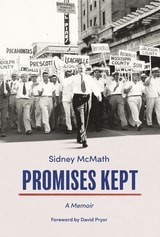
Promises Kept
A MemoirSidney S. McMath
University of Arkansas Press, 2003
Winner of the 2006 Booker Worthen Literary Prize and the 2004 Ragsdale Award
A dominating spirit of public service animated the life of Sidney Sanders McMath (1912–2003), the thirty-fourth governor of Arkansas. Promises Kept, completed and published when McMath was in his nineties, tells his story in his own words—from the piney hills of South Arkansas to the battlefields of World War II; through the human dramas of the courtroom to the marbled corridors of the State Capitol.
In Promises Kept, McMath recounts a rural upbringing that grounded him in the concerns of everyday Arkansans. He tells his life story through key milestones, including distinguished military service and a dramatic political rise to governor of Arkansas. During his four years in office, he pursued reform and modernization by expanding roads and electricity to rural areas, fighting the poll tax, building the state’s first medical center, opening Democratic primaries to Black voters, and standing with President Harry Truman in resisting the segregationist Dixiecrats. McMath’s political career ended amid unproven allegations tied to the highway program—charges he addresses directly here—and concludes with his return to the law, where landmark cases earned him honors.
Throughout, McMath reveals the excitement and the hard choices of real democracy, offering compelling human stories and a crucial perspective of a pivotal time in Arkansas history.
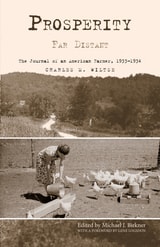
Prosperity Far Distant
The Journal of an American Farmer, 1933–1934Charles M. Wiltse
Ohio University Press, 2012
Fresh from receiving a doctorate from Cornell University in 1933, but unable to find work, Charles M. Wiltse joined his parents on the small farm they had recently purchased in southern Ohio. There, the Wiltses scratched out a living selling eggs, corn, and other farm goods at prices that were barely enough to keep the farm intact.
In wry and often affecting prose, Wiltse recorded a year in the life of this quintessentially American place during the Great Depression. He describes the family’s daily routine, occasional light moments, and their ongoing frustrations, small and large—from a neighbor’s hog that continually broke into the cornfields to the ongoing struggle with their finances. Franklin Roosevelt’s New Deal had little to offer small farmers, and despite repeated requests, the family could not secure loans from local banks to help them through the hard economic times. Wiltse spoke the bitter truth when he told his diary, “We are not a lucky family.” In this he represented millions of others caught in the maw of a national disaster.
The diary is introduced and edited by Michael J. Birkner, Wiltse’s former colleague at the Papers of Daniel Webster Project at Dartmouth College, and coeditor, with Wiltse, of the final volume of Webster’s correspondence.

Prospero's Son
Life, Books, Love, and TheaterSeth Lerer
University of Chicago Press, 2013
Proust, a Family Affair
Laure Murat
University of Chicago Press, 0
A personal take on Proust’s In Search of Lost Time, written by a woman born into the aristocratic world it describes.
Proust’s In Search of Lost Time is many things: a staggering literary achievement, an evocation of an elite milieu, a complex reckoning with memory. For Laure Murat, it was also a map of the world into which she was born—the world of the French Aristocracy. Descended from French nobility on both sides, Murat saw the châteaux and balls of In Search of Lost Time as the backdrop to her own family story, understood anew through Proust’s eyes.
In this beautiful book, Murat explores both the oppressive constraints of the aristocratic life and the fluidity and linguistic virtuosity of Proust’s astonishing seven-volume novel, which shifts focus from codes of behavior to the experience of living. In Proust, a Family Affair, Murat celebrates the emancipating power of literature and the rewards of paying close attention to a text that may, in turn, provoke a close and loving attendance to the self.
Originally published in French, Proust, a Family Affair has won the Prix Médicis and was shortlisted for France’s most coveted literary award, the Prix Goncourt. This readable, moving translation into English by Charlotte Mandell will appeal to lovers of Proust and to all readers who appreciate personal explorations of literary masterpieces.

Proxmire
Bulldog of the SenateJonathan Kasparek
Wisconsin Historical Society Press, 2019

Puccini
His International ArtMichele Girardi
University of Chicago Press, 2000
Pumpkin Seed Point
Being Within The HopiFrank Waters
Ohio University Press, 1973
Frank Waters lived for three years among the Hopi people of Arizona and was quickly drawn into their culture. Pumpkin Seed Point is a beautifully written personal account of Waters’s inner and outer experiences among the Hopi.

Punk Identities, Punk Utopias
Global Punk and MediaEdited by Russ Bestley, Mike Dines, Matt Grimes, Paula Guerra
Intellect Books, 2021
Punk Identities, Punk Utopias unpacks punk and the factors that shape its increasingly complex and indefinable social, political, and economic setting. The third offering in Intellect’s Global Punk series, produced in collaboration with the Punk Scholars Network, this volume examines the broader social, political, and technological concerns that affect punk scenes around the world, from digital technology and new media to gender, ethnicity, identity, and representation.
Drawing on scholarship in cultural studies, musicology, and social sciences, this interdisciplinary collection will add to the academic discussion of contemporary popular culture, particularly in relation to punk and the critical understanding of transnational and cross-cultural dialogue.

Pure Intelligence
The Life of William Hyde WollastonMelvyn C. Usselman
University of Chicago Press, 2015
Pure Intelligence is the first book-length study of Wollaston, his science, and the environment in which he thrived. Drawing on previously-unstudied laboratory records as well as historical reconstructions of chemical experiments and discoveries, and written in a highly accessible style, Pure Intelligence will help to reinstate Wollaston in the history of science, and the pantheon of its great innovators.

Pure Waters
Frank Waters and the Quest for the CosmicFrank Waters
Ohio University Press, 2002
The novels and nonfiction work of writer Frank Waters stand as a monument to his genius and to his lifetime quest to plumb the spiritual depths that he found for himself in the landscape and people of his beloved Southwest. In a career spanning more than half a century, he shared, through his many books, his insights and discoveries with countless readers across the globe.
Now, drawn from rare editorials, speeches, and essays that Frank Waters authored over the years as a reflection and a formation of his life-long themes, Pure Waters provides a treasure trove of exciting new material from this giant of the American Southwest.
In celebration of the centenary of his birth, Swallow Press is pleased to offer this new collection by one of its bestselling and most inspiring authors.

Purple Hummingbird
A Biography of Elizabeth Warder Crozer CampbellClaude N. Warren and Joan S. Schneider
University of Utah Press, 2016
Elizabeth Warder Crozer Campbell and her husband, William Campbell, found themselves forced to move to the Mojave Desert in 1924, its dry climate proving to be the best for William’s frail lungs burned by mustard gas in World War I. They camped at Twentynine Palm Oasis in what is now Joshua Tree National Park, homesteaded nearby, and became a central part of that early community. Life in the remote, stark landscape contrasted sharply with Elizabeth’s early years of wealth and privilege in Pennsylvania. Her resilient spirit made the best of what at first seemed like a bleak situation: she became an amateur archaeologist and explored the desert. A keen observer and independent thinker, she soon hypothesized that prehistoric people had lived in the California deserts along the shores of late Pleistocene lakes and waterways much earlier than was then believed. She devised a means for testing her hypothesis and found evidence to support it. Her interpretations, however, conflicted with the archaeological paradigm of the day and she was dismissed by formally trained archaeologists. Even so, she and her husband continued their work, convinced of the accuracy of her findings. Four decades later the archaeological establishment validated and accepted her ideas. Campbell’s research ultimately revolutionized archaeological thought, forming the basis of today’s landscape archaeology.

Purple on the Inside
How J.B. Hunt Transport Set Itself Apart in a Field Full of Brown CowsKirk Thompson
Epic Books, 2019
J.B. Hunt’s triumphs and struggles provide a fascinating case study of how business theory, leadership, culture, and organizational best-practices have combined to create one of the most successful companies in American history. Kirk Thompson, with more than forty years of experience inside the company, gives a CEO’s account of the company’s evolution, while Matt Waller connects the leadership decisions to business theories that are transferrable to other leaders and industries.
Purple on the Inside is more than a corporate history or business management primer. It’s a practical case study that illustrates what Seth Godin described in Purple Cow, his best-selling book that considers what characteristics make for a remarkable business. It’s the story of leaders and team members who tap into their founder’s spirit for innovation while maintaining the focus and high level of performance needed to grow. It’s a story about developing partnerships, technologies, and expertise that others can’t easily duplicate. And it’s a story of overcoming disheartening setbacks and cultivating the purple cows that have allowed J.B. Hunt Transport to do what many experts said was impossible—stand out from its competition in an industry full of brown cows.

Pushkin's Button
Serena Vitale
University of Chicago Press, 2000
"Pushkin's Button will keep all constituencies of reader fastened to their seats, as they watch Petersburg's lofty denizens leave no moment of the hurtling Pushkin scandal unrecorded or not speculated on."—Monika Greenleaf,Los Angeles Times
"[A] deliciously entertaining whydunit, a book in which every page seduces with a riddle. . . . Vivacious, seductive, original."—Michael Dirda, Washington Post
"A delightful combination of retrograde pleasures (court balls, the demise of a doomed genius) and primary sources. . . . Illuminating."—Richard Lamb, New York Times Book Review
"A book almost impossible to put down."—George Steiner, New Yorker

Putting the Horse before Descartes
My Life's Work on Behalf of AnimalsAuthored by Bernard Rollin
Temple University Press, 2011
When philosopher Bernard Rollin was six years old, he visited an animal shelter and was told about unwanted dogs being put to sleep. The event shaped his moral outlook and initiated his concern for how animals were treated. In his irreverent memoir, Putting the Horse before Descartes, Rollin provides an account of how he came to educate himself and others about the ethical treatment of animals and work toward improvements in animal welfare.
Rollin describes, in witty, often disarming detail, how he became an outspoken critic of how animals were being treated in veterinary and medical schools as well as in research labs. Putting the Horse before Descartes showcases the passionate animal advocate at his best. He recalls teaching veterinary students about ethical issues. He also recalls face-offs with ranchers and cowboys about branding methods and roping competitions in rodeos. In addition, he describes his work to legally mandate more humane conditions for agricultural and laboratory animals. As public concern about animal welfare and the safety of the food supply heighten, Rollin carries on this work all over the world—in classrooms, lecture halls and legislatures, meetings of agricultural associations and industrial settings, as well as in print.
Putting the Horse before Descartes, ultimately, is more than a memoir. Rollin offers a wide-ranging discussion of ethical issues in many settings and he testifies to the myriad ways that people of good conscience accept their ethical responsibility in regard to animals.

Pynchon’s Sound of Music
Christian Hänggi
Diaphanes, 2020