Results by title
4743 books match the query 'Religion' and 206 start with p
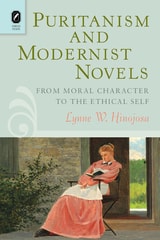
Puritanism and Modernist Novels
From Moral Character to the Ethical SelfLynne W. Hinojosa
The Ohio State University Press, 2015
Puritanism and Modernist Novels offers new formal and contextual readings of early modernist novels by Oscar Wilde, E. M. Forster, James Joyce, and Ford Madox Ford. Hinojosa demonstrates that, while they long for escape, these authors still question the value of the novelistic narrative of confinement and escape. Bridging modernist and novel studies, Puritanism and Modernist Novels contributes to conversations about secularization and religion in both fields, highlighting the limitations created by the secularization narrative of modernity.
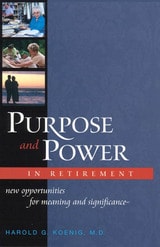
Purpose & Power In Retirement
New Opportunities for Meaning and SignificanceHarold Koenig
Templeton Press, 2003
Eighty million baby boomers are heading toward retirement. Some are retiring now, either out of choice or because they have been laid off. Others will work for a few more years until their retirement plans kick in, until they feel they can retire, or until they're forced to retire. Whatever their age at retirement, they will have better health and live longer than their parents. And each of them will face these questions:
•Do I want a reason to get up in the morning and be excited about the day ahead?•Do I still want to make a difference in the world?
They need a vision—a goal that takes into account their experience, wisdom, strengths, and limitations, and gives purpose to their lives.
Dr. Harold G. Koenig, with expertise in the fields of geriatrics, mental health, and religion, explains that the notion of retirement was in fact a marketing tool developed in the post–World War II period. Continuing today, society's image of retirement is based largely on myths, such as: things will get better when you retire—you'll be able to do everything you wanted to but couldn't when you worked. In fact, these beliefs can be harmful, leading to emotional issues, identity crises, and problems with physical health.
Citing current scientific and medical research, Koenig illustrates how having a purpose motivates and energizes people in their retirement years. He presents a step-by-step guide to identifying a goal toward which they can strive. And he shows how striving for that goal in itself brings meaning, satisfaction, and a sense of reward to retirement years.
"Finding purpose is more urgent than ever during the retirement years, when the search for purpose becomes one of the deepest of human longings," says Koenig. His Purpose and Power in Retirement is an invaluable resource for everyone heading toward retirement, and for anyone seeking meaning in life.
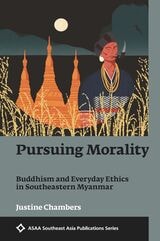
Pursuing Morality
Buddhism and Everyday Ethics in Southeastern MyanmarJustine Chambers
National University of Singapore Press, 2024
Pursuing Morality is an in-depth and fascinating study of ordinary life in Myanmar’s southeast through a unique ethnographic focus on Buddhist Plong (Pwo) Karen. Based on extensive in-depth fieldwork in the small city of Hpa-an, the capital of Karen State, Justine Chambers shines a new light on Plong Buddhists’ lives and the many ways they broker, traverse, enact, cultivate, defend, and pursue moral lives.
This is the first ethnographic study of Myanmar to add to a growing body of anthropological scholarship that is referred to as the “moral turn.” Each chapter examines the lives of Plong Buddhists from different vantage points, calling into question many assumptions about Southeast Asian values and the nature of Buddhist Theravada practice. Critiquing the notion that moral coherence is necessary for ethical selfhood, Chambers demonstrates how the pursuit of morality is varied, performative, and embedded in an affective notion of the self as a moral agent in a relationship with wider structural political forces. This vivid account of everyday life in Myanmar complements existing scholarship on the region and offers a deeper understanding of Buddhism, moral anthropology, and ethics in Southeast Asia.
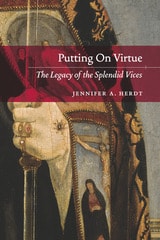
Putting On Virtue
The Legacy of the Splendid VicesJennifer A. Herdt
University of Chicago Press, 2008
Putting on Christ
Augustine's Early Theology of Salvation and the SacramentsTy Paul Monroe
Catholic University of America Press, 2022

Puzzles
A Seminar on the ‘Benefit of Christ’Carlo Ginzburg and Adriano Prosperi
Seagull Books, 2025
Patience Games: A Seminar on the 'Benefit of Christ' invites readers into the unpredictable world of scholarly discovery, where interpretation is not a straight path but a labyrinth of dialogue revision. At the heart of this book is a seminar held forty years ago at the University of Bologna, where students wrestled with The Beneficio di Cristo, the incendiary sixteenth-century text that questioned Church authority and championed salvation through grace alone. This is not a neatly packaged historical study, however—it is an unfiltered look at the errors and insights that emerge in the collective process of reading and debating a text.
Through shifting hypotheses and the sheer unpredictability of research, Patience Games dismantles the illusion of scholarship as a sterile pursuit, revealing instead a messy, deeply human endeavor. Blending sharp analysis with wit and self-irony, the book makes a compelling case for the continued importance of slow reading—even in an age where knowledge is just a click away.