Results by title
3797 books match the query 'poetry' and 204 start with p
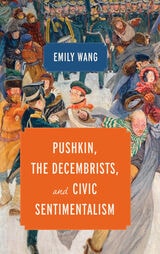
Pushkin, the Decembrists, and Civic Sentimentalism
Emily Wang
University of Wisconsin Press, 2023
In December 1825, a group of liberal aristocrats, officers, and intelligentsia mounted a coup against the tsarist government of Russia. Inspired partially by the democratic revolutions in the United States and France, the Decembrist movement was unsuccessful; however, it led Russia’s civil society to new avenues of aspiration and had a lasting impact on Russian culture and politics. Many writers and thinkers belonged to the conspiracy while others, including the poet Alexander Pushkin, were loosely or ambiguously affiliated. While the Decembrist movement and Pushkin’s involvement has been well covered by historians, Emily Wang takes a novel approach, examining the emotional and literary motivations behind the movement and the dramatic, failed coup.
Through careful readings of the literature of Pushkin and others active in the northern branch of the Decembrist movement, such as Kondraty Ryleev, Wilhelm Küchelbecker, and Fyodor Glinka, Wang traces the development of “emotional communities” among the members and adjacent writers. This book illuminates what Wang terms “civic sentimentalism”: the belief that cultivating noble sentiments on an individual level was the key to liberal progress for Russian society, a core part of Decembrist ideology that constituted a key difference from their thought and Pushkin’s. The emotional program for Decembrist community members was, in other ways, a civic program for Russia as a whole, one that they strove to enact by any means necessary.
Through careful readings of the literature of Pushkin and others active in the northern branch of the Decembrist movement, such as Kondraty Ryleev, Wilhelm Küchelbecker, and Fyodor Glinka, Wang traces the development of “emotional communities” among the members and adjacent writers. This book illuminates what Wang terms “civic sentimentalism”: the belief that cultivating noble sentiments on an individual level was the key to liberal progress for Russian society, a core part of Decembrist ideology that constituted a key difference from their thought and Pushkin’s. The emotional program for Decembrist community members was, in other ways, a civic program for Russia as a whole, one that they strove to enact by any means necessary.
[more]

precis
José Felipe Alvergue
Omnidawn, 2017
The border is a policed realm, neoliberal market, an affective landscape of spectral echoes, a geography of traces. The death of a girl, a crossing narrative, media static of late-century rhetoric on border bodies, precis involves poetry in mapping the Mexico/US border and its relationship to America, while resisting the urge to impose definitiveness. precis simply asks: What about the body? What about the personal and the communal? The reader is asked to follow along without forgetting that overshadowed in every moment of the known, every authorization of what is, there is a print or silence asking what should also be.
[more]
promised instruments
poemsKristiana Colón
Northwestern University Press, 2013
Taking its cue from Toni Morrison’s declaration that "language alone protects us from the scariness of things with no names" Kristiana Colón’s promised instruments stitches its own definitions for what is granted, what is surrendered, what is pilfered, and what is reclaimed. Her poems plumb the problem of woman’s sexuality, sexual agency, mental health, and consent with piercing musicality and disarming vulnerability. promised instruments invites its readers to interrogate their own complicity in these issues and share in the healing process.
[more]
purplish
poetry anger publicsJosé Felipe Alvergue
University of Iowa Press, 2025
José Felipe Alvergue examines anger in American poetry, while reflecting on the permissible/policed cultural affects of our time. By way of BIPOC and QTPOC poets engaging with negativity—frustration, anger, distress—Alvergue argues that affects that reflect a counternarrative to benevolence challenge the colonial underpinnings of “American publics” as a concept of democratic participation and practice of community. Purple politics play out daily within spaces we rely on for shared comfort and belonging, namely neighborhoods, dinner tables, school board meetings, and social media. Purplish America describes the uncertain terrain of potential violence, potential conflict, distrust, and post-factualism upon which language and soma are still expected to thrive.
purplish challenges the idea of an objective or unbiased cultural rationale to purple regions in America by historicizing how anger has been systemically cleansed from the collective sentiments regarding nation-building throughout key moments of our national heritage.
purplish challenges the idea of an objective or unbiased cultural rationale to purple regions in America by historicizing how anger has been systemically cleansed from the collective sentiments regarding nation-building throughout key moments of our national heritage.
[more]