Results by title
4917 books match the query 'Philosophy' and 321 start with p

Prosthetic Immortalities
Biology, Transhumanism, and the Search for Indefinite LifeAdam R Rosenthal
University of Minnesota Press, 2024
Examining the links between today’s ideas of radical life extension and age-old notions of immortality
From Plato’s notion of generation to Derrida’s concept of survival to such modern phenomena as anti-aging treatments, cryogenics, cloning, and whole-brain uploads, Adam Rosenthal’s Prosthetic Immortalities shows how the dream of indefinite life has always been a technological one: a matter of prosthesis. He argues that every biological instance of perpetual life, from one-celled organisms to rejuvenating jellyfish to Henrietta Lacks’s “immortal” cancer cells, always results in the transformation of the original being. There can, therefore, be no certainty of immortality. Yet, because finite mortal life is already marked by difference, division, and change, as Rosenthal concludes: “the problem of immortality will not cease to haunt us.”
Prosthetic Immortalities examines the persistence of humans’ aspirations of deathlessness, showing that the link between immortalization and prostheticization is not unique to a single period but is, rather, a ubiquitous element of the discourse of immortality, encompassing both modern technoscientific efforts and religious discourses of an afterlife. Rosenthal asks to what extent the emergence of a virtual, posited, immortal presence follows from the tenets of empirical science—and not simply from the discourse of biology but also, and more radically still, from biological organization itself.
Rosenthal ultimately argues that the discovery of biological immortals—lifeforms that naturally have indefinitely long lifespans, such as cancer cells and bacteria—present novel conceptual difficulties for traditional philosophical approaches to mortality and selfhood, asking whether it is life itself that first births immortalizing prostheses.
Protecting the Vulnerable
A Re-Analysis of our Social ResponsibilitiesRobert E. Goodin
University of Chicago Press, 1985
Proust And Signs
The Complete TextGilles Deleuze
University of Minnesota Press, 2003
In a remarkable instance of literary and philosophical interpretation, the incomparable Gilles Deleuze reads Marcel Proust’s work as a narrative of an apprenticeship—more precisely, the apprenticeship of a man of letters. Considering the search to be one directed by an experience of signs, in which the protagonist learns to interpret and decode the kinds and types of symbols that surround him, Deleuze conducts us on a corollary search—one that leads to a new understanding of the signs that constitute A la recherche du temps perdu.
In Richard Howard’s graceful translation, augmented with an essay that Deleuze added to a later French edition, Proust and Signs is the complete English version of this work. Admired as an imaginative and innovative study of Proust and as one of Deleuze’s more accessible works, Proust and Signs stands as the writer’s most sustained attempt to understand and explain the work of art.
Psychoanalysis and Social Theory
The Limits of SociologyIan Craib
University of Massachusetts Press, 1989

Psychoanalysis--A Theory in Crisis
Marshall Edelson
University of Chicago Press, 1988

Psychopolitics
Conversations with Trevor Cribben MerrillJean-Michel Oughourlian
Michigan State University Press, 2012
For thousands of years, political leaders have unified communities by aligning them against common enemies. However, today more than ever, the search for “common” enemies results in anything but unanimity. Scapegoats like Saddam Hussein, for example, led to a stark polarization in the United States. Renowned neuropsychiatrist and psychologist Jean-Michel Oughourlian proposes that the only authentic enemy is the one responsible for both everyday frustrations and global dangers, such as climate change—ourselves. Oughourlian, who pioneered an “interdividual” psychology with René Girard, reveals how all people are bound together in a dynamic, contingent process of imitation, and shows that the same patterns of irrational mimetic desire that bring individuals together and push them apart also explain the behavior of nations.

Psychotherapy As Religion
The Civil Divine In AmericaWilliam M. Epstein
University of Nevada Press, 2006
A provocative look at America on the couch.In Psychotherapy as Religion, William Epstein sets out to debunk claims that psychotherapy provides successful clinical treatment for a wide range of personal and social problems. He argues that the practice is not a science at all but rather the civil religion of America, reflecting the principles of radical self-invention and self-reliance deeply embedded in the psyche of the nation. Epstein begins by analyzing a number of clinical studies conducted over the past two decades that purport to establish the effectiveness of psychotherapeutic treatments. He finds that each study violates in some way the standard criteria of scientific credibility and that the field has completely failed to establish objective procedures and measurements to assess clinical outcomes. Epstein exposes psychotherapy’s deep roots in the religious and intellectual movements of the early nineteenth century by demonstrating striking parallels between various types of therapy and such popular practices as Christian Science and spiritualism. Psychotherapy has taken root in our culture because it so effectively reflects our national faith in individual responsibility for social and personal problems. It thrives as the foundation of American social welfare policy, blaming deviance and misery on deficiencies of character rather than on the imperfections of society and ignoring the influence of unequal and deficient social conditions while requiring miscreants to undergo the moral reeducation that psychotherapy represents. This is a provocative, brilliantly argued look at America on the couch. Psychotherapy as Religion is essential reading for anyone interested in the history and current state of mental health.
Public Administration and the State
A Postmodern PerspectiveMichael W. Spicer
University of Alabama Press, 2005
A critical examination of public administration's pervasive vision of a powerful state
Woodrow Wilson argued for a state led by a powerful government, guided by science and enlightened experts, for the accomplishment of a set of collective purposes—in other words, a purposive state. Michael Spicer contends that though Wilson and those who followed him have not typically explored questions of political and constitutional theory in their writing, a clear and strong vision of the state has emerged in their work nonetheless.
Building upon the work of Dwight Waldo and others who have sought to explore and reveal the political theory behind the seemingly neutral language of administration, Spicer explores the roots—both historical and philosophical—of the purposive state. He considers the administrative experience of 18th-century Prussia and its relationship to the vision of the purposive state, and examines the ways this idea has been expressed in the 20th century. He then looks at the practical problems such a vision creates for public policy in a fragmented postmodern political culture. Finally, Spicer explores an alternative view of public administration—one based on a civil association model appropriate to our constitutional traditions and contemporary culture.
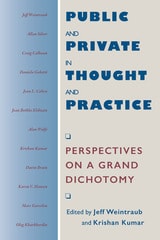
Public and Private in Thought and Practice
Perspectives on a Grand DichotomyEdited by Jeff Weintraub and Krishan Kumar
University of Chicago Press, 1997
In contexts ranging from friendship, the family, and personal life to nationalism, democratic citizenship, the role of women in social and political life, and the contrasts between western and (post-)Communist societies, this book brings out the ways the various uses of the public/private distinction are simultaneously distinct and interconnected. Public and Private in Thought and Practice will be of interest to students and scholars in disciplines including politics, law, philosophy, history, sociology, and women's studies.
Contributors include Jeff Weintraub, Allan Silver, Craig Calhoun, Daniela Gobetti, Jean L. Cohen, Jean Bethke Elshtain, Alan Wolfe, Krishan Kumar, David Brain, Karen Hansen, Marc Garcelon, and Oleg Kharkhordin.
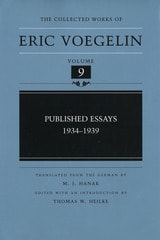
Published Essays, 1934-1939 (CW9)
Eric Voegelin, Edited & Intro by Thomas W. Heilke, & Translated by M. J. Hanak
University of Missouri Press, 2001
In this collection of essays, which covers the years from 1934 to1939, we see Eric Voegelin in the role of both scholar and public intellectual in Vienna until he was forced to flee the Nazi terror that descended on Austria in 1938. Revealing the broad spectrum of thinking and scientific study of this relatively young scholar, Voegelin's essays range from Austrian politics, Austrian constitutional history, and European racism to questions of the formation and expression of public opinion, theories of administrative law, and the role of political science in public university education. Several essays serve as useful commentaries on, elaborations of, or synopses of arguments Voegelin made in the five books he had published between 1928 and 1938.
Within these topical headings, there are multiple thematic threads that wind their way through these essays and that remain of interest to contemporary readers. Thirteen of the pieces contained in this collection are short items that Voegelin published in trade journals and newspapers, of which nine appeared in the Wiener Zeitung in 1934 and the Neue Freie Presse in 1937. In these we see two brief periods in which Voegelin played the role of public intellectual not only as a lecturer but also in print.
These essays will be of interest to a wide range of scholars, including constitutional historians, historians of political science, political theorists, and students of Voegelin's later work.
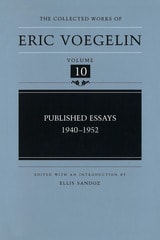
Published Essays, 1940-1952 (CW10)
Eric Voegelin & Edited & Intro by Ellis Sandoz.
University of Missouri Press, 2000
Published Essays, 1940-1952, includes some of Eric Voegelin's most provocative and interesting essays. Containing his first publications after he fled Vienna and settled in the United States following Hitler's annexation of Austria, this volume provides eyewitness commentary on the rise of National Socialism from the first days of World War II onward. A major study entitled "Growth of the Race Idea" presents a masterful summary of the two volumes on that subject Voegelin first published in 1933. A related essay of wide interest is entitled "Nietzsche, the Crisis, and the War."
Another facet of Voegelin's thought incorporated within this volume of the Essays is his extraordinary analysis of the diplomatic correspondence conducted between the Western powers, the papacy, and the Great Khans, whose breathtaking expansion of the Mongol Empire for a time threatened to extinguish Western civilization itself and resulted in a two-century domination of Russia. Another major study is "The Origins of Scientism," an illuminating analysis of the grounds of much of modern philosophy and of all modern political ideologies.
There are also surveys of the state of political theory in the late forties, penetrating studies of utopian thought with essays on Thomas More and Goethe, and a concluding essay that explores the intricacies of "Gnostic Politics"—a familiar theme from Voegelin's contemporaneous New Science of Politics. This volume of published essays shows Eric Voegelin at his most accessible best.
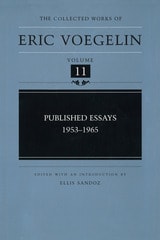
Published Essays, 1953-1965 (CW11)
Eric Voegelin & Edited & Intro by Ellis Sandoz
University of Missouri Press, 2000
The period covered by the material published in this volume marks the transition in Eric Voegelin's career from Louisiana to Munich. After twenty years in the United States, in 1958 Voegelin accepted an invitation to fill the political science chair at Ludwig Maximilian University, a position left vacant throughout the Nazi period and last occupied by the famous Max Weber, who had died in 1920.
The themes most prominent in the fourteen items reprinted here reflect the concerns of a transition, not only in a scholar's career, and in the momentous shifts in world politics taking place around him, but also in the development of his understanding of the stratification of reality and the attendant demands for a science of human affairs adequate to the challenges posed by the persistent crisis of the West in its latest configurations and by contemporary philosophy.
Several of the items herein originated as talks to a specific organization on problems facing German democratization and the development of a market economy amid the ruins of a fragmented culture and infrastructure in a society without historically evolved institutional supports for a satisfactory social and political order. Accordingly, pragmatic matters occupy a central place in a number of these pieces, especially the overriding question of how Germany could move from an illiberal and ideological political order into a modern liberal democratic one.
Those accustomed to the theoretical profundity of Voegelin's writings may find welcome relief in the down-to-earth, commonsensical drift of this material addressed, often, to laymen and businessmen. But, of course, the philosophical subject matter lurks everywhere. It finds full expression in several instances as the controlling context of even the least pretentious presentations. One of the attractions of these essays is what the author brings forward as serviceable elementary guideposts under adverse conditions of intellectual disarray, social decay, and turmoil.
Published Essays, 1966-1985 (CW12)
Eric Voegelin & Edited & Intro by Ellis Sandoz
University of Missouri Press, 0
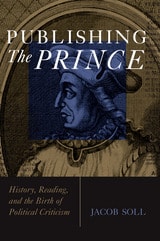
Publishing The Prince
History, Reading, and the Birth of Political CriticismJacob Soll
University of Michigan Press, 2010
As new ideas arose during the Enlightenment, many political thinkers published their own versions of popular early modern "absolutist" texts and transformed them into manuals of political resistance. As a result, these works never achieved a fixed and stable edition. Publishing The Prince illustrates how Abraham-Nicolas Amelot de La Houssaye created the most popular late seventeenth- and eighteenth-century version of Machiavelli's masterpiece. In the process of translating, Amelot also transformed the work, altering its form and meaning, and his ideas spread through later editions.
Revising the orthodox schema of the public sphere in which political authority shifted away from the crown with the rise of bourgeois civil society in the eighteenth century, Soll uses the example of Amelot to show for the first time how the public sphere in fact grew out of the learned and even royal libraries of erudite scholars and the bookshops of subversive, not-so-polite publicists of the republic of letters.
Jacob Soll is Associate Professor of History at Rutgers University.
Cover art courtesy of Annenberg Rare Book Room and Manuscript Library, University of Pennsylvania
Jacket Design: Stephanie Milanowski
"Jacob Soll traces the origins of Enlightenment criticism to the practices of learned humanists and hard-pressed literary entrepreneurs. This learned and lively book is also a tour de force of historical research and interpretation."
---Anthony Grafton, author of Cardano's Cosmos and Bring Out Your Dead
"Brilliant. How the printed page changed political philosophy into investigative reporting, and reason of state into the unmasking of power."
---J. G. A. Pocock, author of The Machiavellian Moment
"Soll's path-breaking study is a 'must read' for all those interested in the history of political thought and early modern intellectual history."
---Barbara Shapiro, University of California Berkeley
"Soll has done [Amelot] and his context justice, writing as he does with a clear, singular, and welcome voice."
---Margaret C. Jacobs, American Historical Review

Pulses of Abstraction
Andrew R. Johnston
University of Minnesota Press, 2020
Punctuations
How the Arts Think the PoliticalMichael J. Shapiro
Duke University Press, 2019
Punishment and Modern Society
A Study in Social TheoryDavid Garland
University of Chicago Press, 1990
"Punishment and Modern Society is an outstanding delineation of the sociology of punishment. At last the process that is surely the heart and soul of criminology, and perhaps of sociology as well—punishment—has been rescued from the fringes of these 'disciplines'. . . . This book is a first-class piece of scholarship."—Graeme Newman, Contemporary Sociology
"Garland's treatment of the theorists he draws upon is erudite, faithful and constructive. . . . Punishment and Modern Society is a magnificent example of working social theory."—John R. Sutton, American Journal of Sociology
"Punishment and Modern Society lifts contemporary penal issues from the mundane and narrow contours within which they are so often discussed and relocates them at the forefront of public policy. . . . This book will become a landmark study."—Andrew Rutherford, Legal Studies
"This is a superbly intelligent study. Its comprehensive coverage makes it a genuine review of the field. Its scholarship and incisiveness of judgment will make it a constant reference work for the initiated, and its concluding theoretical synthesis will make it a challenge and inspiration for those undertaking research and writing on the subject. As a state-of-the-art account it is unlikely to be bettered for many a year."—Rod Morgan, British Journal of Criminology
Winner of both the Outstanding Scholarship Award of the Crime and Delinquency Division of the Society for the Study of Social Problems and the Distinguished Scholar Award from the American Sociological Association's Crime, Law, and Deviance Section
Punishment and Political Order
Keally McBride
University of Michigan Press, 2007
Most of us think of punishment as an ugly display of power. But punishment also tells us something about the ideals and aspirations of a people and their government. How a state punishes reveals whether or not it is confident in its own legitimacy and sovereignty. Punishment and Political Order examines the questions raised by the state’s exercise of punitive power—from what it is about human psychology that desires sanction and order to how the state can administer pain while calling for justice. Keally McBride's book demonstrates punishment's place at the core of political administration and the stated ideals of the polity.
"From start to finish this is a terrific, engaging book. McBride offers a fascinating perspective on punishment, calling attention to its utility in understanding political regimes and their ideals. She succeeds in reminding us of the centrality of punishment in political theory and, at the same time, in providing a framework for understanding contemporary events. I know of no other book that does as much to make the subject of punishment so compelling."
—Austin Sarat, Amherst College
"Punishment and Political Order will be welcome reading for anyone interested in understanding law in society, punishment and political spectacle, or governing through crime control. This is a clear, accessible, and persuasive examination of punishment—as rhetoric and reality. Arguing that punishment is a complex product of the social contract, this book demonstrates the ways in which understanding the symbolic power and violence of the law provides analytical tools for examining the ideological function of prison labor today, as well as the crosscutting and contingent connections between language and identity, legitimation and violence, sovereignty and agency more generally."
—Bill Lyons, Director, Center for Conflict Management, University of Akron
"Philosophical explorations of punishment have often stopped with a theory of responsibility. McBride's book moves well beyond this. It shows that the problem of punishment is a central issue for any coherent theory of the state, and thus that punishment is at the heart of political theory. This is a stunning achievement."
—Malcolm M. Feeley, University of California at Berkeley
Keally McBride is Assistant Professor of Politics at the University of San Francisco.

Pure Unlimited Love
An Eternal Creative Force and Blessing Taught by All ReligionsSir John Templeton
Templeton Press, 2000
Understanding and expressing unconditional love—also called agape love—can be a lifelong quest. First, however, we must ask ourselves and others what it is. Is it an action, a universal energy, or a creative principle? And if we understand it, can its expression ever be realized, or is it simply a divine attribute?
These and other questions are addressed in an inspirational and practical style in this philosophical essay from Sir John Templeton. He seeks to define pure, unlimited love as the "transcendent power of divine love that expresses itself through our hearts and minds when we are open and receptive to it." Its greatest attributes are love, joy, peace, patience, kindness, goodness, faithfulness, gentleness, and self-control.
Another important concept is that God's love is given to us because we seek and accept it, not because we deserve it. It is the humble and sincere person who is most receptive to God's perfect love. This love can be awakened in other people through the action of love itself. We learn what it is from those who have it, and we can begin to recognize it through loving service to others.
Basic reality seems to be that the more you try to be like God by radiating unlimited love, the more you become flooded by waves of love from others and from God. Sir John summarizes with the statement, "How wonderful it would be if we could begin to say whenever we meet or depart, 'God loves you and I do too.'" This, in fact, is the essence of pure, unlimited love—a concept we can understand and can begin to practice in our daily lives. This thoughtful book can serve as an inspiration as well as a step-by-step guide on how to put this into practice.
Pursuing Morality
Buddhism and Everyday Ethics in Southeastern MyanmarJustine Chambers
National University of Singapore Press, 2024
Pursuing Morality is an in-depth and fascinating study of ordinary life in Myanmar’s southeast through a unique ethnographic focus on Buddhist Plong (Pwo) Karen. Based on extensive in-depth fieldwork in the small city of Hpa-an, the capital of Karen State, Justine Chambers shines a new light on Plong Buddhists’ lives and the many ways they broker, traverse, enact, cultivate, defend, and pursue moral lives.
This is the first ethnographic study of Myanmar to add to a growing body of anthropological scholarship that is referred to as the “moral turn.” Each chapter examines the lives of Plong Buddhists from different vantage points, calling into question many assumptions about Southeast Asian values and the nature of Buddhist Theravada practice. Critiquing the notion that moral coherence is necessary for ethical selfhood, Chambers demonstrates how the pursuit of morality is varied, performative, and embedded in an affective notion of the self as a moral agent in a relationship with wider structural political forces. This vivid account of everyday life in Myanmar complements existing scholarship on the region and offers a deeper understanding of Buddhism, moral anthropology, and ethics in Southeast Asia.
Putting On Virtue
The Legacy of the Splendid VicesJennifer A. Herdt
University of Chicago Press, 2008