8642 books match the query '20th Century' and 24 start with q
cover of Quabbin: The Accidental Wilderness

Quabbin

The Accidental Wilderness

Thomas Conuel

University of Massachusetts Press, 1990

When one looks out on the quiet waters and forested hills of Quabbin Reservoir in west central Massachusetts, it is hard to imagine that the area was once dotted with buildings and farmlands or that it echoed with the activity of several villages and towns. Today, the daytime silence may be broken only by the cry of a hawk overhead or the slap of a plunging fish, and the evening calm, by the lonesome howl of a coyote. But in the nineteenth century, things were quite different.

In 1895, engineers for the Metropolitan Water Board began to search the state of Massachusetts for a site on which to construct a reservoir to supply water for the growing city of Boston. Sixty-five miles west of the city, in a region of high hills and running streams known as the Swift River Valley, they found what they were looking for. When Quabbin Reservoir was finally completed and filled in 1946, the engineers had created the third largest body of fresh water in New England and hand accomplished one of the larger public works projects of its time. They had also uprooted and displaced the valley's inhabitants, leveled and flooded four towns and six villages—and formed a magnificent wilderness on some 85,000 acres. 

The valley that was once known for its picturesque villages and mill ponds is now, over forty years later, home to a wide array of wildlife. Coyote, bobcat, and deer flourish, and Quabbin's eagle restoration project, begun in 1982, produced the first nesting pair of bald eagles in Massachusetts in almost a century. Today, the bald eagle population at Quabbin is estimated at forty-one birds.

But this accidental wilderness is being increasingly threatened. As early as the 1950s, the sounds of power boats occasionally intruded on the peaceful silence of the waters. In more recent years, acid rain, ozone and other pollutants, the ravages of a herd of hungry deer, and demands for increased recreational use are all jeopardizing Quabbin's waters and forests.

This book tells the story of Quabbin, tracing Quabbin's history, describing its natural resources, and discussing the environmental challenges it currently faces. The original edition, issued by the Massachusetts Audubon Society in 1981, has now been expanded and updated.
[more]
cover of Quaker Brotherhood: Interracial Activism and the American Friends Service Committee, 1917-1950

Quaker Brotherhood

Interracial Activism and the American Friends Service Committee, 1917-1950

Allan W. Austin

University of Illinois Press, 2012
 
The Religious Society of Friends and its service organization, the American Friends Service Committee (AFSC) have long been known for their peace and justice activism. The abolitionist work of Friends during the antebellum era has been well documented, and their contemporary anti-war and anti-racism work is familiar to activists around the world. Quaker Brotherhood is the first extensive study of the AFSC's interracial activism in the first half of the twentieth century, filling a major gap in scholarship on the Quakers' race relations work from the AFSC's founding in 1917 to the beginnings of the civil rights movement in the early 1950s.
 
Allan W. Austin tracks the evolution of key AFSC projects such as the Interracial Section and the American Interracial Peace Committee, which demonstrate the tentativeness of the Friends' activism in the 1920s, as well as efforts in the 1930s to make scholarly ideas and activist work more theologically relevant for Friends. Documenting the AFSC's efforts to help European and Japanese American refugees during World War II, Austin shows that by 1950, Quakers in the AFSC had honed a distinctly Friendly approach to interracial relations that combined scholarly understandings of race with their religious views.
 
In tracing the transformation of one of the most influential social activist groups in the United States over the first half of the twentieth century, Quaker Brotherhood presents Friends in a thoughtful, thorough, and even-handed manner. Austin portrays the history of the AFSC and race--highlighting the organization's boldness in some aspects and its timidity in others--as an ongoing struggle that provides a foundation for understanding how shared agency might function in an imperfect and often racist world.
 
Highlighting the complicated and sometimes controversial connections between Quakers and race during this era, Austin uncovers important aspects of the history of Friends, pacifism, feminism, American religion, immigration, ethnicity, and the early roots of multiculturalism.
[more]
cover of Quakers and Nazis: Inner Light in Outer Darkness

Quakers and Nazis

Inner Light in Outer Darkness

Hans A. Schmitt

University of Missouri Press, 1997

Why the title Quakers and Nazis, not Quakers against Nazis? Was not hostility part of the interaction between the two groups? On the contrary, Hans A. Schmitt's compelling story describes American, British, and German Quakers' attempts to mitigate the suffering among not only victims of Nazism but Nazi sympathizers in Austria and Lithuania as well.

With numerous poignant illustrations of the pressure and social cost involved in being a Quaker from 1933 to 1945, Quakers and Nazis: Inner Light in Outer Darkness reveals a facet of Nazi Germany that is entirely unknown to most people. The book focuses on the heroic acts foreign and German Quakers performed under the Nazi regime, offering fully documented and original information regarding the Quakers' commitment to nonviolence and the relief of the victims.

Schmitt's narrative reveals the stress and tension of the situation. How should a Quaker behave in a meeting for worship with a policeman present? Spies did not stop Friends in worship services from openly criticizing Hitler and Göring, but Nazis did inflict torment on Friends. Yet Friends did not, could not, respond in like manner. Olga Halle was one Friend who worked to get people, mostly Jews, out of Germany until America entered the war. When emigration was outlawed, twenty-eight were stranded. Years later her distress was still so deep that even on her deathbed she recited their names.

Schmitt reminds us that virtually all the Berlin Quakers secreted Jews throughout the war. He shows how these brave Quakers opposed the Nazis even after they lost their jobs and had been harassed by the Gestapo. Risking their lives, the Friends persisted in their efforts to alleviate suffering.

At a time when the scholarly world is divided as to whether all Germans knew and approved of the Final Solution, this book makes a valuable contribution to the discussion. Quakers—despite their small numbers—played, and continue to play, an important role in twentieth-century humanitarian relief. Quakers and Nazis: Inner Light in Outer Darkness, a study of how Friends performed under the extreme pressure of a totalitarian regime, will add significantly to our general understanding of Quaker and German history.
[more]
cover of Qualified Hope: A Postmodern Politics of Time

Qualified Hope

A Postmodern Politics of Time

Mitchum Huehls

The Ohio State University Press, 2009

What is the political value of time, and where does that value reside? Should politics place its hope in future possibility, or does that simply defer action in the present? Can the present ground a vision of change, or is it too circumscribed by the status quo?
 
In Qualified Hope: A Postmodern Politics of Time, Mitchum Huehls contends that conventional treatments of time’s relationship to politics are limited by a focus on real-world experiences of time. By contrast, the innovative literary forms developed by authors in direct response to political events such as the Cold War, globalization, the emergence of identity politics, and 9/11 offer readers uniquely literary experiences of time. And it is in these literary experiences of time that Qualified Hope identifies more complicated—and thus more productive—ways to think about the time-politics relationship.
 
Qualified Hope challenges the conventional characterization of postmodernism as a period in which authors reject time in favor of space as the primary category for organizing experience and knowledge. And by identifying a common commitment to time at the heart of postmodern literature, Huehls suggests that the period-defining divide between multiculturalism and theory is not as stark as previously thought.
 
 
[more]
cover of Quare Joyce

Quare Joyce

Joseph Valente, Editor

University of Michigan Press, 2000
Much of the most influential work on Joyce over the last decade has been devoted to the study of gender representation, performance, privilege, and anxiety. Among other results, this work has made the heterosexual imperative visible as an arbitrary ideological limit. Now, in Quare Joyce, some of the most prominent scholars of Joyce address themselves directly to questions of homoerotic desire in Joyce's work, drawing on and furthering queer theory in a dazzling set of essays. Beyond simply locating another layer of cultural import in Joyce's endlessly rich oeuvre, this project reconstructs a whole other creative and critical history for his writing. The twelve essays, organized in pairs under the headings "Intersexualities," "Rethinking the Closet," "Homophobia and Misogyny," "Homocolonial Relations," "Joyce's Lesbian Other," and "Recent Controversies," explore the range of Joyce's work, from "An Encounter" through Finnegans Wake, and take on three related tasks: to redress the compulsory heterosexuality that has traditionally hampered even the most sophisticated and progressive scholarship on Joyce; to import a queer theory perspective; and to take up the manifold question of homosexuality as it pertains to the always slippery articulation of Joyce's life and work. Quare Joyce will directly interest not only Joyceans, modernists, and students of Irish literature, but also scholars in the fields of postcolonial and queer theory, gay and cultural studies.
[more]
cover of Quarter Notes: Improvisations and Interviews

Quarter Notes

Improvisations and Interviews

Charles Wright

University of Michigan Press, 1995

Quarter Notes harvests recent reviews, essays, memoirs, and interviews by acclaimed poet Charles Wright. Wright uses creative variations on the form of the linear essay including interviews with himself as interviewee, correspondence (with Charles Simic), and experimentation with what he calls Improvisations "non- linear associational storylines". The book's short, staccato-like bursts add up to much more than the sum of their parts.
This satisfying collection includes reminiscences and meditations on the details of memory and what it means to visit the past; the vices of titleism and the hydrosyllabic foot in poetry; a comparison of poems and journeys; appreciation of poets Donald Justice and John Crow Ransom; an attempt to define "image"; discussions of the current state of poetry; and various highlights from the Charles Wright Literary Festival.
Charles Wright's books of poetry include The World of the Ten Thousand Things and Country Music: Selected Early Poems. He received the 1993 Ruth Lilly Poetry Prize and the 1992 Award of Merit Medal from the American Academy of Arts and Letters. He is Souder Family Professor of English, University of Virginia.
[more]
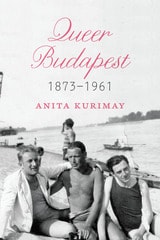
cover of Queer Budapest, 1873–1961

Queer Budapest, 1873–1961

Anita Kurimay

University of Chicago Press, 2020

By the dawn of the twentieth century, Budapest was a burgeoning cosmopolitan metropolis. Known at the time as the “Pearl of the Danube,” it boasted some of Europe’s most innovative architectural and cultural achievements, and its growing middle class was committed to advancing the city’s liberal politics and making it an intellectual and commercial crossroads between East and West. In addition, as historian Anita Kurimay reveals, fin-de-siècle Budapest was also famous for its boisterous public sexual culture, including a robust gay subculture. Queer Budapest is the riveting story of nonnormative sexualities in Hungary as they were understood, experienced, and policed between the birth of the capital as a unified metropolis in 1873 and the decriminalization of male homosexual acts in 1961.
 
Kurimay explores how and why a series of illiberal Hungarian regimes came to regulate but also tolerate and protect queer life. She also explains how the precarious coexistence between the illiberal state and queer community ended abruptly at the close of World War II. A stunning reappraisal of sexuality’s political implications, Queer Budapest recuperates queer communities as an integral part of Hungary’s—and Europe’s—modern incarnation.
[more]
cover of Queer Contiguities of Nigerian Literature

Queer Contiguities of Nigerian Literature

Kerry Manzo

Michigan State University Press, 2026
Queer Contiguities of Nigerian Literature explores how normative ideas of sex and gender have shaped the development of Nigerian literature. Tracing this influence from the rise of mid-twentieth-century modernist writing to the contemporary appearance of LGBTQIA literature, Kerry Manzo presents a new framework for understanding Nigerian literature, one in which sexuality and gender—or more specifically, their containment through national discourses of heteronormativity in colonial and postcolonial Nigeria—are central to its problematics and poetics. Drawing on interdisciplinary research and archival materials, including institutional records, personal letters, small publications, and other ephemera, Manzo illuminates the historical and material conditions that have placed limitations on the literary representation of women and sexual minorities and shaped the national masculine tradition of letters.
 
[more]
cover of Queer Episodes in Music and Modern Identity

Queer Episodes in Music and Modern Identity

Edited by Sophie Fuller and Lloyd Whitesell

University of Illinois Press, 2001

Exploring the relationship between queer sexuality and music in the late nineteenth and early twentieth century

Queer Episodes in Music and Modern Identity approaches modern sexuality by way of music. Through the hidden or lost stories of composers, scholars, patrons, performers, audiences, repertoires, venues, and specific works, this intriguing volume explores points of intersection between music and queerness in Europe and the United States in the years 1870 to 1950--a period when dramatic changes in musical expression and in the expression of individual sexual identity played similar roles in washing away the certainties of the past. Pursuing the shadowy, obscured tracks of queerness, contributors unravel connections among dissident identities and concrete aspects of musical style, gestures, and personae.

Contributors are Byron Adams, Philip Brett, Malcolm Hamrick Brown, Sophie Fuller, Mitchell Morris, Jann Pasler, Ivan Raykoff, Fiona Richards, Eva Rieger, Gillian Rodger, Sherrie Tucker, and Lloyd Whitesell.
[more]
cover of Queer Forster

Queer Forster

Edited by Robert K. Martin and George Piggford

University of Chicago Press, 1997

This groundbreaking volume presents a radical revision of gay criticism and focuses on E. M. Forster's place in the emerging field of queer studies.

Many previous critics of Forster downplayed his homosexuality or read Forster naively in terms of gay liberation. This collection situates Forster within the Bloomsbury Group and examines his relations to major figures such as Henry James, Edward Carpenter, and Virginia Woolf. Particular attention is paid to Forster's several accounts of India and their troubled relation to the British colonial enterprise. Analyzing a wide range of Forster's work, the authors examine material from Forster's undergraduate writings to stories written more than a half-century later.

A landmark book for the study of gender in literature, Queer Forster brings the terms "queer" and "gay" into conversation, opening up a dialogue on wider dimensions of theory and allowing a major revaluation of modernist inventions of sexual identity.
[more]
cover of Queer Legacies: Stories from Chicago’s LGBTQ Archives

Queer Legacies

Stories from Chicago’s LGBTQ Archives

John D'Emilio

University of Chicago Press, 2020
The variety of LGBTQ life in Chicago is too abundant and too diverse to be contained in a single place. But since 1981, the Gerber/Hart Library and Archives has striven to do just that, amassing a wealth of records related to the city’s gay, lesbian, bisexual, transgender, and queer-identified people and organizations. In Queer Legacies, John D’Emilio—a pioneering scholar in the field—digs deep into Gerber/Hart’s collection to unearth a kaleidoscopic look at the communities built by generations of LGBTQ people. Excavated from one of the country’s most important, yet overlooked, LGBTQ archives, D’Emilio’s entertaining and enthusiastic essays range in focus from politics and culture to social life, academia, and religion. He gives readers an inclusive and personal look at fifty years of a national fight for visibility, recognition, and equality led by LGBTQ Americans who, quite literally, made history. In these troubled times, it will surely inspire a new generation of scholars and activists.
[more]
cover of Queer London: Perils and Pleasures in the Sexual Metropolis, 1918-1957

Queer London

Perils and Pleasures in the Sexual Metropolis, 1918-1957

Matt Houlbrook

University of Chicago Press, 2005

In August 1934, young Cyril L. wrote to his friend Billy about all the exciting men he had met, the swinging nightclubs he had visited, and the vibrant new life he had forged for himself in the big city. He wrote, "I have only been queer since I came to London about two years ago, before then I knew nothing about it." London, for Cyril, meant boundless opportunities to explore his newfound sexuality. But his freedom was limite: he was soon arrested, simply for being in a club frequented by queer men.

Cyril's story is Matt Houlbrook's point of entry into the queer worlds of early twentieth-century London. Drawing on previously unknown sources, from police reports and newspaper exposés to personal letters, diaries, and the first queer guidebook ever written, Houlbrook here explores the relationship between queer sexualities and modern urban culture that we take for granted today. He revisits the diverse queer lives that took hold in London's parks and streets; its restaurants, pubs, and dancehalls; and its Turkish bathhouses and hotels—as well as attempts by municipal authorities to control and crack down on those worlds. He also describes how London shaped the culture and politics of queer life—and how London was in turn shaped by the lives of queer men. Ultimately, Houlbrook unveils the complex ways in which men made sense of their desires and who they were. In so doing, he mounts a sustained challenge to conventional understandings of the city as a place of sexual liberation and a unified queer culture.

A history remarkable in its complexity yet intimate in its portraiture, Queer London is a landmark work that redefines queer urban life in England and beyond.

“A ground-breaking work. While middle-class lives and writing have tended to compel the attention of most historians of homosexuality, Matt Houlbrook has looked more widely and found a rich seam of new evidence. It has allowed him to construct a complex, compelling account of interwar sexualities and to map a new, intimate geography of London.”—Matt Cook, The Times Higher Education Supplement
 
Winner of History Today’s Book of the Year Award, 2006

[more]
cover of Queer Marxism in Two Chinas

Queer Marxism in Two Chinas

Petrus Liu

Duke University Press, 2015
In Queer Marxism in Two Chinas Petrus Liu rethinks the relationship between Marxism and queer cultures in mainland China and Taiwan. Whereas many scholars assume the emergence of queer cultures in China signals the end of Marxism and demonstrates China's political and economic evolution, Liu finds the opposite to be true. He challenges the persistence of Cold War formulations of Marxism that position it as intellectually incompatible with queer theory, and shows how queer Marxism offers a nonliberal alternative to Western models of queer emancipation. The work of queer Chinese artists and intellectuals not only provides an alternative to liberal ideologies of inclusion and diversity, but demonstrates how different conceptions of and attitudes toward queerness in China and Taiwan stem from geopolitical tensions. With Queer Marxism in Two Chinas Liu offers a revision to current understandings of what queer theory is, does, and can be.
 
[more]
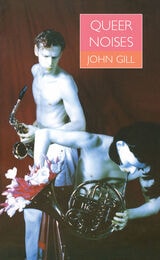
cover of Queer Noises: Male and Female Homosexuality in Twentieth-Century Music

Queer Noises

Male and Female Homosexuality in Twentieth-Century Music

John Gill

University of Minnesota Press, 1995

[more]
cover of Queer People

Queer People

Carroll and Garrett Graham. Afterword by Budd Schulberg.

Southern Illinois University Press, 1976

A brilliantly savage story, Queer People is, according to Budd Schulberg, “a racy testament to an era as totally van­ished as the civilization of the Aztecs,” and if not the Hollywood novel is “at least a truly seminal work.”

Today’s readers will recognize in this long-forgotten Hollywood novel the seeds of three longer-lived ones, The Day of the Locust, What Makes Sammy Run?,and The Last Tycoon. They may also recognize Whitey, the hero of the Grahams’ novel, as a forerunner of F. Scott Fitzgerald’s Pat Hobby.

The central figure in the novel is an archetypal newspaper reporter who drifts to Hollywood. Whitey discovers the social microcosm of the studio-people, and finds himself in his ele­ment. He penetrates strange places and encounters queer people—the story conference, the three-day party, the titans and the moguls. When a murder ends his interlude he leaves Hollywood as casually as he discovered it.

Originally published in 1930 Queer People was a scandalous roman à clef, irreverent to the “industry,” and totally amoral—qualities lacking in later Hol­lywood fiction. Hence itis at once an important social document and an ex­citing original work.

[more]
cover of Queer Tidalectics: Linguistic and Sexual Fluidity in Contemporary Black Diasporic Literature

Queer Tidalectics

Linguistic and Sexual Fluidity in Contemporary Black Diasporic Literature

Emilio Amideo

Northwestern University Press, 2021

In Queer Tidalectics, Emilio Amideo investigates how Anglophone writers James Baldwin, Jackie Kay, Thomas Glave, and Shani Mootoo employ the trope of fluidity to articulate a Black queer diasporic aesthetics. Water recurs as a figurative and material site to express the Black queer experience within the diaspora, a means to explore malleability and overflowing sexual, gender, and racial boundaries. Amideo triangulates language, the aquatic, and affect to delineate a Black queer aesthetics, one that uses an idiom of fluidity, slipperiness, and opacity to undermine and circumvent gender normativity and the racialized heteropatriarchy embedded in English. The result is an outline of an ever-expanding affective archive of experiential knowledge.
 
Amideo engages and extends the work of Black queer studies, Oceanic studies, ecocriticism, phenomenology, and new materialism through the theorizations of Sara Ahmed, Omise’eke Natasha Tinsley, M. Jacqui Alexander, Édouard Glissant, José Esteban Muñoz, and Edward Kamau Brathwaite, among others. Ambitious in scope and captivating to read, Queer Tidalectics brings Caribbean writers like Glissant and Brathwaite into queer literary analysis—a major scholarly contribution.


[more]
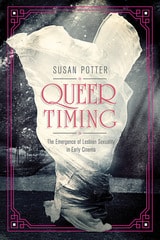
cover of Queer Timing: The Emergence of Lesbian Sexuality in Early Cinema

Queer Timing

The Emergence of Lesbian Sexuality in Early Cinema

Susan Potter

University of Illinois Press, 2019

John Leo and Dana Heller Award for Best Single Work, Anthology, Multi-Authored or Edited Book in LGBTQ Studies, Popular Culture Association (PCA), 2020

In Queer Timing, Susan Potter offers a counter-history that reorients accepted views of lesbian representation and spectatorship in early cinema. Potter sees the emergence of lesbian figures as only the most visible but belated outcome of multiple sexuality effects. Early cinema reconfigured older erotic modalities, articulated new--though incoherent--sexual categories, and generated novel forms of queer feeling and affiliation.

Potter draws on queer theory, silent film historiography, feminist film analysis, and archival research to provide an original and innovative analysis. Taking a conceptually oriented approach, she articulates the processes of filmic representation and spectatorship that reshaped, marginalized, or suppressed women's same-sex desires and identities. As she pursues a sense of "timing," Potter stages scenes of the erotic and intellectual encounters shared by historical spectators, on-screen figures, and present-day scholars. The result is a daring revision of feminist and queer perspectives that foregrounds the centrality of women's same-sex desire to cinematic discourses of both homo- and heterosexuality.

[more]
cover of Queering Cold War Poetry: Ethics of Vulnerability in Cuba and the United States

Queering Cold War Poetry

Ethics of Vulnerability in Cuba and the United States

Eric Keenaghan

The Ohio State University Press, 2009
Many feel that individualism, and the security it demands, define democracy and freedom. This belief is characteristic of the attitude that thinkers from John Dewey to Michel Foucault have criticized as "liberalist." In actuality, we share intimate associations with one another through contacts established by our bodies and even by language.
In Queering Cold War Poetry, Eric Keenaghan offers queer theory, queer studies, and literary theory a new political and conceptual language for reevaluating past and present high valuations of individualism and security. He examines four Cold War poets from Cuba and the United States—Wallace Stevens, José Lezama Lima, Robert Duncan, and Severo Sarduy. These writers, who lived in an era when homosexuals were regarded as outsiders or even security threats, offer critiques of nationalism and liberalism. In their struggles against state and cultural mandates that foreclosed positive estimations of vulnerability, Stevens, Lezama, Duncan, and Sarduy radically revised ethics and identity in their day. Their work exemplifies how much modernist poetry disseminates experiences of differences that challenge prevailing attitudes about individuals' relationships to one another and to their nations. Through studies of Cuban and U.S. lyric and poetics, Queering Cold War Poetry clears the way for imagining what it means to belong to a passionate and compassionate citizenry which celebrates vulnerability, searches for difference in itself and each of its constituent individuals, and identifies less with a nation than with a global community.
 
[more]
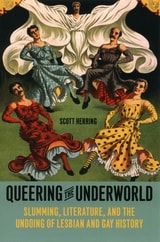
cover of Queering the Underworld: Slumming, Literature, and the Undoing of Lesbian and Gay History

Queering the Underworld

Slumming, Literature, and the Undoing of Lesbian and Gay History

Scott Herring

University of Chicago Press, 2007

At the start of the twentieth century, tales of “how the other half lives” experienced a surge in popularity. People looking to go slumming without leaving home turned to these narratives for spectacular revelations of the underworld and sordid details about the deviants who populated it.

In this major rethinking of American literature and culture, Scott Herring explores how a key group of authors manipulated this genre to paradoxically evade the confines of sexual identification. Queering the Underworld examines a range of writers, from Jane Addams and Willa Cather to Carl Van Vechten and Djuna Barnes, revealing how they fulfilled the conventions of slumming literature but undermined its goals, and in the process, queered the genre itself. Their work frustrated the reader’s desire for sexual knowledge, restored the inscrutability of sexual identity, and cast doubt on the value of a homosexual subculture made visible and therefore subject to official control.

Herring is persuasive and polemical in connecting these writers to ongoing debates about lesbian and gay history and politics, and Queering the Underworld will be widely read by students and scholars of literature, history, and sexuality.

[more]
cover of Questions of Poetics: Language Writing and Consequences

Questions of Poetics

Language Writing and Consequences

Barrett Watten

University of Iowa Press, 2016

Questions of Poetics is Barrett Watten’s major reassessment of the political history, social formation, and literary genealogy of Language writing. A key participant in the emergent bicoastal poetic avant-garde as poet, editor, and publisher, Watten has developed, over three decades of writing in poetics, a sustained account of its theory and practice. The present volume represents the core of Watten’s critical writing and public lecturing since the millennium, taking up the historical origins and continuity of Language writing, from its beginnings to the present.

Each chapter is a theoretical inquiry into an aspect of poetics in an expanded sense—from the relation of experimental poetry to cultural logics of liberation and political economy, to questions of community and the politics of the avant-garde, to the cultural contexts where it is produced and intervenes. Each serves as a kind of thought experiment that theorizes and assesses the consequences of Language writing in expanded fields of meaning that include history, political theory, art history, and narrative theory. While all are grounded in a series of baseline questions of poetics, they also polemically address the currently turbulent debates on the politics of the avant-garde, especially Language writing, among emerging communities of poets.

In manifold ways, Watten masterfully demonstrates the aesthetic and political aims of Language writing, its influence on emerging literary schools, and its present aesthetic, critical, and political horizons. Questions of Poetics will be a major point of reference in continuing debates on poetry and literary history, a critical reexamination for already familiar readers and a clearly presented introduction for new ones. 
[more]
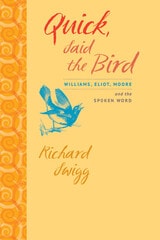
cover of Quick, Said the Bird: Williams, Eliot, Moore, and the Spoken Word

Quick, Said the Bird

Williams, Eliot, Moore, and the Spoken Word

Richard Swigg

University of Iowa Press, 2012

When William Carlos Williams said, “It’s all in / the sound,” when T. S. Eliot hailed the invigorating force of the “auditory imagination,” or when Marianne Moore applauded “the clatter and true sound” of Williams’s verse, each poet invoked the dimension that bound them together. In Quick, Said the Bird, Richard Swigg makes the case for acoustics as the basis of the linkages, kinships, and inter-illuminations of a major twentieth-century literary relationship. Outsiders in their home terrain who nevertheless continued to reach back to their own American vocal identities, Williams, Eliot, and Moore embody a unique lineage that can be traced from their first significant works (1909–1918) to the 1960s.
 
In reconstructing the auditory dimension in the work of the three poets, Quick, Said the Bird does not neglect the visual text. Whether in the form of Moore’s quirky patternings, Eliot’s expandable verse-frames, or Williams’s springy stanzas, the printed shape on the page is here brought together with the spoken word in vital interplay: the eye-read text cut against by sequential utterance in a restoration of the poetry’s full effect. By seeing and hearing the verse at the same moment—together with reading side-by-side discussions of the quarrels, friendships, mutual borrowings, and shared energies of Williams, Eliot, and Moore—the reader gains a remarkable new understanding of their individual achievements.By sound and sight, Quick, Said the Bird takes the reader straight into the physical textures of the finest works by three outstanding figures of twentieth-century American poetry.
[more]
cover of Quicksand and Cactus

Quicksand and Cactus

Juanita Brooks

Utah State University Press, 1992
Juanita Brooks became one of the best-known historians of Mormon and Utah history. Her autobiography is a valuable source of information on early southern Utah and Mormon history.
[more]
cover of Quixote's Soldiers: A Local History of the Chicano Movement, 1966–1981

Quixote's Soldiers

A Local History of the Chicano Movement, 1966–1981

By David Montejano

University of Texas Press, 2010
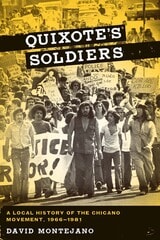
In the mid-1960s, San Antonio, Texas, was a segregated city governed by an entrenched Anglo social and business elite. The Mexican American barrios of the west and south sides were characterized by substandard housing and experienced seasonal flooding. Gang warfare broke out regularly. Then the striking farmworkers of South Texas marched through the city and set off a social movement that transformed the barrios and ultimately brought down the old Anglo oligarchy. In Quixote’s Soldiers, David Montejano uses a wealth of previously untapped sources, including the congressional papers of Henry B. Gonzalez, to present an intriguing and highly readable account of this turbulent period. Montejano divides the narrative into three parts. In the first part, he recounts how college student activists and politicized social workers mobilized barrio youth and mounted an aggressive challenge to both Anglo and Mexican American political elites. In the second part, Montejano looks at the dynamic evolution of the Chicano movement and the emergence of clear gender and class distinctions as women and ex-gang youth struggled to gain recognition as serious political actors. In the final part, Montejano analyzes the failures and successes of movement politics. He describes the work of second-generation movement organizations that made possible a new and more representative political order, symbolized by the election of Mayor Henry Cisneros in 1981.
[more]
cover of Quoting Caravaggio: Contemporary Art, Preposterous History

Quoting Caravaggio

Contemporary Art, Preposterous History

Mieke Bal

University of Chicago Press, 1999

As period, as style, as sensibility, the Baroque remains elusive, its definition subject to dispute. Perhaps this is so in part because baroque vision resists separation of mind and body, form and matter, line and color, image and discourse. In Quoting Caravaggio, Mieke Bal deploys this insight of entanglement as a form of art analysis, exploring its consequences for both contemporary and historical art, as well as for current conceptions of history.

Mieke Bal’s primary object of investigation in Quoting Caravaggio is not the great seventeenth-century painter, but rather the issue of temporality in art. In order to retheorize linear notions of influence in cultural production, Bal analyzes the productive relationship between Caravaggio and a number of late-twentieth-century artists who "quote" the baroque master in their own works. These artists include Andres Serrano, Carrie Mae Weems, Ken Aptekar, David Reed, and Ana Mendieta, among others. Each chapter of Quoting Caravaggio shows particular ways in which quotation is vital to the new art but also to the source from which it is derived. Through such dialogue between present and past, Bal argues for a notion of "preposterous history" where works that appear chronologically first operate as an aftereffect caused by the images of subsequent artists.

Quoting Caravaggio is a rigorous, rewarding work: it is at once a meditation on history as creative, nonlinear process; a study of the work of Caravaggio and the Baroque; and, not least, a brilliant critical exposition of contemporary artistic representation and practice.


"[A] profoundly enlivening exercise in art criticism, in which the lens of theory magnifies rather than diminishes its object. . . . [A] remarkable book. . . . The power of Quoting Caravaggio resides in the intelligence and authority of the writer."—Roger Malbert, Times Literary Supplement
[more]