Results by title
1116 books match the query 'Africa' and 4 start with q
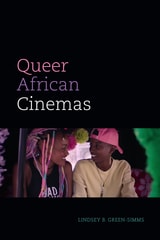
Queer African Cinemas
Lindsey B. Green-Simms
Duke University Press, 2022
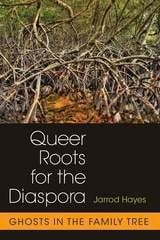
Queer Roots for the Diaspora
Ghosts in the Family TreeJarrod Hayes
University of Michigan Press, 2016
The central argument of Queer Roots for the Diaspora is that, in spite of these debates, ultimately the desire for roots contains the “roots” of its own deconstruction. The book considers alternative root narratives that acknowledge the impossibility of returning to origins with any certainty; welcome sexual diversity; acknowledge their own fictionality; reveal that even a single collective identity can be rooted in multiple ways; and create family trees haunted by the queer others patrilineal genealogy seems to marginalize.
The roots narratives explored in this book simultaneously assert and question rooted identities within a number of diasporas—African, Jewish, and Armenian. By looking at these together, one can discern between the local specificities of any single diaspora and the commonalities inherent in diaspora as a global phenomenon. This comparatist, interdisciplinary study will interest scholars in a diversity of fields, including diaspora studies, postcolonial studies, LGBTQ studies, French and Francophone studies, American studies, comparative literature, and literary theory.
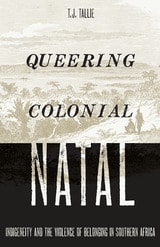
Queering Colonial Natal
Indigeneity and the Violence of Belonging in Southern AfricaT. J. Tallie
University of Minnesota Press, 2019
How were indigenous social practices deemed queer and aberrant by colonial forces?
In Queering Colonial Natal, T.J. Tallie travels to colonial Natalestablished by the British in 1843, today South Africa’s KwaZulu-Natal provinceto show how settler regimes “queered” indigenous practices. Defining them as threats to the normative order they sought to impose, they did so by delimiting Zulu polygamy; restricting alcohol access, clothing, and even friendship; and assigning only Europeans to government schools.
Using queer and critical indigenous theory, this book critically assesses Natal (where settlers were to remain a minority) in the context of the global settler colonial project in the nineteenth century to yield a new and engaging synthesis. Tallie explores the settler colonial history of Natal’s white settlers and how they sought to establish laws and rules for both whites and Africans based on European mores of sexuality and gender. At the same time, colonial archives reveal that many African and Indian people challenged such civilizational claims.
Ultimately Tallie argues that the violent collisions between Africans, Indians, and Europeans in Natal shaped the conceptions of race and gender that bolstered each group’s claim to authority.
Questioning African Cinema
Conversations With FilmmakersNwachukwu Frank Ukadike
University of Minnesota Press, 2002
The most comprehensive account available of filmmaking in Africa today
Diverse in their art, paradoxically more celebrated abroad than they are at home, African filmmakers eke out their visions against a backdrop of complex historical, social, economic, and political practices. The richness of their accomplishments emerges with compelling clarity in this book, in which African filmmakers speak candidly about their work.
Featuring interviews with key personalities from twelve nations, Questioning African Cinema provides the most extensive, comprehensive account ever given of the origins, practice, and implications of filmmaking in Africa. Speaking with pioneers Med Hondo, Souleymane Cissé, and Kwaw Ansah; renowned feature filmmakers Djibril Mambéty, Haile Gerima, and Safi Faye; and award-winning younger filmmakers Idrissa Ouedraogo, Cheick Oumar Sissoko, and Jean-Pierre Bekolo, N. Frank Ukadike identifies trends and individual practices even as he surveys the evolution of African cinema and addresses the politics and problems of seeing Africa through an African lens. Situating the unique achievement of each filmmaker within the geographic, historical, social, and political context of African cinema, he also explores questions about acting, distribution and exhibition, history, theory and criticism, video-based television production, and television’s relationship to independent film.