1272 books match the query 'Asia' and 7 start with q

cover of Qing Colonial Enterprise: Ethnography and Cartography in Early Modern China

Qing Colonial Enterprise

Ethnography and Cartography in Early Modern China

Laura Hostetler

University of Chicago Press, 2001

In Qing Colonial Enterprise, Laura Hostetler shows how Qing China (1636-1911) used cartography and ethnography to pursue its imperial ambitions. She argues that far from being on the periphery of developments in the early modern period, Qing China both participated in and helped shape the new emphasis on empirical scientific knowledge that was simultaneously transforming Europe—and its colonial empires—at the time.

Although mapping in China is almost as old as Chinese civilization itself, the Qing insistence on accurate, to-scale maps of their territory was a new response to the difficulties of administering a vast and growing empire. Likewise, direct observation became increasingly important to Qing ethnographic writings, such as the illustrated manuscripts known as "Miao albums" (from which twenty color paintings are reproduced in this book). These were intended to educate Qing officials about various non-Han peoples so that they could govern these groups more effectively.Hostetler's groundbreaking account will interest anyone studying the history of the early modern period and colonialism.

[more]
cover of Queer Activism in India: A Story in the Anthropology of Ethics

Queer Activism in India

A Story in the Anthropology of Ethics

Naisargi Dave

Duke University Press, 2012

In Queer Activism in India, Naisargi Dave examines the formation of lesbian communities in India from the 1980s to the early 2000s. Based on ethnographic fieldwork conducted with activist organizations in Delhi, a body of letters written by lesbian women, and research with lesbian communities and queer activist groups across the country, Dave studies the everyday practices that constitute queer activism in India.

Dave argues that activism is an ethical practice comprised of critique, invention, and relational practice. Her analysis investigates the relationship between the ethics of activism and the existing social norms and conditions from which activism emerges. Through her study of different networks and institutions, Dave documents how activism oscillates between the potential for new social arrangements and the questions that arise once the activists' goals have been accomplished. Dave's book addresses a relevant and timely phenomenon and makes an important contribution to the anthropology of queer communities, social movements, affect, and ethics.

[more]
cover of Queer Chimerica: A Speculative Auto/Ethnography of the Cool Child

Queer Chimerica

A Speculative Auto/Ethnography of the Cool Child

Shana Ye

University of Michigan Press, 2024

Blending archival work, ethnography, and cultural analysis with memoir, graphic arts, and science fiction, Queer Chimerica unpacks the ways in which the transnational circulation of queer culture, politics, and institutions are structured through the antagonist interdependence of China and the United States. By examining the intersecting timelines of the rise of queer theory and the rise of China in the late Cold War era, Shana Ye explores the relationship between the discourse of queer fluidity and capital’s demands for labor flexibility. 

Drawing on rare archival material and oral historical accounts of queer life from the 1950s to the late 2010s, the author shows how these accounts make sense of the variegated landscapes of desires, transformations, and conundrums in postsocialist China. The author illustrates party cadres in the Cultural Revolution, tongzhi activism mediated by the explosive politics of Tiananmen upheaval, HIV/AIDS community outreach workers, feminist artists and digital activists, leftist queer theorists, and fictional bio-engineers, layering these vivid depictions to reveal the poetic messiness of queer world-making. Queer Chimerica offers insight into the governmentality of LGBT rights, the rules of legibility and recognition, the geo- and bio-politics of identity, and the class-ridden appropriation of queer history and community. Thus understanding the production of queerness unveils the uneven distributions of capital, knowledge, affect, and opportunity that reproduce queer precarity and agency.  

 

[more]
cover of Queer Companions: Religion, Public Intimacy, and Saintly Affects in Pakistan

Queer Companions

Religion, Public Intimacy, and Saintly Affects in Pakistan

Omar Kasmani

Duke University Press, 2022

In Queer Companions Omar Kasmani theorizes saintly intimacy and the construction of queer social relations at Pakistan’s most important site of Sufi pilgrimage. Conjoining queer theory and the anthropology of Islam, Kasmani outlines the felt and enfleshed ways in which saintly affections bind individuals, society, and the state in Pakistan through a public architecture of intimacy. Islamic saints become lovers and queer companions just as a religious universe is made valuable to critical and queer forms of thinking. Focusing on the lives of ascetics known as fakirs in Pakistan, Kasmani shows how the affective bonds with the place’s patron saint, a thirteenth-century antinomian mystic, foster unstraight modes of living in the present. In a national context where religious shrines are entangled in the state’s infrastructures of governance, coming close to saints further entails a drawing near to more-than-official histories and public forms of affect. Through various fakir life stories, Kasmani contends that this intimacy offers a form of queer world making with saints.
[more]
cover of Queer Korea

Queer Korea

Todd A. Henry, editor

Duke University Press, 2020

Since the end of the nineteenth century, the Korean people have faced successive waves of foreign domination, authoritarian regimes, forced dispersal, and divided development. Throughout these turbulent times, “queer” Koreans were ignored, minimized, and erased in narratives of their modern nation, East Asia, and the wider world. This interdisciplinary volume challenges such marginalization through critical analyses of non-normative sexuality and gender variance. Considering both personal and collective forces, the contributors extend individualized notions of queer neoliberalism beyond those typically set in Western queer theory. Along the way, they recount a range of illuminating topics, from shamanic rituals during the colonial era and B-grade comedy films under Cold War dictatorship to female masculinity among today’s youth and transgender confrontations with the resident registration system. More broadly, Queer Korea offers readers new ways of understanding the limits and possibilities of human liberation under exclusionary conditions of modernity in Asia and beyond.

Contributors. Pei Jean Chen, John (Song Pae) Cho, Chung-kang Kim, Todd A. Henry, Merose Hwang, Ruin, Layoung Shin, Shin-ae Ha, John Whittier Treat
[more]
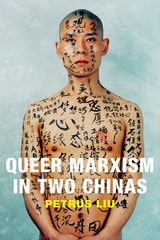
cover of Queer Marxism in Two Chinas

Queer Marxism in Two Chinas

Petrus Liu

Duke University Press, 2015
In Queer Marxism in Two Chinas Petrus Liu rethinks the relationship between Marxism and queer cultures in mainland China and Taiwan. Whereas many scholars assume the emergence of queer cultures in China signals the end of Marxism and demonstrates China's political and economic evolution, Liu finds the opposite to be true. He challenges the persistence of Cold War formulations of Marxism that position it as intellectually incompatible with queer theory, and shows how queer Marxism offers a nonliberal alternative to Western models of queer emancipation. The work of queer Chinese artists and intellectuals not only provides an alternative to liberal ideologies of inclusion and diversity, but demonstrates how different conceptions of and attitudes toward queerness in China and Taiwan stem from geopolitical tensions. With Queer Marxism in Two Chinas Liu offers a revision to current understandings of what queer theory is, does, and can be.
 
[more]
cover of Queer Throughlines: Spaces of Queer Activism in South Korea and the Korean Diaspora

Queer Throughlines

Spaces of Queer Activism in South Korea and the Korean Diaspora

Ju Hui Judy Han

University of Michigan Press, 2025

Queer Throughlines draws on years of direct participation, interviews, and ethnography to examine transnational Korean LGBTQ+ activism since the 1990s. Han maps the sites and routes of leftist and queer political movements, highlighting challenges posed by Christian conservatives in both South Korea and the United States. The book uses the concept of “throughlines” to weave together a web of movement stories across time and space: a coalition of Los Angeles–based LGBTQ+ activists and allies fighting an anti-gay petition campaign led by Korean immigrant churches; queer activists involved in anti-war protests in Seoul; progressive clergy embracing inclusivity and risking heresy charges and excommunication; and queer and trans activists refusing to be sidelined from visions of political change underway. These moments do not always line up in a straightforward narrative of victory or progress, yet they create powerful lines of solidarity, community, and kinship.
[more]