788 books match the query 'Caribbean & Latin American' and 3 start with q

cover of Queer Tidalectics: Linguistic and Sexual Fluidity in Contemporary Black Diasporic Literature

Queer Tidalectics

Linguistic and Sexual Fluidity in Contemporary Black Diasporic Literature

Emilio Amideo

Northwestern University Press, 2021

In Queer Tidalectics, Emilio Amideo investigates how Anglophone writers James Baldwin, Jackie Kay, Thomas Glave, and Shani Mootoo employ the trope of fluidity to articulate a Black queer diasporic aesthetics. Water recurs as a figurative and material site to express the Black queer experience within the diaspora, a means to explore malleability and overflowing sexual, gender, and racial boundaries. Amideo triangulates language, the aquatic, and affect to delineate a Black queer aesthetics, one that uses an idiom of fluidity, slipperiness, and opacity to undermine and circumvent gender normativity and the racialized heteropatriarchy embedded in English. The result is an outline of an ever-expanding affective archive of experiential knowledge.
 
Amideo engages and extends the work of Black queer studies, Oceanic studies, ecocriticism, phenomenology, and new materialism through the theorizations of Sara Ahmed, Omise’eke Natasha Tinsley, M. Jacqui Alexander, Édouard Glissant, José Esteban Muñoz, and Edward Kamau Brathwaite, among others. Ambitious in scope and captivating to read, Queer Tidalectics brings Caribbean writers like Glissant and Brathwaite into queer literary analysis—a major scholarly contribution.


[more]
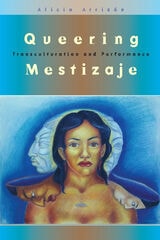
cover of Queering Mestizaje: Transculturation and Performance

Queering Mestizaje

Transculturation and Performance

Alicia Arrizón

University of Michigan Press, 2006

Queering Mestizaje employs theories of postcolonial cultural studies (including performance studies, queer and feminist theory) to examine the notion of mestizaje---the mixing of races, and specifically indigenous peoples, with European colonizers---and how this phenomenon manifests itself in three geographically diverse spaces: the United States, Latin America, and the Philippines. Alicia Arrizón argues that, as an imaginary site for racialized, gendered, and sexualized identities, mestizaje raises questions about historical transformation and cultural memory across Spanish postcolonial sites. Arrizón offers new, queer readings of the hybrid, the intercultural body, and the hyphenated self, building on the work of Gloria Anzaldúa, Antonio Benitez-Rojo, Walter Mignolo, and Vera Kutzinski, while challenging accepted discourses about the relationship between colonizer and colonized. Queering Mestizaje is unique in the connections it makes between the Spanish colonial legacy in the Philippines and in the Americas. An engagingly eclectic array of cultural materials---including examples from performance art, colonial literature, visual art, fashion, and consumer products---are discussed, and included in the book's twenty-nine illustrations. "Arrizón takes as her point of departure the connections and distinctions between the four keywords in the title (each with a long, specific, and convoluted history in its own right) while bringing together the Philippines, the Hispanophone Caribbean, and the United States to configure a map carved by the same blade of colonialism and imperialism. In its conjoining of queer, mestizaje, transculturation and performance, the pleasurable and enlightening variety of its textual examples, and its commitment to theorize desire from the space of queer mestizaje, her book makes a unique and accomplished contribution." ---Yvonne Yarbro-Bejarano, Stanford University Alicia Arrizón is Professor of Women's Studies at the University of California, Riverside. She is author of Latina Performance: Traversing the Stage and co-editor of Latinas on Stage: Practice and Theory. Illustration: Judith F. Baca, La Mestizaje (1991), pastel on paper. © SPARC.
[more]
cover of Questing Fictions: Latin America’s Family Romance

Questing Fictions

Latin America’s Family Romance

Djelal KadirForeword by Terry Cochran

University of Minnesota Press, 1986

Questing Fictions was first published in 1986. Minnesota Archive Editions uses digital technology to make long-unavailable books once again accessible, and are published unaltered from the original University of Minnesota Press editions.

Questing Fictions analyzes twentieth-century Latin American fiction in the light of contemporary literary theory. Djelal Kadir examines key works by several writers—including Jorges Luis Borges, Octavio Paz, Lezama Lima, Alejo Carpentier, Juan Rulfo, and Carlos Fuentes—and demonstrates how these writers are obliged to invent their own reality and how their successors inevitably must continue that inventive tradition. In a larger sense, Kadir describes how works of literature originate and, in turn, generate other literary works.

Aiming at the specific nature of discourse written from the perspective of non-European cultures, Questing Fictions identifies and focuses on the predicament of writers caught between the cultural domination of Europe and the need to strive for cultural autonomy. Kadir explains that this predicament is shared by all Latin American authors and may well characterize all recently emergent literatures. He traces the problems of continuity and rupture within the Latin American tradition and addresses, as well, deeper questions of narrative and narration. In the process, Kadir reveals the interrelatedness of the continent's principal fables and shows their relationship to the larger Western tradition. Finally, Questing Fictions posits that Latin American narratives cannot escape the the quest for an identity that they can never fully attain.
[more]