Results by title
2728 books match the query 'Education' and 8 start with q
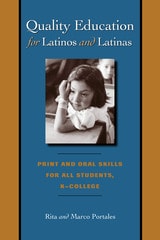
Quality Education for Latinos and Latinas
Print and Oral Skills for All Students, K–CollegeBy Rita and Marco Portales
University of Texas Press, 2005
As educators and legislators across the country debate how to improve public schools, the most vital factor often disappears from the equation—the relationship between the teacher and the student. According to veteran educators Rita and Marco Portales, this relationship is the central issue in the education of students, especially Latino/a students who often face serious barriers to school success because of the legacy of racism, insufficient English-language skills, and cultural differences with the educational establishment.
To break down these barriers and help Latino/a students acquire a quality education, the Portaleses focus attention on the teacher-student relationship and offer a proven method that teachers can use to strengthen the print and oral skills of their students. They begin by analyzing the reasons why schools too often fail to educate Latino/a students, using eloquent comments from young Latinos/as and their parents to confirm how important the teacher-student relationship is to the student's success. Then they show how all educational stakeholders—teachers, administrators, state education agencies, legislators, and parents—can work together to facilitate the teacher-student relationship and improve student education. By demonstrating how teachers can improve students' reading, critical thinking, writing, and oral communication skills across the curriculum, they argue that learning can be made more relevant for students, keeping their interest levels high while preparing them for academically competitive colleges.

Que valga la pena
Un manual para jovenes en busca de sentidoAnna B. Moreland
Catholic University of America Press, 2026
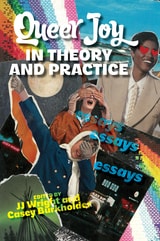
Queer Joy in Theory and Practice
EssaysJJ Wright
Rutgers University Press, 2027
Queer Joy in Theory and Practice: Essays on Resistance, Thriving, and Liberation centers queer joy as a radical method of resistance and world-building in the face of rising homophobia, transphobia, and systemic violence. Rather than framing queer and trans lives solely through trauma, this groundbreaking collection explores how joy functions as a site of possibility, solidarity, and social change. This book bridges theory, research, and practice to examine queer joy across classrooms, communities, art, public spaces, and activism. With chapters on education, abolitionist politics, drag, parenting, street art, and festivals, this timely and interdisciplinary volume illuminates joy as a transformative force—one that refuses despair and instead imagines liberatory, life-affirming futures for queer and trans communities worldwide.
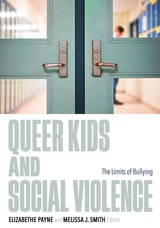
Queer Kids and Social Violence
The Limits of BullyingElizabethe Payne
University of Minnesota Press, 2025
Challenging the myths about LGBTQ+ kids and bullying: what it means to protect queer kids in schools
Conversations around LGBTQ+ kids in school have become dominated by the subject of bullying. Although this may be due to good-faith efforts to protect vulnerable students, Queer Kids and Social Violence demonstrates that a focus on bullying as acts of individual peer aggression fails to address the social norms that perpetuate the violence. Considering the broader contexts of bullying, this volume offers ways to engage with queer youth that are both more humanizing and more likely to create sustainable change.
Essays by leading international scholars analyze how bullying discourse shapes policy and practice, using in-depth case studies, research findings, and examinations of political policy to guide readers through the various forms of violence, identity regulation, and identity erasure in schools. Offering conversation-shifting interventions to respond to a difficult and frightening political moment for LGBTQ+ youth, Queer Kids and Social Violence is a rounded, empathetic picture that does queer youth justice and points the way toward safer schools for all.
Contributors: Ana María Amigo-Ventureira, Durell M. Callier, Cristyn Davies, Renée DePalma, Tania Ferfolja, Jessica Fields, Elliot Fonarev, Jen Gilbert, Tristan Gleason, Dominique C. Hill, Angela Ingram, Laurie Gutmann Kahn, Cris Mayo, Mollie McQuillan, Aoife Neary, C.J. Pascoe, Victoria Rawlings, EJ Renold, Jessica Ringrose, Kerry H. Robinson, Dorte Marie Søndergaard, Cris Townley, Jacqueline Ullman, Boni Wozolek.
Retail e-book files for this title are screen-reader friendly with images accompanied by short alt text and/or extended descriptions.
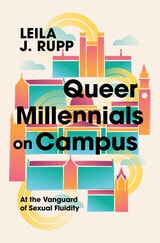
Queer Millennials on Campus
At the Vanguard of Sexual FluidityLeila J. Rupp
University of Chicago Press, 2027
An intimate portrayal of the college experiences of queer and non-binary millennials and what they tell us about the shifting shape of desires and identities in the twenty-first century.
College has long been considered a distinct place for self-discovery. This is particularly true when it comes to gender and sexual identities. In Queer Millennials on Campus, Leila J. Rupp draws on a host of remarkably open and honest interviews with queer women and nonbinary assigned-female-at-birth students at the University of California, Santa Barbara. The accessible narrative wends its way through their lives, from their first experiences of queer desires, through their intimacies and relationships, negotiating their identities, and coming out (or not) to friends and family members. Rupp sheds new light on the Millennial generation, who played a pivotal role in popularizing and embracing the concept of sexual fluidity, helping to challenge older notions of stable sexual and gender identities.
Ultimately, the voices in the book argue that self-awareness about one’s desires, intimate relationships, and identities should be acknowledged and celebrated. Written with deep empathy and understanding, Queer Millennials on Campus honors queer sexual awareness and joy.
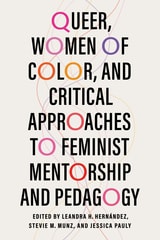
Queer, Women of Color, and Critical Approaches to Feminist Mentorship and Pedagogy
Edited by Leandra H. Hernández, Stevie M. Munz, and Jessica Pauly
University of Illinois Press, 2025
The first section draws upon the contributors’ unique and situated experiences of mentorship in academia. Essays explore their past and current experiences with feminist mentorship in relationships that take many forms: faculty members with fellow faculty members; faculty members with undergraduate and graduate students; and faculty members who feel as if they have become family with their mentors and mentees. In the second section, the contributors deeply interrogate the practices of feminist mentoring by problematizing practices and offering new ways, places, and formats that make space and consider new possibilities. A conclusion reflects on the future of feminist mentorship amidst contemporary debates and concerns in higher education.
Enriching and hopeful, Queer, Women of Color, and Critical Approaches to Feminist Mentorship and Pedagogy is a much-needed challenge to traditional forms of mentorship.
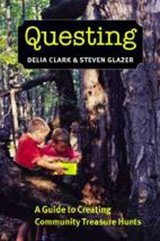
Questing
A Guide to Creating Community Treasure HuntsDelia Clark and Steven Glazer
University Press of New England, 2006
Quiet Methodologies
Humility in the HumanitiesSuzanne Bost
University of Minnesota Press, 2025
Reimagining humanities scholarship with humility and inclusive attention
How might foregrounding the writings of colonized peoples transform the ways we work in the humanities? In an era dominated by loud political rhetoric, Suzanne Bost advocates for quieter modes of scholarship: intellectual humility rather than ego, collaboration and conversation rather than singular argumentation, continual reflection and revision rather than defensiveness, and a willingness to believe in different ways of being and knowing rather than adhering to academic norms. With Quiet Methodologies, she demonstrates practical decolonial scholarship and proposes alternative approaches for fostering meaningful engagement.
Turning to feminist, queer, and decolonial writings from Gloria Anzaldúa, Alexis Pauline Gumbs, Audre Lorde, and many others, Bost reflects on what we do when we work with literature, culture, and ideas. She weaves together multiple voices, methods of writing, and culturally diverse epistemologies and uses creative devices such as collage, her own original poetry, revision, lists, images, and conversation to disengage academic thought and writing from colonial theories and archives that have passed as neutral. Eschewing conventional monograph formats, her work embraces a reciprocal and heterogeneous learning process with profound ethical implications.
Part of a movement of reimagining research and education through care, Quiet Methodologies is a powerful exploration of the possibilities of criticism during crises. It encourages readers to be visionary and pragmatic, challenging current conditions and offering alternative ideas for the future of the humanities.
Retail e-book files for this title are screen-reader friendly with images accompanied by short alt text and/or extended descriptions.