Results by title
570 books match the query 'Gay Studies' and 47 start with q
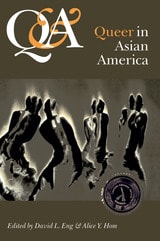
Q & A Queer And Asian
Queer & Asian In AmericaAlvin Eng
Temple University Press, 1998
Q & A approaches matters of identity from a variety of points of view and academic disciplines in order to explore the multiple crossings of race and ethnicity with sexuality and gender. Drawing together the work of visual artists, fiction writers, community organizers, scholars, and participants in roundtable discussions, the collection gathers an array of voices and experiences that represent the emerging communities of a queer Asian America. Collectively, these contributors contend that Asian American studies needs to be more attentive to issues of sexuality and that queer studies needs to be more attentive to other aspects of difference, especially race and ethnicity. Vigorously rejecting the notion that a symmetrical relationship between race and homosexuality would weaken lesbian/gay and queer movements, the editors refuse to "believe that a desirably queer world is one in which we remain perpetual aliens -- queer houseguests -- in a queer nation."
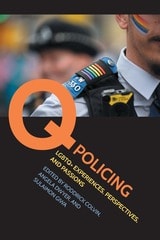
Q Policing
LGBTQ+ Experiences, Perspectives, and PassionsEdited by Roddrick Colvin, Angela Dwyer, and Sulaimon Giwa
Southern Illinois University Press, 2024
Global perspectives on policing within LGBTQ+ communities
Relationships between law enforcement and lesbian, gay, bisexual, transgender, and queer (LGBTQ+) communities have always been varied and complex. On one hand, history is filled with incidents of police harassment: raids that sparked famous uprisings and rebellions; shoddy police investigations into the murders of LGBTQ+ community members; a corrosive organizational culture marked by heteronormativity and misogyny. Yet positive changes are being made, such as the creation of LGBTQ+ police associations, participation by police officers in Pride Parades around the world, and formal apologies for past actions. To some LGBTQ+ community members, police are the physical manifestations of state-sanctioned oppression and abuse. To others, they are guardians who have become partners in public safety.
Q Policing features eighteen contributors from around the world who explore the nature of the relationship between LGBTQ+ communities and the police. Part 1 of the book offers insights on policing and racial and ethnic constructions, including efforts to build collaborative models of community-building within groups and with law enforcement. Part 2 highlights the experiences of individuals who may be marginalized due to various social constructions such as transgender, unhoused, southern, or kink-involved. Finally, Part 3 shares perspectives of queer folks inside policing.
The contributors—scholars, social workers, police officers, and other community leaders—cover diverse topics, including queer experiences of policing in southern India, clinical implications for mental health professionals working with Latinx LGBTQ+ people, transgender and nonbinary peoples’ presentation management during encounters with law enforcement, discriminatory policies in place in the southern United States, the pathologization of kink, and more. Essays analyze interviews with the “Pride Defenders” in Hamilton, Canada, as well as British and American police officers transitioning while in uniform. They explore the experiences of gay, lesbian, and genderqueer police officers, map principal findings and central concerns that structure extant scholarship on gay police officers in the UK, use queer theory to explore the effectiveness of LGBTQ+ liaisons, and more.
The volume editors adopt an inclusive global perspective to account for contextually located experiences of queer people within and outside of the United States. The book incorporates a variety of voices, data sources, and methodologies, but contributors share an intentional focus on race, age, sex, gender, and other identities that helps explain and contextualize queer people’s experiences around and in policing. The diverse, international group of contributors—whose voices are not often heard in traditional outlets and mainstream media—demonstrates that despite discrimination, harassment, and violence, LGBTQ+ communities continue to thrive.
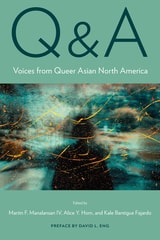
Q&A
Voices from Queer Asian North AmericaEdited by Martin F. Manalansan IV, Alice Y. Hom, and Kale Bantigue Fajardo
Temple University Press, 2021
First published in 1998, Q & A: Queer in Asian America, edited by David L. Eng and Alice Y. Hom, became a canonical work in Asian American studies and queer studies. This new edition of Q & A is neither a sequel nor an update, but an entirely new work borne out of the progressive political and cultural advances of the queer experiences of Asian North American communities.
The artists, activists, community organizers, creative writers, poets, scholars, and visual artists that contribute to this exciting new volume make visible the complicated intertwining of sexuality with race, class, gender, and ethnicity. Sections address activism, radicalism, and social justice; transformations in the meaning of Asian-ness and queerness in various mass media issues of queerness in relation to settler colonialism and diaspora; and issues of bodies, health, disability, gender transitions, death, healing, and resilience.
The visual art, autobiographical writings, poetry, scholarly essays, meditations, and analyses of histories and popular culture in the new Q & Agesture to enduring everyday racial-gender-sexual experiences of mis-recognition, micro-aggressions, loss, and trauma when racialized Asian bodies are questioned, pathologized, marginalized, or violated. This anthology seeks to expand the idea of Asian and American in LGBTQ studies.
Contributors: Marsha Aizumi, Kimberly Alidio, Paul Michael (Mike) Leonardo Atienza, Long T. Bui, John Paul (JP) Catungal, Ching-In Chen, Jih-Fei Cheng, Kim Compoc, Sony Coráñez Bolton, D’Lo, Patti Duncan, Chris A. Eng, May Farrales, Joyce Gabiola, C. Winter Han, Douglas S. Ishii, traci kato-kiriyama, Jennifer Lynn Kelly, Mimi Khúc, Anthony Yooshin Kim, Việt Lê, Danni Lin, Glenn D. Magpantay, Leslie Mah, Casey Mecija, Maiana Minahal, Sung Won Park, Thea Quiray Tagle, Emily Raymundo, Vanita Reddy, Eric Estuar Reyes, Margaret Rhee, Thomas Xavier Sarmiento, Pahole Sookkasikon, Amy Sueyoshi, Karen Tongson, Kim Tran, Kay Ulanday Barrett, Reid Uratani, Eric C. Wat, Sasha Wijeyeratne, Syd Yang, Xine Yao, and the editors
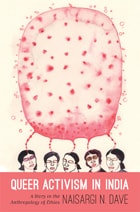
Queer Activism in India
A Story in the Anthropology of EthicsNaisargi Dave
Duke University Press, 2012
Dave argues that activism is an ethical practice comprised of critique, invention, and relational practice. Her analysis investigates the relationship between the ethics of activism and the existing social norms and conditions from which activism emerges. Through her study of different networks and institutions, Dave documents how activism oscillates between the potential for new social arrangements and the questions that arise once the activists' goals have been accomplished. Dave's book addresses a relevant and timely phenomenon and makes an important contribution to the anthropology of queer communities, social movements, affect, and ethics.
Queer Bangkok
21st Century Markets, Media, and RightsEdited by Peter A. Jackson
Hong Kong University Press, 2011
Queer Behavior
Scott Burton and Performance ArtDavid J. Getsy
University of Chicago Press, 2022
Scott Burton (1939–89) created performance art and sculpture that drew on queer experience and the sexual cultures that flourished in New York City in the 1970s. David J. Getsy argues that Burton looked to body language and queer behavior in public space—most importantly, street cruising—as foundations for rethinking the audiences and possibilities of art. This first book on the artist examines Burton’s underacknowledged contributions to performance art and how he made queer life central in them. Extending his performances about cruising, sexual signaling, and power dynamics throughout the decade, Burton also came to create functional sculptures that covertly signaled queerness by hiding in plain sight as furniture waiting to be used.
With research drawing from multiple archives and numerous interviews, Getsy charts Burton’s deep engagements with postminimalism, performance, feminism, behavioral psychology, design history, and queer culture. A restless and expansive artist, Burton transformed his commitment to gay liberation into a unique practice of performance, sculpture, and public art that aspired to be antielitist, embracing of differences, and open to all. Filled with stories of Burton’s life in New York’s art communities, Queer Behavior makes a case for Burton as one of the most significant out queer artists to emerge in the wake of the Stonewall uprising and offers rich accounts of queer art and performance art in the 1970s.
Queer Bergman
Sexuality, Gender, and the European Art CinemaBy Daniel Humphrey
University of Texas Press, 2013
One of the twentieth century’s most important filmmakers—indeed one of its most important and influential artists—Ingmar Bergman and his films have been examined from almost every possible perspective, including their remarkable portrayals of women and their searing dramatizations of gender dynamics. Curiously however, especially considering the Swedish filmmaker’s numerous and intriguing comments on the subject, no study has focused on the undeniably queer characteristics present throughout this nominally straight auteur’s body of work; indeed, they have barely been noted.
Queer Bergman makes a bold and convincing argument that Ingmar Bergman’s work can best be thought of as profoundly queer in nature. Using persuasive historical evidence, including Bergman’s own on-the-record (though stubbornly ignored) remarks alluding to his own homosexual identifications, as well as the discourse of queer theory, Daniel Humphrey brings into focus the director’s radical denunciation of heteronormative values, his savage and darkly humorous deconstructions of gender roles, and his work’s trenchant, if also deeply conflicted, attacks on homophobically constructed forms of patriarchic authority. Adding an important chapter to the current discourse on GLBT/queer historiography, Humphrey also explores the unaddressed historical connections between post–World War II American queer culture and a concurrently vibrant European art cinema, proving that particular interrelationship to be as profound as the better documented associations between gay men and Hollywood musicals, queer spectators and the horror film, lesbians and gothic fiction, and others.

Queer Bonds, Volume 17
Joshua Joanou Weiner
Duke University Press, 0
Queer Brown Voices
Personal Narratives of Latina/o LGBT ActivismEdited by Uriel Quesada, Letitia Gomez, and Salvador Vidal-Ortiz
University of Texas Press, 2015
In the last three decades of the twentieth century, LGBT Latinas/os faced several forms of discrimination. The greater Latino community did not often accept sexual minorities, and the mainstream LGBT movement expected everyone, regardless of their ethnic and racial background, to adhere to a specific set of priorities so as to accommodate a “unified” agenda. To disrupt the cycle of sexism, racism, and homophobia that they experienced, LGBT Latinas/os organized themselves on local, state, and national levels, forming communities in which they could fight for equal rights while simultaneously staying true to both their ethnic and sexual identities. Yet histories of LGBT activism in the 1970s, 1980s, and 1990s often reduce the role that Latinas/os played, resulting in misinformation, or ignore their work entirely, erasing them from history.
Queer Brown Voices is the first book published to counter this trend, documenting the efforts of some of these LGBT Latina/o activists. Comprising essays and oral history interviews that present the experiences of fourteen activists across the United States and in Puerto Rico, the book offers a new perspective on the history of LGBT mobilization and activism. The activists discuss subjects that shed light not only on the organizations they helped to create and operate, but also on their broad-ranging experiences of being racialized and discriminated against, fighting for access to health care during the HIV/AIDS epidemic, and struggling for awareness.
Queer Chinese Cultures and Mobilities
Kinship, Migration, and Middle ClassesJohn Wei
Hong Kong University Press, 2020
Queer Cinema in the World
Karl Schoonover and Rosalind Galt
Duke University Press, 2016
Queer Comrades
Gay Identity and Tongzhi Activism in Postcolonial ChinaHongwei Bao
National University of Singapore Press, 2018
Queer Diasporas
Cindy Patton and Benigno Sánchez-Eppler, editors
Duke University Press, 2000
Incorporating literary analysis, ethnographic research, and theories of diaspora, migration, and transnationalism, the essays in this volume address an impressive range of topics, from the divergent medical and epidemiological understandings of the AIDS pandemic to 1950s lesbian pulp fiction. While one chapter focuses on the appropriation of religious ceremony by gay Filipino immigrants in New York City, another investigates the implicit connection between Jewishness and homosexuality in the work of Freud. The gendering of domestic roles in food preparation and consumption in Japanese society gives way to a discussion of Cuban and Jamaican homoeroticism as seen in the works of Reinaldo Arenas and Claude McKay. Chilean author D’Halmar’s orientalization of Spain as queer space and the hybrid nature of queer ‘zine culture in Quebec are the subject of others. The collection concludes with a monologue by “Walid,” a young gay Arab living in the occupied territory, whose sexual and national identities change according to his sexual and social needs.
Illuminating the complex nature of queerness in the postmodern world, Queer Diasporas contributes to the advancement of gay and lesbian studies. It will be important to those working in cultural, literary, and postcolonial studies.
Contributors. Michele Aina Barale, Daniel Boyarin, Sandra Buckley, Rhonda Cobham, Amir Sumaka’i Fink, Marcie Frank, Martin F. Manalansan IV, Sylvia Molloy, Cindy Patton, Jacob Press, Jennifer Robertson, Benigno Sánchez-Eppler
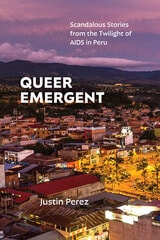
Queer Emergent
Scandalous Stories from the Twilight of AIDS in PeruJustin Perez
Duke University Press, 2025
Queer Encounters with Communist Power
Non-Heterosexual Lives and the State in Czechoslovakia, 1948-1989Vera Sokolová
Karolinum Press, 2019
Contrary to expectations, the book reveals that despite the Czechoslovak Communist regime’s brutality in many areas of life, the state did not carry out a hateful or seditious campaign against homosexual and non-heterosexual people. Rather, the official state sexology offices functioned from the late 1970s onward as essentially the first gay clubs in socialist Czechoslovakia. Interweaving the memories of non-heterosexual Czech women born between 1929 and 1952, Věra Sokolová’s study both enriches and challenges existing scholarship on lesbian and gay history during this era, promising to radically change the way we view gender, sexuality, and everyday life during East European socialism.
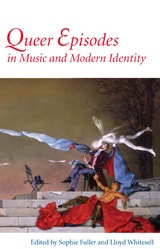
Queer Episodes in Music and Modern Identity
Edited by Sophie Fuller and Lloyd Whitesell
University of Illinois Press, 2001
Exploring the relationship between queer sexuality and music in the late nineteenth and early twentieth century
Queer Episodes in Music and Modern Identity approaches modern sexuality by way of music. Through the hidden or lost stories of composers, scholars, patrons, performers, audiences, repertoires, venues, and specific works, this intriguing volume explores points of intersection between music and queerness in Europe and the United States in the years 1870 to 1950--a period when dramatic changes in musical expression and in the expression of individual sexual identity played similar roles in washing away the certainties of the past. Pursuing the shadowy, obscured tracks of queerness, contributors unravel connections among dissident identities and concrete aspects of musical style, gestures, and personae.
Contributors are Byron Adams, Philip Brett, Malcolm Hamrick Brown, Sophie Fuller, Mitchell Morris, Jann Pasler, Ivan Raykoff, Fiona Richards, Eva Rieger, Gillian Rodger, Sherrie Tucker, and Lloyd Whitesell.
Queer Family Values
Valerie Lehr
Temple University Press, 1999
The flaw in the fight for gay and lesbian marriage rights, argues Lehr in Queer Family Values, lies in its failure to call into question the forms of oppression -- gender, racial, and economic -- that lead society to privilege the nuclear family. Lehr calls for activists to counter conservative discourses that see the nuclear family -- what Lehr considers a socially defined institution that works to maintain, in various ways, inequalities among people -- as the only responsible and mature family alternative. She asks for an approach to family issues and individual liberty that challenges power rather than demands access to privilege. She advocates social policies that enhance the freedom of all people, not simply those gay and lesbian adults seeking to be part of the dominant vision of family in our society.
Analyzing recent works on family, gender, race, and class, Lehr shapes a theory of rights, freedom, and democracy that can liberate us from the strictures of conservative hegemony. She also provides practical examples of how activists can work for a more compassionate and caring society. She devotes a chapter, for example, to the responsibilities activists have to lesbian and gay youths, who -- unlike other children, who might find refuge from social injustice at home -- most often find in the traditional American home homophobia and isolation. Asserting that family care should be seen as a community function, Queer Family Values offers an alternative political strategy focused not on gaining rights, but on enhancing democracy and equality in private life.
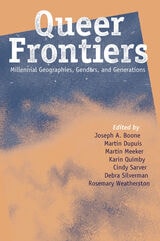
Queer Frontiers
Millennial Geographies, Genders, and GenerationsEdited by Joseph A. Boone, et.al.
University of Wisconsin Press, 2000
From the history of gay and lesbian studies to the emergence of video bars, from an interview with playwright Cherrie Moraga to a photo record of 1950s gay Los Angeles, these original essays tackle the past, present, and future of queer sexuality from all directions. Queer Frontiers brings together the most vital and energetic voices around; whether promising young scholar or veteran of gay activism, each contributor is helping to move the debate into uncharted territory.
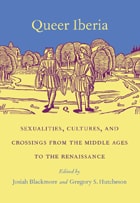
Queer Iberia
Sexualities, Cultures, and Crossings from the Middle Ages to the RenaissanceJosiah Blackmore and Gregory S. Hutcheson, eds.
Duke University Press, 1999
To show how sexual otherness is most evident at points of cultural conflict, the contributors use a variety of methodologies and perspectives and consider source materials that originated in Castilian, Latin, Arabic, Catalan, and Galician-Portuguese. Covering topics from the martydom of Pelagius to the exploits of the transgendered Catalina de Erauso, this volume is the first to provide a comprehensive historical examination of the relations among race, gender, sexuality, nation-building, colonialism, and imperial expansion in medieval and early modern Iberia. Some essays consider archival evidence of sexual otherness or evaluate the use of “deviance” as a marker for cultural and racial difference, while others explore both male and female homoeroticism as literary-aesthetic discourse or attempt to open up canonical texts to alternative readings.
Positing a queerness intrinsic to Iberia’s historical process and cultural identity, Queer Iberia will challenge the field of Iberian studies while appealing to scholars of medieval, cultural, Hispanic, gender, and gay and lesbian studies.
Contributors. Josiah Blackmore, Linde M. Brocato, Catherine Brown, Israel Burshatin, Daniel Eisenberg, E. Michael Gerli, Roberto J. González-Casanovas, Gregory S. Hutcheson, Mark D. Jordan, Sara Lipton, Benjamin Liu, Mary Elizabeth Perry, Michael Solomon, Louise O. Vasvári, Barbara Weissberger
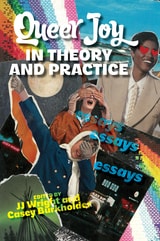
Queer Joy in Theory and Practice
EssaysJJ Wright
Rutgers University Press, 2027
Queer Joy in Theory and Practice: Essays on Resistance, Thriving, and Liberation centers queer joy as a radical method of resistance and world-building in the face of rising homophobia, transphobia, and systemic violence. Rather than framing queer and trans lives solely through trauma, this groundbreaking collection explores how joy functions as a site of possibility, solidarity, and social change. This book bridges theory, research, and practice to examine queer joy across classrooms, communities, art, public spaces, and activism. With chapters on education, abolitionist politics, drag, parenting, street art, and festivals, this timely and interdisciplinary volume illuminates joy as a transformative force—one that refuses despair and instead imagines liberatory, life-affirming futures for queer and trans communities worldwide.

Queer Kinship and Family Change in Taiwan
Brainer, Amy
Rutgers University Press, 2019
Interweaving the narratives of multiple family members, including parents and siblings of her queer and trans informants, Amy Brainer analyzes the strategies that families use to navigate their internal differences. In Queer Kinship and Family Change in Taiwan, Brainer looks across generational cohorts for clues about how larger social, cultural, and political shifts have materialized in people’s everyday lives. Her findings bring light to new parenting and family discourses and enduring inequalities that shape the experiences of queer and heterosexual kin alike.
Brainer’s research takes her from political marches and support group meetings to family dinner tables in cities and small towns across Taiwan. She speaks with parents and siblings who vary in whether and to what extent they have made peace with having a queer or transgender family member, and queer and trans people who vary in what they hope for and expect from their families of origin. Across these diverse life stories, Brainer uses a feminist materialist framework to illuminate struggles for personal and sexual autonomy in the intimate context of family and home.
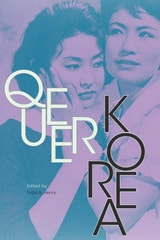
Queer Korea
Todd A. Henry, editor
Duke University Press, 2020
Contributors. Pei Jean Chen, John (Song Pae) Cho, Chung-kang Kim, Todd A. Henry, Merose Hwang, Ruin, Layoung Shin, Shin-ae Ha, John Whittier Treat
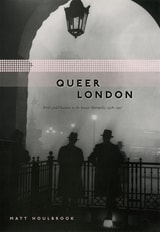
Queer London
Perils and Pleasures in the Sexual Metropolis, 1918-1957Matt Houlbrook
University of Chicago Press, 2005
Cyril's story is Matt Houlbrook's point of entry into the queer worlds of early twentieth-century London. Drawing on previously unknown sources, from police reports and newspaper exposés to personal letters, diaries, and the first queer guidebook ever written, Houlbrook here explores the relationship between queer sexualities and modern urban culture that we take for granted today. He revisits the diverse queer lives that took hold in London's parks and streets; its restaurants, pubs, and dancehalls; and its Turkish bathhouses and hotels—as well as attempts by municipal authorities to control and crack down on those worlds. He also describes how London shaped the culture and politics of queer life—and how London was in turn shaped by the lives of queer men. Ultimately, Houlbrook unveils the complex ways in which men made sense of their desires and who they were. In so doing, he mounts a sustained challenge to conventional understandings of the city as a place of sexual liberation and a unified queer culture.
A history remarkable in its complexity yet intimate in its portraiture, Queer London is a landmark work that redefines queer urban life in England and beyond.
Winner of History Today’s Book of the Year Award, 2006
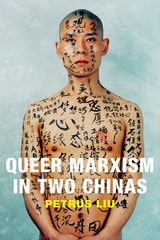
Queer Marxism in Two Chinas
Petrus Liu
Duke University Press, 2015
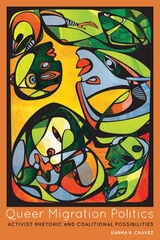
Queer Migration Politics
Activist Rhetoric and Coalitional PossibilitiesKarma Chavez
University of Illinois Press, 2013
Queer Migrations
Sexuality, U.S. Citizenship, and Border CrossingsEithne Luibheid
University of Minnesota Press, 2005
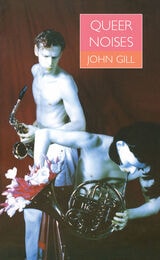
Queer Noises
Male and Female Homosexuality in Twentieth-Century MusicJohn Gill
University of Minnesota Press, 1995

Queer Ricans
Cultures and Sexualities in the DiasporaLawrence La Fountain-Stokes
University of Minnesota Press, 2009
Highlighting cultural and political resistance within Puerto Rico’s gay, lesbian, bisexual, and transgender subcultures, La Fountain-Stokes pays close attention to differences of gender, historical moment, and generation, arguing that Puerto Rican queer identity changes over time and is experienced in very different ways. He traces an arc from 1960s Puerto Rico and the writings of Luis Rafael Sánchez to New York City in the 1970s and 1980s (Manuel Ramos Otero), Philadelphia and New Jersey in the 1980s and 1990s (Luz María Umpierre and Frances Negrón-Muntaner), and Chicago (Rose Troche) and San Francisco (Erika López) in the 1990s, culminating with a discussion of Arthur Avilés and Elizabeth Marrero’s recent dance-theater work in the Bronx.
Proposing a radical new conceptualization of Puerto Rican migration, this work reveals how sexuality has shaped and defined the Puerto Rican experience in the United States.
Queer Theory without Antinormativity
Robyn Wiegman and Elizabeth A. Wilson, special issue editors
Duke University Press, 0
Queer Tourism
Geographies of Globalization, Volume 8Jasbir K. Puar, ed.
Duke University Press, 0
Essays explore a range of geographical areas and cover topics that include an autoethnographic account of a queer traveler in Cuba, the development of gay and lesbian tourism in Madrid and Mexico, and gay and lesbian tourist events such as World Pride 2001 in Rome. The collection also includes an essay focusing on lesbian tourism—a study of the history of lesbian tourism on Eresos, Lesvos.
Contributors. Lionel Cantú, Gabriel Giorgi, Venetia Kantsa, Lawrence La Fountain-Stokes, Michael Luongo, Kevin Markwell, Jasbir Kaur Puar, Dereka Rushbrook
Queer Transexions of Race, Nation, and Gender, Volume 15
Anne McClintock, Phillip Brian Harper, José Esteban Muñoz and Trish Rosen, eds.
Duke University Press, 0
In the first section of this issue, Race and Queer Sexuality, international authors address topics ranging from Asian American queer identity and its relation to transnational and diasporic concerns to homophobia and its relationship to black nationalism in South Africa. Other subjects include, sexuality, race, and public space; lesbian pedagogy and the nation in Latin America; and an analysis of cross-race and cross-gender drag in the work of L.A. drag queen Vaginal Creme Davis. In the second section, The Politics of Transgression, contributors focus on transgression and its relationship to power and history. One essay explores Irish immigration in the U.S. and the Irish female body as a figure of transnational contagion and blood panic, while another focuses on Oscar Wilde, race, and queer sexuality. Other pieces include a meditation on British filmmaker and writer Derek Jarman’s film, Blue.
Race and Queer Sexuality confronts the limitations of prior work in queer theory while providing a starting point for discussion of race, queer sexuality, and the politics of transgression that will be part of queer theory of the future.
Contributors. Judith Butler, David Eng, Licia Fiol-Mata, Judith Halberstam, Phillip Brian Harper, Neville Hoad, Rachel Holmes, Don Kulick, Tim Lawrence, Rosalind Morris, José Esteban Muñoz, Ben Singer, David Valentine, Priscilla Wald, Riki Anne Wilchins
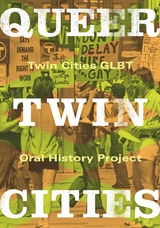
Queer Twin Cities
University of Minnesota Press, 2010
A pioneering look at the queer history, politics, and spaces of the Twin Cities
The Twin Cities is home to one of the largest and most vital GLBT populations in the nation—and one of the highest percentages of gay residents in the country. Drawn from the pioneering work of the Twin Cities GLBT Oral History Project—a collective organization of students, scholars, and activists devoted to documenting and interpreting the lives of GLBT people in Minneapolis and St. Paul—Queer Twin Cities is a uniquely critical collection of essays on Minnesota’s vibrant queer communities, past and present.
A rich blend of oral history, archival research, and ethnography, Queer Twin Cities uses sexuality to chart connections between people’s lives in Minnesota. Topics range from turn-of-the-century Minneapolis amid moral reform—including the highly publicized William Williams murder trial and efforts to police Bridge Square, aka ‘skid row’—to northern Minnesota and the importance of male companionship among lumber workers, and to postwar life, when the increased visibility of queer life went hand in hand with increased regulation, repression, and violence. Other essays present a portrait of early queer spaces in the Twin Cities, such as Kirmser’s Bar, the Viking Room, and the Persian Palms, and the proliferation of establishments like the Dugout and the 19 Bar. Exploring the activism of GLBT Two-Spirit indigenous people, the antipornography movements of the 1980s, and the role of gay men in the gentrification of Minneapolis neighborhoods, this volume brings the history of queer life and politics in the Twin Cities into fascinating focus.Engaging and revelatory, Queer Twin Cities offers a critical analysis of local history and community and fills a glaring omission in the culture and history of Minnesota, looking not only to a remarkable past but to our collective future.
Queer Visibility in Post-socialist Cultures
Edited by Nárcisz Fejes and Andrea P. Balogh
Intellect Books, 2013
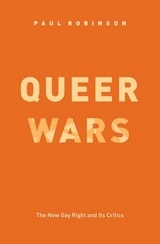
Queer Wars
The New Gay Right and Its CriticsPaul Robinson
University of Chicago Press, 2004
Queer Wars limns this new gay right, offering the first extended consideration of gay conservatism and its more trenchant critics. Here celebrated historian of gay culture Paul Robinson draws particular attention to three features of this new political movement. First, he explores how gay conservatives have rejected the idea that commitment to gay freedom should involve equal dedication to the causes of other marginalized people, be they racial minorities, women, or the poor. Second, Robinson demonstrates why gay conservatives embrace more traditional gender ideals—why they are hostile to effeminacy among men and mannishness among women. Finally, exploring the support for sexual restraint among gay conservatives, Robinson dissects their condemnation of promiscuity and their assault on behavior they deem dissolute.
Timely and rich in suggestive propositions, Queer Wars will prove to be essential reading for anyone interested in gay culture and contemporary politics.
Queer about Comics
Darieck Scott and Ramzi Fawaz, special issue editors
Duke University Press, 2018
Contributors examine the relationships among reader, creator, and community across a range of comics production, including mainstream superhero comics, independent LGBTQ comics, and avant-garde and experimental feminist narratives. They also address queer forms of identification elicited by the classic X-Men character Rogue, the lesbian grassroots publishing networks that helped shape Alison Bechdel’s oeuvre, and the production of black queer fantasy in the Black Panther comic book series, among other topics.
Contributors andré carrington, Anthony Michael D’Agostino, Ramzi Fawaz, Margaret Galvan, Yetta Howard, Joshua Abraham Kopin, Kate McCullough, Darieck Scott, Jessica Q. Stark, Shelley Streeby, Rebecca Wanzo
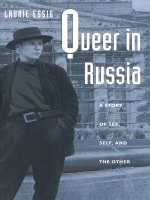
Queer in Russia
A Story of Sex, Self, and the OtherLaurie Essig
Duke University Press, 1999
While male homosexual acts were criminalized in Russia before 1993, women attracted to women were policed by the medical community, who saw them less as criminals than as diseased persons potentially cured by drug therapy or transsexual surgery. After describing accounts of pre-perestroika persecution, Essig examines the more recent state of sexual identities in Russia. Although the fall of communism brought new freedom to Russian queers, there are still no signs of a mass movement forming around the issue, and few identify themselves as lesbians or gay men, even when they are involved in same-sex relations. Essig does reveal, however, vibrant manifestations of gay life found at the local level—in restaurants, discos, clubs, and cruising strips, in newspapers, journals, literature, and the theater. Concluding with a powerful exploration of the surprising affinities between some of Russia’s most prominent nationalists and its queers, Queer in Russia fills a gap in both Russian and cultural studies.

Queer/Early/Modern
Carla Freccero
Duke University Press, 2006
Combining feminist theory, queer theory, psychoanalysis, deconstruction, and literary criticism, Freccero takes up a series of theoretical and historical issues related to debates in queer theory, feminist theory, the history of sexuality, and early modern studies. She juxtaposes readings of early and late modern texts, discussing the lyric poetry of Petrarch, Louise Labé, and Melissa Ethridge; David Halperin’s take on Michel Foucault via Apuleius’s The Golden Ass and Boccaccio’s Decameron; and France’s domestic partner legislation in connection with Marguerite de Navarre’s Heptameron. Turning to French cleric Jean de Léry’s account, published in 1578, of having witnessed cannibalism and religious rituals in Brazil some twenty years earlier and to the twentieth-century Brandon Teena case, Freccero draws on Jacques Derrida’s concept of spectrality to propose both an ethics and a mode of interpretation that acknowledges and is inspired by the haunting of the present by the past.
Queer/Migration, Volume 14
Eithne Luibhéid ,spec issue ed
Duke University Press, 0
The issue, featuring essays by both established and emerging scholars, situates queer migration within global processes of colonization, globalization, capitalism, nationalism, and slavery. One contributor argues that a queer Atlantic history emerged during the Middle Passage experience of slavery, connecting this history to the contemporary movement of Haitian refugees and Dominican migrant laborers. Another contributor considers how the policing of queer migrant bodies and of “unnatural offenses” by colonial administrations in the Nicobar and Andaman islands ultimately reconfigured the ecology of the entire Indian Ocean archipelago. Still another contributor theorizes how gay couples composed of young Asian émigrés and considerably older white citizens negotiate Australian immigration policy to subvert dominant forms of nationalism and citizenship embedded in long histories of inequality between Australia and Asia. Other essays explore how transgender histories and theories transform queer migration scholarship; how “queer complicities” with contemporary neoliberal migration politics uphold regimes of violence and inequality; and how migration regimes and settlement policies in various parts of the world identify individuals as “queer,” “deviant,” or “abnormal” within racial, gender, class, cultural, and geopolitical hierarchies.
Contributors. Bobby Benedicto, Carlos Ulises Decena, Kale Bantigue Fajardo, Maja Horn, Adi Kuntsman, Eithne Luibhéid, Clare Sears, Omise’eke Natasha Tinsley, Kath Weston, Audrey Yue
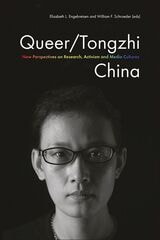
Queer/Tongzhi China
New Perspectives on Research, Activism and Media CulturesEdited by Elisabeth L. Engebretsen and William F. Schroeder
National University of Singapore Press, 2015
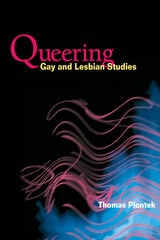
Queering Gay and Lesbian Studies
Thomas Piontek
University of Illinois Press, 2005
In this pioneering new study, Thomas Piontek provides a critical analysis of the development of gay and lesbian studies alongside the development of queer theory, the disputes between them, and criticism of their activities from both in and outside of the gay academic community. Examining disputes about transgendering, gay male promiscuity, popular culture, gay history, political activism, and non-normative sexual practices, Piontek argues that it is vital to queer gay and lesbian studies--opening this emerging discipline to queer critical interventions without, however, further institutionalizing queer theory.
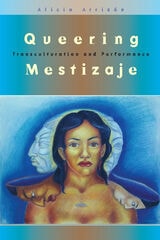
Queering Mestizaje
Transculturation and PerformanceAlicia Arrizón
University of Michigan Press, 2006
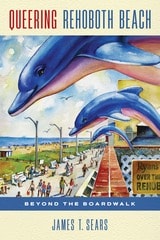
Queering Rehoboth Beach
Beyond the BoardwalkJames T. Sears
Temple University Press, 2024
Sears draws upon extensive oral history accounts, archival material, and personal narratives to chronicle “the Battle for Rehoboth,” which unfolded in the late 20th century, as conservative town leaders and homeowners opposed progressive entrepreneurs and gay activists. He recounts not just the emergence of the gay and lesbian bars, dance clubs, and organizations that drew the queer community to the region, but also the efforts of local politicians and homeowners, among other groups who fought to develop and protect the traditional identity of this beach town. Moreover, issues of race, class, and gender and sexuality informed opinions as residents and visitors struggled with the AIDS crisis and the legacy of Jim Crow.
Queering Rehoboth Beach is more than just an inspiring story about a community’s resilience and determination to establish a safe space for itself in the wake of the era of Don’t Ask, Don’t Tell. It is also a terrific beach read.
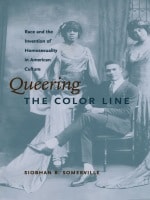
Queering the Color Line
Race and the Invention of Homosexuality in American CultureSiobhan B. Somerville
Duke University Press, 2000
At about the same time that the 1896 Supreme Court Plessy v. Ferguson decision hardened the racialized boundary between black and white, prominent trials were drawing the public’s attention to emerging categories of sexual identity. Somerville argues that these concurrent developments were not merely parallel but in fact inextricably interrelated and that the discourses of racial and sexual “deviance” were used to reinforce each other’s terms. She provides original readings of such texts as Havelock Ellis’s late nineteenth-century work on “sexual inversion,” the 1914 film A Florida Enchantment, the novels of Pauline E. Hopkins, James Weldon Johnson’s Autobiography of an Ex-Coloured Man, and Jean Toomer’s fiction and autobiographical writings, including Cane. Through her analyses of these texts and her archival research, Somerville contributes to the growing body of scholarship that focuses on discovering the intersections of gender, race, and sexuality.
Queering the Color Line will have broad appeal across disciplines including African American studies, gay and lesbian studies, literary criticism, cultural studies, cinema studies, and gender studies.
Queering the Public Sphere in Mexico and Brazil
Sexual Rights Movements in Emerging DemocraciesRafael de la Dehesa
Duke University Press, 2010
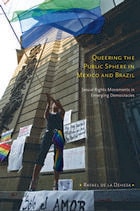
De la Dehesa studied the archives of activists, social-movement organizations, political parties, religious institutions, legislatures, and state agencies, and he interviewed hundreds of individuals, not only LGBT activists, but also feminists, AIDS and human-rights activists, party militants, journalists, academics, and state officials. He marshals his prodigious research to reveal the interplay between evolving representative institutions and LGBT activists’ entry into the political public sphere in Latin America, offering a critical analysis of the possibilities opened by emerging democratic arrangements, as well as their limitations. At the same time, exploring activists’ engagement with the international arena, he offers new insights into the diffusion and expression of transnational norms inscribing sexual rights within a broader project of liberal modernity. Queering the Public Sphere in Mexico and Brazil is a landmark examination of LGBT political mobilization.
Queering the Renaissance
Jonathan Goldberg, ed.
Duke University Press, 1994
The presence of contemporary history can be felt throughout the volume, beginning with an investigation of the uses of Renaissance precedents in the 1986 U.S. Supreme Court decision Bowers v. Hardwick, to a piece on the foundations of 'our' national imaginary, and an afterword that addresses how identity politics has shaped the work of early modern historians. The volume examines canonical and noncanonical texts, including highly coded poems of the fifteenth-century Italian poet Burchiello, a tale from Marguerite de Navarre's Heptameron, and Erasmus's letters to a young male acolyte. English texts provide a central focus, including works by Spenser, Shakespeare, Bacon, Donne, Beaumont and Fletcher, Crashaw, and Dryden. Broad surveys of the complex terrains of friendship and sodomy are explored in one essay, while another offers a cross-cultural reading of the discursive sites of lesbian desire.
Contributors. Alan Bray, Marcie Frank, Carla Freccero, Jonathan Goldberg, Janet Halley, Graham Hammill, Margaret Hunt, Donald N. Mager, Jeff Masten, Elizabeth Pittenger, Richard Rambuss, Alan K. Smith, Dorothy Stephens, Forrest Tyler Stevens, Valerie Traub, Michael Warner
Queering the Underworld
Slumming, Literature, and the Undoing of Lesbian and Gay HistoryScott Herring
University of Chicago Press, 2007
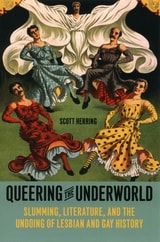
In this major rethinking of American literature and culture, Scott Herring explores how a key group of authors manipulated this genre to paradoxically evade the confines of sexual identification. Queering the Underworld examines a range of writers, from Jane Addams and Willa Cather to Carl Van Vechten and Djuna Barnes, revealing how they fulfilled the conventions of slumming literature but undermined its goals, and in the process, queered the genre itself. Their work frustrated the reader’s desire for sexual knowledge, restored the inscrutability of sexual identity, and cast doubt on the value of a homosexual subculture made visible and therefore subject to official control.
Herring is persuasive and polemical in connecting these writers to ongoing debates about lesbian and gay history and politics, and Queering the Underworld will be widely read by students and scholars of literature, history, and sexuality.
Queers Read This!
LGBTQ Literature NowRamzi Fawaz and Shante Pradigm Smalls, special issue editors
Duke University Press, 2018
Contributors: Aliyyah Abdur-Rahman, Cynthia Barounis, Tyler Bradway, Ramzi Fawaz, Jennifer James, Martin Joseph Ponce, Natalie Prizel, Shanté Paradigm Smalls, Samuel Solomon.