Results by title
52 books match the query 'Gender identity in literature' and 5 start with q
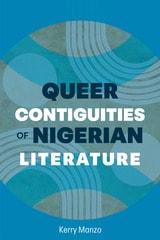
Queer Contiguities of Nigerian Literature
Kerry Manzo
Michigan State University Press, 2026
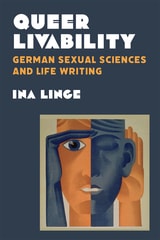
Queer Livability
German Sexual Sciences and Life WritingIna Linge
University of Michigan Press, 2023
Finalist: Waterloo Centre for German Studies Book Prize | December 10, 2024
This book brings together an exciting new archive of queer and trans voices from the history of sexual sciences in the German-speaking world. A new language to express possibilities of gender and sexuality emerged at the turn of the twentieth century, from Sigmund Freud’s theories of homosexuality in Vienna to Magnus Hirschfeld’s “third sex” in Berlin. Together, they provided a language of sex and sexuality that is still recognizable today. Queer Livability: German Sexual Sciences and Life Writing shows that individual voices of trans and queer writers had a significant impact on the production of knowledge about gender and sexuality during this time and introduces lesser known texts to a new readership. It shows the remarkable power of queer life writing in imagining and creating the possibilities of a livable life in the face of restrictive legal, medical, and social frameworks.
Queer Livability: German Sexual Sciences and Life Writing will be of interest to anyone who wants to learn more about LGBTQ+ history and literature. It also provides a fascinating insight into the historical roots for our thinking about gender and sexuality today. The book will be of relevance to an academic readership of students and faculty in German studies, literary studies, European history, and the interdisciplinary fields of gender and sexuality studies, medical humanities, and the history of sexuality.
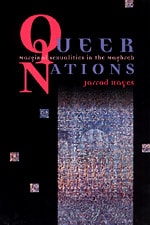
Queer Nations
Marginal Sexualities in the MaghrebJarrod Hayes
University of Chicago Press, 2000
In this incisive postcolonial study, Jarrod Hayes uses literary analysis to examine how Francophone novelists from the Maghreb engaged in a diametric nation-building project. Their works imagined a diverse nation peopled by those who were excluded by the dominant political discourses, especially those who did not conform to traditional sexual norms. By incorporating representations of marginal sexualities, sexual dissidence, and gender insubordination, Maghrebian novelists imagined an anticolonial struggle that would result in sexual liberation and envisioned nations that could be defined and developed inclusively.
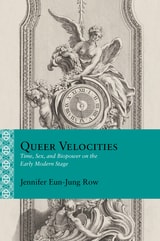
Queer Velocities
Time, Sex, and Biopower on the Early Modern StageJennifer Eun-Jung Row
Northwestern University Press, 2022
The twin innovations of precise, portable timepieces and the development of the theater as a state institution together ignited new types of embodiments, orderly and disorderly pleasures, and normative and wayward rhythms of life. Row leverages a painstakingly formalist and rhetorical analysis of tragedies by Jean Racine and Pierre Corneille to show how the staging of delay or haste can critically interrupt the normative temporalities of marriage, motherhood, mourning, or sovereignty—the quotidian rhythms and paradigms so necessary for the biopolitical management of life. Row’s approach builds on the queer turn to temporality and Elizabeth Freeman’s notion of the chronobiopolitical to wager that queerness can also be fostered by the sensations of disruptive speed and slowness. Ultimately, Row suggests that the theater not only contributed to the glitter of Louis XIV’s absolutist spectacle but also ignited new forms of knowing and feeling time, as well as new modes of loving, living, and being together.
Queer and Trans Aesthetics
Lloyd Whitesell
University of Michigan Press, 2026
If a creative individual identifies as queer or trans, does that fact belong solely to the realm of biography, or does it pertain to their artistic achievement? In Queer and Trans Aesthetics, Lloyd Whitesell discusses literature, visual culture, audio-visual media, music, and performance from the 19th to the 21st century. Through this analysis, Whitesell develops a systematic framework to enrich our understanding of LGBTQ aesthetics and cultural production. He traces the history of queer aesthetic inquiry, develops a justification for a synthetic approach, identifies a fund of expressive strategies motivated by queer subjectivity, and highlights how such strategies create affinity across differences of gender, race, local context, and artistic media.
Rooted in a gender-inclusive theory of queer/trans subjectivity, the book draws on testimony from people of diverse backgrounds, genders, and races. Whitesell engages with debates in the existing scholarly literature while making connections between a wide range of artists: some from mainstream canons, some established subcultural figures, and others only now emerging as notable contributors to queer culture. The book explores five expressive archetypes or poses which have had profound significance in queer art traditions: the Monster, the Victim, the Trickster, the Dandy, and the Dreamer. Each offers a repertoire of creative responses to social oppression and configures queer subjective experience in a unique way. With its unique systematic approach, Queer and Trans Aesthetics enhances our knowledge of queer aesthetic traditions across genres and time.