Results by title
328 books match the query 'Islam' and 4 start with q
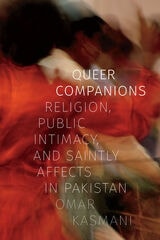
Queer Companions
Religion, Public Intimacy, and Saintly Affects in PakistanOmar Kasmani
Duke University Press, 2022
In Queer Companions Omar Kasmani theorizes saintly intimacy and the construction of queer social relations at Pakistan’s most important site of Sufi pilgrimage. Conjoining queer theory and the anthropology of Islam, Kasmani outlines the felt and enfleshed ways in which saintly affections bind individuals, society, and the state in Pakistan through a public architecture of intimacy. Islamic saints become lovers and queer companions just as a religious universe is made valuable to critical and queer forms of thinking. Focusing on the lives of ascetics known as fakirs in Pakistan, Kasmani shows how the affective bonds with the place’s patron saint, a thirteenth-century antinomian mystic, foster unstraight modes of living in the present. In a national context where religious shrines are entangled in the state’s infrastructures of governance, coming close to saints further entails a drawing near to more-than-official histories and public forms of affect. Through various fakir life stories, Kasmani contends that this intimacy offers a form of queer world making with saints.
[more]
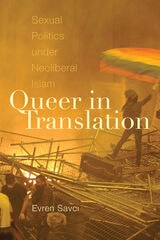
Queer in Translation
Sexual Politics under Neoliberal IslamEvren Savci
Duke University Press, 2021
In Queer in Translation, Evren Savcı analyzes the travel and translation of Western LGBT political terminology to Turkey in order to illuminate how sexual politics have unfolded under Recep Tayyip Erdoğan's AKP government. Under the AKP's neoliberal Islamic regime, Savcı shows, there has been a stark shift from a politics of multicultural inclusion to one of securitized authoritarianism. Drawing from ethnographic work with queer activist groups to understand how discourses of sexuality travel and are taken up in political discourse, Savcı traces the intersection of queerness, Islam, and neoliberal governance within new and complex regimes of morality. Savcı turns to translation as a queer methodology to think Islam and neoliberalism together and to evade the limiting binaries of traditional/modern, authentic/colonial, global/local, and East/West—thereby opening up ways of understanding the social movements and political discourse that coalesce around sexual liberation in ways that do justice to the complexities both of what circulates under the signifier Islam and of sexual political movements in Muslim-majority countries.
[more]
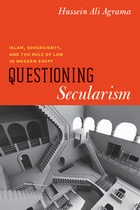
Questioning Secularism
Islam, Sovereignty, and the Rule of Law in Modern EgyptHussein Ali Agrama
University of Chicago Press, 2012
The central question of the Arab Spring—what democracies should look like in the deeply religious countries of the Middle East—has developed into a vigorous debate over these nations’ secular identities. But what, exactly, is secularism? What has the West’s long familiarity with it inevitably obscured? In Questioning Secularism, Hussein Ali Agrama tackles these questions. Focusing on the fatwa councils and family law courts of Egypt just prior to the revolution, he delves deeply into the meaning of secularism itself and the ambiguities that lie at its heart.
Drawing on a precedent-setting case arising from the family law courts —the last courts in Egypt to use Shari‘a law—Agrama shows that secularism is a historical phenomenon that works through a series of paradoxes that it creates. Digging beneath the perceived differences between the West and Middle East, he highlights secularism’s dependence on the law and the problems that arise from it: the necessary involvement of state sovereign power in managing the private spiritual lives of citizens and the irreducible set of legal ambiguities such a relationship creates. Navigating a complex landscape between private and public domains, Questioning Secularism lays important groundwork for understanding the real meaning of secularism as it affects the real freedoms of a citizenry, an understanding of the utmost importance for so many countries that are now urgently facing new political possibilities.
[more]
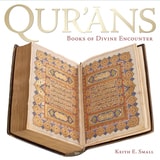
Qur'ans
Books of Divine EncounterKeith E. Small
Bodleian Library Publishing, 2015
With Qur'ans: Books of Divine Encounter, Keith E. Small has written a rich visual history of the Qur'an focused on more than fifty manuscripts in the collection of the Bodleian Library, University of Oxford. One of the oldest and finest collections of Qur'an in the English-speaking world, it includes treasures from parchment pages from Islam’s earliest centuries to a highly adorned copy of the Qur'an that once belonged to Tipu Sultan, the eighteenth-century ruler of the Islamic Kingdom of Mysore. Beginning with a brief introduction, Small takes readers through the Qur'an’s origins. The book then follows the development of the Qur'an chronologically and geographically, treating in each chapter the themes of textual development, divine presence, and political and religious identity. A wealth of full-color illustrations facilitates an examination of the artistic legacy of the Qur'an, including the beautiful calligraphy that became the foundation of Islamic visual culture for centuries to come.
A lavishly illustrated historical overview,Qur'ans: Books of Divine Encounter brings together in one volume a magnificent range of Qur'ans, bearing singular insight into these beautiful and significant sacred texts.
A lavishly illustrated historical overview,Qur'ans: Books of Divine Encounter brings together in one volume a magnificent range of Qur'ans, bearing singular insight into these beautiful and significant sacred texts.
[more]