Results by title
221 books match the query 'Personal narratives' and 2 start with q
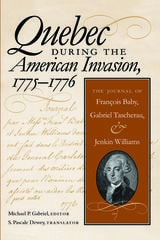
Quebec During the American Invasion, 1775-1776
The Journal of Francois Baby, Gabriel Taschereau, and Jenkin WilliamsMichael P. Gabriel
Michigan State University Press, 2005
Available for the first time in English, the 1776 journal of François Baby, Gabriel Taschereau, and Jenkin Williams provides an insight into the failure to incite rebellion in Quebec by American revolutionaries. While other sources have shown how British soldiers and civilians and the French-Canadian gentry (the seigneurs) responded to the American invasion of 1775–1776, this journal focuses on French-Canadian peasants (les habitants) who made up the vast majority of the population; in other words, the journal helps explain why Quebec did not become the "fourteenth colony."
After American forces were expelled from Quebec in early 1776, the British governor, Sir Guy Carleton, sent three trusted envoys to discover who had collaborated with the rebels from the south. They traveled to fifty-six parishes and missions in the Quebec and Trois Rivières district, discharging disloyal militia officers and replacing them with faithful subjects. They prepared a report on each parish, revealing actions taken to support the Americans or the king. Baby and his colleagues documented a wide range of responses. Some habitants enlisted with the Americans; others supplied them with food, firewood, and transportation. Some habitants refused to cooperate with the king’s soldiers. In some parishes, women were the Americans’ most zealous supporters. Overall, the Baby Journal clearly reveals that the habitants played an important, but often overlooked, role in the American invasion.
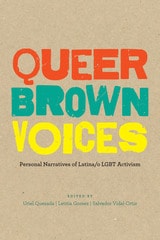
Queer Brown Voices
Personal Narratives of Latina/o LGBT ActivismEdited by Uriel Quesada, Letitia Gomez, and Salvador Vidal-Ortiz
University of Texas Press, 2015
In the last three decades of the twentieth century, LGBT Latinas/os faced several forms of discrimination. The greater Latino community did not often accept sexual minorities, and the mainstream LGBT movement expected everyone, regardless of their ethnic and racial background, to adhere to a specific set of priorities so as to accommodate a “unified” agenda. To disrupt the cycle of sexism, racism, and homophobia that they experienced, LGBT Latinas/os organized themselves on local, state, and national levels, forming communities in which they could fight for equal rights while simultaneously staying true to both their ethnic and sexual identities. Yet histories of LGBT activism in the 1970s, 1980s, and 1990s often reduce the role that Latinas/os played, resulting in misinformation, or ignore their work entirely, erasing them from history.
Queer Brown Voices is the first book published to counter this trend, documenting the efforts of some of these LGBT Latina/o activists. Comprising essays and oral history interviews that present the experiences of fourteen activists across the United States and in Puerto Rico, the book offers a new perspective on the history of LGBT mobilization and activism. The activists discuss subjects that shed light not only on the organizations they helped to create and operate, but also on their broad-ranging experiences of being racialized and discriminated against, fighting for access to health care during the HIV/AIDS epidemic, and struggling for awareness.