2018 books match the query 'Political aspects' and 9 start with q
cover of Qualified Hope: A Postmodern Politics of Time

Qualified Hope

A Postmodern Politics of Time

Mitchum Huehls

The Ohio State University Press, 2009
What is the political value of time, and where does that value reside? Should politics place its hope in future possibility, or does that simply defer action in the present? Can the present ground a vision of change, or is it too circumscribed by the status quo?
 
In Qualified Hope: A Postmodern Politics of Time, Mitchum Huehls contends that conventional treatments of time’s relationship to politics are limited by a focus on real-world experiences of time. By contrast, the innovative literary forms developed by authors in direct response to political events such as the Cold War, globalization, the emergence of identity politics, and 9/11 offer readers uniquely literary experiences of time. And it is in these literary experiences of time that Qualified Hope identifies more complicated—and thus more productive—ways to think about the time-politics relationship.
 
Qualified Hope challenges the conventional characterization of postmodernism as a period in which authors reject time in favor of space as the primary category for organizing experience and knowledge. And by identifying a common commitment to time at the heart of postmodern literature, Huehls suggests that the period-defining divide between multiculturalism and theory is not as stark as previously thought.
 
 
[more]
cover of Quantum Justice: Global Girls Cultivating Disruption through Spoken Word Poetry

Quantum Justice

Global Girls Cultivating Disruption through Spoken Word Poetry

Crystal Leigh Endsley

University of Texas Press, 2023

How girls of color from eight global communities strategize on questions of identity, social issues, and political policy through spoken word poetry.

Around the world, girls know how to perform. Grounded in her experience of “putting a mic in the margins” by facilitating workshops for girls in Ethiopia, South Africa, Tanzania, and the United States, scholar/advocate/artist Crystal Leigh Endsley highlights how girls use spoken word poetry to narrate their experiences, dreams, and strategies for surviving and thriving. By centering the process of creating and performing spoken word poetry, this book examines how girls forecast what is possible for their collective lives.

In this book, Endsley combines poetry, discourse analysis, photovoice, and more to forge the feminist theory of “quantum justice,” which forefronts girls’ relationships with their global counterparts. Using quantum justice theory, Endsley examines how these collaborative efforts produce powerful networks and ultimately map trajectories of social change at the micro level. By inviting transnational dialogue through spoken word poetry, Quantum Justice emphasizes how the imaginative energy in hip-hop culture can mobilize girls to connect and motivate each other through spoken word performance and thereby disrupt the status quo.
[more]
cover of Queer Cinema in the World

Queer Cinema in the World

Karl Schoonover and Rosalind Galt

Duke University Press, 2016
Proposing a radical vision of cinema's queer globalism, Karl Schoonover and Rosalind Galt explore how queer filmmaking intersects with international sexual cultures, geopolitics, and aesthetics to disrupt dominant modes of world making. Whether in its exploration of queer cinematic temporality, the paradox of the queer popular, or the deviant ecologies of the queer pastoral, Schoonover and Galt reimagine the scope of queer film studies. The authors move beyond the gay art cinema canon to consider a broad range of films from Chinese lesbian drama and Swedish genderqueer documentary to Bangladeshi melodrama and Bolivian activist video. Schoonover and Galt make a case for the centrality of queerness in cinema and trace how queer cinema circulates around the globe–institutionally via film festivals, online consumption, and human rights campaigns, but also affectively in the production of a queer sensorium. In this account, cinema creates a uniquely potent mode of queer worldliness, one that disrupts normative ways of being in the world and forges revised modes of belonging.
[more]
cover of Queer Frontiers: Millennial Geographies, Genders, and Generations

Queer Frontiers

Millennial Geographies, Genders, and Generations

Edited by Joseph A. Boone, et.al.

University of Wisconsin Press, 2000

In the first collection of its kind, twenty-three scholars, artists, and critics forecast the impact of queer theory on the future of sexuality. Arguing that queer theory is poised to transform society’s perception of gender itself, this thoroughly interdisciplinary anthology locates itself at the forefront of various debates both inside and outside the academy.
    From the history of gay and lesbian studies to the emergence of video bars, from an interview with playwright Cherrie Moraga to a photo record of 1950s gay Los Angeles, these original essays tackle the past, present, and future of queer sexuality from all directions. Queer Frontiers brings together the most vital and energetic voices around; whether promising young scholar or veteran of gay activism, each contributor is helping to move the debate into uncharted territory.

[more]
cover of Queer Kinship: Race, Sex, Belonging, Form

Queer Kinship

Race, Sex, Belonging, Form

Teagan Bradway and Elizabeth Freeman, editors

Duke University Press, 2022

The contributors to this volume assert the importance of queer kinship to queer and trans theory and to kinship theory. In a contemporary moment marked by the rising tides of neoliberalism, fascism, xenophobia, and homo- and cis-nationalism, they approach kinship as both a horizon and a source of violence and possibility. The contributors challenge dominant theories of kinship that ignore the devastating impacts of chattel slavery, settler colonialism, and racialized nationalism on the bonds of Black and Indigenous people and people of color. Among other topics, they examine the “blood tie” as the legal marker of kin relations, the everyday experiences and memories of trans mothers and daughters in Istanbul, the outsourcing of reproductive labor in postcolonial India, kinship as a model of governance beyond the liberal state, and the intergenerational effects of the adoption of Indigenous children as a technology of settler colonialism. Queer Kinship pushes the methodological and theoretical underpinnings of queer theory forward while opening up new paths for studying kinship.

Contributors. Aqdas Aftab, Leah Claire Allen, Teagan Bradway, Juliana Demartini Brito, Judith Butler, Dilara Çalışkan, Christopher Chamberlin, Aobo Dong, Brigitte Fielder, Elizabeth Freeman, John S. Garrison, Nat Hurley, Joseph M. Pierce, Mark Rifkin, Poulomi Saha, Kath Weston
[more]
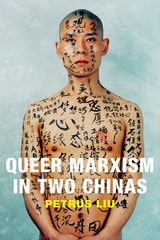
cover of Queer Marxism in Two Chinas

Queer Marxism in Two Chinas

Petrus Liu

Duke University Press, 2015

In Queer Marxism in Two Chinas Petrus Liu rethinks the relationship between Marxism and queer cultures in mainland China and Taiwan. Whereas many scholars assume the emergence of queer cultures in China signals the end of Marxism and demonstrates China's political and economic evolution, Liu finds the opposite to be true. He challenges the persistence of Cold War formulations of Marxism that position it as intellectually incompatible with queer theory, and shows how queer Marxism offers a nonliberal alternative to Western models of queer emancipation. The work of queer Chinese artists and intellectuals not only provides an alternative to liberal ideologies of inclusion and diversity, but demonstrates how different conceptions of and attitudes toward queerness in China and Taiwan stem from geopolitical tensions. With Queer Marxism in Two Chinas Liu offers a revision to current understandings of what queer theory is, does, and can be.
 
[more]
cover of Queer Objects to the Rescue: Intimacy and Citizenship in Kenya

Queer Objects to the Rescue

Intimacy and Citizenship in Kenya

George Paul Meiu

University of Chicago Press, 2023

Examines forms of intimate citizenship that have emerged in relation to growing anti-homosexual violence in Kenya.
 
Campaigns calling on police and citizens to purge their countries of homosexuality have taken hold across the world. But the “homosexual threat” they claim to be addressing is not always easy to identify. To make that threat visible, leaders, media, and civil society groups have deployed certain objects as signifiers of queerness. In Kenya, for example, bead necklaces, plastics, and even diapers have come to represent the danger posed by homosexual behavior to an essentially “virile” construction of national masculinity.
 
In Queer Objects tothe Rescue, George Paul Meiu explores objects that have played an important and surprising role in both state-led and popular attempts to rid Kenya of various imagined threats to intimate life. Meiu shows that their use in the political imaginary has been crucial to representing the homosexual body as a societal threat and as a target of outrage, violence, and exclusion, while also crystallizing anxieties over wider political and economic instability. To effectively understand and critique homophobia, Meiu suggests, we must take these objects seriously and recognize them as potential sources for new forms of citizenship, intimacy, resistance, and belonging.
[more]
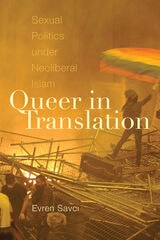
cover of Queer in Translation: Sexual Politics under Neoliberal Islam

Queer in Translation

Sexual Politics under Neoliberal Islam

Evren Savci

Duke University Press, 2021

In Queer in Translation, Evren Savcı analyzes the travel and translation of Western LGBT political terminology to Turkey in order to illuminate how sexual politics have unfolded under Recep Tayyip Erdoğan's AKP government. Under the AKP's neoliberal Islamic regime, Savcı shows, there has been a stark shift from a politics of multicultural inclusion to one of securitized authoritarianism. Drawing from ethnographic work with queer activist groups to understand how discourses of sexuality travel and are taken up in political discourse, Savcı traces the intersection of queerness, Islam, and neoliberal governance within new and complex regimes of morality. Savcı turns to translation as a queer methodology to think Islam and neoliberalism together and to evade the limiting binaries of traditional/modern, authentic/colonial, global/local, and East/West—thereby opening up ways of understanding the social movements and political discourse that coalesce around sexual liberation in ways that do justice to the complexities both of what circulates under the signifier Islam and of sexual political movements in Muslim-majority countries.
[more]
cover of Quest for a Suitable Past: Myth and Memory in Central and Eastern Europe

Quest for a Suitable Past

Myth and Memory in Central and Eastern Europe

Lucian Boia

Central European University Press, 2017

The past may be approached from a variety of directions. A myth provides a sense of direction: it reunites people around certain values and projects and pushes them in one direction or another. The present volume brings together a range of case studies of myth making and myth breaking in east Europe from the nineteenth century to the present day. In particular, it focuses on the complex process through which memories are transformed into myths. This problematic interplay between memory and myth-making is analyzed in conjunction with the role of myths in the political and social life of the region. The essays include cases of forging myths about national pre-history, about the endorsement of nation building by means of historiography, and above all, about communist and post-communist mythologies. The studies shed new light on the creation of local and national identities, as well as the legitimization of ideologies through myth-making. Together, the individual contributions show that myths were often instrumental in the vast projects of social and political mobilization during a period which has witnessed, among others, two world wars and the harsh oppression of the communist regimes.
[more]