Results by title
1427 books match the query 'Politics' and 3 start with q
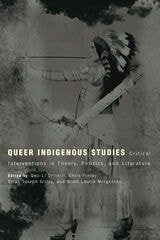
Queer Indigenous Studies
Critical Interventions in Theory, Politics, and LiteratureEdited by Qwo-Li Driskill, Chris Finley, Brian Joseph Gilley, and Scott Lauria Morgensen
University of Arizona Press, 2011
The bold opening to Queer Indigenous Studies invites new dialogues in Native American and Indigenous studies about the directions and implications of queer Indigenous studies. The collection notably engages Indigenous GLBTQ2 movements as alliances that also call for allies beyond their bounds, which the co-editors and contributors model by crossing their varied identities, including Native, trans, straight, non-Native, feminist, Two-Spirit, mixed blood, and queer, to name just a few.
Rooted in the Indigenous Americas and the Pacific, and drawing on disciplines ranging from literature to anthropology, contributors to Queer Indigenous Studies call Indigenous GLBTQ2 movements and allies to center an analysis that critiques the relationship between colonialism and heteropatriarchy. By answering critical turns in Indigenous scholarship that center Indigenous epistemologies and methodologies, contributors join in reshaping Native studies, queer studies, transgender studies, and Indigenous feminisms.
Based on the reality that queer Indigenous people “experience multilayered oppression that profoundly impacts our safety, health, and survival,” this book is at once an imagining and an invitation to the reader to join in the discussion of decolonizing queer Indigenous research and theory and, by doing so, to partake in allied resistance working toward positive change.
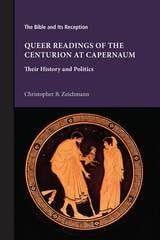
Queer Readings of the Centurion at Capernaum
Their History and PoliticsChristopher B. Zeichmann
SBL Press, 2022
The first-ever monograph on the history of queer biblical interpretation of a controversial biblical passage
Since the 1950s, homoerotic readings of the pericope in which Jesus heals a Roman centurion’s slave have been built upon three of the account’s features: the specific Greek word pais, which can refer to youth, slave, or the junior partner in a sexual relationship between two men; Luke’s characterization of the young man as “dear” (entimos) to the centurion; and commonplace homoeroticism in the Roman army. Rather than affirming or denying the historical reality of a sexual relationship between the centurion and the young man, Christopher B. Zeichmann instead traces the shifting patterns of queer readings of the text and the influences of the sexual, political, and theological discourses of late twentieth- and early twenty-first-century Europe, the United States, and Australia. Readers will see how distinct political contexts have led interpreters to find very different meanings about the sexual subtexts of this story.

Quiché Rebelde
Religious Conversion, Politics, and Ethnic Identity in GuatemalaBy Ricardo Falla
University of Texas Press, 2001
Since the arrival of the Spanish in the sixteenth century, the Maya population of Guatemala has been forced to adapt to extraordinary challenges. Under colonial rule, the Indians had to adapt enough to satisfy the Spanish while resisting those changes not necessary for survival, applying their understanding of the world to the realities they confronted daily. Despite the major changes wrought in their way of life by centuries of submission, the Maya have managed to regenerate, and thus maintain, their self-identity.
Among the major challenges they have faced has been the imposition of outside religions. Quiché Rebelde examines what happened when Acción Católica came into the Guatemalan municipio of San Antonio Ilotenango, Quiché, to convert its inhabitants.
Ricardo Falla, a Guatemalan Jesuit priest and anthropologist, analyzes the movement's origins and why some people became part of it while others resisted. He shows how religion was used as another tool to readapt to the changing environment—natural, economic, political, and social. His work is the first major empirical study of how change occurred in a Maya community with no serious loss of Maya identity—and how the process of conversion is related to more general processes of cultural change that actually strengthen ethnic identity.