2916 books match the query 'Politics and government' and 4 start with q

cover of Q. Aurelius Symmachus: A Political Biography

Q. Aurelius Symmachus

A Political Biography

Cristiana Sogno

University of Michigan Press, 2010

[more]
cover of Quest for a Suitable Past: Myth and Memory in Central and Eastern Europe

Quest for a Suitable Past

Myth and Memory in Central and Eastern Europe

Lucian Boia

Central European University Press, 2017
The past may be approached from a variety of directions. A myth provides a sense of direction: it reunites people around certain values and projects and pushes them in one direction or another. The present volume brings together a range of case studies of myth making and myth breaking in east Europe from the nineteenth century to the present day. In particular, it focuses on the complex process through which memories are transformed into myths. This problematic interplay between memory and myth-making is analyzed in conjunction with the role of myths in the political and social life of the region. The essays include cases of forging myths about national pre-history, about the endorsement of nation building by means of historiography, and above all, about communist and post-communist mythologies. The studies shed new light on the creation of local and national identities, as well as the legitimization of ideologies through myth-making. Together, the individual contributions show that myths were often instrumental in the vast projects of social and political mobilization during a period which has witnessed, among others, two world wars and the harsh oppression of the communist regimes.
[more]
cover of Quiet Revolution: Struggle for the Democratic Party and the Shaping of Post-Reform Politics

Quiet Revolution

Struggle for the Democratic Party and the Shaping of Post-Reform Politics

Byron E. Shafer

Russell Sage Foundation, 1983
This is the story of a revolution without fanfare, a hidden struggle for party reform that produced a new era in national politics. From this struggle emerged the greatest deliberately planned and centrally imposed change in the mechanics of delegate selection, and hence presidential nomination, in all of American history. The success of this revolution heralded the arrival of new political coalitions that would alter the very character of presidential politics, from campaign organization to grass-roots participation. The battle for reform raged within the Democratic party from 1968 to 1972, although it would quickly affect the Republican party as well. It was intense, intricate—and nearly invisible. Yet its chronicle is essential background for political practitioners, professional commentators, and interested citizens alike. And it is the basis for understanding the subsequent course of national politics and the current shape of presidential politics. Quiet Revolution provides the first definitive account of this struggle for reform, an account that is at once modern political history and an illuminating analysis of contemporary American politics. Based on candid interviews with numerous key participants and on extensive archival material, this compelling narrative offers the fascination of political maneuvers closely observed, the drama of momentous events unfolding, and the challenge of a new politics newly interpreted.
[more]
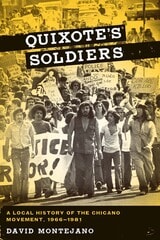
cover of Quixote's Soldiers: A Local History of the Chicano Movement, 1966–1981

Quixote's Soldiers

A Local History of the Chicano Movement, 1966–1981

By David Montejano

University of Texas Press, 2010

In the mid-1960s, San Antonio, Texas, was a segregated city governed by an entrenched Anglo social and business elite. The Mexican American barrios of the west and south sides were characterized by substandard housing and experienced seasonal flooding. Gang warfare broke out regularly. Then the striking farmworkers of South Texas marched through the city and set off a social movement that transformed the barrios and ultimately brought down the old Anglo oligarchy. In Quixote’s Soldiers, David Montejano uses a wealth of previously untapped sources, including the congressional papers of Henry B. Gonzalez, to present an intriguing and highly readable account of this turbulent period. Montejano divides the narrative into three parts. In the first part, he recounts how college student activists and politicized social workers mobilized barrio youth and mounted an aggressive challenge to both Anglo and Mexican American political elites. In the second part, Montejano looks at the dynamic evolution of the Chicano movement and the emergence of clear gender and class distinctions as women and ex-gang youth struggled to gain recognition as serious political actors. In the final part, Montejano analyzes the failures and successes of movement politics. He describes the work of second-generation movement organizations that made possible a new and more representative political order, symbolized by the election of Mayor Henry Cisneros in 1981.
[more]