Results by title
4127 books match the query 'Science' and 16 start with q
QRB vol 95 num 3
The University of Chicago Press
University of Chicago Press Journals, 2020
Qualitative-Quantitative Research Methodology
Exploring the Interactive ContinuumIsadore Newman and Carolyn R. Benz
Southern Illinois University Press, 1998
Rejecting the artificial dichotomy between qualitative and quantitative research strategies in the social and behavioral sciences, Isadore Newman and Carolyn R. Benz argue that the two approaches are neither mutually exclusive nor interchangeable; rather, the actual relationship between the two paradigms is one of isolated events on a continuum of scientific inquiry.
Through graphic and narrative descriptions, Newman and Benz show research to be a holistic endeavor in the world of inquiry. To clarify their argument, they provide a diagram of the "qualitative-quantitative interactive continuum" showing that qualitative analysis with its feedback loops can easily modify the types of research questions asked in quantitative research and that the quantitative results and its feedback can change what will be asked qualitatively.
In their model for research—an "interactive continuum"—Newman and Benz emphasize four major points: the research question dictates the selection of research methods; consistency between question and design can lead to a method of critiquing research studies in professional journals; the interactive continuum model is built around the place of theory; and the assurance of "validity" of research is central to all studies.
Quantifying Life
A Symbiosis of Computation, Mathematics, and BiologyDmitry A. Kondrashov
University of Chicago Press, 2016
With Quantifying Life, Dmitry A. Kondrashov offers an accessible introduction to the breadth of mathematical modeling used in biology today. Assuming only a foundation in high school mathematics, Quantifying Life takes an innovative computational approach to developing mathematical skills and intuition. Through lessons illustrated with copious examples, mathematical and programming exercises, literature discussion questions, and computational projects of various degrees of difficulty, students build and analyze models based on current research papers and learn to implement them in the R programming language. This interplay of mathematical ideas, systematically developed programming skills, and a broad selection of biological research topics makes Quantifying Life an invaluable guide for seasoned life scientists and the next generation of biologists alike.
Quantitative Genetic Studies of Behavioral Evolution
Edited by Christine R. B. Boake
University of Chicago Press, 1994
Christine R. B. Boake brings together current theoretical and empirical studies to show how quantitative genetics can illuminate topics as diverse as sexual selection, migration, sociality, and aggressive behavior. Nearly half of the chapters focus on conceptual issues, ranging from quantitative genetic models to the complementary roles of quantitative genetic and optimality approaches in evolutionary studies. Other chapters illustrate how to use the techniques by providing surveys of research fields, such as the evolution of mating behavior, sexual selection, migration, and size-dependent behavioral variation. The balance of the volume offers case studies of territoriality in fruit flies, cannibalism in flour beetles, mate-attractive traits in crickets, locomotor behavior and physiology in the garter snake, and cold adaptation in the house mouse. Taken together, these studies document both the benefits and pitfalls of quantitative genetics.
This book shows the advanced student and scholar of behavioral evolution and genetics the many powerful uses of quantitative genetics in behavioral research.
Quantum 2.0
The Weird Physics Driving a New Revolution in TechnologyPaul Davies
University of Chicago Press, 2025
Quantum computers, quantum cryptography, and even quantum AI—a century after the discovery of an unexpected physical world, researchers are putting this puzzling science to work in dazzling new ways.
In this exhilarating and mind-bending book, renowned scientist and author Paul Davies offers readers a glimpse of how quantum physics has led to a quantum technology revolution. Quantum 2.0 reveals how today’s brightest minds are harnessing exotic states of matter that have no counterpart in everyday life. Specifically, all eyes are on entanglement, called “spooky” by Einstein, which links the activities of separated particles even across vast distances.
By manipulating these weird properties of atoms, electrons, and photons, scientists are driving the burgeoning field of “quantum information science,” featuring new tools such as quantum computers, quantum cryptography, and the quantum internet. In turn, their efforts have attracted billions of dollars in investments and triggered a frantic quantum arms race between nations. At the same time, theorists are taking a closer look at quantum systems themselves, which possess properties that defy intuition and shred everyday notions of reality. Davies explains how researchers, including himself, are wrestling with quantum theory to make sense of this realm, where ghostly quantum particles produce tiny forces in nanotechnology, cause black holes to evaporate, and may even contribute to the universe’s accelerating expansion. A trusted guide, Davies takes readers from the basic concepts to today’s cutting edge, inviting us all to glimpse the wonderland of quantum physics and its stunning implications.
Quantum 2.0
The Weird Physics Driving a New Revolution in TechnologyPaul Davies
University of Chicago Press, 2025
In this exhilarating and mind-bending book, renowned scientist and author Paul Davies offers readers a glimpse of how quantum physics has led to a quantum technology revolution. Quantum 2.0 reveals how today’s brightest minds are harnessing exotic states of matter that have no counterpart in everyday life. Specifically, all eyes are on entanglement, called “spooky” by Einstein, which links the activities of separated particles even across vast distances.
By manipulating these weird properties of atoms, electrons, and photons, scientists are driving the burgeoning field of “quantum information science,” featuring new tools such as quantum computers, quantum cryptography, and the quantum internet. In turn, their efforts have attracted billions of dollars in investments and triggered a frantic quantum arms race between nations. At the same time, theorists are taking a closer look at quantum systems themselves, which possess properties that defy intuition and shred everyday notions of reality. Davies explains how researchers, including himself, are wrestling with quantum theory to make sense of this realm, where ghostly quantum particles produce tiny forces in nanotechnology, cause black holes to evaporate, and may even contribute to the universe’s accelerating expansion. A trusted guide, Davies takes readers from the basic concepts to today’s cutting edge, inviting us all to glimpse the wonderland of quantum physics and its stunning implications.

Quantum Art & Uncertainty
Paul Thomas
Intellect Books, 2018
In order to draw parallels between art, science, and culture, this publication will explore the ways that selected art works have contributed to a form of cultural pedagogy. It follows the integration of culture and science in artists’ expressions to create meaningful experiences that expose the probabilities and uncertainties equally present in the world of science.
Quantum Dialogue
The Making of a RevolutionMara Beller
University of Chicago Press, 1999
Beller draws her argument from her radical new reading of the history of the quantum revolution, especially the development of the Copenhagen interpretation. One of several competing approaches, this version succeeded largely due to the rhetorical skills of Niels Bohr and his colleagues. Using extensive archival research, Beller shows how Bohr and others marketed their views, misrepresenting and dismissing their opponents as "unreasonable" and championing their own not always coherent or well-supported position as "inevitable."
Quantum Dialogue, winner of the 1999 Morris D. Forkosch Prize of the Journal of the History of Ideas, will fascinate everyone interested in how stories of "scientific revolutions" are constructed and "scientific consensus" achieved.
"[A]n intellectually stimulating piece of work, energised by a distinct point of view."—Dipankar Home, Times Higher Education Supplement
"[R]emarkable and original. . . . [Beller's] arguments are thoroughly supported and her conclusions are meticulously argued. . . . This is an important book that all who are interested in the emergence of quantum mechanics will want to read."—William Evenson, History of Physics Newsletter
Quantum Field Theory in Curved Spacetime and Black Hole Thermodynamics
Robert M. Wald
University of Chicago Press, 1994
In this book, Robert Wald provides a coherent, pedagogical introduction to the formulation of quantum field theory in curved spacetime. He begins with a treatment of the ordinary one-dimensional quantum harmonic oscillator, progresses through the construction of quantum field theory in flat spacetime to possible constructions of quantum field theory in curved spacetime, and, ultimately, to an algebraic formulation of the theory. In his presentation, Wald disentangles essential features of the theory from inessential ones (such as a particle interpretation) and clarifies relationships between various approaches to the formulation of the theory. He also provides a comprehensive, up-to-date account of the Unruh effect, the Hawking effect, and some of its ramifications. In particular, the subject of black hole thermodynamics, which remains an active area of research, is treated in depth.
This book will be accessible to students and researchers who have had introductory courses in general relativity and quantum field theory, and will be of interest to scientists in general relativity and related fields.
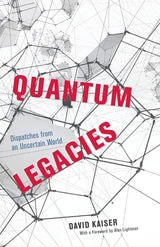
Quantum Legacies
Dispatches from an Uncertain WorldDavid Kaiser
University of Chicago Press, 2024
The ideas at the root of quantum theory remain stubbornly, famously bizarre: a solid world reduced to puffs of probability; particles that tunnel through walls; cats suspended in zombielike states, neither alive nor dead; and twinned particles that share entangled fates. For more than a century, physicists have grappled with these conceptual uncertainties while enmeshed in the larger uncertainties of the social and political worlds around them, a time pocked by the rise of fascism, cataclysmic world wars, and a new nuclear age.
In Quantum Legacies, David Kaiser introduces readers to iconic episodes in physicists’ still-unfolding quest to understand space, time, and matter at their most fundamental. In a series of vibrant essays, Kaiser takes us inside moments of discovery and debate among the great minds of the era—Albert Einstein, Erwin Schrödinger, Stephen Hawking, and many more who have indelibly shaped our understanding of nature—as they have tried to make sense of a messy world.
Ranging across space and time, the episodes span the heady 1920s, the dark days of the 1930s, the turbulence of the Cold War, and the peculiar political realities that followed. In those eras as in our own, researchers’ ambition has often been to transcend the vagaries of here and now, to contribute lasting insights into how the world works that might reach beyond a given researcher’s limited view. In Quantum Legacies, Kaiser unveils the difficult and unsteady work required to forge some shared understanding between individuals and across generations, and in doing so, he illuminates the deep ties between scientific exploration and the human condition.
Quantum Measurement
Beyond ParadoxRichard A. Healey
University of Minnesota Press, 1998
A new approach to the quantum measurement dilemma.
With relativity theory, quantum mechanics stands as the conceptual foundation of modern physics. It forms the basis by which we understand the minute workings of the subatomic world. But at its core lies a paradox: standard conceptions of quantum mechanics imply that the results of many of the actual measurements supporting and verifying quantum mechanical theory can have no definite outcomes. Some quantity such as position or momentum is always indefinite on a quantum system; and if an indefinite quantity is measured, the macroscopic state of the measuring apparatus that is supposed to record the outcome instead becomes indefinite itself. In Quantum Measurement, editors Richard A. Healey and Geoffrey Hellman marshal the resources of leading physicists and philosophers of science, skillfully joining their insights and ingenuity to yield some of the most innovative and altogether promising thought to date on this enigmatic issue.
Throughout this authoritative volume, these authors explore the subtle and varied ways in which quantum mechanics informs the conditions, indeed the very process, of quantum measurement. The latest work on decoherence phenomena is combined with sophisticated modal interpretations, suggesting that definite values might be systematically attributed to a limited class of quantum observables while gauging the correspondent impact of environmental interactions on quantum interference terms. What emerges from this careful synthesis is a theoretically powerful and energetic new approach to the measurement dilemma, one that furthers our conceptual understanding of the fundamental interconnections between micro- and macroscopic systems, and that strives, ultimately, to describe and define within a unified quantum mechanical framework the breadth of our physical reality.Contributors: Guido Bacciagaluppi, Balliol College, Oxford; Jeffrey Bub, U of Maryland; Rob Clifton, U of Pittsburgh; Michael Dickson, Indiana U; Dennis Dieks, Utrecht U, Netherlands; Andrew Elby; Meir Hemmo; Anthony J. Leggett, U of Illinois; Bradley Monton; Abner Shimony, Boston U; William G. Unruh, U of British Columbia; Pieter E. Vermaas.ISBN 0-8166-3065-8 Cloth/jacket $39.95x 232 pages 5 figures 5 7/8 x 9 JuneMinnesota Studies in the Philosophy of Science Series, Volume 17Translation inquiries: University of Minnesota Press
Quantum Mechanics
Historical Contingency and the Copenhagen HegemonyJames T. Cushing
University of Chicago Press, 1994
Since the late 1920s, the theory formulated by Niels Bohr and his colleagues at Copenhagen has been the dominant interpretation of quantum mechanics. Yet an alternative interpretation, rooted in the work of Louis de Broglie in the early 1920s and reformulated and extended by David Bohm in the 1950s, equally well explains the observational data. Through a detailed historical and sociological study of the physicists who developed different theories of quantum mechanics, the debates within and between opposing camps, and the receptions given to each theory, Cushing shows that despite the preeminence of the Copenhagen view, the Bohm interpretation cannot be ignored. Cushing contends that the Copenhagen interpretation became widely accepted not because it is a better explanation of subatomic phenomena than is Bohm's, but because it happened to appear first.
Focusing on the philosophical, social, and cultural forces that shaped one of the most important developments in modern physics, this provocative book examines the role that timing can play in the establishment of theory and explanation.
Quantum Statistical Physics of Molecular Systems
František Šanda
Karolinum Press, 2026
A text designed for courses in quantum statistical physics, which explains the concept of the density matrix and links it with the quantum theory of relaxation and decoherence and with the most common spectroscopic probes.
This book covers the material for a one-semester introductory course in quantum statistical physics, designed for Master’s students in chemical physics and biophysics preparing to work in the fields of NMR, vibrational spectroscopy, or electronic spectroscopy. The course introduces the density matrix formalism and connects it to students’ existing knowledge of classical statistical physics. It then presents the main results of quantum relaxation theory in terms of population transfer and decoherence, and relates quantum relaxation to its most widely used experimental probes in spectroscopy.
Quaternary Extinctions
A Prehistoric RevolutionEdited by Paul S. Martin and Richard G. Klein
University of Arizona Press, 1984
"May be regarded as a kind of standard encyclopedia for Pleistocene vertebrate paleontology for years to come." —American Scientist
"Should be read by paleobiologists, biologists, wildlife managers, ecologists, archeologists, and anyone concerned about the ongoing extinction of plants and animals." —Science
"Uncommonly readable and varied for watchers of paleontology and the rise of humankind." —Scientific American
"Represents a quantum leap in our knowledge of Pleistocene and Holocene palaeobiology. . . . Many volumes on our bookshelves are destined to gather dust rather than attention. But not this one." —Nature
"Two strong impressions prevail when first looking into this epic compendium. One is the judicious balance of views that range over the whole continuum between monocausal, cultural, or environmental explanations. The second is that both the data base and theoretical sophistication of the protagonists in the debate have improved by a quantum leap since 1967." —American Anthropologist

Questing
A Guide to Creating Community Treasure HuntsDelia Clark and Steven Glazer
University Press of New England, 2006
Questions concerning Aristotle's On Animals (The Fathers of the Church, Mediaeval Continuation, Volume 9)
Irven M. Albert the Great
Catholic University of America Press, 2008