Results by title
87 books match the query 'Sexual minorities' and 18 start with q
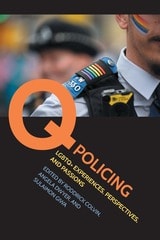
Q Policing
LGBTQ+ Experiences, Perspectives, and PassionsEdited by Roddrick Colvin, Angela Dwyer, and Sulaimon Giwa
Southern Illinois University Press, 2024
Global perspectives on policing within LGBTQ+ communities
Relationships between law enforcement and lesbian, gay, bisexual, transgender, and queer (LGBTQ+) communities have always been varied and complex. On one hand, history is filled with incidents of police harassment: raids that sparked famous uprisings and rebellions; shoddy police investigations into the murders of LGBTQ+ community members; a corrosive organizational culture marked by heteronormativity and misogyny. Yet positive changes are being made, such as the creation of LGBTQ+ police associations, participation by police officers in Pride Parades around the world, and formal apologies for past actions. To some LGBTQ+ community members, police are the physical manifestations of state-sanctioned oppression and abuse. To others, they are guardians who have become partners in public safety.
Q Policing features eighteen contributors from around the world who explore the nature of the relationship between LGBTQ+ communities and the police. Part 1 of the book offers insights on policing and racial and ethnic constructions, including efforts to build collaborative models of community-building within groups and with law enforcement. Part 2 highlights the experiences of individuals who may be marginalized due to various social constructions such as transgender, unhoused, southern, or kink-involved. Finally, Part 3 shares perspectives of queer folks inside policing.
The contributors—scholars, social workers, police officers, and other community leaders—cover diverse topics, including queer experiences of policing in southern India, clinical implications for mental health professionals working with Latinx LGBTQ+ people, transgender and nonbinary peoples’ presentation management during encounters with law enforcement, discriminatory policies in place in the southern United States, the pathologization of kink, and more. Essays analyze interviews with the “Pride Defenders” in Hamilton, Canada, as well as British and American police officers transitioning while in uniform. They explore the experiences of gay, lesbian, and genderqueer police officers, map principal findings and central concerns that structure extant scholarship on gay police officers in the UK, use queer theory to explore the effectiveness of LGBTQ+ liaisons, and more.
The volume editors adopt an inclusive global perspective to account for contextually located experiences of queer people within and outside of the United States. The book incorporates a variety of voices, data sources, and methodologies, but contributors share an intentional focus on race, age, sex, gender, and other identities that helps explain and contextualize queer people’s experiences around and in policing. The diverse, international group of contributors—whose voices are not often heard in traditional outlets and mainstream media—demonstrates that despite discrimination, harassment, and violence, LGBTQ+ communities continue to thrive.
Queer Bangkok
21st Century Markets, Media, and RightsEdited by Peter A. Jackson
Hong Kong University Press, 2011
Queer Brown Voices
Personal Narratives of Latina/o LGBT ActivismEdited by Uriel Quesada, Letitia Gomez, and Salvador Vidal-Ortiz
University of Texas Press, 2015
In the last three decades of the twentieth century, LGBT Latinas/os faced several forms of discrimination. The greater Latino community did not often accept sexual minorities, and the mainstream LGBT movement expected everyone, regardless of their ethnic and racial background, to adhere to a specific set of priorities so as to accommodate a “unified” agenda. To disrupt the cycle of sexism, racism, and homophobia that they experienced, LGBT Latinas/os organized themselves on local, state, and national levels, forming communities in which they could fight for equal rights while simultaneously staying true to both their ethnic and sexual identities. Yet histories of LGBT activism in the 1970s, 1980s, and 1990s often reduce the role that Latinas/os played, resulting in misinformation, or ignore their work entirely, erasing them from history.
Queer Brown Voices is the first book published to counter this trend, documenting the efforts of some of these LGBT Latina/o activists. Comprising essays and oral history interviews that present the experiences of fourteen activists across the United States and in Puerto Rico, the book offers a new perspective on the history of LGBT mobilization and activism. The activists discuss subjects that shed light not only on the organizations they helped to create and operate, but also on their broad-ranging experiences of being racialized and discriminated against, fighting for access to health care during the HIV/AIDS epidemic, and struggling for awareness.

Queer Chimerica
A Speculative Auto/Ethnography of the Cool ChildShana Ye
University of Michigan Press, 2024
Blending archival work, ethnography, and cultural analysis with memoir, graphic arts, and science fiction, Queer Chimerica unpacks the ways in which the transnational circulation of queer culture, politics, and institutions are structured through the antagonist interdependence of China and the United States. By examining the intersecting timelines of the rise of queer theory and the rise of China in the late Cold War era, Shana Ye explores the relationship between the discourse of queer fluidity and capital’s demands for labor flexibility.
Drawing on rare archival material and oral historical accounts of queer life from the 1950s to the late 2010s, the author shows how these accounts make sense of the variegated landscapes of desires, transformations, and conundrums in postsocialist China. The author illustrates party cadres in the Cultural Revolution, tongzhi activism mediated by the explosive politics of Tiananmen upheaval, HIV/AIDS community outreach workers, feminist artists and digital activists, leftist queer theorists, and fictional bio-engineers, layering these vivid depictions to reveal the poetic messiness of queer world-making. Queer Chimerica offers insight into the governmentality of LGBT rights, the rules of legibility and recognition, the geo- and bio-politics of identity, and the class-ridden appropriation of queer history and community. Thus understanding the production of queerness unveils the uneven distributions of capital, knowledge, affect, and opportunity that reproduce queer precarity and agency.
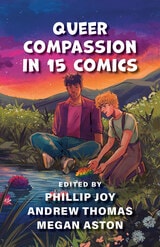
Queer Compassion in 15 Comics
Edited by Phillip Joy, Andrew Thomas, and Megan Aston
Lever Press, 2024
These comics are created by queer artists for queer audiences and with the intent for queer self-expression and representation. Social science researchers spoke to diverse members of LGBTQ+ communities to explore their beliefs about and experiences of compassion. Fifteen queer comics were commissioned to illustrate those stories, making the process of creating each comic a unique collaboration between researchers and artists, blending data exploring the meanings of compassion for queer folks with the creativity, passion, and understanding of a queer comic artist.
These stories reflect not only the harsh realities that many queer people face but they also uplift queer voices, illustrate strength, and capture queer resolve to make life more compassionate. Queer people, living in a cis-heteronormative world, often face experiences of marginalization, discrimination, stigma, trauma, and invisibility in everyday life. Queer Compassion shows that its titular emotion can be the bridge that brings understanding and creates community connections — a bridge that is particularly needed at this time.
Queer Contiguities of Nigerian Literature
Kerry Manzo
Michigan State University Press, 2026
Queer Indigenous Cinemas
Sovereign Genders from Seven DirectionsGabriel S. Estrada
University of Arizona Press, 2026
The seven Indigenous directions—east, south, west, north, down, up, and center—provide a map of understanding gender in media history.
In Queer Indigenous Cinemas, scholar Gabriel S. Estrada offers an analysis of queer Indigenous media from the Americas, the Pacific, and the Caribbean. This groundbreaking work uses Indigenous directional space and sovereign mapping methods to uncover the emotional, spiritual, and cultural dimensions of queer Indigenous lives. The book’s seven chapters—each one of the directions—look closely at media such as cinema and streaming videos that draw on Indigenous concepts from diverse nations such as Diné, Caxcan, Kanaka Maoli, and Nehiyawak. Estrada discusses how the cinema brings into focus the ways that many Indigenous genders do not conform with the male/female binary, genders and sexualities that may or may not overlap with contemporary constructions of gay, lesbian, bisexual, transgender, intersex, and two-spirit (LGBTQI2+) identities.
Highlighting the struggles and resistances of two-spirit peoples, Estrada’s analysis engages with films that represent the diverse and sovereign identities of queer Indigenous peoples. Estrada provides a framework for understanding how queer Indigenous media producers confront colonial trauma and reclaims space for the spiritual and bodily sovereignty of LGBTQI2+ peoples.
Queer Indigenous Studies
Critical Interventions in Theory, Politics, and LiteratureEdited by Qwo-Li Driskill, Chris Finley, Brian Joseph Gilley, and Scott Lauria Morgensen
University of Arizona Press, 2011
The bold opening to Queer Indigenous Studies invites new dialogues in Native American and Indigenous studies about the directions and implications of queer Indigenous studies. The collection notably engages Indigenous GLBTQ2 movements as alliances that also call for allies beyond their bounds, which the co-editors and contributors model by crossing their varied identities, including Native, trans, straight, non-Native, feminist, Two-Spirit, mixed blood, and queer, to name just a few.
Rooted in the Indigenous Americas and the Pacific, and drawing on disciplines ranging from literature to anthropology, contributors to Queer Indigenous Studies call Indigenous GLBTQ2 movements and allies to center an analysis that critiques the relationship between colonialism and heteropatriarchy. By answering critical turns in Indigenous scholarship that center Indigenous epistemologies and methodologies, contributors join in reshaping Native studies, queer studies, transgender studies, and Indigenous feminisms.
Based on the reality that queer Indigenous people “experience multilayered oppression that profoundly impacts our safety, health, and survival,” this book is at once an imagining and an invitation to the reader to join in the discussion of decolonizing queer Indigenous research and theory and, by doing so, to partake in allied resistance working toward positive change.
Queer Korea
Todd A. Henry, editor
Duke University Press, 2020
Contributors. Pei Jean Chen, John (Song Pae) Cho, Chung-kang Kim, Todd A. Henry, Merose Hwang, Ruin, Layoung Shin, Shin-ae Ha, John Whittier Treat
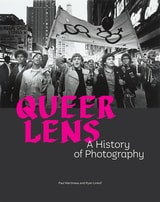
Queer Lens
A History of PhotographyPaul Martineau
J. Paul Getty Trust, The, 2025
Discover how photography helped define queer identity, visibility, and community in this richly illustrated “tour de force.”―Emma Jacob, Aesthetica Magazine
Winner of the 2026 Lambda Literary Award for LGBTQ+ Anthology.
“Potent and inspiring. . . . An empowering photography retrospective that reflects American queer communities.”―Aleena Ortiz, Foreword Reviews
From intimate portraits to public protests, Queer Lens: A History of Photography explores the transformative role of photography in LGBTQ+ communities from the 19th century to today. Edited by Paul Martineau and Ryan Linkof, this volume brings together scholars and artists to examine desire, kinship, gender expression, activism, and visibility. Historical photographs and contemporary works reveal how queer people have pictured themselves and challenged restrictive definitions of identity, while lively essays illuminate the intersections of photography and queer life.
This award-winning volume:
-
Spans nearly two centuries, connecting photography’s earliest experiments with contemporary expressions of queer identity.
-
Features nearly 300 images by some of photography’s most celebrated artists, including Thomas Eakins, Alice Austen, Nan Goldin, Robert Mapplethorpe, Annie Leibovitz, David LaChapelle, Laura Aguilar, Mickalene Thomas, and Paul Mpagi Sepuya.
-
Includes essays exploring how race, gender, class, and desire shape queer representation and photographic practice.
-
Concludes with a personal afterword by acclaimed photographer Catherine Opie on representation and visibility.
For lovers of photography and LGBTQ+ history, Queer Lens offers a new perspective on the people, images, and relationships that have shaped queer life.
Published to accompany an exhibition held at the J. Paul Getty Museum at the Getty Center from June 17 to September 28, 2025.
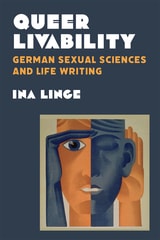
Queer Livability
German Sexual Sciences and Life WritingIna Linge
University of Michigan Press, 2023
Finalist: Waterloo Centre for German Studies Book Prize | December 10, 2024
This book brings together an exciting new archive of queer and trans voices from the history of sexual sciences in the German-speaking world. A new language to express possibilities of gender and sexuality emerged at the turn of the twentieth century, from Sigmund Freud’s theories of homosexuality in Vienna to Magnus Hirschfeld’s “third sex” in Berlin. Together, they provided a language of sex and sexuality that is still recognizable today. Queer Livability: German Sexual Sciences and Life Writing shows that individual voices of trans and queer writers had a significant impact on the production of knowledge about gender and sexuality during this time and introduces lesser known texts to a new readership. It shows the remarkable power of queer life writing in imagining and creating the possibilities of a livable life in the face of restrictive legal, medical, and social frameworks.
Queer Livability: German Sexual Sciences and Life Writing will be of interest to anyone who wants to learn more about LGBTQ+ history and literature. It also provides a fascinating insight into the historical roots for our thinking about gender and sexuality today. The book will be of relevance to an academic readership of students and faculty in German studies, literary studies, European history, and the interdisciplinary fields of gender and sexuality studies, medical humanities, and the history of sexuality.
Queer Nightlife
Kemi Adeyemi, Kareem Khubchandani, Ramón H. Rivera-Servera, Editors
University of Michigan Press, 2021
The mass shooting at a queer Latin Night in Orlando in July 2016 sparked a public conversation about access to pleasure and selfhood within conditions of colonization, violence, and negation. Queer Nightlife joins this conversation by centering queer and trans people of color who apprehend the risky medium of the night to explore, know, and stage their bodies, genders, and sexualities in the face of systemic and social negation. The book focuses on house parties, nightclubs, and bars that offer improvisatory conditions and possibilities for “stranger intimacies,” and that privilege music, dance, and sexual/gender expressions. Queer Nightlife extends the breadth of research on “everynight life” through twenty-five essays and interviews by leading scholars and artists. The book’s four sections move temporally from preparing for the night (how do DJs source their sounds, what does it take to travel there, who promotes nightlife, what do people wear?); to the socialities of nightclubs (how are social dance practices introduced and taught, how is the price for sex negotiated, what styles do people adopt to feel and present as desirable?); to the staging and spectacle of the night (how do drag artists confound and celebrate gender, how are spaces designed to create the sensation of spectacularity, whose bodies become a spectacle already?); and finally, how the night continues beyond the club and after sunrise (what kinds of intimacies and gestures remain, how do we go back to the club after Orlando?).
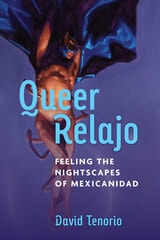
Queer Relajo
Feeling the Nightscapes of MexicanidadDavid Tenorio
University of Michigan Press, 2025
2026 Dance Studies Association de la Torre Bueno First Book Award Shortlist Finalist
In 2015, Mexico City declared itself a “gay-friendly” city and followed up with a gay tourist guide and new laws permitting changes to gender markers on legal documents, sanctioning same-sex marriage, and allowing joint adoption of children. At the same time, patterns of violence and discrimination against women, trans, and queer people have continued throughout the country. In Queer Relajo, David Tenorio argues that while Mexico City aims to bring visibility to queer sociality, the benefits of legitimizing queer space remain unclear.
Combining readings of film, digital media, and performance with drag autoethnography, Queer Relajo quite literally plays with how relajo (or playfulness) structures the spaces of queer nightlife in urban contexts by revealing how nighttime intimacy can minimize the paralyzing effects of violence and precarity in a neoliberal Mexico. Considering the political implications of when a queer/trans person is present at night, Tenorio argues that queer feelings of play are not only essential to sexual liberation, but also resist neoliberal commodification and heteronormative extraction.
Queer Roots for the Diaspora
Ghosts in the Family TreeJarrod Hayes
University of Michigan Press, 2016
The central argument of Queer Roots for the Diaspora is that, in spite of these debates, ultimately the desire for roots contains the “roots” of its own deconstruction. The book considers alternative root narratives that acknowledge the impossibility of returning to origins with any certainty; welcome sexual diversity; acknowledge their own fictionality; reveal that even a single collective identity can be rooted in multiple ways; and create family trees haunted by the queer others patrilineal genealogy seems to marginalize.
The roots narratives explored in this book simultaneously assert and question rooted identities within a number of diasporas—African, Jewish, and Armenian. By looking at these together, one can discern between the local specificities of any single diaspora and the commonalities inherent in diaspora as a global phenomenon. This comparatist, interdisciplinary study will interest scholars in a diversity of fields, including diaspora studies, postcolonial studies, LGBTQ studies, French and Francophone studies, American studies, comparative literature, and literary theory.
Queer and Trans Aesthetics
Lloyd Whitesell
University of Michigan Press, 2026
If a creative individual identifies as queer or trans, does that fact belong solely to the realm of biography, or does it pertain to their artistic achievement? In Queer and Trans Aesthetics, Lloyd Whitesell discusses literature, visual culture, audio-visual media, music, and performance from the 19th to the 21st century. Through this analysis, Whitesell develops a systematic framework to enrich our understanding of LGBTQ aesthetics and cultural production. He traces the history of queer aesthetic inquiry, develops a justification for a synthetic approach, identifies a fund of expressive strategies motivated by queer subjectivity, and highlights how such strategies create affinity across differences of gender, race, local context, and artistic media.
Rooted in a gender-inclusive theory of queer/trans subjectivity, the book draws on testimony from people of diverse backgrounds, genders, and races. Whitesell engages with debates in the existing scholarly literature while making connections between a wide range of artists: some from mainstream canons, some established subcultural figures, and others only now emerging as notable contributors to queer culture. The book explores five expressive archetypes or poses which have had profound significance in queer art traditions: the Monster, the Victim, the Trickster, the Dandy, and the Dreamer. Each offers a repertoire of creative responses to social oppression and configures queer subjective experience in a unique way. With its unique systematic approach, Queer and Trans Aesthetics enhances our knowledge of queer aesthetic traditions across genres and time.
Queer in Translation
Sexual Politics under Neoliberal IslamEvren Savci
Duke University Press, 2021
Queer/Tongzhi China
New Perspectives on Research, Activism and Media CulturesEdited by Elisabeth L. Engebretsen and William F. Schroeder
National University of Singapore Press, 2015
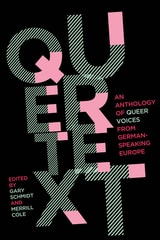
Quertext
An Anthology of Queer Voices from German-Speaking EuropeEdited by Gary Schmidt and Merrill Cole
University of Wisconsin Press, 2021
These outstanding texts exemplify the glittering variety of styles, themes, settings, and subjects addressed by openly queer authors who write in German today. They explore identity, sexuality, history, fantasy, loss, and discovery. Their authors, narrators, and characters explore gender nonconformity and living queer everywhere from city centers to rural communities. They are gay, lesbian, bisexual, trans, and nonbinary. They are exiles, immigrants, and travelers through time and space.
Witty, titillating, and a delight to read, Quertext opens up new worlds of experience for readers interested in queer life beyond the Anglophone world.
Featuring work by Jürgen Bauer • Ella Blix • Claudia Breitsprecher • Lovis Cassaris • Gunther Geltinger • Joachim Helfer • Odile Kennel • Friedrich Kröhnke • Anja Kümmel • Marko Martin • Hans Pleschinski • Christoph Poschenrieder • Peter Rehberg • Michael Roes • Sasha Marianna Salzmann • Angela Steidele • Antje Rávik Strubel • Alain Claude Sulzer • Antje Wagner • J. Walther • Tania Witte • Yusuf Yeşilöz