Results by title
21 books match the query 'Erotica'
Crossings
Creative Ecologies of CruisingJoão Florêncio
Rutgers University Press, 2025
A creative dialogue between a queer artist and a queer academic reminiscing about and thinking with their cruising experiences, Crossings takes queer sex practices and cultures seriously as ways of knowing and world-making. The result is an erotic hybrid form hovering between scholarship and avant-garde experimentation, between critical manifesto and sex memoir. Here, the voices of each author, merged together in one, invite the reader to inhabit the erotic spacetime between self and other, the familiar and the strange, desire and pleasure, climax and release. That is, the spaces and temporalities of cruising itself.

Cultural Erotics in Cuban America
Ricardo L. Ortíz
University of Minnesota Press, 2006
In this wide-ranging work Ortíz argues for the authentically diasporic quality of postrevolutionary, off-island Cuban experience. Highlighting various forms of cultural expression, Cultural Erotics in Cuban America traces underrepresented communities’ responses to the threat of cultural disappearance in an overwhelming and hegemonic U.S. culture. Ortíz shows how the work of Cuban-American writers and artists challenges the heteronormativity of both home and host culture. Focusing on artists who have had an ambivalent, indirect, or nonexistent connection to Miami, he presents close readings of such novelists as Reinaldo Arenas, Roberto G. Fernández, Achy Obejas, and Cristina García, the playwright Eduardo Machado, the poet Rafael Campo, and musical performers Albita Rodríguez and Celia Cruz.
Ortíz charts the legacies of sexism and homophobia in patriarchal Cuban culture, as well as their influence on Cuban-revolutionary and Cuban-exile ideologies. Moving beyond the outdated cultural terms of the Cold War, he looks forward to envision queer futures for Cuban-American culture free from the ties to restrictive—indeed, oppressive—constructions of nation, place, language, and desire.
Ricardo L. Ortíz is associate professor of English at Georgetown University.
Electronic Eros
Bodies and Desire in the Postindustrial AgeBy Claudia Springer
University of Texas Press, 1996
The love affair between humans and the machines that have made us faster and more powerful has expanded into cyberspace, where computer technology seems to offer both the promise of heightened erotic fulfillment and the threat of human obsolescence. In this pathfinding study, Claudia Springer explores the techno-erotic imagery in recent films, cyberpunk fiction, comic books, television, software, and writing on virtual reality and artificial intelligence to reveal how these futuristic images actually encode current debates concerning gender roles and sexuality.
Drawing on psychoanalytical and film theory, as well as the history of technology, Springer offers the first sustained analysis of eroticism and gender in such films as RoboCop, The Terminator, Eve of Destruction, and Lawnmower Man; cyberpunk books such as Neuromancer, Count Zero, Virtual Light, A Fire in the Sun, and Lady El; the comic books Cyberpunk and Interface, among others; and the television series Mann and Machine. Her analysis demonstrates that while new electronic technologies have inspired changes in some pop culture texts, others stubbornly recycle conventions from the past, refusing to come to terms with the new postmodern social order.
Written to be accessible and entertaining for students and general readers as well as scholars, Electronic Eros will be of interest to a wide interdisciplinary audience.
G-Strings and Sympathy
Strip Club Regulars and Male DesireKatherine Frank
Duke University Press, 2002
Frank’s ethnography draws on her work as an exotic dancer in five clubs, as well as on her interviews with over thirty regular customers—middle-class men in their late-twenties to mid-fifties. Reflecting on the customers’ dual desires for intimacy and visibility, she explores their paradoxical longings for "authentic" interactions with the dancers, the ways these aspirations are expressed within the highly controlled and regulated strip clubs, and how they relate to beliefs and fantasies about social class and gender. She considers how regular visits to strip clubs are not necessarily antithetical to marriage or long-term heterosexual relationships, but are based on particular beliefs about marriage and monogamy that make these clubs desirable venues. Looking at the relative "classiness" of the clubs where she worked—ranging from the city’s most prestigious clubs to some of its dive bars—she reveals how the clubs are differentiated by reputations, dress codes, cover charges, locations, and clientele, and describes how these distinctions become meaningful and erotic for the customers. Interspersed throughout the book are three fictional interludes that provide an intimate look at Frank’s experiences as a stripper—from the outfits to the gestures, conversations, management, coworkers, and, of course, the customers.
Focusing on the experiences of the male clients, rather than those of the female sex workers, G-Strings and Sympathy provides a nuanced, lively, and tantalizing account of the stigmatized world of strip clubs.
God of River Mud
A NovelVic Sizemore
West Virginia University Press, 2024
Winner, 2025 Tennessee Book Award, Fiction
Grappling with innate desires and LGBTQ identity, a family struggles under the oppressive expectations foisted on them by fundamentalist Christianity.
Told through alternating perspectives, God of River Mud chronicles the lives of Berna Minor, her husband, their four children, and Berna’s secret lover.
To escape a life of poverty and abuse, Berna Cannaday marries Zechariah Minor, a fundamentalist Baptist preacher, and commits herself to his faith, trying to make it her own. After Zechariah takes a church beside the Elk River in rural Clay, West Virginia, Berna falls in love with someone from their congregation—Jordan, a woman who has known since childhood that he was meant to be a man. Berna keeps her secret hidden as she struggles to be the wife and mother she believes God wants her to be. Berna and Zechariah’s children struggle as well, trying to reconcile the theology they are taught at home with the fast-changing world around them. And Jordan struggles to find a community and a life that allow him both to be safely and fully himself, as Jay, and to be loved for who he is.
As the decades and stories unfold, traditional evangelical Bible culture and the values of rural Appalachia clash against innate desires, LGBTQ identity, and gender orientation. Sympathies develop—sometimes unexpectedly—as the characters begin to reconcile their faith and their love. God of River Mud delves into the quandary of those marginalized and dehumanized within a religious patriarchy and grapples with the universal issues of identity, faith, love, and belonging.
Hammer of the Dogs
A NovelJarret Keene
University of Nevada Press, 2023
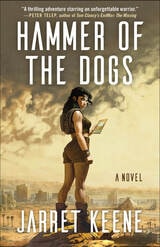
Set in the wasteland of post-apocalyptic Las Vegas, Hammer of the Dogs is a literary dystopian adventure filled with high-octane fun starring twenty-one-year-old Lash. With her high-tech skill set and warrior mentality, Lash is a master of her own fate as she helps to shield the Las Vegas valley’s survivors and protect her younger classmates at a paramilitary school holed up in Luxor on the Las Vegas Strip. After graduation, she’ll be alone in fending off the deadly intentions and desires of the school’s most powerful opponents.
When she’s captured by the enemy warlord, she’s surprised by two revelations: He’s not the monster her headmaster wants her to believe and the one thing she can’t safeguard is her own heart. Hammer of the Dogs celebrates the courageousness of a younger generation in the face of authority while exploring the difficult choices a conscionable young woman must make with her back against a blood-spattered wall. It’s a story of transformation and maturity, as Lash grapples with her own identity and redefines the glittering Las Vegas that Nevada is known for.
Hogg
A NovelSamuel R. Delany
University of Alabama Press, 2004
A fearless descent into the darkest corners of human desire and violence.
First written thirty-five years ago and completed days before the Stonewall riots in New York, award-winning author Samuel R. Delany’s Hogg is one of America’s most famous “unpublishable” novels. It recounts three days in 1969 in the life of truck driver and rapist-for-hire, Franklin Hargus. Narrated by his young accomplice, Delaney’s novel portrays an exploration of erotic depravity, a capacious landscape of sexuality that transgresses social and erotic boundaries.
While testing readers’ tolerance, what transfigures the novel into a work of literature is Delany’s refusal, faced with moral anxieties and revulsion, to mutilate or disown his creation. Hogg’s characters wear recognizable human faces, possessing intense loyalty, perverse admiration, and a kind of integrity. Hargus fascinates. He is the embodiment of what society can turn people into, the decaying condition of the human soul.
In the Face of Death We Are Equal
Mu Cao
Seagull Books, 2020
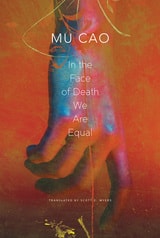
“Those who know me call me Old He, and they also know that I’ve worked in a crematorium for my entire life.” Here begins Mu Cao’s novel In the Face of Death We Are Equal, an unrelentingly realistic portrait of working-class gay men in the underbelly of Chinese society. He Donghai is days away from his sixtieth birthday and long-awaited retirement from his job as a corpse burner at a Beijing crematorium. As he approaches the momentous day, he reflects on his life and his relationship with a special group of young men who live and love on the margins of Chinese society. One of them is Ah Qing, a young migrant worker who leaves his village in Henan Province to earn a living in cities—and who has an unexpected personal connection to He. Through a disrupted and nonlinear narrative technique, and alternating between first, second, and third person, In the Face of Death We Are Equal tells the story of Ah and other young men like him.
Sometimes enraging, often humorous, but always powerful, this novel explores the economic and sexual exploitation of young men and women from China’s impoverished countryside who seek survival in the shadow of China’s economic “miracle.” Deftly translated by Scott E. Myers, it is the first title in Seagull’s new Pride List, which showcases important queer writing from around the world. Written in Mu Cao’s trademark earthy, sometimes graphic, idiom, In the Face of Death We Are Equal will be a valuable addition to queer and Chinese literature in translation.

In the Forbidden City
An Anthology of Erotic Fiction by Italian WomenEdited by Maria Rosa Cutrufelli
University of Chicago Press, 2000
Now Italian women have turned the tables. With In the Forbidden City, translated from the Italian, acclaimed novelist Maria Rosa Cutrufelli brings together fourteen short erotic stories by contemporary Italian women writers. Well-established voices are juxtaposed with new ones; traditional forms provide a contrast with the experimental. In Sandra Petrignani's dialogue "Body" a women and a former lover engage in a heady debate about desire and indifference; Margherita Ciacobino delivers a tale of lesbian desire, a theme uncommon in Italian literature; Dacia Maraini writes on the literature of eroticism penned by women writers that ingeniously manages to be erotic in its own right; and Rossana Campo, in one of the most entertaining entries, offers a hip-rattling tri-logue on love voiced by some super-cool adolescents. In her introduction, Cutrufelli draws in even more writers such as Jean Baudrillard, Angela Carter, and Georges Bataille in her introductory essay on the theoretical issues of desire and seduction.
Now finally available to English readers, In the Forbidden City constitutes a breakthrough volume in literary erotica by Italian women that is both profound and engaging.
Love in a Dead Language
Lee Siegel
University of Chicago Press, 1999
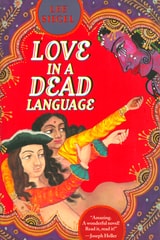
"Rare is the book that makes one stop and wonder: Is this a literary masterpiece or do I need my head examined? But such is the alternately awe-inspiring and goofy thrall cast by Lee Siegel's Love in a Dead Language. . . . His work stands out as a book that is not simply a novel but its own genus of rollicking, narrative scholarship . . . it is just the cerebral aphrodisiac we need." —Carol Lloyd, Salon
"Immensely clever and libidinously hilarious. . . . [T]he most astonishing thing about Love in a Dead Language is its ingenious construction. Insofar as any printed volume can lay claim to being a multimedia work, this book earns that distinction." —Paul di Filippo, Washington Post Book World
"Now along comes Lee Siegel, who mixes a bit of Borges with some Nabokov and then adds an erotic gloss from the Kama Sutra to write Love in a Dead Language, a witty, bawdy, language-rich farce of academic life. . . . Whether it is post-modern or not, Love in a Dead Language is pulled off with such unhinged élan by Mr. Siegel that it is also plain good fun, a clever, literate satire in which almost everything is both travestied and, strangely, loved by its author." —Richard Bernstein, The New York Times
"Love in a Dead Language deserves space on the short, high shelf of literary wonders." —Tom LeClair, New York Times Book Review
1999 New York Times Book Review Notable Book of the Year
My Sister's Continent
A NovelGina Frangello, Lidia Yuknavitch
Northwestern University Press, 2026
Kirby is a young woman attempting to come to terms with a failed bout of therapy and the truth about her identical twin, Kendra. Since girlhood, Kirby both idolized and envied Kendra, a fearless and charismatic ballet dancer who commanded the attention of everyone in their orbit. In the aftermath of tragedy, Kirby is sent a case study by a former psychiatrist intent on publishing a distorted version of her family’s secrets. She responds by using Kendra’s private and revealing journals to reconstruct their final months together, as well as her own “disastrous” time in therapy, to voice her own truth.
Freud’s “Dora,” a young woman whose mysterious symptoms he contentiously chalked up to “hysteria,” appears at turns in the faces of each twin as they navigate a world of sexuality, familial dysfunction, and possibly-psychosomatic ailments. Reissued with a new foreword by Lidia Yuknavitch, Frangello’s groundbreaking early novel brings “Dora” into a new era.
Rated RX
Sheree Rose with and after Bob FlanaganEdited by Yetta Howard
The Ohio State University Press, 2020
Curated with attention to queer-crip subjectivities and transgressive feminisms, Rated RX includes essays by and interviews with scholars, artists, and Rose’s collaborators that address gender politics, archival practices, minority embodiment, and disability in Rose’s work as well as more than eighty photographs and rare archival materials reflecting Rose’s recent and past performances. Offering a necessary corrective, Rated RX is the first collection to underscore Sheree Rose as a legendary figure in performance art and BDSM subcultural history, reflecting her lifetime of involvement in documenting the underground and the transformative role her work plays in sexual, subcultural, and art exhibitionism.
School
A NovelRay Levy
University of Alabama Press, 2023
Both an exorcism of contemporary academia and a comedic portrait of an artist seeking the means to survive.
At once angry and jubilant, Ray Levy’s School is a curse on a dying system and an incantation for transforming pain into a vessel for capacious, creative selfhood.
A dissertation manuscript possessed by the spirit of Marquis de Sade; a lecture on psychoanalysis delivered as stand-up comedy by a dysphoric graduate student; a review of a found-footage horror movie that’s also a YouTube video of a conference presentation on French theory; an interview with an avant-garde filmmaker that’s really an invocation for conjuring your demon brother; oversharing and withholding, chanting and channeling, School is a slapstick roast of Derrida’s corpse and a mystical vision of a life in which you have not lost.
Secret Body
Erotic and Esoteric Currents in the History of ReligionsJeffrey J. Kripal
University of Chicago Press, 2017
Kripal tells his story, biographically, historically and politically contextualizing each of the six books of his Chicago corpus, from Kali’s Child to Mutants and Mystics, all the while answering his censors and critics and exploring new implications of his thought. In the process, he begins to sketch out a speculative “new comparativism” in twenty theses. The result is a new vision for the study of religion, one that takes in the best of the past, engages with outside critiques from the sciences and the humanities, and begins to blaze a new positive path forward. A major work decades in the making, Secret Body will become a landmark in the study of religion.
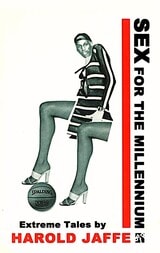
Sex for the Millennium
Extreme TalesHarold Jaffe
University of Alabama Press, 2026
An innovative work of experimental prose examining the entanglements of media, authority, and embodied experience.
Sex for the Millennium: Extreme Tales by Harold Jaffe is a provocative collection of experimental narratives that push the boundaries of form, language, and subject matter. Blending fiction, satire, and cultural commentary, the book presents a series of fragmented “extreme” episodes that explore the intersections of desire, power, and media in contemporary society.
Jaffe uses the concept of sex as a central metaphor rather than a literal focus, exploring how desire can be shaped, controlled, and commodified within larger social and political systems. Rather than following a traditional plot, Jaffe constructs a shifting landscape populated by characters caught in systems of control shaped by institutions, technology, and consumer culture. The stories examine how identity and intimacy are mediated by external forces.
Jaffe's work reflects postmodern literary traditions, using disjointed narratives and abrupt tonal shifts to unsettle the reader. His writing challenges social norms and exposes the underlying mechanisms of authority and manipulation at work in everyday life. With dark humor and intentional provocation, Sex for the Millennium: Extreme Tales offers a critique of modern culture, inviting readers to confront questions about autonomy, authenticity, and the influence of media in shaping human experience.
Slut Lullabies
StoriesGina Frangello, Rebecca Makkai
Northwestern University Press, 2026
Through beauty, horror, humor, and chaos, Gina Frangello’s electric stories mine the human experience. A gay Latino man whose pious relatives are boycotting his commitment ceremony becomes caught up in hypocrisy and splendor when his lover’s Waspy mother hires a glitzy wedding coordinator. A desperate teen “seduces” her teacher in order to blackmail him into funding her young stepmother’s escape from their violent home. A wife turns to infidelity and drugs to distract her from chronic pain following an accident. A teenage boy attempts atonement in Amsterdam after having exploited and betrayed his naive girlfriend at home. A socialite must confront her dark past as her husband’s deteriorating illness erodes both her bank account and social standing.
Intimate and raw, this new edition of Frangello’s short fiction includes two previously unpublished stories. A foreword by Rebecca Makkai explains how Frangello’s incendiary work has opened the door for writing about deeply flawed and fascinating women.
The Faith Healer of Olive Avenue
StoriesManuel Muñoz and Cherríe Moraga
Northwestern University Press, 2025
From the divergent paths of triplet brothers to a grieving father confronting his mistreatment of his son, these stories interweave a recurring cast of neighborhood characters, many of them in search of escape or release. Lauded for its empathetic portrayals of communities often ignored, The Faith Healer of Olive Avenue won a Whiting Award and an O. Henry Award; it was shortlisted for the Frank O’Connor International Short Story Award as one of the best collections published in English worldwide. A new foreword by author and activist Cherríe Moraga gives testament to Muñoz’s status as “the cartographer of a people.”
Trouble Will Save You
Three NovellasDavid Nikki Crouse
University of Alaska Press, 2023
While Crouse’s prize-winning collection of short fiction The Man Back There offered up insights into a kind of self-destructive masculinity, these novellas now sensitively and persuasively capture the inner landscapes of women struggling with grief and isolation. Trouble Will Save You is a unique and fully realized work from a keenly empathetic writer.
Praise for The Man Back There:
“In this virtuoso collection of stories, David Crouse guides us directly to where the shadow lies—the disorienting loss, the surprising heartache, the forgotten wound—those inevitable areas of the psyche we all share and through which only truth, illuminated with a such a light touch here, can deliver us; The Man Back There is the work of the real thing.”
—Andre Dubus III, author of House of Sand and Fog
“I chose these stories because they made me feel. I felt the characters like I would feel a stranger in a room or on a bus with me, with an irrational sympathy more animal than moral in its nature.”
—Mary Gaitskill, 2007 Mary McCarthy Prize judge
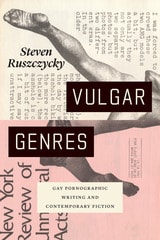
Vulgar Genres
Gay Pornographic Writing and Contemporary FictionSteven Ruszczycky
University of Chicago Press, 2021
Long fixated on visual forms, the field of porn studies is overdue for a book-length study of gay pornographic writing. Steven Ruszczycky delivers with an impressively researched work on the ways gay pornographic writing emerged as a distinct genre in the 1960s and went on to shape queer male subjectivity well into the new millennium.
Ranging over four decades, Ruszczycky draws on a large archive of pulp novels and short fiction, lifestyle magazines and journals, reviews, editorial statements, and correspondence. He puts these materials in conversation with works by a number of contemporary writers, including William Carney, Dennis Cooper, Samuel Delany, John Rechy, and Matthew Stadler. While focused on the years 1966 to 2005, Vulgar Genres reveals that the history of gay pornographic writing during this period informs much of what has happened online over the past twenty years, from cruising to the production of digital pornographic texts. The result is a milestone in porn studies and an important contribution to the history of gay life.
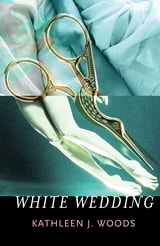
White Wedding
Kathleen J. Woods
University of Alabama Press, 2022
An enigmatic woman wanders from a pleasure mansion to a backyard wedding, upending the lives of everyone present
No one knows the woman at the wedding. Not the caterer, an easy target, succumbing to her advances. Not the pregnant bride or her tangled family, trying to spin a fairytale wedding under a melting hot summer sun. Not even the bride’s stepsister, Charlotte, who, in the middle of the night and despite her better judgment, allows this wandering wedding crasher into her car.
Crusted in dried blood and other bodily fluids, the woman exists in layers of sense and story, a nesting doll of pornographic tales in which fantasy and banality collide and blur. In this novel that is at once visceral, vivid, and spare, the uninvited guest gives each of those she meets what they want, whether they like it or not.
Here writhe distinct bodies in distinct ecstasies, echoing and defying inherited American narratives about gender, shame, and pleasure. With an edge of humor and horror, Woods explores if —and how—we consent to our own desires.
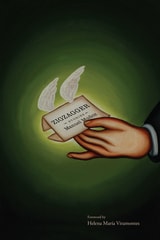
Zigzagger
StoriesManuel Muñoz and Helena María Viramontes
Northwestern University Press, 2025
Manuel Muñoz’s first collection of stories goes beyond the traditional family myths of Mexican American literature and the image of California’s Central Valley as a lush world of rural tranquility, instead exploring the constant struggle of characters against their physical and personal surroundings. A teenage boy learns the consequences of succumbing to the lure of a town outsider; a young farm worker attempts to hide his supervision of a group of children from the town police; a father must expose his own secrets after his son is found murdered in a highway motel. Experiencing conflicts of family and sexuality and the pain of loss and memory, the characters in Zigzagger seek to reconcile themselves with the rural towns of their upbringing—places that, by nature, are bordered by loneliness.