Results by title
22279 books match the query 'Social Science' and 128 start with q
Queer Legacies
Stories from Chicago’s LGBTQ ArchivesJohn D'Emilio
University of Chicago Press, 2020
Queer Livability
German Sexual Sciences and Life WritingIna Linge
University of Michigan Press, 2023
Finalist: Waterloo Centre for German Studies Book Prize | December 10, 2024
This book brings together an exciting new archive of queer and trans voices from the history of sexual sciences in the German-speaking world. A new language to express possibilities of gender and sexuality emerged at the turn of the twentieth century, from Sigmund Freud’s theories of homosexuality in Vienna to Magnus Hirschfeld’s “third sex” in Berlin. Together, they provided a language of sex and sexuality that is still recognizable today. Queer Livability: German Sexual Sciences and Life Writing shows that individual voices of trans and queer writers had a significant impact on the production of knowledge about gender and sexuality during this time and introduces lesser known texts to a new readership. It shows the remarkable power of queer life writing in imagining and creating the possibilities of a livable life in the face of restrictive legal, medical, and social frameworks.
Queer Livability: German Sexual Sciences and Life Writing will be of interest to anyone who wants to learn more about LGBTQ+ history and literature. It also provides a fascinating insight into the historical roots for our thinking about gender and sexuality today. The book will be of relevance to an academic readership of students and faculty in German studies, literary studies, European history, and the interdisciplinary fields of gender and sexuality studies, medical humanities, and the history of sexuality.
Queer London
Perils and Pleasures in the Sexual Metropolis, 1918-1957Matt Houlbrook
University of Chicago Press, 2005
Cyril's story is Matt Houlbrook's point of entry into the queer worlds of early twentieth-century London. Drawing on previously unknown sources, from police reports and newspaper exposés to personal letters, diaries, and the first queer guidebook ever written, Houlbrook here explores the relationship between queer sexualities and modern urban culture that we take for granted today. He revisits the diverse queer lives that took hold in London's parks and streets; its restaurants, pubs, and dancehalls; and its Turkish bathhouses and hotels—as well as attempts by municipal authorities to control and crack down on those worlds. He also describes how London shaped the culture and politics of queer life—and how London was in turn shaped by the lives of queer men. Ultimately, Houlbrook unveils the complex ways in which men made sense of their desires and who they were. In so doing, he mounts a sustained challenge to conventional understandings of the city as a place of sexual liberation and a unified queer culture.
A history remarkable in its complexity yet intimate in its portraiture, Queer London is a landmark work that redefines queer urban life in England and beyond.
Winner of History Today’s Book of the Year Award, 2006

Queer Lovers and Hateful Others
Regenerating Violent Times and PlacesJin Haritaworn
Pluto Press, 2015
At the centre of this book is the concept of 'queer regeneration.' Haritaworn sees the queer lover as a transitional object which allows the present-day neoliberal regime to make punishment and neglect appear as signs of care and love for diversity. Alongside this shift, in the wake of older moral panics over crime, violence, patriarchy, integration, and segregation, the new Other, that is, the homophobic migrant appears. To understand this transition, Queer Lovers and Hateful Others looks at the environments in which queer bodies have become worthy of protection, and the everyday erasures that shape life in the inner city, and how queer activists actively seek out and dispel the myths of sites of nostalgia for the 'invented traditions' of women-and-gay-friendliness.
Haritaworn guides the reader through a rich archive of media, arts, policy, and activism, including posters, newspaper reports, hate crime action plans, urban projects, psychological studies, demonstrations, kiss-ins, political speeches, and films. In the process, queer lovers, drag kings, criminalised youth, homosexuals persecuted under National Socialism, and other figures of degeneracy and regeneration appear on a shared plane, where new ways of sharing space become imaginable.

Queer Marxism in Two Chinas
Petrus Liu
Duke University Press, 2015
Queer Migration Politics
Activist Rhetoric and Coalitional PossibilitiesKarma Chavez
University of Illinois Press, 2013
Queer Migration and Asylum in Europe
Edited by Richard C. M. Mole
University College London, 2021
Europe is a popular destination for LGBTQ people seeking to escape discrimination and persecution. Yet, while European institutions have done much to promote the legal equality of sexual minorities and a number of states pride themselves on their acceptance of sexual diversity, the image of European tolerance is often quite different from the reality faced by LGBTQ migrants and asylum seekers. Queer Migration and Asylum in Europe brings together scholars from politics, sociology, urban studies, anthropology, and law to analyze how and why queer individuals migrate to Europe, as well as the legal, social, and political frameworks they are forced to navigate in the destination societies. The subjects covered include LGBTQ Latino migrants in queer and diasporic spaces in London; the diasporic consciousness of queer Polish, Russian, and Brazilian migrants in Berlin; the role of the Council of Europe in shaping legal and policy frameworks relating to queer migration and asylum; the challenges facing bisexual asylum seekers; queer asylum and homonationalism in the Netherlands; and the role of space, faith, and LGBTQ organizations in Germany, Italy, the UK, and France in supporting queer asylum seekers.
Queer Migrations
Sexuality, U.S. Citizenship, and Border CrossingsEithne Luibheid
University of Minnesota Press, 2005
Queer Millennials on Campus
At the Vanguard of Sexual FluidityLeila J. Rupp
University of Chicago Press, 2027
An intimate portrayal of the college experiences of queer and non-binary millennials and what they tell us about the shifting shape of desires and identities in the twenty-first century.
College has long been considered a distinct place for self-discovery. This is particularly true when it comes to gender and sexual identities. In Queer Millennials on Campus, Leila J. Rupp draws on a host of remarkably open and honest interviews with queer women and nonbinary assigned-female-at-birth students at the University of California, Santa Barbara. The accessible narrative wends its way through their lives, from their first experiences of queer desires, through their intimacies and relationships, negotiating their identities, and coming out (or not) to friends and family members. Rupp sheds new light on the Millennial generation, who played a pivotal role in popularizing and embracing the concept of sexual fluidity, helping to challenge older notions of stable sexual and gender identities.
Ultimately, the voices in the book argue that self-awareness about one’s desires, intimate relationships, and identities should be acknowledged and celebrated. Written with deep empathy and understanding, Queer Millennials on Campus honors queer sexual awareness and joy.
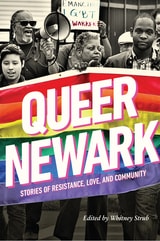
Queer Newark
Stories of Resistance, Love, and CommunityWhitney Strub
Rutgers University Press, 2024
Histories of gay and lesbian urban life typically focus on major metropolitan areas like San Francisco and New York, opportunity-filled destinations for LGBTQ migrants from across the country. Yet there are many other queer communities in economically depressed cities with majority Black and Hispanic populations that receive far less attention. Though just a few miles from New York, Newark is one of these cities, and its queer histories have been neglected—until now.
Queer Newark charts a history in which working-class people of color are the central actors and in which violence, poverty, and homophobia could never suppress joy, resistance, love, and desire. Drawing from rare archives that range from oral histories to vice squad reports, this collection’s authors uncover the sites and people of Newark’s queer past in bars, discos, ballrooms, and churches. Exploring the intersections of class, race, gender, and sexuality, they offer fresh perspectives on the HIV/AIDS epidemic, community relations with police, Latinx immigration, and gentrification, while considering how to best tell the rich and complex stories of queer urban life. Queer Newark reveals a new side of New Jersey’s largest city while rewriting the history of LGBTQ life in America.
Queer Nightlife
Kemi Adeyemi, Kareem Khubchandani, Ramón H. Rivera-Servera, Editors
University of Michigan Press, 2021
The mass shooting at a queer Latin Night in Orlando in July 2016 sparked a public conversation about access to pleasure and selfhood within conditions of colonization, violence, and negation. Queer Nightlife joins this conversation by centering queer and trans people of color who apprehend the risky medium of the night to explore, know, and stage their bodies, genders, and sexualities in the face of systemic and social negation. The book focuses on house parties, nightclubs, and bars that offer improvisatory conditions and possibilities for “stranger intimacies,” and that privilege music, dance, and sexual/gender expressions. Queer Nightlife extends the breadth of research on “everynight life” through twenty-five essays and interviews by leading scholars and artists. The book’s four sections move temporally from preparing for the night (how do DJs source their sounds, what does it take to travel there, who promotes nightlife, what do people wear?); to the socialities of nightclubs (how are social dance practices introduced and taught, how is the price for sex negotiated, what styles do people adopt to feel and present as desirable?); to the staging and spectacle of the night (how do drag artists confound and celebrate gender, how are spaces designed to create the sensation of spectacularity, whose bodies become a spectacle already?); and finally, how the night continues beyond the club and after sunrise (what kinds of intimacies and gestures remain, how do we go back to the club after Orlando?).
Queer Noises
Male and Female Homosexuality in Twentieth-Century MusicJohn Gill
University of Minnesota Press, 1995

Queer Objects to the Rescue
Intimacy and Citizenship in KenyaGeorge Paul Meiu
University of Chicago Press, 2023
Campaigns calling on police and citizens to purge their countries of homosexuality have taken hold across the world. But the “homosexual threat” they claim to be addressing is not always easy to identify. To make that threat visible, leaders, media, and civil society groups have deployed certain objects as signifiers of queerness. In Kenya, for example, bead necklaces, plastics, and even diapers have come to represent the danger posed by homosexual behavior to an essentially “virile” construction of national masculinity.
In Queer Objects tothe Rescue, George Paul Meiu explores objects that have played an important and surprising role in both state-led and popular attempts to rid Kenya of various imagined threats to intimate life. Meiu shows that their use in the political imaginary has been crucial to representing the homosexual body as a societal threat and as a target of outrage, violence, and exclusion, while also crystallizing anxieties over wider political and economic instability. To effectively understand and critique homophobia, Meiu suggests, we must take these objects seriously and recognize them as potential sources for new forms of citizenship, intimacy, resistance, and belonging.
Queer Phenomenology
Orientations, Objects, OthersSara Ahmed
Duke University Press, 2006
Ahmed proposes that a queer phenomenology might investigate not only how the concept of orientation is informed by phenomenology but also the orientation of phenomenology itself. Thus she reflects on the significance of the objects that appear—and those that do not—as signs of orientation in classic phenomenological texts such as Husserl’s Ideas. In developing a queer model of orientations, she combines readings of phenomenological texts—by Husserl, Heidegger, Merleau-Ponty, and Fanon—with insights drawn from queer studies, feminist theory, critical race theory, Marxism, and psychoanalysis. Queer Phenomenology points queer theory in bold new directions.
Queer Readings of the Centurion at Capernaum
Their History and PoliticsChristopher B. Zeichmann
SBL Press, 2022
The first-ever monograph on the history of queer biblical interpretation of a controversial biblical passage
Since the 1950s, homoerotic readings of the pericope in which Jesus heals a Roman centurion’s slave have been built upon three of the account’s features: the specific Greek word pais, which can refer to youth, slave, or the junior partner in a sexual relationship between two men; Luke’s characterization of the young man as “dear” (entimos) to the centurion; and commonplace homoeroticism in the Roman army. Rather than affirming or denying the historical reality of a sexual relationship between the centurion and the young man, Christopher B. Zeichmann instead traces the shifting patterns of queer readings of the text and the influences of the sexual, political, and theological discourses of late twentieth- and early twenty-first-century Europe, the United States, and Australia. Readers will see how distinct political contexts have led interpreters to find very different meanings about the sexual subtexts of this story.
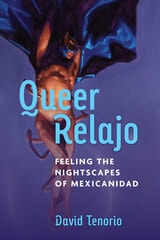
Queer Relajo
Feeling the Nightscapes of MexicanidadDavid Tenorio
University of Michigan Press, 2025
2026 Dance Studies Association de la Torre Bueno First Book Award Shortlist Finalist
In 2015, Mexico City declared itself a “gay-friendly” city and followed up with a gay tourist guide and new laws permitting changes to gender markers on legal documents, sanctioning same-sex marriage, and allowing joint adoption of children. At the same time, patterns of violence and discrimination against women, trans, and queer people have continued throughout the country. In Queer Relajo, David Tenorio argues that while Mexico City aims to bring visibility to queer sociality, the benefits of legitimizing queer space remain unclear.
Combining readings of film, digital media, and performance with drag autoethnography, Queer Relajo quite literally plays with how relajo (or playfulness) structures the spaces of queer nightlife in urban contexts by revealing how nighttime intimacy can minimize the paralyzing effects of violence and precarity in a neoliberal Mexico. Considering the political implications of when a queer/trans person is present at night, Tenorio argues that queer feelings of play are not only essential to sexual liberation, but also resist neoliberal commodification and heteronormative extraction.

Queer Ricans
Cultures and Sexualities in the DiasporaLawrence La Fountain-Stokes
University of Minnesota Press, 2009
Highlighting cultural and political resistance within Puerto Rico’s gay, lesbian, bisexual, and transgender subcultures, La Fountain-Stokes pays close attention to differences of gender, historical moment, and generation, arguing that Puerto Rican queer identity changes over time and is experienced in very different ways. He traces an arc from 1960s Puerto Rico and the writings of Luis Rafael Sánchez to New York City in the 1970s and 1980s (Manuel Ramos Otero), Philadelphia and New Jersey in the 1980s and 1990s (Luz María Umpierre and Frances Negrón-Muntaner), and Chicago (Rose Troche) and San Francisco (Erika López) in the 1990s, culminating with a discussion of Arthur Avilés and Elizabeth Marrero’s recent dance-theater work in the Bronx.
Proposing a radical new conceptualization of Puerto Rican migration, this work reveals how sexuality has shaped and defined the Puerto Rican experience in the United States.
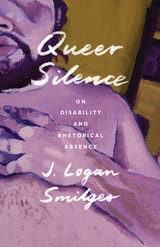
Queer Silence
On Disability and Rhetorical AbsenceJ. Logan Smilges
University of Minnesota Press, 2022
Championing the liberatory potential of silence to address the fraught disability politics of queerness
In queer culture, silence has been equated with voicelessness, complicity, and even death. Queer Silence insists, however, that silence can be a generative and empowering mode of survival. Triangulating insights from queer studies, disability studies, and rhetorical studies, J. Logan Smilges explores what silence can mean for people whose bodyminds signify more powerfully than their words.
Queer Silence begins by historicizing silence’s negative reputation, beginning with the ways homophile activists rejected medical models pathologizing homosexuality as a disability, resulting in the silencing of disability itself. This silencing was redoubled by HIV/AIDS activism’s demand for “out, loud, and proud” rhetorical activities that saw silence as capitulation.
Reading a range of cultural artifacts whose relative silence has failed to attract queer attachment, from anonymous profiles on Grindr to ex-gays to belated gender transitions to disability performance art, Smilges argues for silence’s critical role in serving the needs of queers who are never named as such. Queer Silence urges queer activists and queer studies scholars to reconcile with their own ableism by acknowledging the liberatory potential of silence, a mode of engagement that disattached queers use every day for resistance, sociality, and survival.
Retail e-book files for this title are screen-reader friendly with images accompanied by short alt text and/or extended descriptions.
Cover alt text: Background detail of a painting on canvas shows a partial view of the upper body and face of a figure, bearded and naked; title in painted script.
Queer Social Philosophy
CRITICAL READINGS FROM KANT TO ADORNORandall Halle
University of Illinois Press, 2004
Queer Theory without Antinormativity
Robyn Wiegman and Elizabeth A. Wilson, special issue editors
Duke University Press, 0
Queer Throughlines
Spaces of Queer Activism in South Korea and the Korean DiasporaJu Hui Judy Han
University of Michigan Press, 2025
Queer Tidalectics
Linguistic and Sexual Fluidity in Contemporary Black Diasporic LiteratureEmilio Amideo
Northwestern University Press, 2021
Amideo engages and extends the work of Black queer studies, Oceanic studies, ecocriticism, phenomenology, and new materialism through the theorizations of Sara Ahmed, Omise’eke Natasha Tinsley, M. Jacqui Alexander, Édouard Glissant, José Esteban Muñoz, and Edward Kamau Brathwaite, among others. Ambitious in scope and captivating to read, Queer Tidalectics brings Caribbean writers like Glissant and Brathwaite into queer literary analysis—a major scholarly contribution.
Queer Timing
The Emergence of Lesbian Sexuality in Early CinemaSusan Potter
University of Illinois Press, 2019
John Leo and Dana Heller Award for Best Single Work, Anthology, Multi-Authored or Edited Book in LGBTQ Studies, Popular Culture Association (PCA), 2020
In Queer Timing, Susan Potter offers a counter-history that reorients accepted views of lesbian representation and spectatorship in early cinema. Potter sees the emergence of lesbian figures as only the most visible but belated outcome of multiple sexuality effects. Early cinema reconfigured older erotic modalities, articulated new--though incoherent--sexual categories, and generated novel forms of queer feeling and affiliation.
Potter draws on queer theory, silent film historiography, feminist film analysis, and archival research to provide an original and innovative analysis. Taking a conceptually oriented approach, she articulates the processes of filmic representation and spectatorship that reshaped, marginalized, or suppressed women's same-sex desires and identities. As she pursues a sense of "timing," Potter stages scenes of the erotic and intellectual encounters shared by historical spectators, on-screen figures, and present-day scholars. The result is a daring revision of feminist and queer perspectives that foregrounds the centrality of women's same-sex desire to cinematic discourses of both homo- and heterosexuality.
Queer Tourism
Geographies of Globalization, Volume 8Jasbir K. Puar, ed.
Duke University Press, 0
Essays explore a range of geographical areas and cover topics that include an autoethnographic account of a queer traveler in Cuba, the development of gay and lesbian tourism in Madrid and Mexico, and gay and lesbian tourist events such as World Pride 2001 in Rome. The collection also includes an essay focusing on lesbian tourism—a study of the history of lesbian tourism on Eresos, Lesvos.
Contributors. Lionel Cantú, Gabriel Giorgi, Venetia Kantsa, Lawrence La Fountain-Stokes, Michael Luongo, Kevin Markwell, Jasbir Kaur Puar, Dereka Rushbrook

Queer Traffic
Sex, Panic, Free TradeJennifer Tyburczy
Duke University Press, 2025

Queer Transexions of Race, Nation, and Gender, Volume 15
Anne McClintock, Phillip Brian Harper, José Esteban Muñoz and Trish Rosen, eds.
Duke University Press, 0
In the first section of this issue, Race and Queer Sexuality, international authors address topics ranging from Asian American queer identity and its relation to transnational and diasporic concerns to homophobia and its relationship to black nationalism in South Africa. Other subjects include, sexuality, race, and public space; lesbian pedagogy and the nation in Latin America; and an analysis of cross-race and cross-gender drag in the work of L.A. drag queen Vaginal Creme Davis. In the second section, The Politics of Transgression, contributors focus on transgression and its relationship to power and history. One essay explores Irish immigration in the U.S. and the Irish female body as a figure of transnational contagion and blood panic, while another focuses on Oscar Wilde, race, and queer sexuality. Other pieces include a meditation on British filmmaker and writer Derek Jarman’s film, Blue.
Race and Queer Sexuality confronts the limitations of prior work in queer theory while providing a starting point for discussion of race, queer sexuality, and the politics of transgression that will be part of queer theory of the future.
Contributors. Judith Butler, David Eng, Licia Fiol-Mata, Judith Halberstam, Phillip Brian Harper, Neville Hoad, Rachel Holmes, Don Kulick, Tim Lawrence, Rosalind Morris, José Esteban Muñoz, Ben Singer, David Valentine, Priscilla Wald, Riki Anne Wilchins
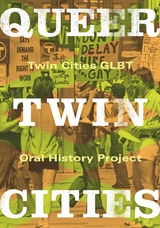
Queer Twin Cities
University of Minnesota Press, 2010
A pioneering look at the queer history, politics, and spaces of the Twin Cities
The Twin Cities is home to one of the largest and most vital GLBT populations in the nation—and one of the highest percentages of gay residents in the country. Drawn from the pioneering work of the Twin Cities GLBT Oral History Project—a collective organization of students, scholars, and activists devoted to documenting and interpreting the lives of GLBT people in Minneapolis and St. Paul—Queer Twin Cities is a uniquely critical collection of essays on Minnesota’s vibrant queer communities, past and present.
A rich blend of oral history, archival research, and ethnography, Queer Twin Cities uses sexuality to chart connections between people’s lives in Minnesota. Topics range from turn-of-the-century Minneapolis amid moral reform—including the highly publicized William Williams murder trial and efforts to police Bridge Square, aka ‘skid row’—to northern Minnesota and the importance of male companionship among lumber workers, and to postwar life, when the increased visibility of queer life went hand in hand with increased regulation, repression, and violence. Other essays present a portrait of early queer spaces in the Twin Cities, such as Kirmser’s Bar, the Viking Room, and the Persian Palms, and the proliferation of establishments like the Dugout and the 19 Bar. Exploring the activism of GLBT Two-Spirit indigenous people, the antipornography movements of the 1980s, and the role of gay men in the gentrification of Minneapolis neighborhoods, this volume brings the history of queer life and politics in the Twin Cities into fascinating focus.Engaging and revelatory, Queer Twin Cities offers a critical analysis of local history and community and fills a glaring omission in the culture and history of Minnesota, looking not only to a remarkable past but to our collective future.
Queer Visibility in Post-socialist Cultures
Edited by Nárcisz Fejes and Andrea P. Balogh
Intellect Books, 2013
Queer Voices in Hip Hop
Cultures, Communities, and Contemporary PerformanceLauron J. Kehrer
University of Michigan Press, 2022
Queer Wars
The New Gay Right and Its CriticsPaul Robinson
University of Chicago Press, 2004
Queer Wars limns this new gay right, offering the first extended consideration of gay conservatism and its more trenchant critics. Here celebrated historian of gay culture Paul Robinson draws particular attention to three features of this new political movement. First, he explores how gay conservatives have rejected the idea that commitment to gay freedom should involve equal dedication to the causes of other marginalized people, be they racial minorities, women, or the poor. Second, Robinson demonstrates why gay conservatives embrace more traditional gender ideals—why they are hostile to effeminacy among men and mannishness among women. Finally, exploring the support for sexual restraint among gay conservatives, Robinson dissects their condemnation of promiscuity and their assault on behavior they deem dissolute.
Timely and rich in suggestive propositions, Queer Wars will prove to be essential reading for anyone interested in gay culture and contemporary politics.
Queer about Comics
Darieck Scott and Ramzi Fawaz, special issue editors
Duke University Press, 2018
Contributors examine the relationships among reader, creator, and community across a range of comics production, including mainstream superhero comics, independent LGBTQ comics, and avant-garde and experimental feminist narratives. They also address queer forms of identification elicited by the classic X-Men character Rogue, the lesbian grassroots publishing networks that helped shape Alison Bechdel’s oeuvre, and the production of black queer fantasy in the Black Panther comic book series, among other topics.
Contributors andré carrington, Anthony Michael D’Agostino, Ramzi Fawaz, Margaret Galvan, Yetta Howard, Joshua Abraham Kopin, Kate McCullough, Darieck Scott, Jessica Q. Stark, Shelley Streeby, Rebecca Wanzo
Queer and Trans Aesthetics
Lloyd Whitesell
University of Michigan Press, 2026
If a creative individual identifies as queer or trans, does that fact belong solely to the realm of biography, or does it pertain to their artistic achievement? In Queer and Trans Aesthetics, Lloyd Whitesell discusses literature, visual culture, audio-visual media, music, and performance from the 19th to the 21st century. Through this analysis, Whitesell develops a systematic framework to enrich our understanding of LGBTQ aesthetics and cultural production. He traces the history of queer aesthetic inquiry, develops a justification for a synthetic approach, identifies a fund of expressive strategies motivated by queer subjectivity, and highlights how such strategies create affinity across differences of gender, race, local context, and artistic media.
Rooted in a gender-inclusive theory of queer/trans subjectivity, the book draws on testimony from people of diverse backgrounds, genders, and races. Whitesell engages with debates in the existing scholarly literature while making connections between a wide range of artists: some from mainstream canons, some established subcultural figures, and others only now emerging as notable contributors to queer culture. The book explores five expressive archetypes or poses which have had profound significance in queer art traditions: the Monster, the Victim, the Trickster, the Dandy, and the Dreamer. Each offers a repertoire of creative responses to social oppression and configures queer subjective experience in a unique way. With its unique systematic approach, Queer and Trans Aesthetics enhances our knowledge of queer aesthetic traditions across genres and time.
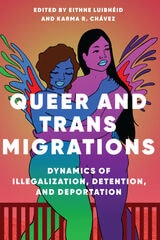
Queer and Trans Migrations
Dynamics of Illegalization, Detention, and DeportationEdited by Eithne Luibheid and Karma R. Chavez
University of Illinois Press, 2020
Bridging voices and works from inside and outside of the academy, and international in scope, Queer and Trans Migrations illuminates new perspectives in the field of queer and trans migration studies.
Contributors: Andrew J. Brown, Julio Capó, Jr., Anna Carastathis, Jack Cáraves, Karma R. Chávez, Ryan Conrad, Elif, Katherine Fobear, Monisha Das Gupta, Jamila Hammami, Edward Ou Jin Lee, Leece Lee-Oliver, Eithne Luibhéid, Hana Masri, Yasmin Nair, Bamby Salcedo, Fadi Saleh, Rafael Ramirez Solórzano, José Guadalupe Herrera Soto, Myrto Tsilimpounidi, Suyapa Portillo Villeda, Sasha Wijeyeratne, Ruben Zecena

Queer in Russia
A Story of Sex, Self, and the OtherLaurie Essig
Duke University Press, 1999
While male homosexual acts were criminalized in Russia before 1993, women attracted to women were policed by the medical community, who saw them less as criminals than as diseased persons potentially cured by drug therapy or transsexual surgery. After describing accounts of pre-perestroika persecution, Essig examines the more recent state of sexual identities in Russia. Although the fall of communism brought new freedom to Russian queers, there are still no signs of a mass movement forming around the issue, and few identify themselves as lesbians or gay men, even when they are involved in same-sex relations. Essig does reveal, however, vibrant manifestations of gay life found at the local level—in restaurants, discos, clubs, and cruising strips, in newspapers, journals, literature, and the theater. Concluding with a powerful exploration of the surprising affinities between some of Russia’s most prominent nationalists and its queers, Queer in Russia fills a gap in both Russian and cultural studies.
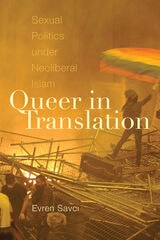
Queer in Translation
Sexual Politics under Neoliberal IslamEvren Savci
Duke University Press, 2021

Queer in a Legal Sense
Brown Citizenship and Other Lawful FictionsJosé A. de la Garza Valenzuela
University of Texas Press, 2026
Contrasting works by queer Chicano writers against the legal landscape of sexuality and migration to interrogate the “lawful fiction” that denies queer migrants citizenship and community.
Activists for immigrants and queer people under assault by US authorities focus overwhelmingly on protections presumed to be afforded by citizenship through narratives that have rarely had a place for queer immigrants, who have consistently faced special obstacles to legal entry and citizenship that only recently are being applied more widely. Queer in a Legal Sense studies literary works by gay Chicanx writers alongside instruments of law, showing through this juxtaposition how racialized queer people have been imagined as nonviable from the standpoint of citizenship. In stories by John Rechy, Arturo Islas, Rigoberto González, Michael Nava, and Jaime Cortez, José de la Garza Valenzuela finds what has gone missing in the migrant movement’s pursuit of gendered avenues to civic participation. Further, these works illuminate the production of fictions in canons of law, like those announced by the Florida legislature’s “Purple Pamphlet” and by the US Supreme Court in Boutilier v. INS and Bowers v. Hardwick. Queer in a Legal Sense argues that, through selective ommissions and inclusions, legal fictions place queerness outside the boundaries of citizenship and powerfully undermine queer representation in pro-migrant advocacy.
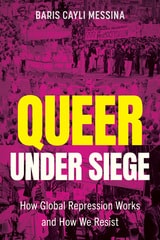
Queer under Siege
How Global Repression Works and How We ResistBaris Cayli Messina
Temple University Press, 2027
Queer Under Siege reveals that collective repression is not only a global system, but also a moral process that shapes how people tolerate (and even justify) exclusion and oppression. Baris Cayli Messina probes the question of what kind of society sustains its morality by expelling those who are already most vulnerable? and interrogates why societies continually generate the conditions that produce repression, requiring the unyielding struggle of queer people to survive.
Cayli Messina draws on archives, court records, suicide letters, and activist testimony from the around the world to develop a conceptual framework to trace this process through three interlocking forms and mechanisms: moral eviction, which defines moral repression; punitive hypervisibility, which animates political repression; and sanctioned oblivion, which consolidates epistemic repression.
Queer Under Siege shows that the criminalization of queer life is not a misfire, but an intentional and systematic action that makes disparate societies perceive social order as safe. Arguing that survival is a political act across borders and generations, Cayli Messina traces effective methods of queer activism.
Queer, Women of Color, and Critical Approaches to Feminist Mentorship and Pedagogy
Edited by Leandra H. Hernández, Stevie M. Munz, and Jessica Pauly
University of Illinois Press, 2025
The first section draws upon the contributors’ unique and situated experiences of mentorship in academia. Essays explore their past and current experiences with feminist mentorship in relationships that take many forms: faculty members with fellow faculty members; faculty members with undergraduate and graduate students; and faculty members who feel as if they have become family with their mentors and mentees. In the second section, the contributors deeply interrogate the practices of feminist mentoring by problematizing practices and offering new ways, places, and formats that make space and consider new possibilities. A conclusion reflects on the future of feminist mentorship amidst contemporary debates and concerns in higher education.
Enriching and hopeful, Queer, Women of Color, and Critical Approaches to Feminist Mentorship and Pedagogy is a much-needed challenge to traditional forms of mentorship.

Queer/Early/Modern
Carla Freccero
Duke University Press, 2006
Combining feminist theory, queer theory, psychoanalysis, deconstruction, and literary criticism, Freccero takes up a series of theoretical and historical issues related to debates in queer theory, feminist theory, the history of sexuality, and early modern studies. She juxtaposes readings of early and late modern texts, discussing the lyric poetry of Petrarch, Louise Labé, and Melissa Ethridge; David Halperin’s take on Michel Foucault via Apuleius’s The Golden Ass and Boccaccio’s Decameron; and France’s domestic partner legislation in connection with Marguerite de Navarre’s Heptameron. Turning to French cleric Jean de Léry’s account, published in 1578, of having witnessed cannibalism and religious rituals in Brazil some twenty years earlier and to the twentieth-century Brandon Teena case, Freccero draws on Jacques Derrida’s concept of spectrality to propose both an ethics and a mode of interpretation that acknowledges and is inspired by the haunting of the present by the past.
Queer/Migration, Volume 14
Eithne Luibhéid ,spec issue ed
Duke University Press, 0
The issue, featuring essays by both established and emerging scholars, situates queer migration within global processes of colonization, globalization, capitalism, nationalism, and slavery. One contributor argues that a queer Atlantic history emerged during the Middle Passage experience of slavery, connecting this history to the contemporary movement of Haitian refugees and Dominican migrant laborers. Another contributor considers how the policing of queer migrant bodies and of “unnatural offenses” by colonial administrations in the Nicobar and Andaman islands ultimately reconfigured the ecology of the entire Indian Ocean archipelago. Still another contributor theorizes how gay couples composed of young Asian émigrés and considerably older white citizens negotiate Australian immigration policy to subvert dominant forms of nationalism and citizenship embedded in long histories of inequality between Australia and Asia. Other essays explore how transgender histories and theories transform queer migration scholarship; how “queer complicities” with contemporary neoliberal migration politics uphold regimes of violence and inequality; and how migration regimes and settlement policies in various parts of the world identify individuals as “queer,” “deviant,” or “abnormal” within racial, gender, class, cultural, and geopolitical hierarchies.
Contributors. Bobby Benedicto, Carlos Ulises Decena, Kale Bantigue Fajardo, Maja Horn, Adi Kuntsman, Eithne Luibhéid, Clare Sears, Omise’eke Natasha Tinsley, Kath Weston, Audrey Yue
Queer/Tongzhi China
New Perspectives on Research, Activism and Media CulturesEdited by Elisabeth L. Engebretsen and William F. Schroeder
National University of Singapore Press, 2015
Queerbaiting and Fandom
Teasing Fans through Homoerotic PossibilitiesJoseph Brennan
University of Iowa Press, 2019
In this first-ever comprehensive examination of queerbaiting, fan studies scholar Joseph Brennan and his contributors examine cases that shed light on the sometimes exploitative industry practice of teasing homoerotic possibilities that, while hinted at, never materialize in the program narratives. Through a nuanced approach that accounts for both the history of queer representation and older fan traditions, these essayists examine the phenomenon of queerbaiting across popular TV, video games, children’s programs, and more.
Contributors: Evangeline Aguas, Christoffer Bagger, Bridget Blodgett, Cassie Brummitt, Leyre Carcas, Jessica Carniel, Jennifer Duggan, Monique Franklin, Divya Garg, Danielle S. Girard, Mary Ingram-Waters, Hannah McCann, Michael McDermott, E. J. Nielsen, Emma Nordin, Holly Eva Katherine Randell-Moon, Emily E. Roach, Anastasia Salter, Elisabeth Schneider, Kieran Sellars, Isabela Silva, Guillaume Sirois, Clare Southerton
Queering Black Atlantic Religions
Transcorporeality in Candomblé, Santería, and VodouRoberto Strongman
Duke University Press, 2019
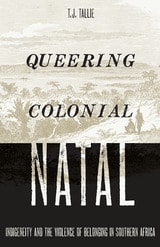
Queering Colonial Natal
Indigeneity and the Violence of Belonging in Southern AfricaT. J. Tallie
University of Minnesota Press, 2019
How were indigenous social practices deemed queer and aberrant by colonial forces?
In Queering Colonial Natal, T.J. Tallie travels to colonial Natalestablished by the British in 1843, today South Africa’s KwaZulu-Natal provinceto show how settler regimes “queered” indigenous practices. Defining them as threats to the normative order they sought to impose, they did so by delimiting Zulu polygamy; restricting alcohol access, clothing, and even friendship; and assigning only Europeans to government schools.
Using queer and critical indigenous theory, this book critically assesses Natal (where settlers were to remain a minority) in the context of the global settler colonial project in the nineteenth century to yield a new and engaging synthesis. Tallie explores the settler colonial history of Natal’s white settlers and how they sought to establish laws and rules for both whites and Africans based on European mores of sexuality and gender. At the same time, colonial archives reveal that many African and Indian people challenged such civilizational claims.
Ultimately Tallie argues that the violent collisions between Africans, Indians, and Europeans in Natal shaped the conceptions of race and gender that bolstered each group’s claim to authority.
Queering Gay and Lesbian Studies
Thomas Piontek
University of Illinois Press, 2005
In this pioneering new study, Thomas Piontek provides a critical analysis of the development of gay and lesbian studies alongside the development of queer theory, the disputes between them, and criticism of their activities from both in and outside of the gay academic community. Examining disputes about transgendering, gay male promiscuity, popular culture, gay history, political activism, and non-normative sexual practices, Piontek argues that it is vital to queer gay and lesbian studies--opening this emerging discipline to queer critical interventions without, however, further institutionalizing queer theory.

Queering Marriage
Challenging Family Formation in the United StatesKimport, Katrina
Rutgers University Press, 2013
Co-Winner of the 2015 Charles Tilly Award for Best Book of the Collective Behavior and Social Movements section from the American Sociological Association
Over four thousand gay and lesbian couples married in the city of San Francisco in 2004. The first large-scale occurrence of legal same-sex marriage, these unions galvanized a movement and reignited the debate about whether same-sex marriage, as some hope, challenges heterosexual privilege or, as others fear, preserves that privilege by assimilating queer couples.
In Queering Marriage, Katrina Kimport uses in-depth interviews with participants in the San Francisco weddings to argue that same-sex marriage cannot be understood as simply entrenching or contesting heterosexual privilege. Instead, she contends, these new legally sanctioned relationships can both reinforce as well as disrupt the association of marriage and heterosexuality.
During her deeply personal conversations with same-sex spouses, Kimport learned that the majority of respondents did characterize their marriages as an opportunity to contest heterosexual privilege. Yet, in a seeming contradiction, nearly as many also cited their desire for access to the normative benefits of matrimony, including social recognition and legal rights. Kimport’s research revealed that the pattern of ascribing meaning to marriage varied by parenthood status and, in turn, by gender. Lesbian parents were more likely to embrace normative meanings for their unions; those who are not parents were more likely to define their relationships as attempts to contest dominant understandings of marriage.
By posing the question—can queers “queer” marriage?—Kimport provides a nuanced, accessible, and theoretically grounded framework for understanding the powerful effect of heterosexual expectations on both sexual and social categories.
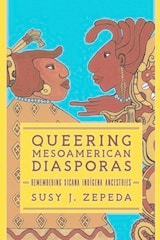
Queering Mesoamerican Diasporas
Remembering Xicana Indigena AncestriesSusy J. Zepeda
University of Illinois Press, 2022
A fascinating exploration of hidden Indígena histories and silences, Queering Mesoamerican Diasporas blends scholarship with spirit practices to reimagine the root work, dis/connection to land, and the political decolonization of Xicana/x peoples.
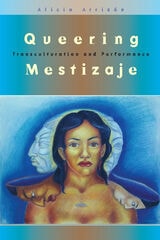
Queering Mestizaje
Transculturation and PerformanceAlicia Arrizón
University of Michigan Press, 2006
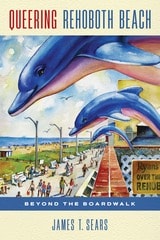
Queering Rehoboth Beach
Beyond the BoardwalkJames T. Sears
Temple University Press, 2024
Sears draws upon extensive oral history accounts, archival material, and personal narratives to chronicle “the Battle for Rehoboth,” which unfolded in the late 20th century, as conservative town leaders and homeowners opposed progressive entrepreneurs and gay activists. He recounts not just the emergence of the gay and lesbian bars, dance clubs, and organizations that drew the queer community to the region, but also the efforts of local politicians and homeowners, among other groups who fought to develop and protect the traditional identity of this beach town. Moreover, issues of race, class, and gender and sexuality informed opinions as residents and visitors struggled with the AIDS crisis and the legacy of Jim Crow.
Queering Rehoboth Beach is more than just an inspiring story about a community’s resilience and determination to establish a safe space for itself in the wake of the era of Don’t Ask, Don’t Tell. It is also a terrific beach read.

Queering Reproduction
Achieving Pregnancy in the Age of TechnoscienceLaura Mamo
Duke University Press, 2007
Mamo provides an overview of a shift within some lesbian communities from low-tech methods of self-insemination to a reliance on outside medical intervention and fertility treatments. Reflecting on the issues facing lesbians who become parents through assisted reproductive technologies, Mamo explores questions about the legal rights of co-parents, concerns about the genetic risks of choosing an anonymous sperm donor, and the ways decisions to become parents affect sexual and political identities. In doing so, she investigates how lesbians navigate the medical system with its requisite range of fertility treatments, diagnostic categories, and treatment trajectories. Combining moving narratives and insightful analysis, Queering Reproduction reveals how medical technology reconfigures social formations, individual subjectivity, and notions of kinship.