Results by title
313 books match the query 'Administration' and 14 start with r
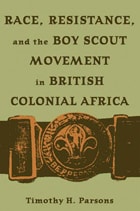
Race, Resistance, and the Boy Scout Movement in British Colonial Africa
In British Colonial AfricaTimothy H. Parsons
Ohio University Press, 2004
Conceived by General Sir Robert Baden-Powell as a way to reduce class tensions in Edwardian Britain, scouting evolved into an international youth movement. It offered a vision of romantic outdoor life as a cure for disruption caused by industrialization and urbanization. Scouting’s global spread was due to its success in attaching itself to institutions of authority. As a result, scouting has become embroiled in controversies in the civil rights struggle in the American South, in nationalist resistance movements in India, and in the contemporary American debate over gay rights.
In Race, Resistance, and the Boy Scout Movement in British Colonial Africa, Timothy Parsons uses scouting as an analytical tool to explore the tensions in colonial society. Introduced by British officials to strengthen their rule, the movement targeted the students, juvenile delinquents, and urban migrants who threatened the social stability of the regime. Yet Africans themselves used scouting to claim the rights of full imperial citizenship. They invoked the Fourth Scout Law, which declared that a scout was a brother to every other scout, to challenge racial discrimination.
Parsons shows that African scouting was both an instrument of colonial authority and a subversive challenge to the legitimacy of the British Empire. His study of African scouting demonstrates the implications and far-reaching consequences of colonial authority in all its guises.
Rank-and-File Rebels
Theories of Power and Change in the 2018 Education StrikesErin Dyke
University Press of Colorado, 2024

Rare Books and Special Collections
Sidney E. Berger
American Library Association, 2014
Rebuilding Trust
Clergy Morale in the Wake of the Abuse CrisisBrandon Vaidyanathan
Catholic University of America Press, 2025
Records and Information Management
Patricia C. Franks
American Library Association, 2018
As Information Management put it, "On the strength of its currency and coverage alone, Franks' book is poised to take over as the recommended go-to reference for both students and RIM professionals for many years to come.” The new second edition cements this work’s status as an up-to-date classic, its content updated and expanded to address emerging technologies, most notably blockchain, and evolving standards and practices. Inside, Franks presents complete coverage of the records and information lifecycle model, encompassing paper, electronic (databases, office suites, email), and new media records (blogs, chat messages, and software as a service). Informed by an advisory board of experts in the field and with contributions by noted authorities, the text addresses such key topics as
- the origins and development of records and information;
- the discipline of information governance and developing a strategic records management plan;
- creation/capture and classification;
- retention strategies, inactive records management, archives, and long-term preservation;
- access, storage, and retrieval;
- electronic records and electronic records management systems;
- the latest on rapidly evolving technologies such as web records, social media, and mobile devices;
- vital records, disaster preparedness and recovery, and business continuity;
- monitoring, auditing, and risk management; and
- education and training.
This book’s authoritative blend of theory and practice makes it a matchless resource for everyone in the archives and records management field. Instructor/trainer extras include a set of ready-to-go, customizable PowerPoint slides to accompany the text.
Records and Information Management
Patricia C. Franks
American Library Association, 2013
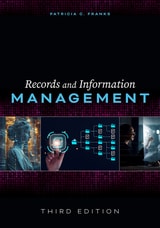
Records and Information Management
Third EditionPatricia C. Franks
American Library Association, 2025
Widely acknowledged as the benchmark text for both students and RIM professionals ("extremely comprehensive and accessible," raves Archival Issues) the new third edition updates its authoritative blend of theory and practice to reflect the field’s dynamically evolving environment, including the rapid rise of applications powered by AI/ML. Franks presents complete coverage of the records and information lifecycle model, encompassing paper, electronic (databases, office suites such as Microsoft 365, and email), and new media records (blogs, chat messages, and software as a service), while acknowledging the influence of emerging and developing technologies and encouraging new ways of meeting the resulting challenges. In this book, enhanced with supplemental contributions from a wide range of thought leaders and practitioners, readers will explore such keys topics as
- the latest advances in disruptive technologies, including blockchain, Web3, the metaverse, and evolving digital communication tools such as enterprise social media;
- an overview of the origins and development of records and information management;
- the discipline of information governance and the steps to develop a strategic records and information management plan;
- a completely new chapter that demystifies data governance, automation, and AI;
- strategies for the creation/capture and classification of records and information;
- approaches to retention strategies, inactive records management, archives, and long-term digital preservation;
- methods for access, storage, and retrieval of records and information;
- insight into electronic records and electronic records management systems;
- practices for safeguarding essential records, including disaster preparedness, recovery, and business continuity;
- approaches to monitoring, auditing, privacy, security, and risk management;
- fresh discussion of the leadership and management skills required of RIM professionals; and
- expert guidance on trendspotting, education, and training.
Requirements for Certification of Teachers, Counselors, Librarians, Administrators for Elementary and Secondary Schools, Eighty-Ninth Edition, 2024–2025
Edited by Alain Park
University of Chicago Press, 2024
This annual volume offers the most complete and current listings of the requirements for certification of a wide range of educational professionals at the elementary and secondary levels. Requirements for Certification is a valuable resource, making much-needed knowledge available in one straightforward volume.
Requirements for Certification of Teachers, Counselors, Librarians, Administrators for Elementary and Secondary Schools, Ninetieth Edition, 2025–2026
Edited by Alain Park
University of Chicago Press, 2025
This annual volume offers the most complete and current listings of the requirements for certification of a wide range of educational professionals at the elementary and secondary levels. Requirements for Certification is a valuable resource, making much-needed knowledge available in one straightforward volume.
Requirements for Certification of Teachers, Counselors, Librarians, Administrators for Elementary and Secondary Schools, Ninety-First Edition, 2026–2027
Edited by Alain Park
University of Chicago Press, 2026
The authoritative annual guide to the requirements for certification of teachers.
This annual volume offers the most complete and current listings of the requirements for certification of a wide range of educational professionals at the elementary and secondary levels. Requirements for Certification is a valuable resource, making much-needed knowledge available in one straightforward volume.

Requirements for Certification of Teachers, Counselors, Librarians, and Administrators for Elementary and Secondary Schools, 2001-2002
Edited by Elizabeth A. Kaye
University of Chicago Press, 2001
Responding to Rapid Change in Libraries
A User Experience ApproachLauren Stara and Callan Bignoli
American Library Association, 2020
In the face of rapid change and an ever-widening constellation of challenges, it’s crucial for library leaders to pull back to the question of “why?” Plotting a sustainable way forward depends upon recommitting ourselves to our underlying values, such as customer service and community-building, while fostering the improvements that change makes possible. With passion, patience, and fortitude, libraries can stride confidently into the future. In this book, noted speakers and consultants Bignoli and Stara speak directly to library directors, managers, administrators, and technology staff, offering concrete guidance on setting or resetting strategic priorities. Taking an interconnected and specific approach to planning for and strengthening the library environment as a whole, their book
- discusses why libraries should embrace change as a fundamental part of library life;
- explores how to harness rapid change to provide more responsive, user-centered library service;
- addresses the ways in which libraries straddle the physical and the digital, in areas such as service provision and collections, illuminating how they overlap and can be improved using similar philosophies;
- presents both a comprehensive overview of library technologies as well as related team and change management advice, all grounded in user experience principles;
- shows how the concepts of sustainability and flexibility apply to physical space planning and design, from furniture selection and arrangement to infrastructure; and
- provides sound guidance on project management, problem solving, preparing for future challenges, personal reflection and self-care, and other leadership topics.
Rio del Norte
People of Upper Rio Grande from Earliest Times to Pueblo RevoltCarroll L. Riley
University of Utah Press, 1995
Rio del Norte chronicles the upper Rio Grande region and its divers peoples across twelve thousand years of continuous history. Based on the most up-to-date historical and archaeological research, Rio del Norte is a tour de force, highlighting the unbroken history of the upper Rio Grande.
Beginning with the mammoth hunters of eleven millennia ago, Carroll Riley adeptly eaves the threads of twelve thousand years of continuous history through the introduction of agriculture, the rise of the Basketmaker-Pueblo (Anasazi) people, and the extraordinary "quickening" that occurred along the Rio Grande and its tributaries as the Anasazi era ended.
At that time large towns appeared, some holding several thousand people who practiced irrigation-based agriculture, maintained complex social and political organizations, and had a rich artistry. This "golden age" was continuing when Spaniards contacted, then colonized and missionized the region. In 1680 the Pueblos joined in a powerful record and ousted the invaders. Although the Spanish returned, the Pueblos have maintained important parts of their cultural heritage to the present.
Running a Small Library
John A. Moorman
American Library Association, 2015