Results by title
471 books match the query 'Aesthetics' and 22 start with r
Rancière's Sentiments
Davide Panagia
Duke University Press, 2018
Reading Zen in the Rocks
The Japanese Dry Landscape GardenFrançois Berthier
University of Chicago Press, 2005
Berthier's guided tour of the famous garden of Ryoanji (Temple) in Kyoto leads him into an exposition of the genre, focusing on its Chinese antecedents and affiliations with Taoist ideas and Chinese landscape painting. He traces the roles of Shinto and Zen Buddhism in the evolution of the garden and also considers how manual laborers from the lowest classes in Japan had a hand in creating some of its highest examples. Parkes contributes an equally original and substantive essay which delves into the philosophical importance of rocks and their "language of stone," delineating the difference between Chinese and Japanese rock gardens and their relationship to Buddhism. Together, the two essays compose one of the most comprehensive and elegantly written studies of this haunting garden form.
Reading Zen in the Rocks is fully illustrated with photographs of all the major gardens discussed, making it a handsome addition to the library of anyone interested in gardening, Eastern philosophy, and the combination of the two that the karesansui so superbly represents.
Praise for the French edition:
"A small book of rare depth, remarkably illustrated, on one of the most celebrated and beautiful rock gardens of the monasteries of Kyoto."—L'Humanité
"Through Le Jardin de Ryoanji, Berthier teaches us to read the zen in the rocks, to discover the language offered by the garden at Ryoanji. Enigmatic, poetic, and disconcerting, an enriching journey through a work of art of surprising modernity, Le Jardin de Ryoanji is a work that will interest all the amateurs of Japanese art and Eastern philosophy."—Lien Horticole
Reading the Figural, or, Philosophy after the New Media
D. N. Rodowick
Duke University Press, 2001
To fully comprehend the emergence of the figural requires a genealogical critique of the aesthetic, Rodowick claims. Seeking allies in this effort to deconstruct the opposition of word and image and to create new concepts for comprehending the figural, he journeys through a range of philosophical writings: Thierry Kuntzel and Marie-Claire Ropars-Wuilleumier on film theory; Jacques Derrida on the deconstruction of the aesthetic; Siegfried Kracauer and Walter Benjamin on the historical image as a utopian force in photography and film; and Gilles Deleuze and Michel Foucault on the emergence of the figural as both a semiotic regime and a new stratagem of power coincident with the appearance of digital phenomena and of societies of control.
Scholars of philosophy, film theory, cultural criticism, new media, and art history will be interested in the original and sophisticated insights found in this book.
Recursive Desire
Rereading Epic TraditionJeremy M. Downes
University of Alabama Press, 1997
A groundbreaking rethinking of epic tradition through recursive literary analysis.
Epic has often been seen as a dead genre, intrinsically patriarchal and nationalistic. Furthermore, the psychological model most frequently applied to the relations between poets has been a violent one--the Freudian masterplot of Oedipus slaying the father to possess the mother. The limited usefulness of such simplistic explanations of epic is readily apparent when confronted with the continuing production of epic poetry long after its so-called death; when confronted with the contemporary drive toward epic among women poets, people of color, and postcolonial poets; and when faced with epic's fundamentally recursive desire--obvious in oral epic, but common to the entire genre--to repeat rather than to kill or evade its precursors.
Recursive desire, rooted in more basic preoedipal negotiations of union and separation rather than in Oedipal conflict, provides an elegant and far more useful explanation. By rereading and substantially redefining epic in this way, this book recognizes and reinvests with meaning the vital recursive qualities of the genre. Examining a diverse array of texts from the Epic of Gilgamesh to Derek Walcott's Osmeros, from the Homeric epics to H.D.'s Helen in Egypt. The book develops a broadened, inclusive, and living tradition of epic poetry, demonstrating the continuities of that tradition across dramatic discontinuities in time, place, worldview, and technology.
Recursive Desire rereads epic tradition and specific epic poems in ways that challenge traditional notions of the genre and open up unexplored fields of endeavor to students of epic, of poetry, and of narrative. With its more powerful and comprehensive psychological model of poetic relations, the book provides readers with a new understanding of epic poetry and its vital, shifting, polyvocal array (and disarray) of textual forces.

Reframing Reality
The Aesthetics of the Surrealist Object in French and Czech CinemaAlison Frank
Intellect Books, 2013
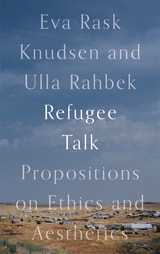
Refugee Talk
Propositions on Ethics and AestheticsEva
Pluto Press, 2022
An innovative approach to the refugee crisis through a focus on language use, discourse and representation
'A wide-ranging, erudite and multi-faceted analyses of the fundamental problem of who gets to be counted as human' - Kate Evans
What does it mean to be a refugee? What political questions do they raise? Through what political rhetoric is their experiences parsed? The ongoing refugee crisis has sparked all these questions and more.
Refugee Talk uses conversation as a research method and ethical practice to approach the representation of and the discourse about and by the refugee. Though refugees who cross borders are routinely registered, filed, and detained, the individual stories they carry are just as routinely overlooked or ignored. When language itself becomes another border that excludes refugees, the need for a new vocabulary that decriminalizes and re-humanizes the refugee experience asserts itself.
The authors engage theoretically with thinkers from Hannah Arendt to Paolo Freire and Kwame A. Appiah and structure the book around conversations with academics, activists, journalists, and refugee artists and writers. The result is a comprehensive humanities approach that places ethics and aesthetics at its core.
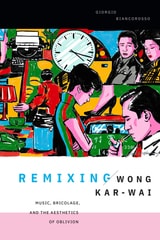
Remixing Wong Kar-wai
Music, Bricolage, and the Aesthetics of OblivionGiorgio Biancorosso
Duke University Press, 2025
Res
Anthropology and Aesthetics, volume 75-76 number 1 (2021)The University of Chicago Press
University of Chicago Press Journals, 2021
Res
Anthropology and Aesthetics, volume 77-78 number 1 (2022)The University of Chicago Press
University of Chicago Press Journals, 2022
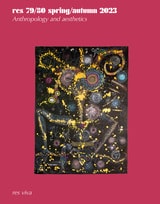
Res
Anthropology and Aesthetics, volume 79-80 number 1 (2023)The University of Chicago Press
University of Chicago Press Journals, 2023
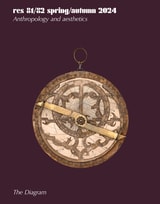
Res
Anthropology and Aesthetics, volume 81-82 number 1 (2024)The University of Chicago Press
University of Chicago Press Journals, 2024
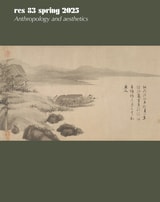
Res
Anthropology and Aesthetics, volume 83 number 1 (2025)The University of Chicago Press
University of Chicago Press Journals, 2025
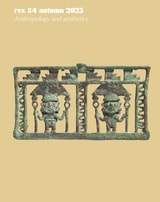
Res
Anthropology and Aesthetics, volume 84 number 1 (Autumn 2025)The University of Chicago Press
University of Chicago Press Journals, 2025
Res
Anthropology and Aesthetics, volume 85 number 1 (Spring 2026)The University of Chicago Press
University of Chicago Press Journals, 2026
Rethinking Borders
John Welchman
University of Minnesota Press, 1996
Reverberations across Small-Scale British Theatre
Politics, Aesthetics and FormsEdited by Patrick Duggan and Victor Ukaegbu
Intellect Books, 2013
Rhetorical Homologies
Form, Culture, ExperienceBarry Brummett
University of Alabama Press, 2009
A highly developed study of the relationships between rhetoric and public culture.
One of the most widely used ideas in scholarship of the humanities and social sciences is that of homology: a formal pattern structuring different kinds of texts, ideas, and experiences. Rhetorical Homologies explores the central meaning of this form in a variety of discourses and also examines the kind of homologies that shape audience responses to personal, public, and political issues. Barry Brummett is most interested in homologies among very different orders of experience and texts: experiences on the battlefield that are homologous to those at a dining room table, for instance. What the common patterns that underlie such cases mean, why they are interesting, and why homology is rhetorical are the subjects of this study.
Brummett focuses on a wide range of topics, from the homologies between rhetoric and weapons throughout history to the homology of ritual injuries as manifested in representations of Christian martyrs, Laurel and Hardy films, the African-American practice of playing the dozens, and televised professional wrestling. Brummett also explores the homology of the Wise Woman, using rhetorical representations of Sojourner Truth and Oprah Winfrey. In a concluding chapter, Brummett argues that the idea of homology is important in understanding how social life is organized in general and that the centrality of discourse in organizing experience makes rhetorical homologies an important perspective for general knowledge beyond the boundaries of this study.
Rhythm and Noise
An Aesthetics of RockTheodore Gracyk
Duke University Press, 1996
What’s in a name? “Rock” or “Rock ’n’ Roll?” Grayck argues that rock and roll is actually a performance style, one in a number of musical styles comprising rock. What distinguishes rock, Gracyk tells us, is how it is mediated by technology: The art is in the recording. The lesson is a heady one, entailing a tour through the history of rock music from Elvis Presley’s first recordings in 1954 to Kurt Cobain’s suicide in 1994. Gracyk takes us through key recordings, lets us hear what rock musicians and their critics have to say, shows us how other kinds of music compare, and gives us the philosophical background to make more than passing sense of the medium. His work takes up the common myths and stereotypes about rock, popular and academic, and focuses on the features of the music that electrify fans and consistently generate controversy. When Elvis came to town, did southern sheriffs say that rock was barbaric and addictive? Well so did Theodor Adorno, in his way, and Allan Bloom, in his, and Gracyk takes aim at this charge as it echoes through the era of recorded music. He looks at what rock has to do with romanticism and, even more, with commercialism. And he questions the orthodoxy of making grand distinctions between “serious” and “popular” art.
Keenly attuned to the nuances of music and of all the ways that we can think about it, this exhilarating book tunes us in, as no other has, to the complex role of rock in American culture.
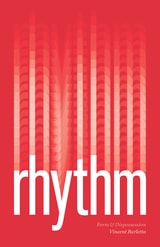
Rhythm
Form and DispossessionVincent Barletta
University of Chicago Press, 2020
Vincent Barletta explores rhythm through three historical moments, each addressing it as a phenomenon that transcends poetry, aesthetics, and even temporality. He reveals rhythm to be a power that holds us in place, dispossesses us, and shapes the foundations of our world. In these moments, Barletta encounters rhythm as a primordial and physical binding force that establishes order and form in the ancient world, as the anatomy of lived experience in early modern Europe, and as a subject of aesthetic and ethical questioning in the twentieth century.
A wide-ranging book covering a period spanning two millennia and texts from over ten languages, Rhythm will expand the conversation around this complex and powerful phenomenon.
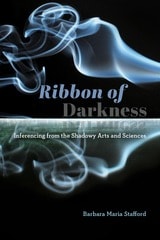
Ribbon of Darkness
Inferencing from the Shadowy Arts and SciencesBarbara Maria Stafford
University of Chicago Press, 2019
Stafford organizes these essays around three concepts that structure the book: inscrutability, ineffability, and intuitability. All three, she explains, allow us to examine how both the arts and the sciences imaginatively infer meaning from the “veiled behavior of matter,” bringing these historically divided subjects into a shared intellectual inquiry and imbuing them with an ethical urgency. A vanguard work at the intersection of the arts and sciences, this book will be sure to guide readers from either realm into unfamiliar yet undeniably fertile territory.
Richer Entanglements
Essays and Notes on Poetry and PoemsGregory Orr
University of Michigan Press, 1993
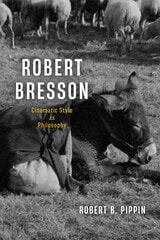
Robert Bresson
Cinematic Style as PhilosophyRobert B. Pippin
University of Chicago Press, 2026
Over a forty-year career, Robert Bresson developed one of the most distinctive cinematic styles in the history of filmmaking. Criticizing conventional movies as “filmed theater,” Bresson proposed instead a way of writing with images, which he called “cinematographs.” Robert B. Pippin argues here for a way of understanding how these stylistic innovations express a range of philosophical commitments, explorations of the possible sources of meaning in late modern life, and the implications of the absence of such sources.