Results by title
297 books match the query 'Alabama' and 11 start with r

Race, Class, and Power in the Alabama Coalfields, 1908-21
Brian Kelly
University of Illinois Press, 2001
Racial Union
Law, Intimacy, and the White State in Alabama, 1865-1954Julie Novkov
University of Michigan Press, 2008
In November 2001, the state of Alabama opened a referendum on its long-standing constitutional prohibition against interracial marriage. A bill on the state ballot offered the opportunity to relegate the state's antimiscegenation law to the dustbin of history. The measure passed, but the margin was alarmingly slim: more than half a million voters, 40 percent of those who went to the polls, voted to retain a racist and constitutionally untenable law.
Julie Novkov's Racial Union explains how and why, nearly forty years after the height of the civil rights movement, Alabama struggled to repeal its prohibition against interracial marriage---the last state in the Union to do so. Novkov's compelling history of Alabama's battle over miscegenation shows how the fight shaped the meanings of race and state over ninety years. Novkov's work tells us much about the sometimes parallel, sometimes convergent evolution of our concepts of race and state in the nation as a whole.
"A remarkably nuanced account of interlocked struggles over race, gender, class and state power. Novkov's site is Alabama, but her insights are for all America."
---Rogers M. Smith, Christopher H. Browne Distinguished Professor of Political Science, University of Pennsylvania
"Hannah Arendt shocked Americans in the 1950s by suggesting that interracial intimacy was the true measure of a society's racial order. Julie Novkov's careful, illuminating, powerful book confirms Arendt's judgment. By ruling on who may be sexually linked with whom, Alabama's courts and legislators created a racial order and even a broad political order; Novkov shows us just how it worked in all of its painful, humiliating power."
---Jennifer L. Hochschild, Henry LaBarre Jayne Professor of Government, Professor of African and African American Studies, and Harvard College Professor
Reborn in America
French Exiles and Refugees in the United States and the Vine and Olive Adventure, 1815-1865Eric Saugera, translated by Madeleine Velguth
University of Alabama Press, 2011
Recollections of War Times
By An Old Veteran while under Stonewall Jackson and Lieutenant General James LongstreetWilliam A. McClendon, with an introduction by Keith S. Bohannon
University of Alabama Press, 2010
"Gus" McClendon joined the 15th Alabama Infantry Regiment, and served in many of the Eastern Theater engagements. More than fifty years later, he sent down his reminiscences, still an unreconstructed Southern patriot, although able to look back with some amusement on his younger self.
Reconstructing Tascalusa's Chiefdom
Pottery Styles and the Social Composition of Late Mississippian Communities along the Alabama RiverAmanda L. Regnier
University of Alabama Press, 2014
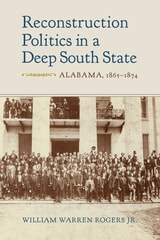
Reconstruction Politics in a Deep South State
Alabama, 1865–1874William Warren Rogers Jr.
University of Alabama Press, 2021
The battle for democracy in reconstruction-era Alabama.
Following the end of the Civil War, white Southerners were forced to concede equal rights to those who had been enslaved, ushering in a new and ruthless brand of politics. Suddenly, the status and place of some four million former slaves dominated the national and regional political dialogue. In Alabama, the Republican Party established itself quickly and powerfully with the participation of a newly freed constituency, firmly aligned against the Democratic Party that had long dictated the governance of the state. Well-heeled planters, merchants, and bankers, joined by yeoman farmers, staged a counterrevolution by gravitating strongly to the Democratic Party and its unabashedly white supremacist measures. The ensuing power struggle in the birthplace of the Confederacy is at the heart of Reconstruction Politics in a Deep South State: Alabama, 1865–1874.
What emerges in William Warren Rogers Jr.’s comprehensive study of the era is a detailed examination of Reconstruction politics, particularly in Alabama. This book explores an explosive and unpredictable political environment that a few years earlier would have been inconceivable. A vivid picture emerges of courthouse rallies and bitter infighting in legislative circles. Rogers’s narrative ventures into darker places as well: to the Tennessee Valley and the Black Belt regions of Alabama, where Klan nightriders used violence against an enemy and ideology they could not abide.
The attempt to capture and account for the unforgiving political landscape created by the extraordinary circumstances of Reconstruction constitutes this study’s most central contribution. Rogers often quotes black and white citizens, Democrats and Republicans. Drawn from newspapers, correspondence, and various federal investigations, these firsthand voices are passionate, unvarnished, and filled with conviction. They offer a startling immediacy and illustrate the temper—or distemper—of the times. Readers are treated to a panoramic unveiling of Reconstruction Alabama politics that provides a sense of what was truly at stake: the values by which a region and the nation as a whole would chart its future for the century to come.
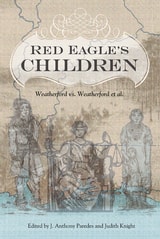
Red Eagle's Children
Weatherford vs. Weatherford et al.Edited by J. Anthony Paredes and Judith Knight
University of Alabama Press, 2012
Tracing identity, law, and legacy in an inheritance dispute that reveals the intersection of two cultural and legal systems: Creek Indian and Euro-American.
In 1846, in the Chancery Court of Mobile, Alabama, William “Red Eagle” Weatherford’s son, by the Indian woman Supalamy, sued his half siblings fathered by Weatherford with two other Creek women, Polly Moniac and Mary Stiggins, for a greater share of Weatherford’s estate. While the court recognized William Jr. as the son of William Sr., he nevertheless lost his petition for inheritance due to the lack of legal evidence concerning the marriage of his biological mother to William Sr. The case, which went to the Alabama Supreme Court in 1851, provides a record of an attempt to interrelate and, perhaps, manipulate differences in cultures as they played out within the ritualized, arcane world of antebellum Alabama jurisprudence.
Although the case has value in the classic mold of salvage ethnography of Creek Indian culture, Red Eagle’s Children, edited by J. Anthony Paredes and Judith Knight, shows that its more enduring value lies in being a source for historical ethnography—that is, for anthropological analyses of cultural dynamics of the past events that complement the narratives of professional historians.
CONTRIBUTORS: David I. Durham / Robbie Ethridge / Judith Knight / J. Anthony Paredes / Paul M. Pruitt Jr. / Nina Gail Thrower / Robert Thrower / Gregory A. Waselkov

Richard Hurdis
A Tale of AlabamaSimms, William Gilmore
University of Arkansas Press, 1995
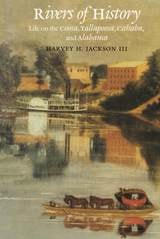
Rivers of History
Life on the Coosa, Tallapoosa, Cahaba, and AlabamaHarvey H. Jackson, III
University of Alabama Press, 1995
An illuminating study of how rivers shaped the history, culture, and environment of Alabama and the American South.
In Rivers of History, acclaimed historian Harvey H. Jackson III blends environmental history with compelling storytelling and traces the evolving relationship between people and rivers—from Indigenous communities who first depended on these waterways, to European settlers, to the development of modern towns and industries. Along the way, readers encounter stories of transportation and trade, conflict and cooperation, ecological change and conservation, all tied to the flow of these essential rivers.
Far more than a geographical study, Rivers of History demonstrates how waterways act as lifelines of human experience. Rivers shaped patterns of settlement, enabled agricultural and economic growth, and served as critical channels for communication across the American South. At the same time, they created challenges—flooding, environmental degradation, and competing demands for natural resources—that continue to influence life in the region today.
Jackson shows how the history of Alabama cannot be understood apart from its rivers. The Coosa, Tallapoosa, Cahaba, and Alabama rivers emerge not simply as physical features on a map, but as powerful forces that connect past and present, nature and society. His interdisciplinary approach—bringing together history, geography, and environmental studies—makes this work especially valuable for students, scholars, and general readers alike.
Accessible yet authoritative, Rivers of History is essential reading for anyone interested in Southern history, environmental change, or the enduring relationship between landscapes and human communities. It offers a compelling reminder that the story of a place is often written in the movement of its waters.
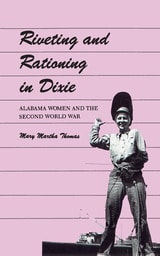
Riveting and Rationing in Dixie
Alabama Women and the Second World WarMary Martha Thomas
University of Alabama Press, 1987
Covers the experience of both black and white Alabama women as defense workers, volunteers, and homemakers. The most important change for women during the war years was their employment in jobs normally held by men, which posed an implicit challenge to traditional notions about femininity and female limitations.
Thomas describes the women employed in the defense industries—how they were recruited and trained, where they worked and under what conditions, and what changes employers made in the workplace to accommodate women, She also discusses the experience of the women who served as volunteers in the Ground Observer Corps, the Citizens’ Service Corps, the Red Cross, and other volunteer agencies. In addition, the author considers how homemakers coped during a time of rationing, housing shortages, lack of schools, and inadequate medical facilities.
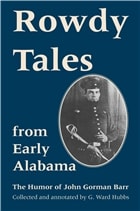
Rowdy Tales from Early Alabama
The Humor of John Gorman BarrJohn Gorman Barr
University of Alabama Press, 1989
The rollicking tales of Old Southwestern humor were a distinctive contribution to American folk culture provided by the frontiersmen of the South and Southwest, a tradition brought to its highest form in the work of Mark Twain. Among the precursors of Twain was John Gorman Barr of Tuscaloosa, Alabama. Like Twain, Barr grew up in a river town, worked in a printing office, and traveled widely; and again like Twain, Barr drew upon the people and places of his home region as the primary sources for his tales.
In addition to the pure entertainment Barr’s stories provide, they also furnish a comprehensive picture of Tuscaloosa and western Alabama in the 1850s—the roaring river town coexisting uneasily with the intellectual sophistication of the recently established University of Alabama.