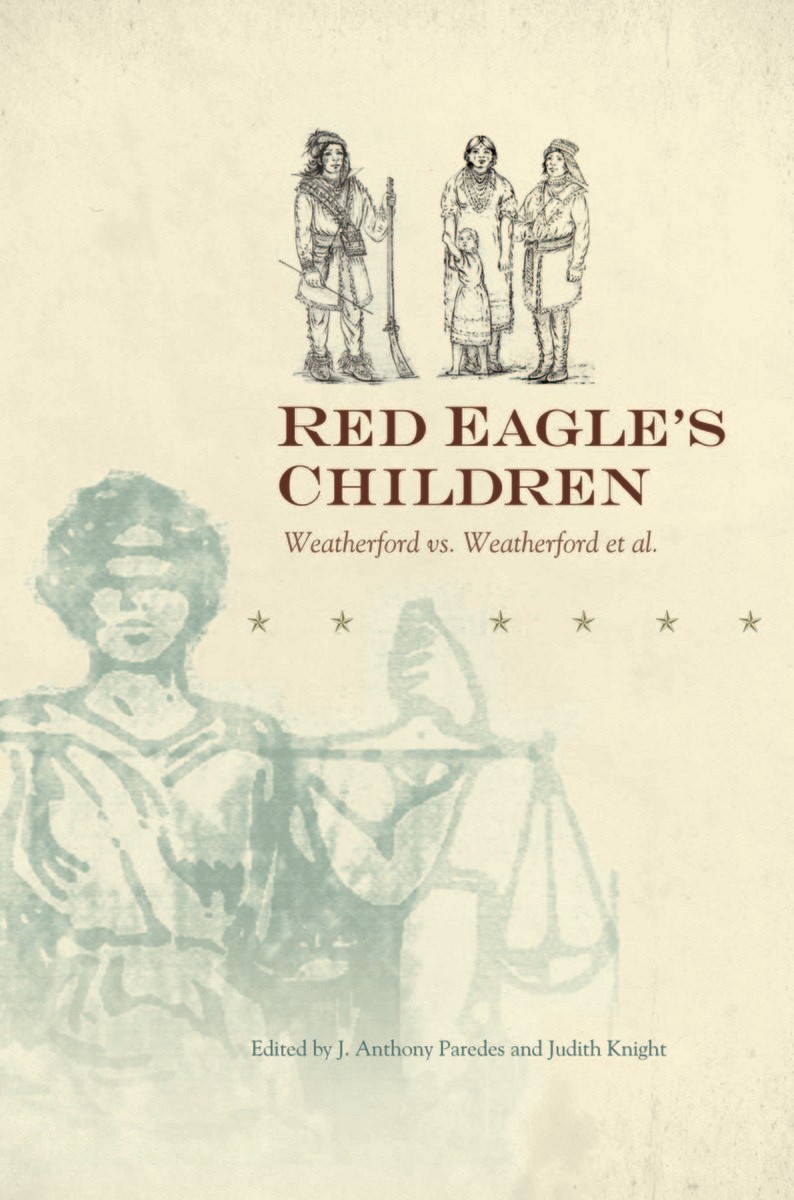
Red Eagle's Children: Weatherford vs. Weatherford et al.
University of Alabama Press, 2012
eISBN: 978-0-8173-8623-8 | Cloth: 978-0-8173-1770-6
Library of Congress Classification KF228.W43R43 2012
Dewey Decimal Classification 346.761052
eISBN: 978-0-8173-8623-8 | Cloth: 978-0-8173-1770-6
Library of Congress Classification KF228.W43R43 2012
Dewey Decimal Classification 346.761052
ABOUT THIS BOOK | AUTHOR BIOGRAPHY | REVIEWS | TOC
ABOUT THIS BOOK
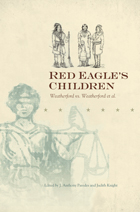
Red Eagle’s Children presents the legal proceedings in an inheritance dispute that serves as an unexpected window on the intersection of two cultural and legal systems: Creek Indian and Euro-American.
Case 1299: Weatherford vs. Weatherford et al. appeared in the Chancery Court of Mobile in 1846 when William “Red Eagle” Weatherford’s son by the Indian woman Supalamy sued his half siblings fathered by Weatherford with two other Creek women, Polly Moniac and Mary Stiggins, for a greater share of Weatherford’s estate. While the court recognized William Jr. as the son of William Sr., he nevertheless lost his petition for inheritance due to the lack of legal evidence concerning the marriage of his biological mother to William Sr. The case, which went to the Alabama Supreme Court in 1851, provides a record of an attempt to interrelate and, perhaps, manipulate differences in cultures as they played out within the ritualized, arcane world of antebellum Alabama jurisprudence.
Although the case has value in the classic mold of salvage ethnography of Creek Indian culture, Red Eagle’s Children, edited by J. Anthony Paredes and Judith Knight, shows that its more enduring value lies in being a source for historical ethnography—that is, for anthropological analyses of cultural dynamics of the past
events that complement the narratives of professional historians.
events that complement the narratives of professional historians.
Contributors
David I. Durham / Robbie Ethridge / Judith
Knight / J. Anthony Paredes / Paul M. Pruitt
Jr. / Nina Gail Thrower / Robert Thrower /
Gregory A. Waselkov
David I. Durham / Robbie Ethridge / Judith
Knight / J. Anthony Paredes / Paul M. Pruitt
Jr. / Nina Gail Thrower / Robert Thrower /
Gregory A. Waselkov
See other books on: Cases | Creek Indians | Domestic relations | Marriage customs and rites | Trials, litigation, etc
See other titles from University of Alabama Press