Results by title
299 books match the query 'Arizona' and 13 start with r
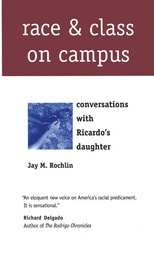
Race and Class on Campus
Conversations with Ricardo’s DaughterJay M. Rochlin
University of Arizona Press, 1997
Here are some insights into the hot issues sparking debate over equal opportunity and American education. In these pages, through the use of a fictional character, author Jay Rochlin presents more than forty very real African American and Mexican American men and women who struggled to earn degrees at a large, nationally recognized university in the west. Their goals, their gains, and their disappointments echo the experiences of millions of others around the country during much of the twentieth century. Perhaps most important, their true stories will provide inspiration to the many young people who wonder whether pursuing the dream of a college education is possible for them.
Readers will warm to the words of Carlos Vélez-Ibáñez, learning as a toddler from his father that the university represented toda la sabiduría del mundo,"all the wisdom in the world." Their hearts will go out to young Laura Banks, barred as a black woman from a "whites only" pool and the swimming class required for her degree in physical education. In the face of open hostility and closed doors, these students and many others persevered. When they were shunned by Anglo social clubs, they created their own. When they were assigned "back of the room" seating because of discrimination, they rose above it. And when their ultimate goal--graduation--was threatened by racism, they fought it.
Looking back, many in the book remember coming from poor families who nonetheless considered themselves middle class and, as such, simply expected their children to go to college. This family support--bolstered by the students' own drive, ambition, and sense of responsibility--seemed to be pivotal to their success. Thus the book comes out strongly on the side of critical race theorists, who emphasize individual effort as a means of combating racism and personal narratives as a way of analyzing the complex issue.
These pages are filled with the voices of everyday men and women. Their language is straightforward and from the heart. Their message is timely, in the midst of current debates over race, class, and affirmative action. And their words--for American education and for the country as a whole--carry force and meaning guaranteed to reach far into the future.
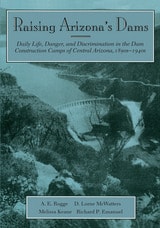
Raising Arizona's Dams
Daily Life, Danger, and Discrimination in the Dam Construction Camps of Central Arizona, 1890s-1940sA. E. Rogge, D. Lorne McWatters, Melissa Keane, and Richard P. Emanuel
University of Arizona Press, 1995
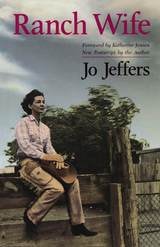
Ranch Wife
Jo Jeffers; Foreword by Katherine Jensen
University of Arizona Press, 1993
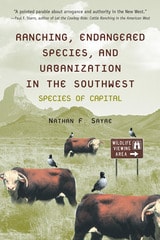
Ranching, Endangered Species, and Urbanization in the Southwest
Species of CapitalNathan F. Sayre
University of Arizona Press, 2002
Nathan Sayre now takes a close look at how the ranching ideal has come into play in the conversion of a large tract of Arizona rangeland from private ranch to National Wildlife Refuge. He tells how the Buenos Aires Ranch, a working operation for a hundred years, became not only a rallying point for multiple agendas in the "rangeland conflict" after its conversion to a wildlife refuge but also an expression of the larger shift from agricultural to urban economies in the Southwest since World War II.
The U.S. Fish and Wildlife Service bought the Buenos Aires Ranch in 1985, removed all livestock, and attempted to restore the land to its "original" grassland in order to protect an endangered species, the masked bobwhite quail. Sayre examines the history of the ranch and the bobwhite together, exploring the interplay of social, economic, and ecological issues to show how ranchers and their cattle altered the land—for better or worse—during a century of ranching and how the masked bobwhite became a symbol for environmentalists who believe that the removal of cattle benefits rangelands and wildlife.
Sayre evaluates both sides of the Buenos Aires controversy—from ranching's impact on the environment to environmentalism's sometimes misguided efforts at restoration—to address the complex and contradictory roles of ranching, endangered species conservation, and urbanization in the social and environmental transformation of the West. He focuses on three dimensions of the Buenos Aires story: the land and its inhabitants, both human and animal; the role of government agencies in shaping range and wildlife management; and the various species of capital—economic, symbolic, and bureaucratic—that have structured the activities of ranchers, environmentalists, and government officials.
The creation of the Buenos Aires National Wildlife Refuge has been a symbolic victory for environmentalists, but it comes at the cost of implicitly legitimizing the ongoing fragmentation and suburbanization of Arizona's still-wild rangelands. Sayre reveals how the polarized politics of "the rangeland conflict" have bound the Fish and Wildlife Service to a narrow, ineffectual management strategy on the Buenos Aires, with greater attention paid to increasing tourism from birdwatchers than to the complex challenge of restoring the masked bobwhite and its habitat. His findings show that the urban boom of the late twentieth century echoed the cattle boom of a century before—capitalizing on land rather than grass, humans rather than cattle—in a book that will serve as a model for restoration efforts in any environment.
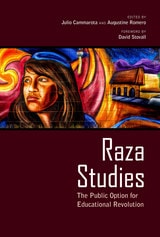
Raza Studies
The Public Option for Educational RevolutionEdited by Julio Cammarota and Augustine Romero; Foreword by David Stovall
University of Arizona Press, 2014
Inspired by Paulo Freire’s vision for critical pedagogy and Chicano activists of the 1960s, the designers of the program believed their program would encourage academic achievement and engagement by Mexican American students. With chapters by leading scholars, this volume explains how the program used “critically compassionate intellectualism” to help students become “transformative intellectuals” who successfully worked to improve their level of academic achievement, as well as create social change in their schools and communities.
Despite its popularity and success inverting the achievement gap, in 2010 Arizona state legislators introduced and passed legislation with the intent of banning MAS or any similar curriculum in public schools. Raza Studies is a passionate defense of the program in the face of heated local and national attention. It recounts how one program dared to venture to a world of possibility, hope, and struggle, and offers compelling evidence of success for social justice education programs.
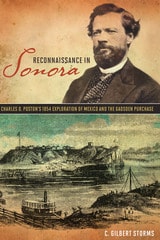
Reconnaissance in Sonora
Charles D. Poston’s 1854 Exploration of Mexico and the Gadsden PurchaseC. Gilbert Storms
University of Arizona Press, 2015
Poston led his party through Sonora and the territory of the 1854 Gadsden Purchase, which today encompasses southern Arizona and a portion of southern New Mexico. The syndicate’s charge to the young adventurer was to acquire land in Mexico in anticipation of the Gadsden Purchase and the building of the transcontinental railroad. Reconnaissance in Sonora details Poston’s expedition, including the founding of the town of Colorado City at the site of present-day Yuma, Arizona.
C. Gilbert Storms explores the American ideas of territorial expansion and Manifest Destiny, the national debate over a route for a transcontinental railroad, the legends of rich gold and silver mines in northern Mexico, and the French and American filibusters that plagued northern Mexico in the early 1850s.
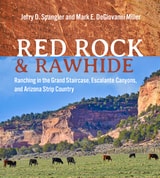
Red Rock and Rawhide
Ranching in the Grand Staircase, Escalante Canyons, and Arizona Strip CountryJerry D. Spangler and Mark E. DeGiovanni Miller
University of Utah Press, 2024
Today, the relatively few cattle ranchers who continue to operate in southern Utah are part of a complex political and social mix of peoples and interests, as Indigenous nations, environmentalists, politicians, and tourists all have differing positions on land use in the region. In Red Rock and Rawhide, Jerry D. Spangler and Mark E. DeGiovanni Miller provide the first comprehensive examination of the history of livestock grazing in the Grand Staircase-Escalante National Monument and surrounding areas, drawing on years of research to show how the culture and industry have changed and continue to evolve.
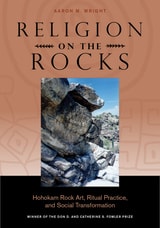
Religion on the Rocks
Hohokam Rock Art, Ritual Practice, and Social TransformationAaron M. Wright
University of Utah Press, 2014
We are nearly all intrigued by the petroglyphs and pictographs of the American Southwest, and we commonly ask what they “mean”. Religion on the Rocks redirects our attention to the equally important matter of what compelled ancient peoples to craft rock art in the first place. To examine this question, Aaron Wright presents a case study from Arizona's South Mountains, an area once flanked by several densely populated Hohokam villages. Synthesizing results from recent archaeological surveys, he explores how the mountains' petroglyphs were woven into the broader cultural landscape and argues that the petroglyphs are relics of a bygone ritual system in which people vied for prestige and power by controlling religious knowledge. The features and strategic placement of the rock art suggest this dimension of Hohokam ritual was participatory and prominent in village life. Around AD 1100, however, petroglyph creation and other ritual practices began to wane, denoting a broad transformation of the Hohokam social world. Wright’s examination of the South Mountains petroglyphs offers a novel narrative of how Hohokam villagers negotiated a concentration of politico-religious authority around platform mounds. Readers will come away with a better understanding of the Hohokam legacy and a greater appreciation for rock art's value to anthropology.
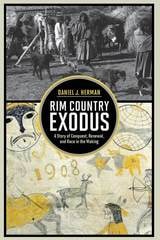
Rim Country Exodus
A Story of Conquest, Renewal, and Race in the MakingDaniel J. Herman
University of Arizona Press, 2012
Winner Labriola Center American Indian National Book Award
For thousands of years, humans have lived on the sprawling escarpment in Arizona known as the Mogollon Rim, a stretch that separates the valleys of central Arizona from the mountains of the north. A vast portion of this dramatic landscape is the traditional home of the Dilzhe’e (Tonto Apache) and the Yavapai. Now Daniel Herman offers a compelling narrative of how—from 1864 to 1934—the Dilzhe’e and the Yavapai came to central Arizona, how they were conquered, how they were exiled, how they returned to their homeland, and how, through these events, they found renewal.
Herman examines the complex, contradictory, and very human relations between Indians, settlers, and Federal agents in late nineteenth- and early twentieth-century Arizona—a time that included Arizona’s brutal Indian wars. But while most tribal histories stay within the borders of the reservation, Herman also chronicles how Indians who left the reservation helped build a modern state with dams, hydroelectricity, roads, and bridges. With thoughtful detail and incisive analysis, Herman discusses the complex web of interactions between Apache, Yavapai, and Anglos that surround every aspect of the story.
Rim Country Exodus is part of a new movement in Western history emphasizing survival rather than disappearance. Just as important, this is one of the first in-depth studies of the West that examines race as it was lived. Race was formulated, Herman argues, not only through colonial and scientific discourses, but also through day-to-day interactions between Indians, agents, and settlers. Rim Country Exodus offers an important new perspective on the making of the West.
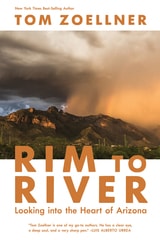
Rim to River
Looking into the Heart of ArizonaTom Zoellner
University of Arizona Press, 2023
Rim to River is the story of this extraordinary journey through redrock country, down canyons, up mesas, and across desert plains to the obscure valley in Mexico that gave the state its enigmatic name. The trek is interspersed with incisive essays that pick apart the distinctive cultural landscape of Arizona: the wine-colored pinnacles and complex spirituality of Navajoland, the mind-numbing stucco suburbs, desperate border crossings, legislative skullduggery, extreme politics, billion-dollar copper ventures, dehydrating rivers, retirement kingdoms, old-time foodways, ghosts of old wars, honky-tonk dreamers, murder mysteries, and magical Grand Canyon reveries.
In Rim to River, Zoellner does for Arizona what Larry McMurtry did for Texas in In a Narrow Grave and what Wallace Stegner did for Utah in Mormon Country: paint an enduring portrait of a misunderstood American state. An indictment, a love letter, and a homecoming story all at once.
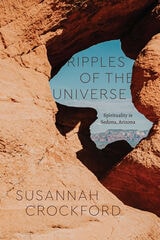
Ripples of the Universe
Spirituality in Sedona, ArizonaSusannah Crockford
University of Chicago Press, 2021
Many people move to Sedona because, they claim, they are called there by its special energy. But they are also often escaping job loss, family breakdown, or foreclosure. Spirituality, Crockford shows, offers a way for people to distance themselves from and critique current political and economic norms in America. Yet they still find themselves monetizing their spiritual practice as a way to both “raise their vibration” and meet their basic needs. Through an analysis of spirituality in Sedona, Crockford gives shape to the failures and frustrations of middle- and working-class people living in contemporary America, describing how spirituality infuses their everyday lives. Exploring millenarianism, conversion, nature, food, and conspiracy theories, Ripples of the Universe combines captivating vignettes with astute analysis to produce a unique take on the myriad ways class and spirituality are linked in contemporary America.
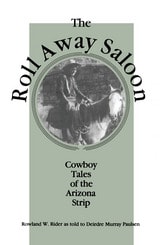
Roll Away Saloon
Rowland W. Rider as told to Deirdre M. Paulsen
Utah State University Press, 1985
Rudo Ensayo
A Description of Sonora and Arizona in 1764Juan Nentvig; Translated, Clarified, and Annotated by Alberto Francisco Pradeau and Robert R. Rasmussen
University of Arizona Press, 1980