Results by title
428 books match the query 'Authorship' and 11 start with r
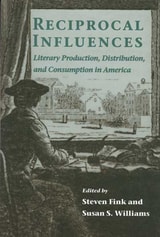
RECIPROCAL INFLUENCES
Literary Production, Distribution, and Consumption in AmericaEdited by Steven Fink and Susan S. Williams
The Ohio State University Press, 1999
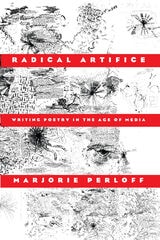
Radical Artifice
Writing Poetry in the Age of MediaMarjorie Perloff
University of Chicago Press, 1992
Re-imagining Doctoral Writing
Cecile Badenhorst
University Press of Colorado, 2021
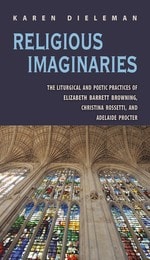
Religious Imaginaries
The Liturgical and Poetic Practices of Elizabeth Barrett Browning, Christina Rossetti, and Adelaide ProcterKaren Dieleman
Ohio University Press, 2012
Explores liturgical practice as formative for how three Victorian women poets imagined the world and their place in it and, consequently, for how they developed their creative and critical religious poetics.
This new study rethinks several assumptions in the field: that Victorian women’s faith commitments tended to limit creativity; that the contours of church experiences matter little for understanding religious poetry; and that gender is more significant than liturgy in shaping women’s religious poetry.
Exploring the import of bodily experience for spiritual, emotional, and cognitive forms of knowing, Karen Dieleman explains and clarifies the deep orientations of different strands of nineteenth-century Christianity, such as Congregationalism’s high regard for verbal proclamation, Anglicanism’s and Anglo-Catholicism’s valuation of manifestation, and revivalist Roman Catholicism’s recuperation of an affective aesthetic. Looking specifically at Elizabeth Barrett Browning, Christina Rossetti, and Adelaide Procter as astute participants in their chosen strands of Christianity, Dieleman reveals the subtle textures of these women’s religious poetry: the different voices, genres, and aesthetics they create in response to their worship experiences. Part recuperation, part reinterpretation, Dieleman’s readings highlight each poet’s innovative religious poetics.
Dieleman devotes two chapters to each of the three poets: the first chapter in each pair delineates the poet’s denominational practices and commitments; the second reads the corresponding poetry. Religious Imaginaries has appeal for scholars of Victorian literary criticism and scholars of Victorian religion, supporting its theoretical paradigm by digging deeply into primary sources associated with the actual churches in which the poets worshipped, detailing not only the liturgical practices but also the architectural environments that influenced the worshipper’s formation. By going far beyond descriptions of various doctrinal positions, this research significantly deepens our critical understanding of Victorian Christianity and the culture it influenced.

Resisting Regionalism
Gender And Naturalism In American Fiction, 1885-1915Donna Campbell
Ohio University Press, 1997
When James Lane Allen defined the “Feminine Principle” and the “Masculine Principle” in American fiction for the Atlantic Monthly in 1897, he in effect described local color fiction and naturalism, two branches of realism often regarded as bearing little relationship to each other. In this award-winning study of both movements, Resisting Regionalism explores the effect the cultural dominance of women’s local color fiction in the 1890’s had on young male naturalist writers, who rebelled against the local colorists and their “teacup tragedies.”
An immensely popular genre, local color fiction reached its peak in the 1880s in such literary journals as Harper’s Monthly, Scribner’s, the Atlantic Monthly, and the Century. These short stories exhibited local “characters,” depicted marginal groups and vanishing folkways, and addressed issues of absence, loss, limitation, and the past. Despite such prickly themes, according to Donna Campbell, local color fiction “fulfilled some specific needs of the public – for nostalgia, for a retreat into mildly exotic locales, for a semblance of order preserved in ritual.”
By the turn of the century, however, local color fiction was fading from the scene, supplanted by writers of adventure fiction and historical romances, with whom local colorists increasingly merged, and opposed by the naturalists. In examining this historic shift, Resisting Regionalism shows that far from being distanced from local color fiction, nationalism emerged in part as a dissenting response to its popularity and to the era’s concerns about the dominance of feminine influence in American literature. The new generation of authors, including Crane, Norris, London, Frederic, Wharton, resisted the cultural myths and narrative strategies common to local colorists Sarah Orne Jewett, Rose Terry Cooke, Mary E. Wilkins Freeman, and Constance Fenimore Woolson. Yet, as Campbell underscores in her analysis of Stephan Crane’s The Monster, the naturalists could, and did, integrate local color conventions with the grotesque and horrifying to powerful effect.
In clear, accessible prose, Resisting Regionalism provides fresh readings of naturalistic works in the context of the dispute between local color and naturalism. In the process, this book shows the debt naturalism owes to local color fiction and illuminates a neglected but significant literary era.
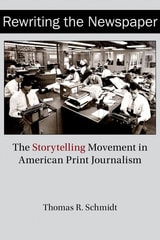
Rewriting the Newspaper
The Storytelling Movement in American Print JournalismThomas R. Schmidt
University of Missouri Press, 2020
Thomas Schmidt analyzes the expansion of narrative journalism and the corresponding institutional changes in the American newspaper industry in the last quarter of the twentieth century. In doing so, he offers the first institutionally situated history of narrative journalism’s evolution from the New Journalism of the 1960s to long-form literary journalism in the 1990s. Based on the analysis of primary sources, industry publications, and oral history interviews, this study traces how narrative techniques developed and spread through newsrooms, advanced by institutional initiatives and a growing network of practitioners, proponents, and writing coaches who mainstreamed the use of storytelling. Challenging the popular belief that it was only a few talented New York reporters (Tome Wolfe, Jimmy Breslin, Gay Talese, Joan Didion, and others) who revolutionized journalism by deciding to employ storytelling techniques in their writing, Schmidt shows that the evolution of narrative in late twentieth century American Journalism was more nuanced, more purposeful, and more institutionally based than the New Journalism myth suggests.
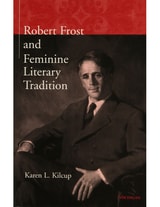
Robert Frost and Feminine Literary Tradition
Karen L. Kilcup
University of Michigan Press, 1998
Robert Lowell's Life and Work
Damaged GrandeurRichard Tillinghast, Editor
University of Michigan Press, 1995
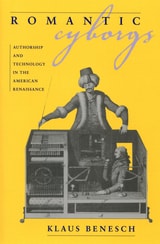
Romantic Cyborgs
Authorship and Technology in the American RenaissanceKlaus Benesch
University of Massachusetts Press, 0
Rousseau as Author
Consecrating One's Life to the TruthChristopher Kelly
University of Chicago Press, 2002
Unlike many other writers of his day, Rousseau refused to publish anonymously, even though he risked persecution for his writings. But Rousseau felt that authors must be self-restrained, as well as bold, and must carefully consider the potential political effects of what they might publish: sometimes seeking the good conflicts with writing the truth. Kelly shows how this understanding of public authorship played a crucial role in Rousseau's conception—and practice—of citizenship and political action.
Rousseau as Author will be a groundbreaking book not just for Rousseau scholars, but for anyone studying Enlightenment ideas about authorship and responsibility.

Rousseau, Judge of Jean-Jacques
DialoguesJean-Jacques Rousseau
Dartmouth College Press, 2012