198 books match the query 'Campaigns' and 6 start with r
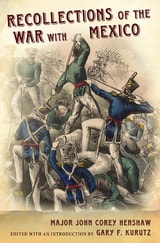
cover of Recollections of the War with Mexico

Recollections of the War with Mexico

Major John Corey Henshaw & Edited by Gary F. Kurutz

University of Missouri Press, 2008

Major John Henshaw, a dutiful regimental officer in the American invasion of Mexico, was one of only a handful of eyewitnesses to describe the two major theaters of that war from start to finish. But unlike most of his peers, he did not see himself as a conquering warrior and took pride in never having taken a life. He even wrote, “If I were alone, no earthly power could induce me to lend a helping hand in this base and infamous war.”

This book presents Henshaw’s recollections for the first time, covering all the action from the first skirmish in southern Texas to the collapse of Mexico City. As a member of the Seventh Infantry Regiment, this pugnacious line officer from New England served under both of the war’s principal generals, Zachary Taylor and Winfield Scott, and survived seven major battles. His writings constitute a virtual “minority opinion” report on the Mexican War.

Henshaw’s recollections include a rare and highly descriptive account of the siege of Fort Texas (later Fort Brown), plus rich new details of the storming of the Bishop’s Palace at Monterrey, the bombardment of Veracruz, the assault on Cerro Gordo, and the savage fighting outside the capital. His records of battles, marches, and maneuvers greatly augment what is already known about the campaign, but in addition to reporting daily occurrences and describing combat in graphic detail, Henshaw also reflected on the strategies and tactics—and what he saw as shortcomings—of officers on both sides.

Bitingly critical of those in command, of American volunteers, and of the war’s glory hounds, Henshaw admired the valor of ordinary soldiers on both sides of the fighting. And in the midst of the carnage, he also found time to describe Mexico’s cities and scenery in rhapsodic prose and express considerable empathy for its people. In addition to the “Recollections,” the volume includes vivid passages from letters Henshaw sent back to his wife, which supply additional details of the campaign. Editor Gary Kurutz provides an extensive biography of Henshaw, as well as comprehensive annotations to the text.

What Henshaw may have lacked as an unquestioning officer he more than made up for as an astute observer. Offering a decidedly different view of this war of American expansion, these writings with their balanced approach lend a fresh perspective among other primary sources and paint a startlingly honest picture of both Americans fighting abroad and those they fought.
[more]
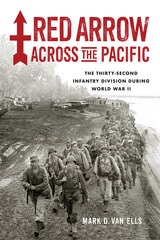
cover of Red Arrow across the Pacific: The Thirty-Second Infantry Division during World War II

Red Arrow across the Pacific

The Thirty-Second Infantry Division during World War II

Mark D. Van Ells

Wisconsin Historical Society Press, 2024

The history of WWII’s most battle-tested US Army division and its crucial role in achieving Allied victory in the Pacific

Red Arrow across the Pacific reveals the long-overdue story of the renowned Thirty-Second "Red Arrow" Infantry Division. Discover how this National Guard unit—which originated in Wisconsin and Michigan but soon evolved to include soldiers from California to New England—became one of the first US military units deployed overseas in World War II, eventually logging more combat hours than any other US Army division. 

Far more than a traditional battle narrative, Red Arrow across the Pacific offers a cultural history of the Red Arrow's wartime experience, from its mobilization in 1940, to its deployment across New Guinea, Australia, and the Philippines, to its postwar occupation of Japan. Drawing from letters, memoirs, and interviews, author Mark D. Van Ells lets the soldiers speak for themselves, describing in their own words the terror of combat, their impressions of foreign lands, the struggle to maintain their own humanity, and the many ways the war profoundly changed them.

Nuanced and remarkably thorough, this book explores the dramatic evolution of the Thirty-Second Infantry Division and reveals how the story of the Red Arrow reflects the experience of the US military during World War II.

“Exceptionally well researched and engagingly written. This book is a must read for any student of military history.”
—Capt. Florian L. Waitl, Command Historian, Wisconsin Army National Guard

“A superb divisional history. . . . Highly recommended for a general audience, as well as readers interested in the Second World War.”
—Mary Louise Roberts, Lucie Aubrac Distinguished Professor Emerita of History, University of Wisconsin–Madison, and author of Sheer Misery: Soldiers in Battle in WWII
 
[more]
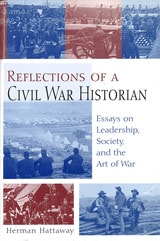
cover of Reflections of a Civil War Historian: Essays on Leadership, Society, and the Art of War

Reflections of a Civil War Historian

Essays on Leadership, Society, and the Art of War

Herman Hattaway & Foreword by Frank E. Vandiver

University of Missouri Press, 2003
Born in New Orleans, Herman Hattaway grew up in the Deep South. While it might not seem such a stretch for him to have become one of the foremost authorities on the Civil War and Southern history, Hattaway was actually at a loss for a career choice when he stumbled into the class of Professor T. Harry Williams at Louisiana State University. Williams’s lectures and writings were so inspiring to Hattaway that he became a regular in his classes, receiving his B.A., M.A., and Ph.D. all under the professor’s tutelage.
This collection of essays is a compendium of Hattaway’s writings from throughout his more-than-forty-year career. He is the author or coauthor of five books that were selections of the History Book Club—Jefferson Davis: Confederate President; Shades of Blue and Gray: An Introductory Military History of the Civil War; Why the South Lost the Civil War; How the North Won: A Military History of the Civil War; and General Stephen D. Lee. He is also the author of the text for Gettysburg to Vicksburg: The Five Original Civil War Battlefield Parks.
Hattaway is a captivating historian who always seeks to engage others in the study of history. He has made many important scholarly contributions to our understanding of the Civil War, including new information on the military use of balloons, the relevance of religion in warfare, and the nature of good (and bad) military leadership. This book will appeal to the many historians and others who have been influenced by Hattaway over the years. It demonstrates how he has evolved as a historian and brings to light many essays that were never before published or published only in specialized journals.
[more]
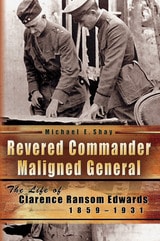
cover of Revered Commander, Maligned General: The Life of Clarence Ransom Edwards, 1859-1931

Revered Commander, Maligned General

The Life of Clarence Ransom Edwards, 1859-1931

Michael E. Shay

University of Missouri Press, 2011
Major General Clarence Ransom Edwards is a vital figure in American military history, yet his contribution to the U.S. efforts in World War I has often been ignored or presented in unflattering terms. Most accounts focus on the disagreements he had with General John J. Pershing, who dismissed Edwards from the command of the 26th (“Yankee”) Division just weeks before the war's end. The notoriety of the Pershing incident has caused some to view Edwards as simply a “political general” with a controversial career. But Clarence Edwards, though often a divisive figure, was a greater man than that. A revered and admired officer whose men called him “Daddy,” Edwards attained an impressive forty-year career, one matched by few wartime leaders.
            Michael E. Shay presents a complete portrait of this notable American and his many merits in Revered Commander, Maligned General. This long-overdue first full-length biography of General Clarence Edwards opens with his early years in Cleveland, Ohio and his turbulent times at West Point. The book details the crucial roles Edwards filled in staff and field commands for the Army before the outbreak of World War I in 1917: Adjutant-General with General Henry Ware Lawton in the Philippine-American War, first chief of the Bureau of Insular Affairs, and commander of U.S. forces in the Panama Canal Zone. Revered Commander, Maligned General follows Edwards as he forms the famous Yankee Division and leads his men into France. The conflict between Edwards and Pershing is placed in context, illuminating the disputes that led to Edwards being relieved of command.
            This well-researched biography quotes a wealth of primary sources in recounting the life of an important American, a man of loyalty and service who is largely misunderstood. Photographs of Edwards, his troops, and his kin—many from Edwards’ own collection—complement the narrative.  In addition, several maps aid readers in following General Edwards as his career moves from the U.S. to Central America to Europe and back stateside. Shay’s portrayalof General Edwards finally provides a balanced account of this unique U.S. military leader.
[more]
cover of Rise and Fall of the Confederacy: The Memoir of Senator Williamson S. Oldham, CSA

Rise and Fall of the Confederacy

The Memoir of Senator Williamson S. Oldham, CSA

Edited & Intro by Clayton E. Jewett

University of Missouri Press, 2006
Williamson S. Oldham was a shrewd and candid observer of the Civil War scene. Representing the always contrary and suspicious Texans in the Confederate Senate, he was a major opponent of President Jefferson Davis and spoke out vehemently against conscription—which he considered an abusive violation of individual rights—and against military interference in the cotton trade.
Oldham’s memoir provides a firsthand look at the Civil War from the perspective of a government insider. In it, he sheds light on such topics as military strategy, foreign relations, taxes, and conflicts between state officials and the Confederate government. Perhaps more important, his travels between Texas and Richmond—both during and after the war—allowed him to observe the many changes taking place in the South, and he made note of both the general sentiment of citizens and the effect of political and military measures on the country.
Throughout the memoir, Oldham consistently stresses the centrality of politics to a society and the necessity of legislating for the will of the people even in times of war. In assessing the Confederacy’s defeat, he points not to military causes but to Congress’s giving in to the will of the president and military leaders rather than ruling for and representing the people.
Clayton E. Jewett has edited and annotated Oldham’s memoir to produce the only fully edited publication of this important document, significantly expanded here over any version previously published. His introduction helps clarify Oldham’s position on many of the topics he discusses, making the memoir accessible to scholar and Civil War buff alike, while his annotations reflect his deep knowledge of the intrigue of wartime political life in both Texas and Richmond.
Oldham’s memoir offers important new insight into not only political leadership and conflicts in a young nation but also the question of why the South lost the Civil War, dispelling many myths about the defeat and bolstering interpretations of the Confederacy’s decline that point more to political than to military causes. Rise and Fall of the Confederacy is one of the major political and social documents of the Confederacy and will be a boon to all scholars of the Civil War era.
[more]
cover of Rommel: The End of a Legend

Rommel

The End of a Legend

Ralf Georg Reuth

Haus Publishing, 2019

Erwin Rommel is the best-known German field commander of World War II. Repeatedly decorated for valor during the First World War, he would go on to lead the German Panzer divisions in France and North Africa. Even his British opponents admitted to admiring his apparent courage, chivalry and leadership, and he became known by the nickname “Desert Fox.” His death, in October 1944, would give rise to speculation for generations to come on how history should judge him. To many he remains the ideal soldier, but, as Reuth shows, Rommel remained loyal to his Führer until forced to commit suicide, and his fame was largely a creation of the master propagandist Joseph Goebbels. Stripping away the many layers of Nazi and Allied propaganda, Reuth argues that Rommel’s life symbolizes the complexity and conflict of the German tragedy: to have followed Hitler into the abyss, and to have considered that to be his duty.
 
[more]