Results by title
282 books match the query 'Caribbean & West Indies' and 9 start with r
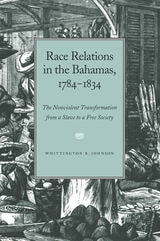
Race Relations in the Bahamas, 1784-1834
The Nonviolent Transformation from a Slave to a Free SocietyWhittington Johnson
University of Arkansas Press, 2000
This deeply researched, clearly written book is a history of black society and its relations with whites in the Bahamas from the close of the American Revolution to emancipation. Whittington B. Johnson examines the communities developed by free, bonded, and mixed-race blacks on the islands as British colonists and American loyalists unsuccessfully tried to establish a plantation economy. The author explores how relations between the races developed civilly in this region, contrasting it with the harsher and more violent experiences of other Caribbean islands and the American South.
Interpreting church documents and Colonial Office papers in a new light, Johnson presents a more favorable conclusion than previously advanced about the conditions endured by victims of the African Diaspora and by Creoles in the Bahama Islands. He makes use of an impressive and important body of archival and secondary research. Race Relations in the Bahamas will be a book of great interest to southern historians, historians of slave societies and black communities, scholars of race relations, and general readers.
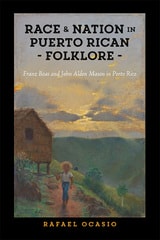
Race and Nation in Puerto Rican Folklore
Franz Boas and John Alden Mason in Porto RicoRafael Ocasio
Rutgers University Press, 2020
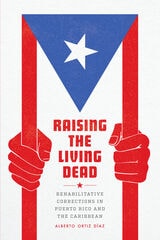
Raising the Living Dead
Rehabilitative Corrections in Puerto Rico and the CaribbeanAlberto Ortiz Díaz
University of Chicago Press, 2023
Raising the Living Dead is a history of Puerto Rico’s carceral rehabilitation system that brings to life the interactions of incarcerated people, their wider social networks, and health care professionals. Alberto Ortiz Díaz describes the ways that multiple communities of care came together both inside and outside of prisons to imagine and enact solution-oriented cultures of rehabilitation from the 1930s to the 1960s. Scientific and humanistic approaches to well-being were deliberately fused to raise the “living dead,” an expression that reemerged in the modern Caribbean to refer to prisoners. These reform groups sought to raise incarcerated people physically, mentally, socially, spiritually, and civically.
The book is based on deep, original archival research into the Oso Blanco (White Bear) penitentiary in Puerto Rico, yet it situates its study within Puerto Rico’s broader carceral archipelago and other Caribbean prisons. The agents of this history include not only physical health professionals, but also psychologists and psychiatrists, social workers, spiritual and religious practitioners, and, of course, the prisoners and their families. By following all these groups and emphasizing the interpersonal exercise of power, Ortiz Díaz tells a story that goes beyond debates about structural and social control.
The book addresses key issues in the history of prisons and the histories of medicine and belief, including how prisoners’ different racial, class, and cultural identities shaped their incarceration and how professionals living in a colonial society dealt with the challenge of rehabilitating prisoners for citizenship.
Raising the Living Dead is not just about convicts, their immediate interlocutors, and their contexts, however, but about how together these open a window into the history of social uplift projects within the (neo)colonial societies of the Caribbean. There is no book like this in Caribbean historiography; few examine these themes in the larger literature on the history of prisons.
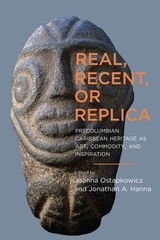
Real, Recent, or Replica
Precolumbian Caribbean Heritage as Art, Commodity, and InspirationEdited by Joanna Ostapkowicz and Jonathan A. Hanna
University of Alabama Press, 2021
A CHOICE OUTSTANDING ACADEMIC TITLE, 2022
Examines the largely unexplored topics in Caribbean archaeology of looting of heritage sites, fraudulent artifacts, and illicit trade of archaeological materials
Real, Recent, or Replica: Precolumbian Caribbean Heritage as Art, Commodity, and Inspiration is the first book-length study of its kind to highlight the increasing commodification of Caribbean Precolumbian heritage. Amerindian art, including “Taíno” art, has become highly coveted by collectors, spurring a prolific and increasingly sophisticated black market of forgeries, but also contemporary artistic engagement, openly appreciated as modern artworks taking inspiration from the past. The contributors to this volume contend with difficult subject matter including the continued looting of archaeological sites in the region, the seismic increase of forgeries, and the imbalance of power and economic relations between the producers and consumers of neo-Amerindian art.
The case studies document the considerable time depth of forgeries in the region (since the late nineteenth century), address the policies put in place by Caribbean governments and institutions to safeguard national patrimony, and explore the impact looted and forged artifacts have on how museums and institutions collect and ultimately represent the Caribbean past to their audiences. Overall, the volume emphasizes the continued desire for the “authentic” Precolumbian artifact, no matter the cost. It provides insights for archaeologists, museum professionals, art historians, and collectors to combat illegal trade and support communities in creating sustainable heritage industries.
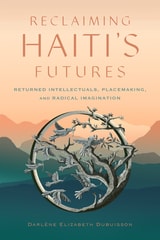
Reclaiming Haiti's Futures
Returned Intellectuals, Placemaking, and Radical ImaginationDarlène Elizabeth Dubuisson
Rutgers University Press, 2025
Winner of the 2024 Annual Book Award from the Society for Latin American and Caribbean Anthropology (SLACA)
Co-winner of the Isis Duarte Book Prize from the Latin American Studies Association
Haiti was once a beacon of Black liberatory futures, but now it is often depicted as a place with no future where emigration is the only way out for most of its population. But Reclaiming Haiti's Futures tells a different story. It is a story about two generations of Haitian scholars who returned home after particular crises to partake in social change. The first generation, called jenerasyon 86, were intellectuals who fled Haiti during the Duvalier dictatorship (1957–1986). They returned after the regime fell to participate in the democratic transition through their political leadership and activism. The younger generation, dubbed the jenn doktè, returned after the 2010 earthquake to partake in national reconstruction through public higher education reform. An ethnography of the future, the book explores how these returned scholars resisted coloniality's fractures and displacements by working toward and creating inhabitability or future-oriented places of belonging through improvisation, rasanblaj (assembly), and radical imagination. By centering on Haiti and the Caribbean, the book offers insights not just into the Haitian experience but also into how fractures have come to typify more aspects of life globally and what we might do about it.
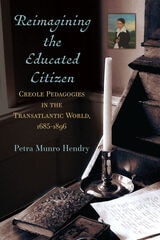
Reimagining the Educated Citizen
Creole Pedagogies in the Transatlantic World, 1685-1896Petra Munro Hendry
University of Michigan Press, 2023
Winner of the 2023 American Educational Research Association (AERA) Division B: Curriculum Studies Outstanding Book Award
Reimagining the Educated Citizen contends that the constructs of public education and citizenship in the struggle to constitute a U.S. national identity are inseparable from the simultaneous emergence of transatlantic constructs of an educated citizen along transnational and transracial lines. The nineteenth century is commonly understood as the age of nationalism and nation formation in which the Anglo-Protestant Common School movement takes center stage in the production of the American democratic citizen. Ironically, the argument for public, Common Schools privileged whiteness instead of equality. This book suggests that an alternative vision of the relationship between education and citizenship emerged from a larger transatlantic history. Given shape by the movement of people, ideas, commodities, and practices across the Caribbean, Africa, Europe, the Gulf of Mexico and the Mississippi Valley, this radical egalitarian vision emerged at the crossroads of the Atlantic-colonial and antebellum Louisiana.
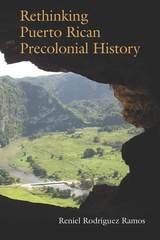
Rethinking Puerto Rican Precolonial History
Reniel Rodríguez Ramos
University of Alabama Press, 2010
The history of Puerto Rico has usually been envisioned as a sequence of colonizations-various indigenous peoples from Archaic through Taíno were successively invaded, assimilated, or eliminated, followed by the Spanish entrada, which was then modified by African traditions and, since 1898, by the United States. The truth is more complex, but in many ways Puerto Rico remains one of the last colonies in the world. This volume focuses on the successive indigenous cultures of Puerto Rico prior to 1493.
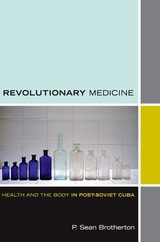
Revolutionary Medicine
Health and the Body in Post-Soviet CubaP. Sean Brotherton
Duke University Press, 2012

Rural Cuba
Lowry Nelson
University of Minnesota Press, 1950
Rural Cuba was first published in 1950. Minnesota Archive Editions uses digital technology to make long-unavailable books once again accessible, and are published unaltered from the original University of Minnesota Press editions.
Impoverished people in a rich land—that is the paradox of Cuba described with thorough documentation by Lowry Nelson, passed professor of sociology at the University of Minnesota. Professor Nelson studied rural Cuba's problems for a year during his appointment as rural sociologist for the U.S. Department of State.
With the cooperation of the Cuban government, Professor Nelson directed a series of detailed sociological surveys of representative rural districts. Data were gathered in these surveys on the family habits, agricultural methods, farm tenure, income, educational opportunities, social activities, and level of living of more than 700 rural Cuban families. This material is combined with historical background, census analyses, and on-the-spot observations for a comprehensive study that fills a gap in the available literature on the subject. The volume includes appendixes providing a description of the geography of the survey area and a verbatim sample report of a survey interviewer, together with a glossary of Spanish words, a bibliography, and tables.
In this book rural Cuba's problems are thoroughly discussed, present-day progress toward their solution is reported, and suggestions are offered for future agricultural policies that could help enrich the lives of Cuba's people.