Results by title

7 books match the query 'Flood'
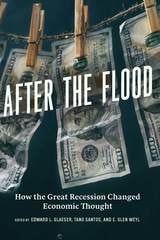
cover of After the Flood: How the Great Recession Changed Economic Thought

After the Flood

How the Great Recession Changed Economic Thought

Edited by Edward L. Glaeser, Tano Santos, and E. Glen Weyl

University of Chicago Press, 2017

The past three decades have been characterized by vast change and crises in global financial markets—and not in politically unstable countries but in the heart of the developed world, from the Great Recession in the United States to the banking crises in Japan and the Eurozone. As we try to make sense of what caused these crises and how we might reduce risk factors and prevent recurrence, the fields of finance and economics have also seen vast change, as scholars and researchers have advanced their thinking to better respond to the recent crises.

A momentous collection of the best recent scholarship, After the Flood illustrates both the scope of the crises’ impact on our understanding of global financial markets and the innovative processes whereby scholars have adapted their research to gain a greater understanding of them. Among the contributors are José Scheinkman and Lars Peter Hansen, who bring up to date decades of collaborative research on the mechanisms that tie financial markets to the broader economy; Patrick Bolton, who argues that limiting bankers’ pay may be more effective than limiting the activities they can undertake; Edward Glaeser and Bruce Sacerdote, who study the social dynamics of markets; and E. Glen Weyl, who argues that economists are influenced by the incentives their consulting opportunities create.

 
[more]
cover of Against the Flood

Against the Flood

Ma Van Khang

Northwestern University Press, 2000
Against the Flood caused a sensation in Viet Nam when it was published in 1999 because of its controversial description of sex and politics in that country. The plot revolves around a writer, Khiem, whose book is banned and who is publicly censured by his contemporaries, while the tangled relationships in his own circle involve drug-trafficking and adultery. His lover, a pretty and intelligent woman, is slandered and sacked from her job and becomes involved in the opium trade. Meanwhile, his wife, a smuggler, has an extramarital affair that results in pregnancy. The novel presents a vivid picture of contemporary Vietnamese society, examining the dramatic tensions inherent in a changing society, and is imbued with the themes of friendship, love, and betrayal.
[more]
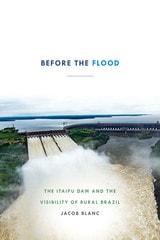
cover of Before the Flood: The Itaipu Dam and the Visibility of Rural Brazil

Before the Flood

The Itaipu Dam and the Visibility of Rural Brazil

Jacob Blanc

Duke University Press, 2019
In Before the Flood Jacob Blanc traces the protest movements of rural Brazilians living in the shadow of the Itaipu dam—the largest producer of hydroelectric power in the world. In the 1970s and 1980s, local communities facing displacement took a stand against the military officials overseeing the dam's construction, and in the context of an emerging national fight for democracy, they elevated their struggle for land into a referendum on the dictatorship itself. Unlike the broader campaign against military rule, however, the conflict at Itaipu was premised on issues that long predated the official start of dictatorship: access to land, the defense of rural and indigenous livelihoods, and political rights in the countryside. In their efforts against Itaipu and through conflicts among themselves, title-owning farmers, landless peasants, and the Avá-Guarani Indians articulated a rural-based vision for democracy. Through interviews and archival research—including declassified military documents and the first-ever access to the Itaipu Binational Corporation—Before the Flood challenges the primacy of urban-focused narratives and unearths the rural experiences of dictatorship and democracy in Brazil.
[more]
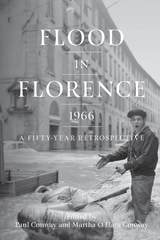
cover of Flood in Florence, 1966: A Fifty-Year Retrospective

Flood in Florence, 1966

A Fifty-Year Retrospective

Paul Conway and Martha O’Hara Conway

Michigan Publishing Services, 2018
On November 4, 1966, the Arno River in Florence, Italy, flooded its banks, breaching the basements and first floors of museums, libraries, and private residences and burying centuries of books, manuscripts, and works of art in muck and muddy water. Flood in Florence, 1966documents a symposium held to mark the 50th anniversary of a natural disaster that served as an impetus for the modern library and museum conservation professions. The proceedings feature illustrated, first-person remembrances of the flood; papers on book conservation, the conservation of works of art, disaster preparedness and response, and the continuing needs for education and training; and a keynote that points toward a future where original artifacts and digital technologies intersect. Providing new insights on a touchstone event by three generations of preservation and conservation professionals, the proceedings deepen our understanding of major advances in conservation practice and shed light on some of the most important lessons from those advances for future generations and the digital age.
[more]
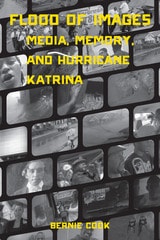
cover of Flood of Images: Media, Memory, and Hurricane Katrina

Flood of Images

Media, Memory, and Hurricane Katrina

By Bernie Cook

University of Texas Press, 2015

Anyone who was not in New Orleans during Hurricane Katrina and the subsequent flooding of the city experienced the disaster as a media event, a flood of images pouring across television and computer screens. The twenty-four-hour news cycle created a surplus of representation that overwhelmed viewers and complicated understandings of the storm, the flood, and the aftermath. As time passed, documentary and fictional filmmakers took up the challenge of explaining what had happened in New Orleans, reaching beyond news reports to portray the lived experiences of survivors of Katrina. But while these narratives presented alternative understandings and more opportunities for empathy than TV news, Katrina remained a mediated experience.

In Flood of Images, Bernie Cook offers the most in-depth, wide-ranging, and carefully argued analysis of the mediation and meanings of Katrina. He engages in innovative, close, and comparative visual readings of news coverage on CNN, Fox News, and NBC; documentaries including Spike Lee’s When the Levees Broke and If God Is Willing and Da Creek Don’t Rise, Tia Lessin and Carl Deal’s Trouble the Water, and Dawn Logsdon and Lolis Elie’s Faubourg Treme; and the HBO drama Treme. Cook examines the production practices that shaped Katrina-as-media-event, exploring how those choices structured the possible memories and meanings of Katrina and how the media’s memory-making has been contested. In Flood of Images, Cook intervenes in the ongoing process of remembering and understanding Katrina.
[more]
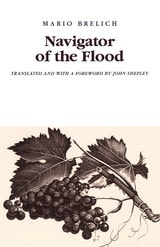
cover of Navigator of the Flood

Navigator of the Flood

Mario Brelich

Northwestern University Press, 1991
Mario Brelich, a Hungarian author writing in Italian, was a superb ironist. In his three novels, of which this is the first, he explored central episodes of the Old and New Testaments with unsparing wit and intelligence. In Navigator of the Flood, Brelich's Noah is a man laboring under a burden of responsibility by a Lord who appears from time to time to "correct"--at man's expense--His own foreknowledge and omniscience. If Noah finds God's commands at times cruel or incomprehensible, if he still sees beauty in a life now under threat of extinction, and wonders why he and his family should be chosen to survive while all others are condemned to perish, he remains the dutiful and upright patriarch who submits to the role assigned to him.
[more]
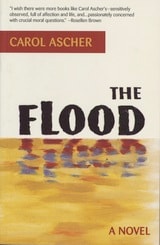
cover of The Flood: A Novel

The Flood

A Novel

Carol Ascher

Northwestern University Press, 1997

Nine-year-old Eva Hoffman is the daughter of Austrian Jewish refugees who have found a precarious safety among a small community of European exiles attached to a psychoanalytic hospital in Topeka, Kansas. It is 1951, and the landmark school desegregation case, Brown v. Topeka Board of Education, is being tried in the local court. As the rising river inundates the town, the Hoffmans open their home to refugees from the flood, and Eva learns the complexities of prejudice—and courage—both within and outside her family.
[more]