Results by title
80 books match the query 'Christianity and politics' and 8 start with r
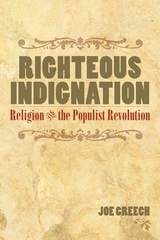
RIGHTEOUS INDIGNATION
Religion and the Populist RevolutionJoe Creech
University of Illinois Press, 2010
This illuminating study shows how Populists wove their political and economic reforms into a grand cosmic narrative pitting the forces of God and democracy against those of Satan and tyranny, and energizing their movement with a sacred sense of urgency. This book also unpacks the southern Protestants’ complicated approach to political and economic questions, as well as addressing broader issues about protest movements, race relations, and the American South.
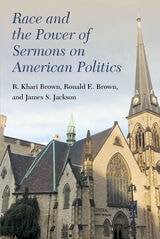
Race and the Power of Sermons on American Politics
R. Khari Brown, Ronald E. Brown, and James S. Jackson
University of Michigan Press, 2021
This book examines the intersection of race, political sermons, and social justice. Religious leaders and congregants who discuss and encourage others to do social justice embrace a form of civil religion that falls close to the covenantal wing of American civil religious thought. Clergy and members who share this theological outlook frame the nation as being exceptional in God’s sight. They also emphasize that the nation’s special relationship with the Creator is contingent on the nation working toward providing opportunities for socioeconomic well-being, freedom, and creative pursuits. God’s covenant, thus, requires inclusion of people who may have different life experiences but who, nonetheless, are equally valued by God and worthy of dignity. Adherents to such a civil religious worldview would believe it right to care for and be in solidarity with the poor and powerless, even if they are undocumented immigrants, people living in non-democratic and non-capitalist nations, or members of racial or cultural out-groups. Relying on 44 national and regional surveys conducted between 1941 and 2019, Race and the Power of Sermons on American Politics explores how racial experiences impact the degree to which religion informs social justice attitudes and political behavior. This is the most comprehensive set of analyses of publicly available survey data on this topic.
Religion and Radical Politics
An Alternative Christian Tradition in the United StatesRobert Craig
Temple University Press, 1995
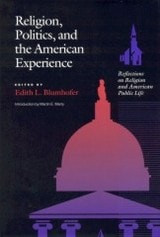
Religion, Politics and the American Experience
Reflections on Religion and American Public LifeEdith L. Blumhofer
University of Alabama Press, 2002
This challenging collection of essays offers a refreshing approach to the troubling--and timely--subject of religion and public policy in America, and the ways in which issues of church and state affect our national identity.
The result of a series of conferences on religion and politics conducted by the Public Religion project at the University of Chicago, funded by a grant from the Pew Charitable Trust, this collection brings together an extraordinarily diverse set of contributors. Represented within its pages are the ideas and opinions of scholars, politicians, and religious leaders with backgrounds in law, politics, history, and divinity, among them Senator Paul Simon of Illinois. With its wide range of critical approaches and varied perspectives, this volume makes a vibrant contribution to the national dialogue on politics and religion.
Chief among the essay topics are the evangelical roots of American political life; early conflicts between Enlightenment thinking and spiritual impulses in developing a national identity; the practical problems that today's politicians face in campaigning; the impact of constitutional and legal language regarding our definitions of religion; and the way in which the media's treatment of our spiriutal life frames our perceptions of it. These thought-provoking essays will inspire readers to rethink, argue, perhaps act, but most importantly, to converse about this timely and important issue.
This volume will have wide cross-disciplinary appeal. Students and scholars of history, religious studies, and political science will find great value within its pages, as will scholars of divinity and law, and members of this general public concerned with the intersection of faith and politics in American life.
Republicanism, Religion, and the Soul of America
Ellis Sandoz
University of Missouri Press, 2006
Revolution as Reformation
Protestant Faith in the Age of Revolutions, 1688–1832Edited by Peter C. Messer and William Harrison Taylor
University of Alabama Press, 2021
Essays that explore how Protestants responded to the opportunities and perils of revolution in the transatlantic age
Revolution as Reformation: Protestant Faith in the Age of Revolutions, 1688–1832 highlights the role that Protestantism played in shaping both individual and collective responses to revolution. These essays explore the various ways that the Protestant tradition, rooted in a perpetual process of recalibration and reformulation, provided the lens through which Protestants experienced and understood social and political change in the Age of Revolutions. In particular, they call attention to how Protestants used those changes to continue or accelerate the Protestant imperative of refining their faith toward an improved vision of reformed religion.
The editors and contributors define faith broadly: they incorporate individuals as well as specific sects and denominations, and as much of “life experience” as possible, not just life within a given church. In this way, the volume reveals how believers combined the practical demands of secular society with their personal faith and how, in turn, their attempts to reform religion shaped secular society.
The wide-ranging essays highlight the exchange of Protestant thinkers, traditions, and ideas across the Atlantic during this period. These perspectives reveal similarities between revolutionary movements across and around the Atlantic. The essays also emphasize the foundational role that religion played in people’s attempts to make sense of their world, and the importance they placed on harmonizing their ideas about religion and politics. These efforts produced novel theories of government, encouraged both revolution and counterrevolution, and refined both personal and collective understandings of faith and its relationship to society.
Rivalry and Reform
Presidents, Social Movements, and the Transformation of American PoliticsSidney M. Milkis and Daniel J. Tichenor
University of Chicago Press, 2019
Rivalry and Reform explores the relationship between presidents and social movements throughout history and into the present day, revealing the patterns that emerge from the epic battles and uneasy partnerships that have profoundly shaped reform. Through a series of case studies, including Abraham Lincoln and abolitionism, Lyndon Johnson and the civil rights movement, and Ronald Reagan and the religious right, Sidney M. Milkis and Daniel J. Tichenor argue persuasively that major political change usually reflects neither a top-down nor bottom-up strategy but a crucial interplay between the two. Savvy leaders, the authors show, use social movements to support their policy goals. At the same time, the most successful social movements target the president as either a source of powerful support or the center of opposition. The book concludes with a consideration of Barack Obama’s approach to contemporary social movements such as Black Lives Matter, United We Dream, and Marriage Equality.
Rock of Ages
Subcultural Religious Identity and Public Opinion among Young EvangelicalsJeremiah J. Castle
Temple University Press, 2019
Evangelicals and Republicans have been powerful—and active—allies in American politics since the 1970s. But as public opinions have changed, are young evangelicals’ political identities and attitudes on key issues changing too? And if so, why? In Rock of Ages, Jeremiah Castle answers these questions to understand their important implications for American politics and society.
Castle develops his own theory of public opinion among young evangelicals to predict and explain their political attitudes and voting behavior. Relying on both survey data and his own interviews with evangelical college students, he shows that while some young evangelicals may be more liberal in their attitudes on some issues, most are just as firmly Republican, conservative, and pro-life on abortion as the previous generation.
Rock of Ages considers not only what makes young evangelicals different from the previous generation, but also what that means for both the church and American politics.