Results by title
76 books match the query 'Church and state' and 11 start with r
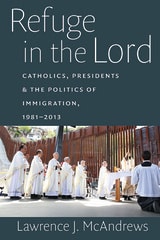
Refuge in the Lord
Lawrence J. McAndrews
Catholic University of America Press, 2015
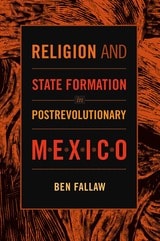
Religion and State Formation in Postrevolutionary Mexico
Ben Fallaw
Duke University Press, 2012
Ben Fallaw argues that previous scholarship has not appreciated the pervasive influence of Catholics and Catholicism on postrevolutionary state formation. By delving into the history of four understudied Mexican states, he is able to show that religion swayed regional politics not just in states such as Guanajuato, in Mexico's central-west "Rosary Belt," but even in those considered much less observant, including Campeche, Guerrero, and Hidalgo. Religion and State Formation in Postrevolutionary Mexico reshapes our understanding of agrarian reform, federal schooling, revolutionary anticlericalism, elections, the Segunda (a second Cristero War in the 1930s), and indigenism, the Revolution's valorization of the Mesoamerican past as the font of national identity.
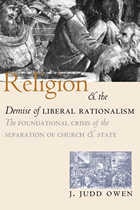
Religion and the Demise of Liberal Rationalism
The Foundational Crisis of the Separation of Church and StateJ. Judd Owen
University of Chicago Press, 2001
J. Judd Owen answers these questions with a remarkable critical analysis of four twentieth-century liberal and postliberal thinkers: John Dewey, John Rawls and, most extensively, Richard Rorty and Stanley Fish. His unique readings of these theorists and their approaches to religion lead him to conclusions that are meticulously constructed and surprising, arguing against the perception of liberalism as simple moral or religious neutrality, calling into question the prevailing justifications for separation of church and state, and challenging the way we think about the very basis of constitutional government.
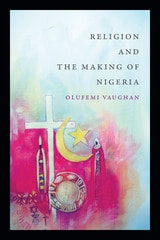
Religion and the Making of Nigeria
Olufemi Vaughan
Duke University Press, 2016
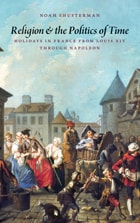
Religion and the Politics of Time
Noah Shusterman
Catholic University of America Press, 2010
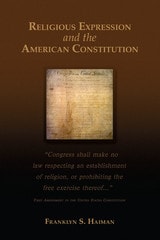
Religious Expression and the American Constitution
Franklyn S. Haiman
Michigan State University Press, 2003
First Amendment rights have been among the most fiercely debated topics in the aftermath of 9/11. In the current environment and fervor for “homeland security,” personal freedoms in exchange for security are coming under more scrutiny. Among these guaranteed freedoms are the protection of religious expression given by the U.S. Constitution and the constitutional prohibitions against behaviors that violate the separation of church and state. The mandate that the government “shall make no law respecting an establishment of religion, or prohibiting the free exercise thereof” is a general principle that has guided American courts in interpreting the original intent of the First Amendment. In Religious Expression and the American Constitution, Haiman focuses on the current state of American law with respect to a broad range of controversial issues affecting religious expression, both verbal and nonverbal, along with a review of the recent history of each issue to provide a full understanding.
Religious Liberty and the American Founding
Natural Rights and the Original Meanings of the First Amendment Religion ClausesVincent Phillip Muñoz
University of Chicago Press, 2022
The Founders understood religious liberty to be an inalienable natural right. Vincent Phillip Muñoz explains what this means for church-state constitutional law, uncovering what we can and cannot determine about the original meanings of the First Amendment’s Religion Clauses and constructing a natural rights jurisprudence of religious liberty.
Drawing on early state constitutions, declarations of religious freedom, Founding-era debates, and the First Amendment’s drafting record, Muñoz demonstrates that adherence to the Founders’ political philosophy would lead neither to consistently conservative nor consistently liberal results. Rather, adopting the Founders’ understanding would lead to a minimalist church-state jurisprudence that, in most cases, would return authority from the judiciary to the American people. Thorough and convincing, Religious Liberty and the American Founding is key reading for those seeking to understand the Founders’ political philosophy of religious freedom and the First Amendment Religion Clauses.
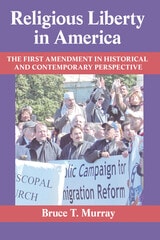
Religious Liberty in America
The First Amendment in Historical and Contemporary PerspectiveBruce T. Murray
University of Massachusetts Press, 2008
A nation founded on church-state separation is still debating where the line is drawn
In recent years a series of highly publicized controversies has focused attention on what are arguably the sixteen most important words in the U.S. Constitution: “Congress shall make no law respecting an establishment of religion, or prohibiting the free exercise thereof.” The ongoing court battles over the inclusion of the words “under God” in the Pledge of Allegiance, the now annual cultural quarrel over “Merry Christmas” vs. “Happy Holidays,” and the political promotion of “faith-based initiatives” to address social problems—all reflect competing views of the meaning of the religious liberty clauses of the First Amendment.
Such disputes, as Bruce T. Murray shows, are nothing new. For more than two hundred years Americans have disagreed about the proper role of religion in public life and where to draw the line between church and state. In this book, he reexamines these debates and distills the volumes of commentary and case law they have generated. He analyzes not only the changing contours of religious freedom but also the phenomenon of American civil religion, grounded in the notion that the nation's purpose is sanctified by a higher authority—an idea that can be traced back to the earliest New England colonists and remains deeply ingrained in the American psyche.
Throughout the book, Murray connects past and present, tracing the historical roots of contemporary controversies. He considers why it is that a country founded on the separation of church and state remains singularly religious among nations, and concludes by showing how the Supreme Court's thinking about the religious liberty clauses has evolved since the late eighteenth century.
Rendering unto Caesar
The Catholic Church and the State in Latin AmericaAnthony Gill
University of Chicago Press, 1997
Rome’s Most Faithful Daughter
The Catholic Church and Independent Poland, 1914–1939Neal Pease
Ohio University Press, 2009
When an independent Poland reappeared on the map of Europe after World War I, it was widely regarded as the most Catholic country on the continent, as “Rome’s Most Faithful Daughter.” All the same, the relations of the Second Polish Republic with the Church—both its representatives inside the country and the Holy See itself—proved far more difficult than expected.
Based on original research in the libraries and depositories of four countries, including recently opened collections in the Vatican Secret Archives, Rome’s Most Faithful Daughter: The Catholic Church and Independent Poland, 1914–1939 presents the first scholarly history of the close but complex political relationship of Poland with the Catholic Church during the interwar period. Neal Pease addresses, for example, the centrality of Poland in the Vatican’s plans to convert the Soviet Union to Catholicism and the curious reluctance of each successive Polish government to play the role assigned to it. He also reveals the complicated story of the relations of Polish Catholicism with Jews, Freemasons, and other minorities within the country and what the response of Pope Pius XII to the Nazi German invasion of Poland in 1939 can tell us about his controversial policies during World War II.
Both authoritative and lively, Rome’s Most Faithful Daughter shows that the tensions generated by the interplay of church and state in Polish public life exerted great influence not only on the history of Poland but also on the wider Catholic world in the era between the wars.

Russian Orthodoxy under the Old Regime
Robert L. Nichols and Theofanis George Stavrou, Editors
University of Minnesota Press, 1978
Russian Orthodoxy under the Old Regime was first published in 1978. Minnesota Archive Editions uses digital technology to make long-unavailable books once again accessible, and are published unaltered from the original University of Minnesota Press editions.
In this book, which is especially suitable for course use, eleven scholars examine one of the most important institutions of imperial Russia, the Orthodox church in the two centuries before the Russian revolution. The material is arranged in two sections, the first devoted to Orthodoxy's role in Russian social and cultural life and the second dealing with the church's relationship to the tsarist regime.