Results by title
401 books match the query 'Civil War, 1861-1865' and 14 start with r
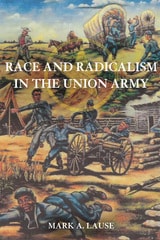
Race and Radicalism in the Union Army
Mark A. Lause
University of Illinois Press, 2013
In this compelling portrait of interracial activism, Mark A. Lause documents the efforts of radical followers of John Brown to construct a triracial portion of the Federal Army of the Frontier. Mobilized and inspired by the idea of a Union that would benefit all, black, Indian, and white soldiers fought side by side, achieving remarkable successes in the field. Against a backdrop of idealism, racism, greed, and the agonies and deprivations of combat, Lause examines links between radicalism and reform, on the one hand, and racialized interactions among blacks, Indians, and whites, on the other.
Lause examines how this multiracial vision of American society developed on the Western frontier. Focusing on the men and women who supported Brown in territorial Kansas, Lause examines the impact of abolitionist sentiment on relations with Indians and the crucial role of nonwhites in the conflict. Through this experience, Indians, blacks, and whites began to see their destinies as interdependent, and Lause discusses the radicalizing impact of this triracial Unionism upon the military course of the war in the upper Trans-Mississippi.
The aftermath of the Civil War destroyed much of the memory of the war in the West, particularly in the Indian Territory (now Oklahoma). The opportunity for an interracial society was quashed by the government's willingness to redefine the lucrative field of Indian exploitation for military and civilian officials and contractors.
Assessing the social interrelations, ramifications, and military impact of nonwhites in the Union forces, Race and Radicalism in the Union Army explores the extent of interracial thought and activity among Americans in this period and greatly expands the historical narrative on the Civil War in the West.
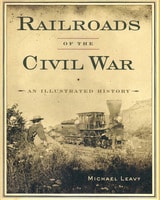
Railroads of the Civil War
An Illustrated HistoryMichael Leavy
Westholme Publishing, 2010
The Photographic Record of the First Wide-Scale Mechanization of War
Over the course of the first half of the nineteenth century, America would find itself following two increasingly divergent tracks: an industrialized North and an agricultural South. By 1860 railroads were firmly entrenched in our culture, reshaping our cities and steering us through the industrial age towards worldwide prominence. From sleepy post towns to the largest east coast cities, the distant hooting of the locomotive whistle drew ever closer and louder, filling listeners with fascination while brightening the eyes of profit-driven industrialists. But this admirable invention, lavishly adorned in brass and iron trimmings, was about to take on a new and deadly role. America’s regional differences would result in a spectacular collision over slavery, and between 1861–1865, the nation fought a savage war. The “iron horse” became a major weapon in the first war fully dependent on railroads. Moreover railroads would escalate and prolong the war, leading to its terrible carnage. Trains were used to move troops rapidly and over great distances, completely changing military strategy. Trains were also used as mobile artillery, armed with large-caliber cannons that could pound cities and fortifications. Trains were a crucial means for supplying the armies on both sides, and it was the severing of the railway lines providing food and munitions to the Army of Northern Virginia that led to Robert E. Lee’s surrender at Appomattox Court House.
In Railroads of the Civil War: An Illustrated History, Michael Leavy uses compelling period photographs and drawings and a rich narrative to reevaluate and illuminate the role of railroads in the Civil War. In addition to identifying details about the various trains and ancillary equipment and buildings in the illustrations, the author explains how trains influenced the outcome of battles and the war in general.
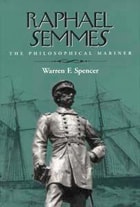
Raphael Semmes
The Philosophical MarinerWarren F. Spencer
University of Alabama Press, 1997
Naval hero for all the South, Raphael Semmes (1809-1877) sailed two famous Confederate raiders. He outfitted CSS Sumter in 1861 and captured 18 Union merchant ships in six months before the raider was blockaded at Gibraltar. Next he took command of CSS Alabama, an English-built raider, and terrorized U.S. merchant vessels on the high seas from August 1862 until the raider was sunk in battle off Cherbourg in June 1864. During that two-year period, he captured more enemy merchant ships than any other cruiser captain in maritime history. He is considered one of the greatest ship's commanders that America has produced.
In this first, full-scale biography that relies on Semmes's private papers, unpublished diaries, and correspondence, Spencer has produced a well-balanced and comprehensive account of the man, as well as the naval officer. The biographer paints a vivid portrait of Semmes—the intellectual, the family man, lawyer, romanticist, nationalist—providing a greater understanding of the man behind the heroic deeds.
Semmes was born in Maryland to a slave-holding family and entered the United States Navy in 1826. In 1849, he moved his family to Mobile, Alabama, to be near the navy base at Pensacola, Florida, and to practice law during leaves. Semmes was an astute student, not only of international and maritime law but also of weather patterns; astronomy; flora and fauna; naval, social, and cultural history; and the classics. His study of constitutional law led him to side with his adopted state in 1861, a move that set the stage for his place in history.
Rebel Bulldog
The Story of One Family, Two States, and the Civil WarJason Lantzer
Indiana Historical Society Press, 2017
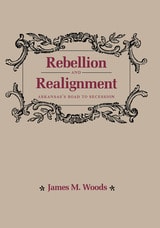
Rebellion and Realignment
Arkansas's Road to SecessionJames M. Woods
University of Arkansas Press, 1987
Arkansas, the Old South’s last frontier, was forced, after the election of Lincoln, to face the issue of secession. A decade earlier, the state had spurned all efforts from within to withdraw from the Union, but the following ten years drew Arkansas deeper into the economic and cultural community that bound it to the other slaveholding states. Now rumblings of secession were heard even before the president-elect assumed office on March 4, 1861. The question was asked on street corners, in offices, barbershops and living rooms: Would Arkansas leave the Union?
Answers to that question caused a fundamental realignment of politics in Arkansas during the winter of 1860–61. The former political coalition of Democrat and Whig fell away in a geographical split between the uplands and the lowlands. In this important and exciting book, the first to tell the story of Arkansas’s road to secession, James Woods examines the differences between uplanders, whose mountain regions offered little useful farmland for any crop, and lowlanders, whose vast deltas were ideally suited for cotton farming. The southern portion of the state began to rely increasingly upon slavery as it became linked to the economy of cotton and Southern antebellum values, but the northern region of the state did not. Woods focuses upon the resulting social, economic, and geographic divisions that grew within Arkansas before and during the secession crisis. He captures the political struggles of the state as it tore away from the nation, and as it threatened, in so doing, to tear itself apart.
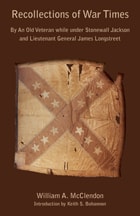
Recollections of War Times
By An Old Veteran while under Stonewall Jackson and Lieutenant General James LongstreetWilliam A. McClendon, with an introduction by Keith S. Bohannon
University of Alabama Press, 2010
"Gus" McClendon joined the 15th Alabama Infantry Regiment, and served in many of the Eastern Theater engagements. More than fifty years later, he sent down his reminiscences, still an unreconstructed Southern patriot, although able to look back with some amusement on his younger self.
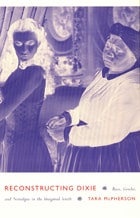
Reconstructing Dixie
Race, Gender, and Nostalgia in the Imagined SouthTara McPherson
Duke University Press, 2003
Illuminating crucial connections between understandings of race, gender, and place on the one hand and narrative and images on the other, McPherson reads a number of representations of the South produced from the 1930s to the present. These are drawn from fiction, film, television, southern studies scholarship, popular journalism, music, tourist sites, the internet, and autobiography. She examines modes of affect or ways of "feeling southern" to reveal how these feelings, along with the narratives and images she discusses, sanction particular racial logics. A wide-ranging cultural studies critique, Reconstructing Dixie calls for vibrant new ways of thinking about the South and for a revamped and reinvigorated southern studies.
Reconstructing Dixie will appeal to scholars in American, southern, and cultural studies, and to those in African American, media, and women’s studies.
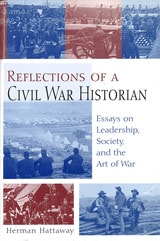
Reflections of a Civil War Historian
Essays on Leadership, Society, and the Art of WarHerman Hattaway & Foreword by Frank E. Vandiver
University of Missouri Press, 2003
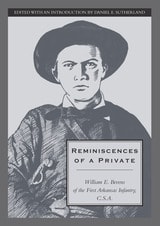
Reminiscences of a Private
William E. Bevens of the First Arkansas Infantry C.S.A.Daniel E. Sutherland
University of Arkansas Press, 1999
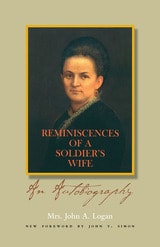
Reminiscences of a Soldier's Wife
An AutobiographyMrs. John A. Logan. Foreword by John Y. Simon
Southern Illinois University Press, 1997
"To tell my own story is to tell that of my famous husband, General John A. Logan," explains Mary S. Logan in the preface to her autobiography.
Married to John A. Logan for thirty-one years, Mary Logan shared in her distinguished husband’s career as a prosecutor in southern Illinois, as a Civil War general, and as a senator from Illinois. She observed firsthand the extraordinary events before, during, and after the Civil War, and she knew personally those world leaders who held the power to shape history. After the death of her husband, she maintained her influence in Washington, D.C. "Under the brightest and darkest skies," she explains, "I have passed than a half-century at the national capital."
Born in 1838, Logan writes of her early days growing up in southern Illinois through 1913, when this book was first published. A skillful observer, she recounts events that are personal, regional, and national in scope. In charming detail, she shares her courtship and subsequent marriage to a young prosecutor from Jackson County and the births of their children. She writes proudly of the Lincoln-Douglas debates in 1858 and her husband’s election to the Thirty-seventh Congress that same year. Logan tells of the coming of the Civil War and of her husband—formerly a Democrat and an enemy of Lincoln—casting his fate with the Union and raising a regiment in southern Illinois. She poignantly describes her brother’s defection to the Confederate Army, her life in war-torn Cairo, Illinois, and her horror at her husband’s severe war wounds. She recounts the battles, the political campaigns, and Lincoln’s reelection and subsequent assassination from her point of view—and, as the wife of a politician and general, hers is a decidedly privileged perspective.
In a position to observe and to participate in events ranging from momentous to minute throughout the latter half of the nineteenth and early twentieth centuries, she reports the essential episodes of history with the flair of journalism, a career she in fact embraced after the death of her husband. She writes movingly of a wounded captain on the road to recovery who suddenly died when the minié shifted next to his lung, amusingly of the excuses soldiers invented to wrangle a pass to town, and elegantly of her trips to Europe and of the pomp and circumstance of the parties attended by the great men and women of the time. Drawing on events grand and small, she re-creates history as only a skillful writer who was in the right place at the right time could.

Riding for the Lone Star
Frontier Cavalry and the Texas Way of War, 1822-1865Nathan A. Jennings
University of North Texas Press, 2016
Rise and Fall of the Confederacy
The Memoir of Senator Williamson S. Oldham, CSAEdited & Intro by Clayton E. Jewett
University of Missouri Press, 2006
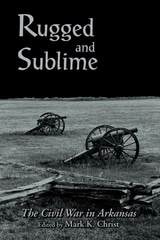
Rugged and Sublime
The Civil War in ArkansasMark Christ
University of Arkansas Press, 1994
When one thinks of the American Civil War, such names as Vicksburg, Gettysburg, and Chancellorsville come immediately to mind. Few recall the battles in the Trans-Mississippi theater.
Rugged and Sublime goes a long way toward filling regrettable blanks in our memory of Arkansas’s role in Civil War. It explore the major clashes and locales of the war, including the state secession convention, seizure of the Little Rock Arsenal, the Battle of Wilson’s Creek, the Pea Ridge campaign, Marmaduke’s invasion of Missouri, the Battle of Helena, and the fall of Little Rock, as well as other actions. Rounding out this new and very readable account are studies of the devolution of Arkansas society when bands of guerillas and jayhawkers menaced the state, the surrender of the Confederate armies, and an assessment of losses.
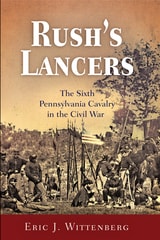
Rush's Lancers
The Sixth Pennsylvania Cavalry in the Civil WarEric J. Wittenberg
Westholme Publishing, 2007
The Sixth Pennsylvania Cavalry, also known as Rush’s Lancers, was a completely volunteer unit and one of the finest regiments to serve in the Civil War. Tracing their history from George Washington’s personal bodyguard during the Revolutionary War, many of the men of the Sixth Pennsylvania were the cream of Philadelphia society, including Richard H. Rush, grandson of Dr. Benjamin Rush, Maj. Robert Morris, Jr., great-grandson of the financier of the Revolutionary War, Capt. Charles Cadwalader, whose great-grandfather was a general under George Washington, Frank H. Furness, architect and Medal of Honor recipient, and George G. Meade, Jr. But it was their actions in battle, not their illustrious family histories, that distinguished Rush’s Lancers. The Sixth Pennsylvania Cavalry earned a reputation for being a highly trained and reliable unit, despite being armed initially with antiquated weapons, leaving their mark on key battlefields, including Antietam, Fredericksburg, Hanover Court House, Chancellorsville, Gettysburg, Brandy Station—where they conducted one of the most famous charges of the war—and Appomattox.
Drawing upon letters, diaries, memoirs, service and pension files, contemporary newspaper coverage, official records, and other primary sources, Rush’s Lancers: The Sixth Pennsylvania Cavalry in the Civil War by distinguished military historian Eric J. Wittenberg is an engrossing account of these young men from both Philadelphia’s social elite and the city’s working classes who, despite not being professional soldiers, answered the Nation’s call to war.