Results by title
319 books match the query 'Communication Studies' and 27 start with r
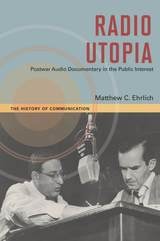
Radio Utopia
Postwar Audio Documentary in the Public InterestMatthew Ehrlich
University of Illinois Press, 2017
Radio, Morality, & Culture
Britain, Canada, and the United States, 1919 - 1945Robert S. Fortner
Southern Illinois University Press, 2005
Radio, Morality, and Culture: Britain, Canada, and the United States, 1919–1945 examines the moral controversies surrounding radio’s development during its formative years. In comparing the fledgling medium in Great Britain, Canada, and the United States, Robert S. Fortner documents how the church failed to participate in radio’s moral development and instead engaged in internecine warfare over issues of legitimacy and orthodoxy.
The church was arguing about theological turf and dealing with internal disputes while radio policy was being developed and communications history was being written. Fortner reveals how the church, doomed to play little more than a bit part in the future of radio, eventually lost its voice altogether in the continuing development of electronic media. Fortner effectively synthesizes cultural history and theory, communication studies, and the role religious organizations played in shaping the content and character of early radio. Geared to scholars of history, communications, and theology, Radio, Morality, and Culture provides a useful resource for research, scholarship, and public policy.
Raveling the Brain
Toward a Transdisciplinary NeurorhetoricJordynn Jack
The Ohio State University Press, 2019
Jack first looks at the problem of “neurohype”—exaggerated or oversimplified claims that essentialize brains and make them “uncritically real”—questioning some of the fundamental assumptions about the brain that experimental protocols and psychological concepts rely on. Then, through examples of research on sex and gender, political orientation, and affect, Jack demonstrates how a rhetorical-material approach can help to generate alternative approaches to studying the brain that might mitigate the problem of neurohype. By raveling out the roots of neurohype and raveling back its use through time, Raveling the Brain shows how rhetoric and neuroscience might be raveled together, or intertwined, to create a stronger transdisciplinary approach that might enrich our understanding of those issues of interest to neuroscientists and humanists alike.
Reading Sounds
Closed-Captioned Media and Popular CultureSean Zdenek
University of Chicago Press, 2015
These are the choices closed captioners face every day. Captioners must decide whether and how to describe background noises, accents, laughter, musical cues, and even silences. When captioners describe a sound—or choose to ignore it—they are applying their own subjective interpretations to otherwise objective noises, creating meaning that does not necessarily exist in the soundtrack or the script.
Reading Sounds looks at closed-captioning as a potent source of meaning in rhetorical analysis. Through nine engrossing chapters, Sean Zdenek demonstrates how the choices captioners make affect the way deaf and hard of hearing viewers experience media. He draws on hundreds of real-life examples, as well as interviews with both professional captioners and regular viewers of closed captioning. Zdenek’s analysis is an engrossing look at how we make the audible visible, one that proves that better standards for closed captioning create a better entertainment experience for all viewers.
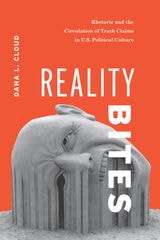
Reality Bites
Rhetoric and the Circulation of Truth Claims in U.S. Political CultureDana L. Cloud
The Ohio State University Press, 2018
Reclaiming Queer
Activist and Academic Rhetorics of ResistanceErin J. Rand
University of Alabama Press, 2014
An examination of the rhetorical linkage of queer theory in the academy with street-level queer activism in the 1980s and early 1990s
The late 1980s and early 1990s were a defining historical moment for both queer activism and queer theory in the United States. LGBTQ communities, confronted with the fatal indifference and homophobia of the AIDS crisis, often responded with angry, militant forms of activism designed not merely to promote acceptance or tolerance, but to forge identity and strength from victimization and assert loudly and forcefully their rights to safety and humanity. The activist reclamation of the word “queer” is one marker of this shift in ideology and practice, and it was mirrored in academic circles by the concurrent emergence of the new field of “queer theory.” That is, as queer activists were mobilizing in the streets, queer theorists were producing a similar foment in the halls and publications of academia, questioning regulatory categories of gender and sexuality, and attempting to illuminate the heteronormative foundations of Western thought. Notably, the narrative of queer theory’s development often describes it as arising from or being inspired by queer activism.
In Reclaiming Queer, Erin J. Rand examines both queer activist and academic practices during this period, taking as her primary object the rhetorical linkage of queer theory in the academy with street-level queer activism. Through this strategic conjuncture of activism and academia, Rand grapples with the specific conditions for and constraints on rhetorical agency in each context. She examines the early texts that inaugurated the field of queer theory, Queer Nation’s infamous “Queers Read This” manifesto, Larry Kramer’s polemic speeches and editorials, the Lesbian Avengers’ humorous and outrageous antics, the history of ACT UP, and the more recent appearance of Gay Shame activism. From these activist and academic discourses, Rand builds a theory of rhetorical agency that posits queerness as the very condition from which agency emerges.
Reclaiming Queer thus offers a critical look at the rhetoric of queer activism, engages the history of queer theory’s institutionalization and the politics of its proliferation, suggests a radically contextual understanding of rhetorical agency and form, and argues for the centrality of queerness to all rhetorical action.

Reclaiming the Media
Communication Rights and Democratic Media RolesEdited by Bart Cammaerts and Nico Carpentier
Intellect Books, 1995
In the twentieth century, the media gave whistleblowers a voice, spearheaded the downfall of powerful politicians, and exposed widespread corporate corruption. How will the twenty-first-century media cope with its storied legacy as the watchdog of democratic society? Reclaiming the Media examines the sometimes tenuous, often fraught relationship between media organizations and civil rights in Europe. In sections devoted to citizenship, participation, contemporary journalism, and activist communication strategies, a panel of European media experts makes the case for deepening the media’s role in democracy.
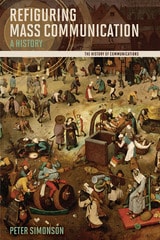
Refiguring Mass Communication
A HistoryPeter Simonson
University of Illinois Press, 2010
This unique inquiry into the history and ongoing moral significance of mass communication also represents a defense, extension, and overhaul of the idea and social form of the discipline. Organized around narrative accounts of individuals and their communicative worlds, Refiguring Mass Communication illuminates significant but overlooked rhetorical episodes in history to enable modern-day readers to rehabilitate and reinvigorate their own engagements with mass communication.
Coined in the 1920s as a way to describe radio, motion pictures, wide-circulation magazines, and the press, the term "mass communication" frequently is misused in the era of cable TV, niche marketing, and the Internet. In Refiguring Mass Communication, Peter Simonson compares his own vision of mass communication with distinct views articulated throughout history by Paul of Tarsus, Walt Whitman, Charles Horton Cooley, David Sarnoff, and Robert K. Merton, utilizing a collection of texts and tenets from a variety of time periods and perspectives. Drawing on textual and archival research as well as access to Merton's personal papers, Simonson broadly reconceives a sense of communication theory and what social processes might be considered species of mass communication. Simonson reveals the geographical and social contexts from which these visions have emerged and the religious and moral horizons against which they have taken shape. In a unique perspective, he considers the American county fair as an example of a live gathering and crucial site that is overlooked in contemporary forms of mass communication, urging a reconsideration of how individuals participate in and shape similar forms.
Reframing Rhetorical History
Cases, Theories, and MethodologiesEdited by Kathleen J. Turner and Jason Edward Black
University of Alabama Press, 2022
A collection of essays providing insights into new directions in rhetorical history
Kathleen J. Turner’s 1998 multicontributor volume Doing Rhetorical History: Concepts and Cases quickly became a foundational text in the field, and the studies in the book have served as an important roadmap for scholars undertaking such scholarship. In the decades since its publication, developments in rhetorical-historical research, engaged scholarship, and academic interventionism have changed the practice of rhetorical history tremendously.
To address this shift, Turner and Jason Edward Black have edited a much-anticipated follow-up volume: Reframing Rhetorical History: Cases, Theories, and Methodologies, which reassesses both history as rhetoric and rhetorical history as practice. This new book attends to a number of topics that have become not just hot-button issues in rhetorical scholarship but have entrenched themselves as anchors within the field. These include digital rhetoric, public memory, race and ethnicity, gender dynamics and sexualities, health and well-being, transnationalism and globalization, social justice, archival methods and politics, and colonialism and decoloniality.
The sixteen essays are divided into four major parts: “Digital Humanities and Culture” introduces methods and cases using twenty-first century technologies; “Identities, Cultures, and Archives” addresses race and gender within the contexts of critical race theory, gendered health rhetoric, race-based public memory, and class/sectionalism; “Approaches to Nationalism and Transnationalism” explores ideologies related to US and international cultures; and “Metahistories and Pedagogies” explores creative ways to approach the frame of metarhetorical history given what the field has learned since the publication of Doing Rhetorical History.
CONTRIBUTORS
Andrew D. Barnes / Jason Edward Black / Bryan Crable / Adrienne E. Hacker Daniels / Matthew deTar / Margaret Franz / Joe Edward Hatfield / J. Michael Hogan / Andre E. Johnson / Madison A. Krall / Melody Lehn / Lisbeth A. Lipari / Chandra A. Maldonado / Roseann M. Mandziuk / Christina L. Moss / Christopher J. Oldenburg / Sean Patrick O’Rourke / Daniel P. Overton / Shawn J. Parry-Giles / Philip Perdue / Kathleen J. Turner
Regendering Delivery
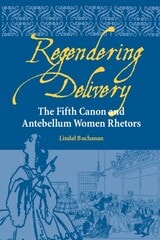
The Fifth Canon and Antebellum Women RhetorsLindal Buchanan
Southern Illinois University Press, 2005
Lindal Buchanan thoroughly analyzes how antebellum women infiltrated the male-dominated realm of public speaking by adapting elocutionary instruction to subversive ends, developing distinctive delivery styles, and reconciling conflicting public and private roles. By detailing the education and oratorical practices of pioneering female public speakers, Regendering Delivery: The Fifth Canon and Antebellum Women Rhetors theorizes how gender impacted the fifth rhetorical canon of delivery and how cultural constructions of the feminine have shaped public performance.
Buchanan argues that restrictive gender norms encouraged antebellum women rhetors to develop unique styles and methods of rhetorical production and performance. She examines how schoolgirls devised ways to learn and practice elocution in academic settings and how women developed inventive delivery strategies to maintain the appearance of femininity even as they participated in conventionally masculine discursive activities from general public speaking to political lobbying. She also identifies collaborative methods that enabled antebellum women to negotiate conflicts between their domestic and rhetorical commitments and thus reach public platforms
Assessing the calculable impact of gender on rhetorical performance, Buchanan maintains that delivery holds particular sexual and textual connotations for women rhetors. Regendering Delivery notably contributes to ongoing feminist efforts to incorporate women into the rhetorical tradition by probing such gendered—and largely overlooked—aspects of oratorical delivery as cultural context, gender norms, elocutionary education, sexuality, maternity, feminine ethos, and collaboration.

Remake, Remodel
Women's Magazines in the Digital AgeBrooke Erin Duffy
University of Illinois Press, 2013
Renovating Value
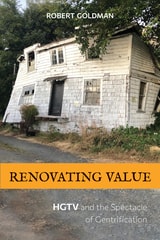
HGTV and the Spectacle of GentrificationRobert Goldman
Temple University Press, 2021
HGTV has perfected stories about creating and capturing value in the housing market. But according to Robert Goldman, this lifestyle network’s beloved flagship programs, Flip or Flop, Property Brothers, and Fixer Upper—where people revitalize modern spaces and reinvent property values—offer “fairy tales” in the wake of the 2008 economic crisis. The cable channel’s seductive, bingeable programs may show how to find and extract value from properties, but, in fact, they insidiously ignore the realities of the real estate and mortgage markets, housing inequality, gentrification, economic insecurity, and even homelessness. In effect, HGTV has turned house flipping into a master narrative about getting ahead in America during an era of otherwise uneasy economic prospects.
HGTV pictures its insular moral economy as an alternative to a crisis-ridden neoliberal finance system that shaped landscapes of foreclosure and financial uncertainty for millions of households. Renovating Value explores the circuitry of consumer credit and debt, and a rent-gap model of gentrification that charts a path to the rehabilitation of Value. Goldman shrewdly critiques the aspirational myth of adding value to a home simply by using imagination, elbow grease, and aesthetic know-how.
Resistance in the Era of Nationalisms
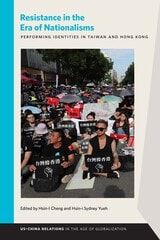
Performing Identities in Taiwan and Hong KongHsin-I Cheng
Michigan State University Press, 2023
Rhetoric and Demagoguery
Patricia Roberts-Miller
Southern Illinois University Press, 2019
In a culture of profit-driven media, demagoguery is a savvy short-term rhetorical strategy. Once it becomes the norm, individuals are more likely to employ it and, in that way, increase its power by making it seem the only way of disagreeing with or about others. When that happens, arguments about policy are replaced by arguments about identity—and criticism is met with accusations that the critic has the wrong identity (weak, treacherous, membership in an out-group) or the wrong feelings (uncaring, heartless).
Patricia Roberts-Miller proposes a definition of demagoguery based on her study of groups and cultures that have talked themselves into disastrously bad decisions. She argues for seeing demagoguery as a way for people to participate in public discourse, and not necessarily as populist or heavily emotional. Demagoguery, she contends, depoliticizes political argument by making all issues into questions of identity. She broaches complicated questions about its effectiveness at persuasion, proposes a new set of criteria, and shows how demagoguery plays out in regard to individuals not conventionally seen as demagogues.
Roberts-Miller looks at the discursive similarities among the Holocaust in early twentieth-century Germany, the justification of slavery in the antebellum South, the internment of Japanese Americans in the United States during World War II, and the U.S.-led invasion of Iraq in 2003, among others. She examines demagoguery among powerful politicians and jurists (Earl Warren, chief justice of the U.S. Supreme Court) as well as more conventional populists (Theodore Bilbo, two-time governor of Mississippi; E. S. Cox, cofounder of the Anglo-Saxon Clubs of America). She also looks at notorious demagogues (Athenian rhetor Cleon, Ann Coulter) and lesser-known public figures (William Hak-Shing Tam, Gene Simmons).
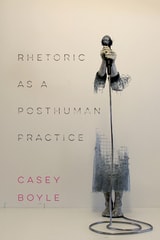
Rhetoric as a Posthuman Practice
Casey Boyle
The Ohio State University Press, 2018
Through case studies of the media art of glitch, urban explorers’ use of social media, and DIY digital networks, this book then reconsiders how practice/exercise functions when the once essential bodies of the individual and a society—the two primary categories authorized by a humanist paradigm—become less reliable categories from which we might orient rhetorical action. In sum, the book argues that rhetorical practice is irreducible to the traditions and categories of humanism and must now exercise its posthuman capacities.

Rhetoric of Health and Medicine As/Is
Theories and Approaches for the FieldEdited by Lisa Melonçon, S. Scott Graham, Jenell Johnson, John A. Lynch, and Cynthia Ryan
The Ohio State University Press, 2020
With a foreword by Judy Segal and in sections that address interdisciplinary perspectives, representations of health and illness in online spaces, and health activism and advocacy, this volume proceeds in a unique format: essays tackle these key topic areas through case studies ranging from food and its relation to public health, to apps that track fertility, to mental health and disability, to racial disparities that exist in public health campaigns about sudden infant death syndrome (SIDS). The essays within each section are then followed by responses from prominent scholars in the rhetoric of health and medicine—including John Lyne, J. Blake Scott, and Lisa Keränen—who take on the central theme and discuss how the theory or concept under study can and should evolve in the next stages of research. Unifying the essays is a consideration of RHM as a theoretical construct guiding research and thinking alongside the conceptual parameters that constitute what RHM is and can be in practice. In asking questions about the role of rhetoric—both as analytic and productive framework—in health and medicine, this volume engages with broader theoretical and ethical concerns about our current healthcare system and how healthcare and medical issues circulate in all the social, cultural, economic, and political aspects of our world.
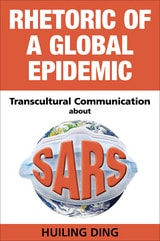
Rhetoric of a Global Epidemic
Transcultural Communication about SARSHuiling Ding
Southern Illinois University Press, 2014
2016 CCCC Best Book Award in Technical and Scientific Communication
In the past ten years, we have seen great changes in the ways government organizations and media respond to and report on emerging global epidemics. The first outbreak to garner such attention was SARS (severe acute respiratory syndrome). In Rhetoric of a Global Epidemic, Huiling Ding uses SARS to explore how various cultures and communities made sense of the epidemic and communicated about it. She also investigates the way knowledge production and legitimation operate in global epidemics, the roles that professionals and professional communicators, as well as individual citizens, play in the communication process, points of contention within these processes, and possible entry points for ethical and civic intervention.
Focusing on the rhetorical interactions among the World Health Organization, the United States, China, and Canada, Rhetoric of a Global Epidemic investigates official communication and community grassroots risk tactics employed during the SARS outbreak. It consists of four historical cases, which examine the transcultural risk communication about SARS in different geopolitical regions at different stages. The first two cases deal with risk communication practices at the early stage of the SARS epidemic when it originated in southern China. The last two cases move to transcultural rhetorical networks surrounding SARS.
With such threats as SARS, avian flu, and swine flu capturing the public imagination and prompting transnational public health preparedness efforts, the need for a rhetoric of global epidemics has never been greater. Government leaders, public health officials, health care professionals, journalists, and activists can learn how to more effectively craft and manage transcultural risk communication from Ding’s examination of the complex and varied modes of communication around SARS. In addition to offering a detailed case study, Rhetoric of a Global Epidemic provides a critical methodology that professional communicators can use in their investigations of epidemics and details approaches to facilitating more open, participatory risk communication at all levels.
Rhetorical Delivery as Technological Discourse
A Cross-Historical StudyBen McCorkle
Southern Illinois University Press, 2012
According to Ben McCorkle, the rhetorical canon of delivery—traditionally seen as the aspect of oratory pertaining to vocal tone, inflection, and physical gesture—has undergone a period of renewal within the last few decades to include the array of typefaces, color palettes, graphics, and other design elements used to convey a message to a chosen audience. McCorkle posits that this redefinition, while a noteworthy moment of modern rhetorical theory, is just the latest instance in a historical pattern of interaction between rhetoric and technology. In Rhetorical
Delivery as Technological Discourse: A Cross-Historical Study, McCorkle explores the symbiotic relationship between delivery and technologies of writing and communication. Aiming to enhance historical understanding by demonstrating how changes in writing technology have altered our conception of delivery, McCorkle reveals the ways in which oratory and the tools of written expression have directly affected one another throughout the ages.
To make his argument, the author examines case studies from significant historical moments in the Western rhetorical tradition. Beginning with the ancient Greeks, McCorkle illustrates how the increasingly literate Greeks developed rhetorical theories intended for oratory that incorporated “writerly” tendencies, diminishing delivery’s once-prime status in the process. Also explored is the near-eradication of rhetorical delivery in the mid-fifteenth century—the period of transition from late manuscript to early print culture—and the implications of the burgeoning
print culture during the nineteenth century.
McCorkle then investigates the declining interest in delivery as technology designed to replace the human voice and gesture became prominent at the beginning of the 1900s. Situating scholarship on delivery within a broader postmodern structure, he moves on to a discussion of the characteristics of contemporary hypertextual and digital communication and its role in reviving the canon, while also anticipating the future of communication technologies, the likely shifts in attitude toward delivery, and the implications of both on the future of teaching rhetoric.
Rhetorical Delivery as Technological Discourse traces a long-view perspective of rhetorical history to present readers a productive reading of the volatile treatment of delivery alongside the parallel history of writing and communication technologies. This rereading will expand knowledge of the canon by not only offering the most thorough treatment of the history of rhetorical delivery available but also inviting conversation about the reciprocal impacts of rhetorical theory and written communication on each other throughout this history.
Rhetorical Economies of Whiteness
Exploring the Intersections of Power, Privilege, and RaceEdited by Robert Asen and Casey Ryan Kelly
The Ohio State University Press, 2024
Contributors:
Godfried Asante, Robert Asen, Charles Athanasopoulos, Paulami Banerjee, Anne Bonds, Linsay M. Cramer, Derek G. Handley, V. Jo Hsu, Kelly Jensen, Casey Ryan Kelly, Kyle R. Larson, George (Guy) F. McHendry Jr., Thomas K. Nakayama, Adedoyin Ogunfeyimi, Rico Self, Stacey K. Sowards, Corinne Mitsuye Sugino
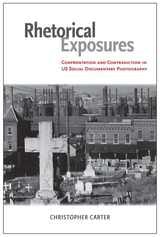
Rhetorical Exposures
Confrontation and Contradiction in US Social Documentary PhotographyChristopher Carter
University of Alabama Press, 2015
Exposing the politics of seeing: how documentary photographs confront inequality and reshape public understanding.
In Rhetorical Exposures, Christopher Carter explores social documentary photography from the nineteenth century to the present in order to illuminate the political dimensions and consequences of photographs taken and selected to highlight social injustice. Documentary photography aims to capture the material reality of life. Carter demonstrates how the creation and display of documentary photographs—often now called “imagetexts”—both invite analysis and raise persistent questions about the political and social causes for the bleak scenes of poverty and distress captured on film.
Carter’s carefully reasoned monograph examines both formal qualities of composition and the historical contexts of the production and display of documentary photographs. In Rhetorical Exposures, Carter explores Jacob Riis’s heartrending photos of Manhattan’s poor in late nineteenth-century New York, Walker Evans’s iconic images of tenant farmers in west Alabama, Ted Streshinsky’s images of 1960s social movements, Camilo José Vergara’s photographic landscapes of urban dereliction in the 1970s, and Chandra McCormick’s portraits of New Orleans’s Ninth Ward scarred by Hurricane Katrina.
While not ascribing specifically political or Marxist intentions to the photographers discussed, Carter frames his arguments in a class-based dialectic that addresses material want as an ineluctable result of social inequality. Carter argues that social documentary photography has the powerful capacity to disrupt complacent habits of viewing and to prompt viewers to confront injustice. Though photography may induce socially disruptive experiences, it remains vulnerable to the same power dynamics it subverts. Therefore, Carter offers a “rhetoric of exposure” that outlines how such social documentary images can be treated as highly tensioned rhetorical objects. His framework enables the analysis of photographs as heterogeneous records of the interaction of social classes and expressions of specific built environments. Rhetorical Exposures also discusses how photographs interact with oral and print media and relate to creations as diverse as public memorials, murals, and graphic novels.
As the creation and dissemination of new media continues to evolve in an environment of increasing anxiety about growing financial inequality, Rhetorical Exposures offers a very apt and timely discussion of the ways social documentary photography is created, employed, and understood.

Rhetorical Homologies
Form, Culture, ExperienceBarry Brummett
University of Alabama Press, 2009
A highly developed study of the relationships between rhetoric and public culture.
One of the most widely used ideas in scholarship of the humanities and social sciences is that of homology: a formal pattern structuring different kinds of texts, ideas, and experiences. Rhetorical Homologies explores the central meaning of this form in a variety of discourses and also examines the kind of homologies that shape audience responses to personal, public, and political issues. Barry Brummett is most interested in homologies among very different orders of experience and texts: experiences on the battlefield that are homologous to those at a dining room table, for instance. What the common patterns that underlie such cases mean, why they are interesting, and why homology is rhetorical are the subjects of this study.
Brummett focuses on a wide range of topics, from the homologies between rhetoric and weapons throughout history to the homology of ritual injuries as manifested in representations of Christian martyrs, Laurel and Hardy films, the African-American practice of playing the dozens, and televised professional wrestling. Brummett also explores the homology of the Wise Woman, using rhetorical representations of Sojourner Truth and Oprah Winfrey. In a concluding chapter, Brummett argues that the idea of homology is important in understanding how social life is organized in general and that the centrality of discourse in organizing experience makes rhetorical homologies an important perspective for general knowledge beyond the boundaries of this study.
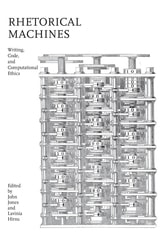
Rhetorical Machines
Writing, Code, and Computational EthicsEdited by John Jones and Lavinia Hirsu
University of Alabama Press, 2019
Rhetorical Machines addresses new approaches to studying computational processes within the growing field of digital rhetoric. While computational code is often seen as value-neutral and mechanical, this volume explores the underlying, and often unexamined, modes of persuasion this code engages. In so doing, it argues that computation is in fact rife with the values of those who create it and thus has powerful ethical and moral implications. From Socrates’s critique of writing in Plato’s Phaedrus to emerging new media and internet culture, the scholars assembled here provide insight into how computation and rhetoric work together to produce social and cultural effects.
This multidisciplinary volume features contributions from scholar-practitioners across the fields of rhetoric, computer science, and writing studies. It is divided into four main sections: “Emergent Machines” examines how technologies and algorithms are framed and entangled in rhetorical processes, “Operational Codes” explores how computational processes are used to achieve rhetorical ends, “Ethical Decisions and Moral Protocols” considers the ethical implications involved in designing software and that software’s impact on computational culture, and the final section includes two scholars’ responses to the preceding chapters. Three of the sections are prefaced by brief conversations with chatbots (autonomous computational agents) addressing some of the primary questions raised in each section.
At the heart of these essays is a call for emerging and established scholars in a vast array of fields to reach interdisciplinary understandings of human-machine interactions. This innovative work will be valuable to scholars and students in a variety of disciplines, including but not limited to rhetoric, computer science, writing studies, and the digital humanities.
Rhetorical Memory
A Study of Technical Communication and Information ManagementStewart Whittemore
University of Chicago Press, 2015
In Rhetorical Memory, Stewart Whittemore demonstrates that strategies we use to manage information—techniques often acquired through trial and error, rarely studied, and generally invisible to us—are as important to our success as the end products of our work. First, he situates information management within the larger field of rhetoric, showing that both are tied to purpose, audience, and situation. He then dives into an engaging and tightly focused workplace study, presenting three cases from a team of technical communicators making use of organizational memory during their everyday work. By examining which techniques succeed and which fail, Whittemore illuminates the challenges faced by technical communicators. He concludes with a number of practical strategies to better organize information, that will help employees, managers, and anyone else suffering from information overload.
Rhetorical Secrets
Mapping Gay Identity and Queer Resistance in Contemporary AmericaDavin Allen Grindstaff
University of Alabama Press, 2006
Exploring how language shapes sexuality, power, and belonging.
Davin Allen Grindstaff, through a series of close textual analyses examining public discourse, uncovers the rhetorical modes of persuasion surrounding the construction of gay male sexual identity. In Part One, Grindstaff establishes his notion of the "rhetorical secret" central to constructions of gay male identity: the practice of sexual identity as a secret, its promise of a coherent sexual self, and the perpetuation of secrecy as a product and strategy of heteronormative discourse.
Grindstaff continues in Part Two to examine major issues related to contemporary conceptions of gay male identity: overturning sodomy laws; public debates over same-sex marriages; medical and social responses to the HIV/AIDS crisis; the rhetorical power of hyper-masculine body images and homoeroticism to creative communities; and, finally, what Grindstaff considers to be the most mysterious and significant rhetorical practice of all: coming out of the closet.
By investigating the public discourse--texts and images that circulate, produce knowledge, and become means of persuasion--surrounding the constructions of sexual identity, Grindstaff challenges heteronormative concepts of sexuality itself, thus creating new maps of social power and new paths of resistance.
Rhetorics of Whiteness
Postracial Hauntings in Popular Culture, Social Media, and EducationEdited by Tammie M. Kennedy, Joyce Irene Middleton, Krista Ratcliffe, with a foreword by Lilia D. Monzó and Peter McLaren
Southern Illinois University Press, 2017
With the election of our first black president, many Americans began to argue that we had finally ended racism, claiming that we now live in a postracial era. Yet near-daily news reports regularly invoke white as a demographic category and recount instances of racialized violence as well as an increased sensitivity to expressions of racial unrest. Clearly, American society isn’t as color-blind as people would like to believe. In Rhetorics of Whiteness: Postracial Hauntings in Popular Culture, Social Media, and Education, contributors reveal how identifications with racialized whiteness continue to manifest themselves in American culture.
The sixteen essays that comprise this collection not only render visible how racialized whiteness infiltrates new twenty-first-century discourses and material spaces but also offer critical tactics for disrupting this normative whiteness. Specifically, contributors examine popular culture (novels, films, TV), social media (YouTube, eHarmony, Facebook), education (state law, the textbook industry, dual credit programs), pedagogy (tactics for teaching via narratives, emotional literacy, and mindfulness) as well as cultural theories (concepts of racialized space, anti-dialogicism, and color blindness). Offering new approaches to understanding racialized whiteness, this volume emphasizes the importance of a rhetorical lens for employing whiteness studies’ theories and methods to identify, analyze, interpret, and interrupt representations of whiteness.
Although whiteness studies has been waning as an active research field for the past decade, the contributors to Rhetorics of Whiteness assert that it hasn’t lost its relevancy because racialized whiteness and issues of systemic racism persist in American society and culture today. Few whiteness studies texts have been published in rhetoric and composition in the past decade, so this collection should quickly become mandatory reading. By focusing on common, yet often overlooked, contemporary examples of how racialized whiteness haunts U.S. society, Rhetorics of Whiteness serves as a valuable text for scholars in the field as well as anyone else interested in the topic.

Rooted Resistance
Agrarian Myth in Modern AmericaNorie R. Singer
University of Arkansas Press, 2020
Through a careful examination of several case studies, Rooted Resistance traverses the ground of agrarian myth in modern America. The authors investigate key figures and movements in the history of modern agrarianism, including the World War I victory garden efforts, the postwar Country Life movement for the vindication of farmers’ rights, the Southern Agrarian critique of industrialism, and the practical and spiritual prophecy of organic farming put forth by J. I. Rodale. This critical history is then brought up to date with recent examples such as the contested South Central Farm in urban Los Angeles and the spectacular rise and fall of the Chipotle “Food with Integrity” branding campaign.
By examining a range of case studies, Singer, Grey, and Motter aim for a deeper critical understanding of the many applications of agrarian myth and reveal why it can help provide a pathway for positive systemic change in the food system.

Ruth Bader Ginsburg’s Legacy of Dissent
Feminist Rhetoric and the LawKatie L. Gibson
University of Alabama Press, 2018
A rhetorical analysis of Justice Ruth Bader Ginsburg’s feminist jurisprudence.
Ruth Bader Ginsburg’s lifelong effort to reshape the language of American law has had profound consequences: she has shifted the rhetorical boundaries of jurisprudence on a wide range of fundamental issues from equal protection to reproductive rights. Beginning in the early 1970s, Ginsburg led a consequential attack on sexist law in the United States. By directly confronting the patriarchal voice of the law, she pointedly challenged an entrenched genre of legal language that silenced the voices and experiences of American women and undermined their status as equal citizens. On the United States Supreme Court, Justice Ginsburg continues to challenge the traditional scripts of legal discourse to insist on a progressive vision of the Constitution and to demand a more inclusive and democratic body of law.
This illuminating work examines Justice Ruth Bader Ginsburg’s contributions in reshaping the rhetoric of the law (specifically through the lens of watershed cases in women’s rights) and describes her rhetorical contributions—beginning with her work in the 1970s as a lawyer and an advocate for the ACLU’s Women’s Rights Project through her tenure as a Supreme Court justice. Katie L. Gibson examines Ginsburg’s rhetoric to argue that she has dramatically shifted the boundaries of legal language. Gibson draws from rhetorical theory, critical legal theory, and feminist theory to describe the law as a rhetorical genre, arguing that Ginsburg’s jurisprudence can appropriately be understood as a direct challenge to the traditional rhetoric of the law.
Ruth Bader Ginsburg stands as an incredibly important figure in late twentieth- and early twenty-first-century feminism. While a growing number of admirers celebrate Justice Ginsburg’s voice of dissent today, Ginsburg’s rhetorical legacy reveals that she has long articulated a sharp and strategic voice of judicial dissent. This study contributes to a more complete understanding of her feminist legacy by detailing the unique contributions of her legal rhetoric.