Results by title
324 books match the query 'Comparative literature' and 10 start with r
Race and the Rhetoric of Resistance
Jeffrey B. Ferguson
Rutgers University Press, 2021
Race to Infinity
Early Modern Distinctions Between Literature and ScienceDavid L. Sedley
Northwestern University Press, 2027
Studying the early modern split between science and literature and the aftermath of their division
The conception of computers as thinking machines and literature as a social field stems from the early modern phenomenon of competing over the infinite as an object not just of contemplation but of appropriation in a race toward virtual control. The rediscovery of this origin undoes a collective forgetting of what technology and texts have in common, what they don’t, and what they can and ought to be in the future. David L. Sedley offers a new history of literature and science’s disciplinary divide—its origin and significance—tracing a series of points along the emerging frontier between these two fields. At each point there are two objects in play and two authors who push the objects in opposite directions: on the one hand, mechanical arts and the essay, probability theory and the novel, and geometry and epic; on the other, Montaigne and Bacon, Pascal and Lafayette, and Hobbes and Milton. Each of these authors, Sedley shows, tried to render an object either algorithmic or infinite to oppose the other’s efforts. Ultimately, Race to Infinity: Early Modern Distinctions Between Literature and Science illuminates the fortunes of the literary in the digital revolution and beyond.
Reading Embodied Citizenship
Disability, Narrative, and the Body PoliticRussell, Emily
Rutgers University Press, 2011
Liberal individualism, a foundational concept of American politics, assumes an essentially homogeneous population of independent citizens. When confronted with physical disability and the contradiction of seemingly unruly bodies, however, the public searches for a story that can make sense of the difference. The narrative that ensues makes "abnormality" an important part of the dialogue about what a genuine citizen is, though its role is concealed as an exception to the rule of individuality rather than a defining difference. Reading Embodied Citizenship brings disability to the forefront, illuminating its role in constituting what counts as U.S. citizenship.
Drawing from major figures in American literature, including Mark Twain, Flannery O'Connor, Carson McCullers, and David Foster Wallace, as well as introducing texts from the emerging canon of disability studies, Emily Russell demonstrates the place of disability at the core of American ideals. The narratives prompted by the encounter between physical difference and the body politic require a new understanding of embodiment as a necessary conjunction of physical, textual, and social bodies. Russell examines literature to explore and unsettle long-held assumptions about American citizenship.
Reading Hegel
Irony, Recollection, CritiqueRobert Lucas Scott
University of Chicago Press, 2025
The relationship between Hegel and literary theory has for a long time been both contested and paradoxical. On the one hand, “theory” is often skeptical of all that Hegel ostensibly stood for: idealism, systematicity, and identity at the expense of difference. Yet, in spite of itself, literary theory is taken to owe a profound debt to Hegel’s philosophy. Robert Lucas Scott’s book complicates this account and argues that literary theory has made the mistake of abstracting Hegel’s thought from its more dynamic presentation in Hegel’s writings, reducing “Hegel” to a series of propositions or positions. Literary theory, Scott argues, misses what is perhaps the greatest innovation of Hegel’s philosophy: a presentation of experience that begins precisely by setting aside all preconceptions or prior assumptions. It is on this point that Hegel’s philosophy itself approaches literature: its content cannot be simply abstracted from the singular experience of reading it. Only through a mode of reading alive to speculative experience can literary theory become truly Hegelian. Scott’s exposition of Hegel offers a model of reading with relevance beyond philosophy: one that is critical without pretensions of mastery and detachment and that honors the singularity of the reading experience without succumbing to the subjectivism of the “postcritical.”
The book also includes engagements with the work of Luther, Kant, Marx, Gillian Rose, Fredric Jameson, Robert Brandom, Catherine Malabou, and more in its recovery of Hegel’s thought for a critical understanding of our time.
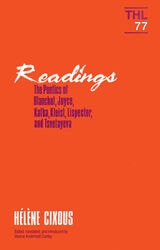
Readings
The Poetics of Blanchot, Joyce, Kakfa, Kleist, Lispector, and TsvetayevaHelene Cixous
University of Minnesota Press, 1991
Readings: The Poetics of Blanchot, Joyce, Kafka, Kleist, Lispector, and Tsvetayeva offers striking and novel textual studies of major literary figures and emergent authors. Selected from Cixous’s seminars taught between 1980 and 1986 at the Universite de Paris VII (Saint-Denis) and at the College International de Philosophie, the texts chronicle the French intellectual scene with its shifting tastes over the decade following May 1986.
In their simple and accessible language, the texts can be read as inspiration for Cixous’s fictional and critical practices. They not only introduce readers to emergent texts from Brazil and Russia, such as Clarice Lispector’s “Foreign Legion” and Marina Tsvetayeva’s “Mother and Music,” but also give new, incisive insights into Joyce’s Portrait of the Artist and Kafka’s “Before the Law.” Drawing from philosophy and psychoanalysis, Readings: The Poetics of Blanchot, Joyce, Kafka, Kleist, Lispector, and Tsvetayeva can be read side-by-side with Reading with Clarice Lispector, as an ongoing meditation on ethics and poetics.Also from MinnesotaReading with Clarice LispectorHelene CixousEdited, translated, and introduced by Verena Andermatt ConleyFor Cixous, Lispector’s work represents one of the finest examples of ecriture feminine in that she practices, in writing, what Cixous is searching for in her theoretical practice: the giving, spending, and inscribing of pleasure; an apprenticeship in the lessons of life.Theory and History of Literature, volume 73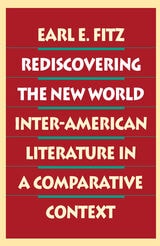
Rediscovering The New World
Inter-American LiteratureEarl E. Fitz
University of Iowa Press, 1991
The concept of "American" literature is not the exclusive province of any one nation. Thanks to the historical circumstances that governed the European conquest and settlement of the Americas, we can and should approach the writings of English and French Canada, the United States, Spanish America, and Brazil as a cohesive group of American literature, worthy of study without constant reference to European texts. Now, Rediscovering the New World makes a timely addition to this expanding field on Inter-American scholarship that should help lead tothe formation of a new canon.
This adventurous and ambitious work begins with an examination of Pre-Columbian literature (and shows that his powerful tradition remains alive and well in the twentieth century), then confronts the narratives of discovery and conquest, the New World epic, identity as the Ur-theme of American literature, miscegenation as another integral theme, and regionalism as a shaping force. Other striking these and juxtapositions include a comparison of Henry James and Machado de Assis as the first two great New World novelists, modernism as both a distinct literary movement and an amorphous body of aesthetic principles, and the conflict between "civilization" and "barbarism."
More in the exploratory spirit of the French Canadian voyageur than in the spirit of the conquistador, Rediscovering the New World is the first scholarly work in English to integrate an international set of American literary cultures. It should inspire other explorers as the field of Inter-American literary relations continues to evolve.
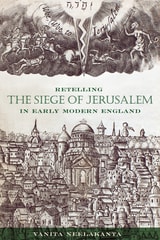
Retelling the Siege of Jerusalem in Early Modern England
Vanita Neelakanta
University of Delaware Press, 2019
Published by University of Delaware Press. Distributed worldwide by Rutgers University Press.
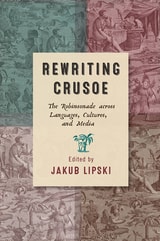
Rewriting Crusoe
The Robinsonade across Languages, Cultures, and MediaJakub Lipski
Bucknell University Press, 2020
Published by Bucknell University Press. Distributed worldwide by Rutgers University Press.
Rivers in Russian Literature
Margaret Ziolkowski
University of Delaware Press, 2011
Published by University of Delaware Press. Distributed worldwide by Rutgers University Press.
Robinson Crusoe after 300 Years
Andreas K. E. Mueller
Bucknell University Press, 2021