Results by title
81 books match the query 'Creation' and 8 start with r
Rabbi Esriel Hildesheimer and the Creation of a Modern Jewish Orthodoxy
David Ellenson
University of Alabama Press, 1990
Tradition, Modernity, and the Making of Modern Orthodoxy.
For many histories of Modern Orthodox Judaism, Rabbi Samson Raphael Hirsch stands as the primary architect of the movement's encounter with modernity. In Rabbi Esriel Hildesheimer and the Creation of a Modern Jewish Orthodoxy, distinguished scholar David Ellenson expands that narrative by recovering the life, thought, and enduring influence of one of Hirsch's most important contemporaries. Through a careful examination of Rabbi Esriel Hildesheimer's writings, leadership, educational initiatives, and responses to the social and intellectual challenges of nineteenth-century Europe, Ellenson demonstrates how Hildesheimer helped forge a model of Orthodoxy that remained firmly committed to Jewish tradition while engaging constructively with the modern world.
Set against a period of profound cultural, political, and religious transformation, this volume explores the tensions confronting European Jewry as modernization, secular education, religious pluralism, and changing political realities reshaped Jewish communal life. Ellenson shows how Hildesheimer addressed these challenges not through rigid isolation but through a pragmatic and intellectually sophisticated approach that balanced fidelity to halakhah with openness to selected aspects of modern culture and scholarship. His vision helped establish a framework for Modern Orthodoxy that continues to influence contemporary Jewish thought and practice.
Beyond its biographical focus, the study provides broader insights into the emergence of Modern Orthodoxy as a religious and intellectual movement. By illuminating Hildesheimer's efforts to integrate traditional scholarship with contemporary realities, Ellenson offers readers a deeper understanding of how Judaism has negotiated the relationship between heritage and change. The result is both a compelling portrait of an influential rabbinic figure and an important examination of the forces that shaped modern Jewish religious identity.
Rabbi Esriel Hildesheimer and the Creation of a Modern Jewish Orthodoxy is essential reading for scholars and students of Jewish studies, religious studies, theology, European history, intellectual history, and modern Judaism. It will also appeal to rabbis, educators, and general readers seeking to understand the historical roots of contemporary Orthodox Jewish life and the ongoing dialogue between tradition and modernity.
Re-Creating Primordial Time
Foundation Rituals and Mythology in the Postclassic Maya CodicesGabrielle Vail and Christine Hernández
University Press of Colorado, 2013
Remarkable similarities exist within the Maya tradition, even as new mythologies were introduced through contact with the Gulf Coast region and highland central Mexico. Vail and Hernández analyze the extant Maya codices within the context of later literary sources such as the Books of Chilam Balam, the Popol Vuh, and the Códice Chimalpopoca to present numerous examples highlighting the relationship among creation mythology, rituals, and lore. Compiling and comparing Maya creation mythology with that of the Borgia codices from highland central Mexico, Re-Creating Primordial Time is a significant contribution to the field of Mesoamerican studies and will be of interest to scholars of archaeology, linguistics, epigraphy, and comparative religions alike.
Reconsidering Olmec Visual Culture
The Unborn, Women, and CreationBy Carolyn E. Tate
University of Texas Press, 2012
Recently, scholars of Olmec visual culture have identified symbols for umbilical cords, bundles, and cave-wombs, as well as a significant number of women portrayed on monuments and as figurines. In this groundbreaking study, Carolyn Tate demonstrates that these subjects were part of a major emphasis on gestational imagery in Formative Period Mesoamerica. In Reconsidering Olmec Visual Culture, she identifies the presence of women, human embryos, and fetuses in monuments and portable objects dating from 1400 to 400 BC and originating throughout much of Mesoamerica. This highly original study sheds new light on the prominent roles that women and gestational beings played in Early Formative societies, revealing female shamanic practices, the generative concepts that motivated caching and bundling, and the expression of feminine knowledge in the 260-day cycle and related divinatory and ritual activities.
Reconsidering Olmec Visual Culture is the first study that situates the unique hollow babies of Formative Mesoamerica within the context of prominent females and the prevalent imagery of gestation and birth. It is also the first major art historical study of La Venta and the first to identify Mesoamerica's earliest creation narrative. It provides a more nuanced understanding of how later societies, including Teotihuacan and West Mexico, as well as the Maya, either rejected certain Formative Period visual forms, rituals, social roles, and concepts or adopted and transformed them into the enduring themes of Mesoamerican symbol systems.
Reel World
An Anthropology of CreationAnand Pandian
Duke University Press, 2015
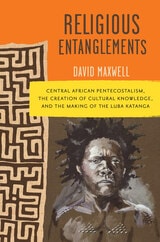
Religious Entanglements
Central African Pentecostalism, the Creation of Cultural Knowledge, and the Making of the Luba KatangaDavid Maxwell
University of Wisconsin Press, 2023
Through the careful reconstruction of knowledge pathways, Maxwell brings into focus the role of Africans in shaping texts, collections, and images as well as in challenging and adapting Western-imported presuppositions and prejudices. Ultimately, Maxwell illustrates the mutually constitutive nature of discourses of identity in colonial Africa and reveals not only how the Luba shaped missionary research but also how these coproducers of knowledge constructed and critiqued custom and convened new ethnic communities.
Making a significant intervention in the study of both the history of African Christianity and the cultural transformations effected by missionary encounters across the globe, Religious Entanglements excavates the subculture of African Pentecostalism, revealing its potentiality for radical sociocultural change.
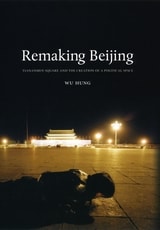
Remaking Beijing
Tiananmen Square and the Creation of a Political SpaceWu Hung
University of Chicago Press, 2005
Wu Hung grew up in Beijing and experienced much of the city's makeover firsthand. In this lavishly illustrated work, he offers a vivid, often personal account of the struggle over Beijing's reinvention, drawing particular attention to Tiananmen Square—the most sacred space in the People's Republic of China. Remaking Beijing considers the square's transformation from a restricted imperial domain into a public arena for political expression, from an epic symbol of socialism into a holy relic of the Maoist regime, and from an official and monumental complex into a site for unofficial and antigovernment demonstrations.
Wu Hung also explores how Tiananmen Square has become a touchstone for official art in modern China—as the site for Mao's monumental portrait, as the location of museums narrating revolutionary history, and as the grounds for extravagant National Day parades celebrating the revolutionary masses. He then shows how in recent years the square has inspired artists working without state sponsorship to create paintings, photographs, and even performances that reflect the spirit of the 1989 uprisings and pose a forceful challenge to official artworks and the sociopolitical system that supports them.
Remaking Beijing will reward anyone interested in modern Chinese history, society, and art, or, more generally, in how urban renewal becomes intertwined with cultural and national politics.

Remembering and Repeating
On Milton's Theology and PoeticsRegina M. Schwartz
University of Chicago Press, 1993
"A brilliant study that quietly but powerfully recharacterizes many of the contexts of discussion in Milton criticism. Particularly noteworthy is Schwartz's ability to introduce advanced theoretical perspectives without ever taking the focus of attention away from the dynamics and problematics of Milton's poem."—Stanley Fish
Rubbish Theory
The Creation and Destruction of Value - New EditionMichael Thompson
Pluto Press, 2017
When his highly influential Rubbish Theory, first published in 1979, Michael Thompson launched the discipline of waste studies. It remains the most comprehensive analysis on the culture of waste to date. Thompson argues that there are two mutually exclusive cultural categories that are socially imposed on the world of objects: a transient category and a durable category. However, he identifies a region of flexibility, wherein a transient object that declines in value and life span can linger in a valueless and timeless limbo of rubbish, until it is discovered by a creative individual and transferred into something deemed durable. He links stability and change on one hand, with materiality on the other, providing a rich analysis of social and cultural dynamics. His instrumental theory of rubbish draws on case studies and anthropological fieldwork to highlight the ever-changing subtleties of object value and our complex relationship to waste.
Bringing Rubbish Theory back into print, this updated edition includes a new introduction, preface, foreword, and afterword, thoroughly exploring how Thompson’s key theories have affected our world in the four decades since it was first published and placing it in a contemporary context that shines light on the continued relevance of the book today.