Results by title
345 books match the query 'Design' and 10 start with r

Ready Player Two
Women Gamers and Designed IdentityShira Chess
University of Minnesota Press, 2017
Cultural stereotypes to the contrary, approximately half of all video game players are now women. A subculture once dominated by men, video games have become a form of entertainment composed of gender binaries. Supported by games such as Diner Dash, Mystery Case Files, Wii Fit, and Kim Kardashian: Hollywood—which are all specifically marketed toward women—the gamer industry is now a major part of imagining what femininity should look like.
In Ready Player Two, media critic Shira Chess uses the concept of “Player Two”—the industry idealization of the female gamer—to examine the assumptions implicit in video games designed for women and how they have impacted gaming culture and the larger society. With Player Two, the video game industry has designed specifically for the feminine ideal: she is white, middle class, heterosexual, cis-gendered, and abled. Drawing on categories from time management and caregiving to social networking, consumption, and bodies, Chess examines how games have been engineered to shape normative ideas about women and leisure.
Ready Player Two presents important arguments about how gamers and game developers must change their thinking about both women and games to produce better games, better audiences, and better industry practices. Ultimately, this book offers vital prescriptions for how one of our most powerful entertainment industries must evolve its ideas of women.
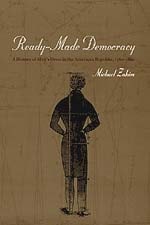
Ready-Made Democracy
A History of Men's Dress in the American Republic, 1760-1860Michael Zakim
University of Chicago Press, 2003
By the early nineteenth century, homespun began to disappear from the American material landscape. Exhortations of industry and modesty, however, remained a common fixture of public life. In fact, they found expression in the form of the business suit. Here, Zakim traces the evolution of homespun clothing into its ostensible opposite—the woolen coats, vests, and pantaloons that were "ready-made" for sale and wear across the country. In doing so, he demonstrates how traditional notions of work and property actually helped give birth to the modern industrial order. For Zakim, the history of men's dress in America mirrored this transformation of the nation's social and material landscape: profit-seeking in newly expanded markets, organizing a waged labor system in the city, shopping at "single-prices," and standardizing a business persona.
In illuminating the critical links between politics, economics, and fashion in antebellum America, Ready-Made Democracy will prove essential to anyone interested in the history of the United States and in the creation of modern culture in general.
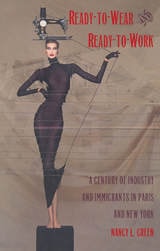
Ready-to-Wear and Ready-to-Work
A Century of Industry and Immigrants in Paris and New YorkNancy L. Green
Duke University Press, 1997
Green focuses on issues of fashion and fabrication as they involve both the production and consumption of clothing. Traditionally, much of the urban garment industry has been organized around small workshops and flexible homework, and Green emphasizes the effect this labor organization had on the men and mostly women who have sewn the garments. Whether considering the immigrant Jews, Italians, Puerto Ricans, Dominicans, and Chinese in New York or the Chinese-Cambodians, Turks, Armenians, and Russian, Polish, and Tunisian Jews in Paris, she outlines similarities of social experience in the shops and the unions, while allowing the voices of the workers, in all their diversity to be heard.
A provocative examination of gender and ethnicity, historical conflict and consensus, and notions of class and cultural difference, Ready-to-Wear and Ready-to-Work breaks new ground in the methodology of comparative history.
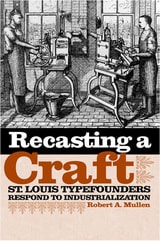
Recasting a Craft
St. Louis Typefounders Respond to IndustrializationRobert A. Mullen
Southern Illinois University Press, 2005
In the nineteenth and early twentieth centuries, type for newspapers and books was set one letter at a time, and the manufacturers of the metal type used in the printing trade were called typefounders. This prominent yet rarely documented industry was essential to the development of modern American publishing and was particularly prevalent in St. Louis. In Recasting a Craft: St. Louis Typefounders Respond to Industrialization, Robert A. Mullen recognizes the city’s significant contributions to typefounding and details how the craft fundamentally changed through mechanization, growth, and the creation of a large conglomerate.
Like many trades of the nineteenth and early twentieth centuries that were eventually lost to industrialization, the typefoundries of St. Louis grew from small shops to factories with organized labor. Mullen describes three distinct periods of the industry that emerged in St. Louis’s typefounding trade: the early struggles in establishing the industry there, the period of intense competition and creative enterprise, and the proliferation of new companies that appealed to those customers who felt alienated by the monopolizing older companies.
Mullen discusses at length the technological, social, and demographic foundations of the immense growth of the trade in the nineteenth century, identifying the changes in typographical design and the demand for it in the new era of advertising. He also profiles the workers, working conditions, and labor issues—such as the failed industry-wide strike of 1903—that emerged as the craft of typefounding entered the industrial age. More than two hundred type designs that originated with the St. Louis firms are listed in an appendix with examples of each face. The volume also contains a list of the catalogs of the St. Louis typefoundries known to exist in the public and academic libraries of the United States.

Regional Economic Institutions and Conflict Mitigation
Design, Implementation, and the Promise of PeaceYoram Z. Haftel
University of Michigan Press, 2014
In addition to the explicit goal of advancing mutual economic interests, regional economic organizations (REOs) are intended to foster regional cohesion and peace. Drawing on a data set detailing the institutional features of 25 REOs established during the 1980s and 1990s, complemented by a case study of ASEAN, Yoram Z. Haftel investigates the factors that affect REOs' ability to mitigate interstate military conflict. He finds fewer interstate conflicts among REO members who have developed high levels of economic integration and who cultivate regular interaction among member-states' representatives. Haftel concludes that, with an appropriate institutional design and fully implemented agreements, an REO can indeed play a role in mitigating interstate conflict and make a meaningful contribution to regional peace.

Responsive Web Design for Libraries
A LITA GuideAmerican Library Association, 2014
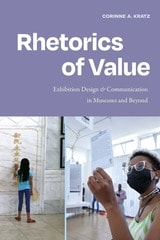
Rhetorics of Value
Exhibition Design and Communication in Museums and BeyondCorinne A. Kratz
Duke University Press, 2025

Rise Of Fashion
A ReaderDaniel Leonhard Purdy
University of Minnesota Press, 2004
A remarkable anthology of key writings that parallels the history of fashion with modern life
Writing more than a century before Vogue, no less a figure than G. W. F. Hegel reviewed the fashion of his day and found it wanting because, in becoming outmoded so quickly, it drew attention away from the timeless beauty of the human form. And Hegel is not unique among philosophers in his interest in fashion’s role; for more than 250 years, social thinkers have considered fashion—its transitive nature, the conformity it inspires, the vast range of its influence—as a defining feature of modern life.
In The Rise of Fashion, Daniel Leonhard Purdy brings together key writings from the Enlightenment to the twentieth century that explore fashion as the ultimate expression of modernity. Making available many previously untranslated or otherwise unfamiliar works from French, German, and English, Purdy establishes an extraordinary lineage of fashion commentary dating back to Mandeville and Voltaire, which laid the groundwork for the writings on commodity culture of Adorno, Benjamin, and the Frankfurt School. From critiques of aristocratic excess to accounts of fashion’s influence on our ideals of masculinity or femininity, from the figure of the dandy and the eroticism of clothing to the class politics of fashion, this landmark reader includes works by philosophers (Carlyle, Rousseau, Georg Simmel) and social theorists (Herbert Spencer, Veblen), as well as writers (Goethe, Baudelaire, Mallarmé, Wilde) and critics (Karl Kraus, Adolf Loos, Simone de Beauvoir).Collecting and contextualizing many of the earliest and most significant formulations of fashion theory, The Rise of Fashion provocatively examines the proposition that to be modern is to be fashionable.
Ronald Searle in Le Monde
Ronald Searle
University of Chicago Press, 2002
Since 1995, Searle has plied his sardonic trade on the coveted op-ed pages of the French daily newspaper Le Monde. This book presents more than a hundred of the best of these cartoons, ranging across politics, the new Europe, the nature of the contemporary economy, social games, and various "angels," both benign and mischievous. Whether skewering the greed of the rich with images of men in suits padding each other's pockets with cash or conducting business under the table, or making a poignant comment about how much harder peace has to work than war to stay in the same place, Searle displays the same pungent, incisive, yet infinitely humane wit. The deceptive simplicity of his lines and shadings combine with meticulously observed details of dress, background, and facial expression to produce arresting images that convey his messages powerfully and beautifully.
By turns delightful, amusing, and disturbing, but always deeply thought provoking, Searle's work reaches well beyond the specific occasion that inspired a given cartoon to illuminate key aspects of public life in the West at the end of the millennium. This book contains twenty-five illustrations not found in the French edition, together with a new preface for English-speaking readers written by Searle himself.
Rules and Restraint
Government Spending and the Design of InstitutionsDavid M. Primo
University of Chicago Press, 2007
One reason budget rules are ineffective, David Primo shows, is that politicians often create and preserve loopholes to protect programs that benefit their constituents. Another reason is that legislators must enforce their own provisions, an arrangement that is seriously compromised by their unwillingness to abide by rules that demand short-term sacrifices for the sake of long-term gain. Convinced that budget rules enacted through such a flawed legislative process are unlikely to work, Primo ultimately calls for a careful debate over the advantages and drawbacks of a constitutional convention initiated by the states—a radical step that would bypass Congress to create a path toward change. Rules and Restraint will be required reading for anyone interested in institutional design, legislatures, and policymaking.