Results by title
117 books match the query 'Digital media' and 5 start with r

Really Fake
Alexandra Juhasz
University of Minnesota Press, 2020
The new truth is the one that circulates: digital truth emerges from lists, databases, archives, and conditions of storage. Multiple truths may be activated through search, link, and retrieve queries. Alexandra Juhasz, Ganaele Langlois, and Nishant Shah respond by taking up story, poetry, and other human logics of care, intelligence, and dignity to explore sociotechnological and politico-aesthetic emergences in a world where information overload has become a new ontology of not-knowing. Their feminist digital methods allow considerations of internet things through alternative networked internet time: slowing down to see, honor, and engage with our past; invoking indeterminacy as a human capacity that lets multiple truths commingle on a page or in a body; and saving the truths of ourselves and our others differently from the corporate internet’s perpetual viral movement.
Writing across their own shared truisms, actors, and touchstones, the authors propose creative tactics, theoretical overtures, and experimental escape routes built to a human scale as ways to regain our capacities to know and tell truths about ourselves.
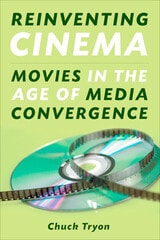
Reinventing Cinema
Movies in the Age of Media ConvergenceTryon, Chuck
Rutgers University Press, 2009
Reinventing Cinema examines film culture at the turn of this century, at the precise moment when digital media are altering our historical relationship with the movies. Spanning multiple disciplines, Chuck Tryon addresses the interaction between production, distribution, and reception of films, television, and other new and emerging media.Through close readings of trade publications, DVD extras, public lectures by new media leaders, movie blogs, and YouTube videos, Tryon navigates the shift to digital cinema and examines how it is altering film and popular culture.
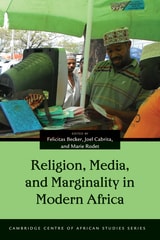
Religion, Media, and Marginality in Modern Africa
Felicitas Becker
Ohio University Press, 2018
In recent years, anthropologists, historians, and others have been drawn to study the profuse and creative usages of digital media by religious movements. At the same time, scholars of Christian Africa have long been concerned with the history of textual culture, the politics of Bible translation, and the status of the vernacular in Christianity. Students of Islam in Africa have similarly examined politics of knowledge, the transmission of learning in written form, and the influence of new media. Until now, however, these arenas—Christianity and Islam, digital media and “old” media—have been studied separately.
Religion, Media, and Marginality in Modern Africa is one of the first volumes to put new media and old media into significant conversation with one another, and also offers a rare comparison between Christianity and Islam in Africa. The contributors find many previously unacknowledged correspondences among different media and between the two faiths. In the process they challenge the technological determinism—the notion that certain types of media generate particular forms of religious expression—that haunts many studies. In evaluating how media usage and religious commitment intersect in the social, cultural, and political landscapes of modern Africa, this collection will contribute to the development of new paradigms for media and religious studies.
Contributors: Heike Behrend, Andre Chappatte, Maria Frahm-Arp, David Gordon, Liz Gunner, Bruce S. Hall, Sean Hanretta, Jorg Haustein, Katrien Pype, and Asonzeh Ukah.
Rhetorical Speculations
The Future of Rhetoric, Writing, and TechnologyScott Sundvall
Utah State University Press, 2019
Rhetoric and writing studies often engages technological shifts reactively, after the production and reception of rhetoric and writing has changed. This collection allows rhetoric and writing scholars to explore modes of critical speculation into the transformative effect of emerging technologies, particularly as a means to speculate on future shifts in the intellectual, pedagogical, and institutional frameworks of the field. In doing so, the project repositions rhetoric and writing scholars as proprietors of our technological future to come rather than as secondary receivers, critics, and adjusters of the technological present.
Major and emerging voices in the field offer a range of styles that include pragmatic, technical, and philosophical approaches to the issue of speculative rhetoric, exploring what new media/writing studies could be—theoretically, pedagogically, and institutionally—as future technologies begin to impinge on the work of writing. Rhetorical Speculations is at the cutting edge of the subject of futures thinking and will have broad appeal to scholars of rhetoric, literacy, futures studies, and material and popular culture.
Contributors:
Bahareh Brittany Alaei, Sarah J. Arroyo, Kristine L. Blair, Geoffrey V. Carter, Sid Dobrin, Kristie S. Fleckenstein, Steve Holmes, Kyle Jensen, Halcyon Lawrence, Alexander Monea, Sean Morey, Alex Reid, Jeff Rice, Gregory L. Ulmer, Anna Worm
Rhetorics of the Digital Nonhumanities
Alex Reid
Southern Illinois University Press, 2021
In Rhetorics of the Digital Nonhumanities, author Alex Reid fashions a potent vocabulary from new materialist theory, media theory, postmodern theory, and digital rhetoric to rethink the connections between humans and digital media. Addressed are the familiar concerns that scholars have with digital culture: how technologies affect attention spans, how digital media are used to compose, and how digital rhetoric is taught.
Rhetoric is now regularly defined as including human and nonhuman actors. Each actor influences the thoughts, arguments, and sentiments that journey through systems of processors, algorithms, humans, air, and metal. The author’s arguments, even though they are unnerving, orient rhetorical practices to a more open, deliberate, and attentive awareness of what we are truly capable of and how we become capable. This volume moves beyond viewing digital media as an expression of human agency. Humans, formed into new collectives of user populations, must negotiate rather than command their way through digital media ecologies.
Chapters centralize the most pressing questions: How do social media algorithms affect our judgment? How do smart phones shape our attention? These questions demand scholarly practice for attending the world around us. They explore attention and deliberation to embrace digital nonhuman composition. Once we see this brave new world, Reid argues, we are compelled to experiment.