Results by title
204 books match the query 'Direction & Production' and 10 start with r
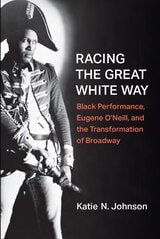
Racing the Great White Way
Black Performance, Eugene O’Neill, and the Transformation of BroadwayKatie N. Johnson
University of Michigan Press, 2023
Finalist: 2023 Theatre Library Association George Freedley Memorial Award
The early drama of Eugene O’Neill, with its emphasis on racial themes and conflicts, opened up extraordinary opportunities for Black performers to challenge racist structures in modern theater and cinema. By adapting O’Neill’s dramatic writing—changing scripts to omit offensive epithets, inserting African American music and dance, or including citations of Black internationalism--theater artists of color have used O’Neill’s texts to raze barriers in American and transatlantic theater.
Challenging the widely accepted idea that Broadway was the white-hot creative engine of U.S. theater during the early 20th century, author Katie N. Johnson reveals a far more complex system of exchanges between the Broadway establishment and a vibrant Black theater scene in New York and beyond to chart a new history of American and transnational theater. In spite of their dichotomous (and at times problematic) representation of Blackness, O’Neill’s plays such as The Emperor Jones and All God’s Chillun Got Wings make ideal case studies because of the way these works stimulated traffic between Broadway and Harlem—and between white and Black America. These investigations of O’Neill and Broadway productions are enriched by the vibrant transnational exchange found in early to mid-20th century artistic production. Anchored in archival research, Racing the Great White Way recovers not only vital lost performance histories, but also the layered contexts for performing bodies across the Black Atlantic and the Circum-Atlantic.
Reality Fictions
The Films of Frederick WisemanThomas W. Benson and Carolyn Anderson
Southern Illinois University Press, 2002
Providing in-depth accounts and close critical examinations of nine of Wiseman’s films—Titicut Follies, High School, Basic Training, Essene, Juvenile Court, Primate, Welfare, Canal Zone, and The Store—thissecond edition features a new introduction, a revised and updated filmography, and an updated bibliography.
No book on documentary film has ever analyzed in such detail the work of a single filmmaker. In impeccable close readings of his films, Tom Benson and Carolyn Anderson explore how Frederick Wiseman has elaborated his widely admired sensibility.
A special feature is an extended chapter on the legal difficulties encountered by Wiseman’s first documentary, Titicut Follies, an unflinching depiction of conditions in the Massachusetts Correctional Institution at Bridgewater. The Commonwealth of Massachusetts took Wiseman to court, seeking to prevent the exhibition of Titicut Follies. In New York State, three judges refused to issue an injunction against the film. In Massachusetts, the film was the subject of a sensational series of legislative hearings and a court trial, in which the principals gave very different stories of the conditions and terms under which the film had been negotiated and produced.
Wiseman, himself an attorney, exchanged charges and countercharges with Massachusetts Attorney General Elliot Richardson, and the controversy split the civil liberties community. Judge Harry Kalus, calling Titicut Follies "a nightmare of ghoulish obscenities," not only ruled for the Commonwealth but ordered that the film be destroyed. On appeal, the Massachusetts Supreme Judicial Court modified the Kalus ruling, allowing the film to be seen only by professional audiences. Titicut Follies became the only American film whose exhibition is restricted for reasons other than obscenity or national security.
After Titicut Follies, Wiseman went on to become a major independent documentary producer. Many of his films have been shown on public television in the United States and at film festivals around the world. The films are widely admired and often highly controversial. Wiseman has developed a unique cinematic rhetoric that draws from both the documentary and fiction traditions to describe American institutions: a high school, basic training, a monastery, a juvenile court, a primate research center, a welfare agency, the Panama canal zone, and a department store. Benson and Anderson scrutinize each of these films, record the reactions of some of his subjects and audiences, and present the heretofore neglected contributions of his four cinematographers: John Marshall, Richard Leiterman, William Brayne, and John Davey.
Regarding Frank Capra
Audience, Celebrity, and American Film Studies, 1930–1960Eric Smoodin
Duke University Press, 2004
Drawing on archival sources including fan letters, exhibitor reports, military and prison records, government and corporate documents, and trade journals, Smoodin explains how the venues where Capra’s films were seen and the strategies used to promote the films affected audience response and how, in turn, audience response shaped film production. He analyzes issues of foreign censorship and government intervention in the making of The Bitter Tea of General Yen; the response of high school students to It Happened One Night; fan engagement with the overtly political discourse of Meet John Doe and Mr. Smith Goes to Washington; San Quentin prisoners’ reaction to a special screening of It’s a Wonderful Life; and at&t’s involvement in Capra’s later documentary work for the Bell Science Series. He also looks at the reception of Capra’s series Why We Fight, used by the American military to train recruits and re-educate German prisoners of war. Illuminating the role of the famous director and his films in American culture, Regarding Frank Capra signals new directions for significant research on film reception and promotion.
Representing
Hip Hop Culture and the Production of Black CinemaS. Craig Watkins
University of Chicago Press, 1998
"Watkins is at his most sophisticated and persuasive when he explains the surprising success of hyper-talented, entrepreneurial, and energetic black artists."—Archon Fung, Boston Book Review
Rewriting Television
Alison Peirse
Rutgers University Press, 2025
Richard Barr
The Playwright's ProducerDavid A. Crespy
Southern Illinois University Press, 2013
In Richard Barr: The Playwright’s Producer, author David A. Crespy investigates the career of one of the theatre’s most vivid luminaries, from his work on the film and radio productions of Orson Welles to his triumphant—and final—production of Stephen Sondheim’s Sweeney Todd: The Demon Barber of Fleet Street. Explored in detail along the way are the producer’s relationship with playwright Edward Albee, whose major plays such as A Zoo Story and Who’s Afraid of Virginia Woolf Barr was the first to produce, and his innovative productions of controversial works by playwrights like Samuel Beckett, Terrence McNally, and Sam Shepard. Crespy draws on Barr’s own writings on the theatre, his personal papers, and more than sixty interviews with theatre professionals to offer insight into a man whose legacy to producers and playwrights resounds in the theatre world. Also included in the volume are a foreword and an afterword by Edward Albee, a three-time Pulitzer Prize–winning playwright and one of Barr’s closest associates.
Richard Linklater
David T. Johnson
University of Illinois Press, 2012
Robert Bresson
Cinematic Style as PhilosophyRobert B. Pippin
University of Chicago Press, 2026
Over a forty-year career, Robert Bresson developed one of the most distinctive cinematic styles in the history of filmmaking. Criticizing conventional movies as “filmed theater,” Bresson proposed instead a way of writing with images, which he called “cinematographs.” Robert B. Pippin argues here for a way of understanding how these stylistic innovations express a range of philosophical commitments, explorations of the possible sources of meaning in late modern life, and the implications of the absence of such sources.
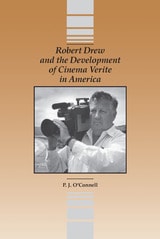
Robert Drew and the Development of Cinema Verite in America
P.J. O'Connell
Southern Illinois University Press, 1992
Author P. J. O’Connell traces Robert Drew’s influence on cinema verite through extensive interviews with Drew and with some of the founding fathers of American cinema verite filmmaking—Donn Alan Pennebaker, Gregory Shuker, and Richard Leacock.
Robert Drew’s contributions to documentary film have been both technical and conceptual. Realizing that his equipment was too heavy and intrusive, Drew persuaded Time-Life Broadcasting to sponsor the development of new, lightweight, portable synchronous sound equipment that freed documentary filmmakers from the bulky, tripod-mounted, AC-powered equipment of the past. His new technology allowed him to capture intense moments as they happened, and to make viewers feel personally involved in the events he presented. While making more than twenty documentaries in the early 1960s, Drew continued to initiate innovations that were not thought possible a generation before him.
P. J. O’Connell is the executive producer of public affairs at Penn State Television and an affiliate assistant professor in the School of Communication at Penn State University.
Roman Polanski
James Morrison
University of Illinois Press, 2006
James Morrison's critical study offers a comprehensive and critically engaged treatment on Roman Polanski's immense body of work. Tracing the filmmaker's remarkably diverse career from its beginnings to 2007, the book provides commentary on all of Polanski's major films in their historical, cultural, social, and artistic contexts. Morrison locates Polanski's work within the genres of comedy and melodrama, arguing that he is not merely obsessed with the theme of repression, but that his true interest is in the concrete—what is out in the open—and why we so rarely see it.
The range of Polanski's filmmaking challenges traditional divisions between high and low culture. For example, The Ninth Gate is a brash pastiche of the horror genre, while The Pianist is an Academy Award-winner about the Holocaust. Dubbing Polanski a relentless critic of modernity, Morrison concludes that his career is representative of the fissures, victories, and rehabilitations of the last fifty years of international cinema.
A volume in the series Contemporary Film Directors, edited by James Naremore